Contents12 sections
This guide was first published in German on handgetestet.de.
The new espresso machine is on the counter, and the first thing ordered is a beautiful tamper. In the wrong diameter. A classic bad buy. It is better to measure the filter basket first and then invest in a coffee scale with a timer, such as the Timemore Black Mirror Basic 2. It changes your espresso more than any other item on this list.
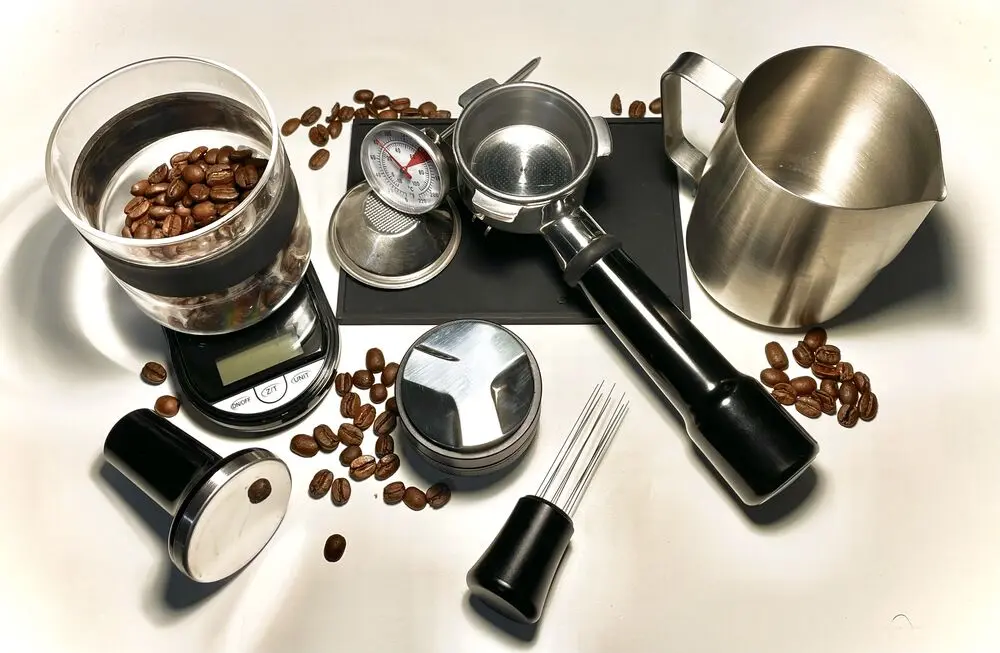
The rest is fine-tuning. You only need a milk pitcher if you drink cappuccino, and a knock box saves trips to the trash can. A bottomless portafilter, a WDT tool and a puck screen help you understand and refine your shots. They are not essentials. If you do not have the machine itself yet, our guide to buying an espresso machine will help.
Step one: measure the filter basket
Portafilters come in several sizes, and the accessories depend on the filter basket, not on the brand. Three diameters cover most home machines. 58 mm is the size of classic portafilters, for example on machines with an E61 brew group; tampers and puck screens for them are usually sold at 58.5 mm. The Sage machines in the Barista series use 54 mm, and according to accessory makers, matching tampers measure 53.3 mm. And 51 mm is found on many compact entry-level machines. Measure the inner diameter of the basket at the top rim with a caliper, or look it up in the manual. A tamper should be just slightly smaller than the basket. Too small? Loose grounds remain at the edge. Too big? It jams.
Step two: the scale before the small stuff
A scale helps from day one, because you record the dose and the yield in grams and can trace the effect of any change. Even the most precise scale, however, does little without evenly ground coffee. If you are still using pre-ground coffee, the grinder is the bigger lever; see our coffee grinder guide.
Seven accessories that really make a difference
| Model | Accessory | Key specs according to the seller | Best for |
|---|---|---|---|
| Timemore Black Mirror Basic 2 | Coffee scale with timer | up to 2,000 g, display in 0.1 g increments, timer starts automatically, flow rate display, USB-C | everyone, as the first accessory |
| Normcore Spring Loaded Tamper V4 | Tamper | 51, 53.3 or 58.5 mm; three springs with 15, 25 and 30 lb | anyone who wants even pressure without practice |
| Motta Europa 350 ml | Milk pitcher | 18/10 stainless steel, 350 ml, made in Italy | cappuccino and flat white for one person |
| Motta Knock Box 7750 | Knock box | 18/10 stainless steel, rubber-coated, removable knock bar, about 11 cm in diameter | small kitchens, one to three shots a day |
| Normcore Bottomless Portafilter 54 mm | Bottomless portafilter | for the Sage Barista series, with 18 g basket | Sage owners who want to see flaws in their shots |
| Normcore WDT Tool V2.1 | WDT tool | eight 0.23 mm needles, stand, spare needles | anyone struggling with clumps from the grinder |
| Normcore Puck Screen | Puck screen | 51, 53.3 or 58.5 mm; 316 stainless steel; several thicknesses | anyone who wants to keep the brew group cleaner |
Timemore Black Mirror Basic 2: grams and seconds at a glance
Up to 2,000 g in 0.1 g increments, according to the manufacturer. As soon as weight is added, the timer starts on its own, and the scale also shows the flow rate. It charges via USB-C. If it is to sit on the drip tray while you pull a shot, measure the clearance under the portafilter first. Be careful when ordering: Timemore sells several similarly named Basic models with different battery life. Considerably more money gets you the Acaia Lunar, which according to the manufacturer has a water-resistant aluminum housing and measures 105 × 105 mm. Recently it was not consistently listed as new on Amazon.de, which is why it is missing from the table. Very few households can justify the extra cost anyway.
Normcore spring-loaded tamper V4: the spring provides the pressure
You press until the spring gives way. With the same pressure every time. According to Normcore, three springs are included (15, 25 and 30 lb), the medium one comes installed, and the tamper is available in 51, 53.3 and 58.5 mm, among other sizes. If you prefer the classic approach and work by feel, Motta offers solid stainless steel tampers with wooden handles, such as the 8100 in 58 mm. Simpler, but it takes a little practice.
Motta Europa 350 ml: small enough for one cup
18/10 stainless steel, made in Italy, with a spout that the seller says is shaped for latte art. 350 ml is enough for one cappuccino, not two. For two people, you take the larger 750 ml version and then need more practice, because a small amount of milk is harder to control in a large pitcher. Without a steam wand, our milk frother guide (in German) is the better place to look.
Motta knock box 7750: unspectacular and solid
A stainless steel container with a rubber-coated bar for knocking out the coffee puck. Because the bar unscrews, it is easier to wash. At about 11 cm in diameter, it fits next to almost any machine, but with several shots a day it means frequent emptying. For larger volumes, Motta has the wider 8250 model.
Normcore bottomless portafilter 54 mm: see what goes wrong
Without spouts, you can see from below how the espresso emerges from the basket. If it sprays out to the side or runs first at one spot, the grounds are unevenly distributed. So it is a learning tool, not a flavor enhancer. An 18 g basket is included. For the Sage Bambino Plus, the information differs depending on the version, so check the fit before ordering.
Normcore WDT tool V2.1: fine needles against clumps
WDT stands for Weiss Distribution Technique: you use thin needles to stir up the grounds in the basket before tamping. Version V2.1 has eight 0.23 mm needles and also comes with a stand and spare needles. If your grinder barely clumps, the effect is small. With basic grinders, it can be noticeable.
Normcore puck screen: a screen on top of the coffee
A thin perforated disc made of 316 stainless steel that is placed on top of the tamped coffee. The brew group stays cleaner, and according to sellers the water is distributed more evenly. Normcore offers it in 51, 53.3 and 58.5 mm and in several thicknesses. The thicker the disc, the less coffee fits in the basket, so check the fill level first. If you already use WDT and a spring-loaded tamper, the difference is less noticeable.
The order in brief
First comes a scale with a timer like the Timemore Black Mirror Basic 2, because it makes every further change measurable. If the tamper that came with the machine is plastic, a metal tamper in the correct diameter comes next, either spring-loaded (Normcore V4) or classic (Motta). Milk drinks? The Motta Europa in 350 ml for one cup, the larger version for two. If a Sage machine extracts unevenly, the WDT tool helps first, followed by the bottomless portafilter if needed. Last of all comes the puck screen for tinkerers.
If you simply want good espresso, you can do fine without it.
Frequently asked questions
What tamper size do I need?
Accessories depend on the filter basket, not on the brand. For classic 58 mm portafilters, tampers are usually sold at 58.5 mm; for the Sage Barista series with 54 mm, accessory makers say 53.3 mm fits. Measure the inner diameter at the top rim with a caliper or look it up in the manual.
Why is a coffee scale more important than a tamper?
With a scale, you record the dose and the yield in grams and can trace the effect of any change. According to the manufacturer, the Timemore Black Mirror Basic 2 weighs in 0.1 g increments, and the timer starts on its own. Without evenly ground coffee, however, even the most precise scale does little; in that case the grinder is the bigger lever.
Is a spring-loaded tamper worth it?
With the Normcore Spring Loaded Tamper V4, you press until the spring gives way, with the same pressure every time. According to Normcore, three springs are included. If you prefer the classic approach and work by feel, Motta offers solid stainless steel tampers with wooden handles that take a little practice.
Which milk pitcher is right for cappuccino?
The Motta Europa with 350 ml is enough for one cappuccino, not two. For two people, you take the larger 750 ml version and then need more practice, because a small amount of milk is harder to control in a large pitcher. You only need a pitcher if you drink milk-based drinks.
What is a bottomless portafilter for?
Without spouts, you can see from below how the espresso emerges from the basket. If it sprays out to the side or runs first at one spot, the grounds are unevenly distributed. So it is a learning tool, not a flavor enhancer. For the Sage Bambino Plus, check the fit beforehand.
What do a WDT tool and a puck screen do?
With the thin needles of a WDT tool, you stir up the grounds before tamping; with basic grinders, the difference can be noticeable. The puck screen sits on top of the coffee and keeps the brew group cleaner. The thicker the disc, the less coffee fits in the basket.
Sources
- Timemore: Basic 2.0 espresso scale with timer
- Normcore: Spring Loaded Tamper V4
- Normcore: tamper overview
- Acaia: Lunar
- Acaia: Lunar specifications
Where to buy
- Timemore Black Mirror Basic 2Check price at Amazon.deAvailable in Germany: Amazon.de
- Normcore Federtamper V4Check price at Amazon.deAvailable in Germany: Amazon.de
- Motta Tamper 8100 58 mmCheck price at Amazon.deAvailable in Germany: Amazon.de
- Motta Europa Milchkännchen 350 mlCheck price at Amazon.deAvailable in Germany: Amazon.de
- Motta Abschlagbehälter 7750Check price at Amazon.deAvailable in Germany: Amazon.de
- Normcore bodenloser Siebträger 54 mmCheck price at Amazon.deAvailable in Germany: Amazon.de
- Normcore WDT-Werkzeug V2.1Check price at Amazon.deAvailable in Germany: Amazon.de
- Normcore Puck ScreenCheck price at Amazon.deAvailable in Germany: Amazon.de