Contents11 sections
This guide was first published in German on handgetestet.de.
Twenty-two kilos. With a folding e-bike, this number decides more often than motor or range, because it is what hangs from your arm on the station stairs. Among the four bikes compared here, we recommend the ADO Air 20 Ultra, because it has the most reliable reports: the ADAC, the German automobile club, and a specialist publication rode it for an extended period, and none of the weaknesses they found calls the purchase into question. If you climb stairs every day, you should still first work out whether you need the lighter bike.
How often will you really fold it?
Lifted into the RV once a month: then a bike can be heavy. Twice a day onto a regional train is something else. Small wheels and a hinge in the frame are only worth accepting if folding pays off in everyday life. Otherwise, a regular bike from our e-bike buying overview (in German) rides more smoothly, and it is often cheaper too.
Incidentally, folding once and folding several times are two different things. Single-fold bikes bend once in the middle of the frame, multi-fold bikes at several points. In the ADAC comparison, test riders got on better with the single fold; multi-folding took more practice but produced the smallest folded size. The four bikes below are sold as folding bikes with a frame hinge.
Train: free, as long as it stays luggage
Folded, the bike travels free of charge as hand luggage on Deutsche Bahn, the German national railway, without a bike ticket and without a bike space. Deutsche Bahn explicitly mentions folding pedelecs here. The condition: the package stands in the luggage rack or multipurpose area, aisles and doors stay clear, and nothing may slide around in the rack above the seat. Deutsche Bahn itself recommends a bag. It gives no fixed size limit, which is little comfort on a full train. For the ADO, according to the retailer, the folded size is around 88.5 × 51 × 67 cm, which is more than a large suitcase. Hardly anyone lifts that above the seat.
On local and regional transport, things get less clear. The ADAC points out that the rules vary by region and operator, so check the terms of your local transit association before you buy. On batteries, Deutsche Bahn states for pedelecs on long-distance trains: permanently mounted for the entire journey, no spare battery, no charging on the train. Whether this applies word for word to the folded bike as hand luggage, it does not say. We would stick to it.
Is one charge enough? Let us assume 12 kilometers each way. For the ADO, the specialist publication Wattmoves expects about 50 kilometers in sport mode and around 70 in eco mode. At 24 kilometers a day, you therefore charge every other evening and keep a reserve for headwinds and winter cold. More on aging and storage is in our guide to e-bike batteries (in German).
RV: weight, hatch, power
Three questions count here, and none of them is in the brochure. First, the payload. Two ADOs weigh 44 kilos, two GermanXia P8Ks with batteries a good 49. Assuming 200 kilos of remaining payload, that uses up almost a quarter before water and clothing are on board. Two Air Carbons would come to 25 kilos.
Second, the storage hatch. Measure the opening, not the space behind it. Third, power: assuming 15 percent loss in the inverter, a 370 Wh battery needs around 435 Wh from the onboard battery, which is about 36 amp-hours at 12 volts. Two bikes therefore draw a good 70 Ah, most of a 100 Ah battery. If you camp off-grid, plan this together with the inverter or a portable power station in the RV. At a campsite with shore power, the calculation takes care of itself.
What a frame hinge has to withstand
With folding bikes, durability deserves a closer look than with other bikes. In 2025, the ADAC put eight folding bikes through 100,000 load cycles with 100 kilos on the test bench. On the Vello Rocky Titan, a weld seam cracked after about two thirds, and again in the repeat test. On two other bikes, the brakes lost too much power in the wet. This field consisted of folding bikes in general, batteries played no role there, and none of the four bikes below was included. We know of no comparable endurance test for them.
Two pieces of advice still carry over: try the folding yourself before buying, and calculate the maximum permitted total weight. At 120 kilos and a 23-kilo bike, 97 kilos remain for you, your backpack and your lock. If you weigh 90 kilos, that leaves seven for luggage. A torque sensor also belongs on the list: in the ADAC comparison of budget pedelecs, cadence-only drives kicked in with a delay on hills, and if you pull away between cars, you notice that immediately.
Four folding e-bikes side by side
| Model | Drive | Battery | Weight, load capacity | Best for |
|---|---|---|---|---|
| ADO Air 20 Ultra | Rear hub motor, 50 Nm, automatic three-speed, belt | 370 Wh, in the seat post (retailer) | 22 kg, 120 kg permitted (retailer) | Train and car trunk, for riders who do not want to shift |
| ADO Air Carbon | 250 W, belt, Bafang (listing) | – | 12.5 kg (manufacturer) | Stairs and frequent transfers |
| Engwe P20 | 250 W, 42 Nm, torque sensor, belt | 36 V, 9.6 Ah, so around 346 Wh | 18.5 kg, 120 kg permitted (listing) | Short rides onward from the station |
| GermanXia Mobilemaster P8K F | Bosch Performance Line, mid-drive motor, 65 Nm, Shimano Nexus 8-speed | 400 Wh (manufacturer) | 24.6 kg with battery, 130 kg permitted (manufacturer) | RV and a local bike shop |
ADO Air 20 Ultra
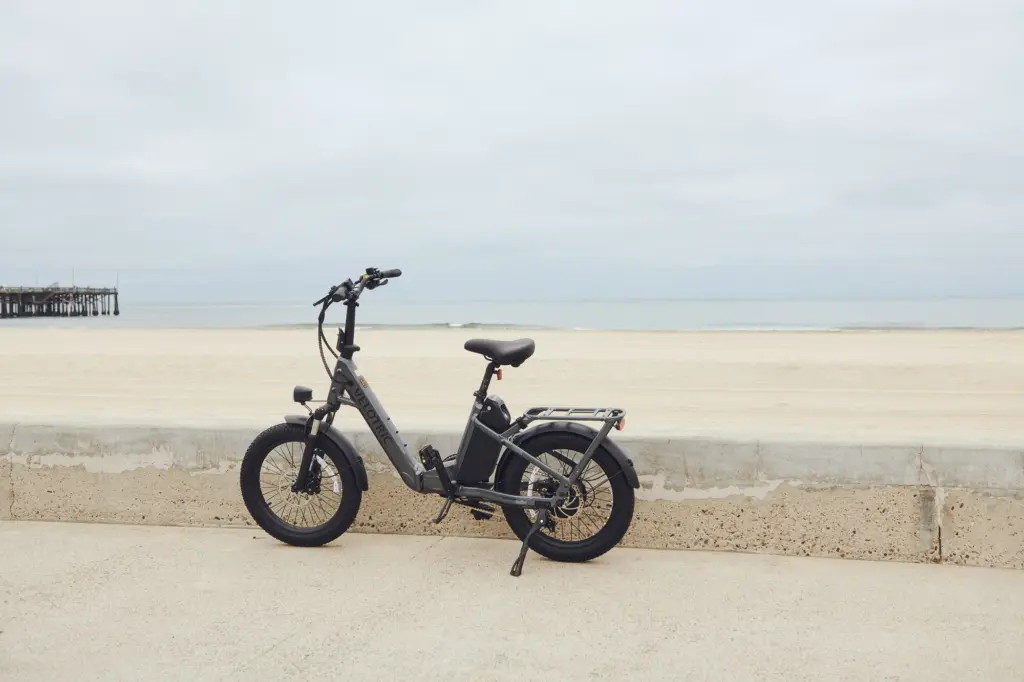
The rear hub motor contains an automatic three-speed gearbox that works without power. So the bike stays rideable even with an empty battery. In spring 2026, the ADAC rode the version with 40 Nm and 346 Wh and called it a solid, nimble bike, with a realistic range of 60 to 70 kilometers. According to Wattmoves, the current version has 50 Nm and an NFC card for unlocking, and the retailer lists the battery at 370 Wh. According to the ADAC, riders up to 1.90 meters fit on it, and with practice, folding takes less than a minute.
The drawbacks are concrete. You cannot shift yourself. The built-in headlight does not turn with the handlebars and does not reach far in total darkness; on unlit paths, an additional light (in German) belongs on the handlebar. Folded, it does not roll, and the magnets do not always latch on the first try.
ADO Air Carbon
At 12.5 kilos according to the manufacturer, it weighs a little over half as much as the Ultra, and that is exactly the reason to buy it. On the manufacturer’s price list, it sits above the Ultra. For the stairs in an older apartment building or daily transfers, the argument is strong; for the storage space in an RV, less so. We have no independent report on the frame and range, so the weight figure remains the seller’s promise.
Engwe P20
Carbon belt, torque sensor, 18.5 kilos. At around 346 Wh, the battery is similar to that of the older Ultra, and Engwe gives the rider height as 155 to 190 cm. All figures come from the seller. As a lighter bike for the last mile from the station, it is worth considering. We know of no independent report on it.
GermanXia Mobilemaster P8K F
The bike for anyone who would rather have a bike shop in town than an app. According to GermanXia, a Bosch Performance Line with 65 Nm does the work, together with a 400 Wh Bosch battery and a Shimano Nexus hub with eight gears. Chain instead of belt. At 24.6 kilos including battery, it is the heaviest bike here, but the manufacturer permits 130 kilos total weight. Folded, it measures about 82 × 41 × 92 cm. On the RV, the weight is hardly a problem; on the station platform, it is. That leaves the delivery time. The manufacturer’s shop states around twelve weeks, and a large part is paid in advance. Ask about the current status.
Which bike for which route?
- Train plus city, few stairs: ADO Air 20 Ultra. The automatic gearbox and belt save maintenance; 22 kilos still have to be carried.
- Lots of steps or tight transfers: ADO Air Carbon, if you are willing to pay extra for less weight and can live with thin data.
- RV, with a local bike shop in mind: GermanXia Mobilemaster P8K F; clarify payload, storage hatch and delivery time first.
- Short feeder routes: Engwe P20, provided a test ride is possible.
A good bike lock (in German) belongs with it in any case, even if the bike usually stays indoors. And if you realize while doing the math that you do not actually fold: then you have spared yourself a bad buy. Without a motor, it gets lighter: our folding bike guide (in German) compares folding bikes for train commuters.
Frequently asked questions
Can I take a folding e-bike on the train for free?
Folded, it travels free of charge as hand luggage on Deutsche Bahn, the German national railway, which explicitly mentions folding pedelecs. The package must stand in the luggage rack or multipurpose area, with aisles and doors kept clear. Deutsche Bahn itself recommends a bag. On local and regional transport, the rules vary by region, so check with your local transit association.
What is the difference between a folding bike that folds once and one that folds several times?
Single-fold bikes bend once in the middle of the frame, multi-fold bikes at several points. In the ADAC comparison, test riders got on better with the single fold. Multi-folding took more practice but produced the smallest folded size.
How heavy can a folding e-bike be?
That depends on how often you carry it. If it is lifted into the RV once a month, a bike can be heavy; twice a day onto a regional train is something else. The ADO Air 20 Ultra weighs 22 kilos, the ADO Air Carbon 12.5 kilos according to the manufacturer, and the GermanXia P8K F 24.6 kilos with battery.
What range does the ADO Air 20 Ultra have?
The specialist publication Wattmoves expects about 50 kilometers in sport mode and around 70 in eco mode. With the older version and its 346 Wh battery, the ADAC achieved a realistic 60 to 70 kilometers. At 24 kilometers a day, you therefore charge every other evening and keep a reserve.
What should I look for in a folding e-bike for the RV?
Three things: the payload, because two ADOs weigh 44 kilos; the opening of the storage hatch, not the space behind it; and power. A 370 Wh battery draws around 36 amp-hours from the onboard battery. At a campsite with shore power, that calculation takes care of itself.
What should I check before buying a folding e-bike?
Try the folding yourself and calculate the maximum permitted total weight: at 120 kilos and a 23-kilo bike, 97 kilos remain for the rider, backpack and lock. A torque sensor belongs on the list, because in the ADAC comparison, cadence-only drives kicked in with a delay on hills.
Sources
- ADAC: Ado Air 20 Ultra folding e-bike ride report
- ADAC: Eight folding bikes tested
- ADAC: Budget pedelecs tested
- Wattmoves: ADO Air 20 Ultra V2026 in everyday use
- Deutsche Bahn: Taking folding bikes on board
- Deutsche Bahn: Luggage on the train
- Deutsche Bahn: Long-distance bike ticket
- Ejunkie (German retailer): ADO Air 20 Ultra 2026 specifications
- GermanXia: Mobilemaster P8K F
- Notebookcheck: ADO Air 20 Ultra 2026
Where to buy
- ADO Air 20 UltraCheck price at Amazon.deCheck price at Amazon.co.ukCheck price at Amazon.nlCheck price at Amazon.com.beCheck price at Amazon.frCheck price at Amazon.itCheck price at Amazon.esCheck price at Amazon.plCheck price at Amazon.seAvailable in Germany: Amazon.de
- ADO Air CarbonCheck price at Amazon.deCheck price at Amazon.co.ukCheck price at Amazon.nlCheck price at Amazon.com.beCheck price at Amazon.frCheck price at Amazon.itCheck price at Amazon.esCheck price at Amazon.plCheck price at Amazon.seAvailable in Germany: Amazon.de
- Engwe P20Check price at Amazon.deCheck price at Amazon.co.ukCheck price at Amazon.nlCheck price at Amazon.com.beCheck price at Amazon.frCheck price at Amazon.itCheck price at Amazon.esCheck price at Amazon.plCheck price at Amazon.seAvailable in Germany: Amazon.de
- GermanXia Mobilemaster P8K FCheck price at Amazon.deCheck price at Amazon.co.ukCheck price at Amazon.nlCheck price at Amazon.com.beCheck price at Amazon.frCheck price at Amazon.itCheck price at Amazon.esCheck price at Amazon.plCheck price at Amazon.seAvailable in Germany: Amazon.de