Contents13 sections
This guide was first published in German on handgetestet.de.
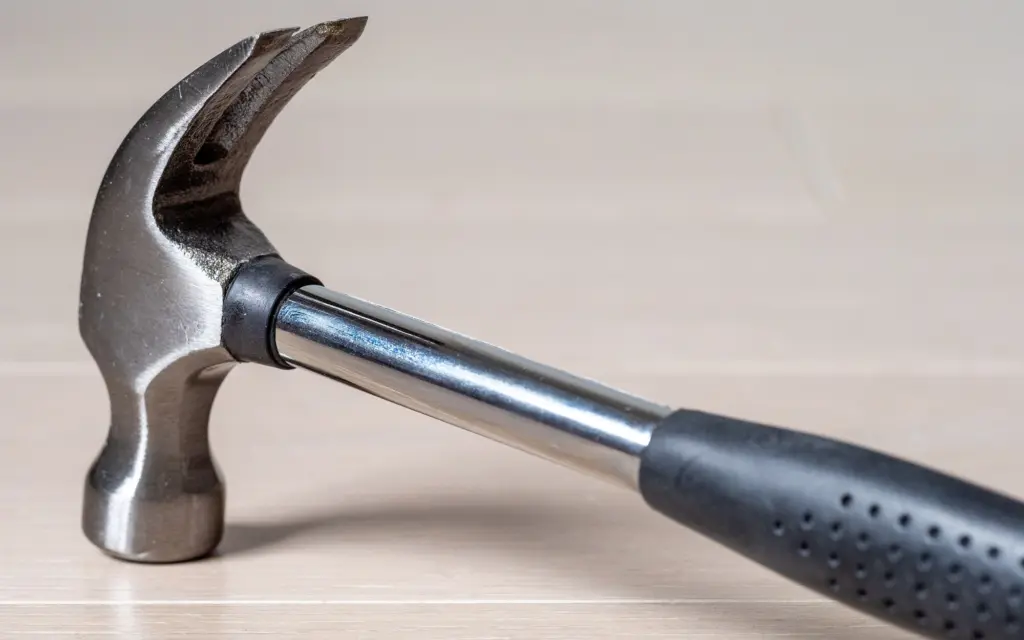
There is no one hammer for everything, even if toolboxes are often stocked exactly that way. For picture hooks, wall anchors and small repairs, a machinist’s hammer with a 300 g head to German standard DIN 1041 is enough. Our recommendation for that is the Picard SecuTec No. 12 in 300 g, because a hardened sleeve protects the handle from overstrikes. If you nail laths, lay paving stones or work with a chisel, you need a second hammer. Which one? The questions below answer that.
How do I recognize a good hammer?
First, by the head. Picard points out that the standard requires a permanently stamped or laser-etched manufacturer’s mark in the hammer head. According to the manufacturer, a DIN number without this mark is not permitted, and a print on the handle is not enough. Face and peen should have a clean chamfer of about 45 degrees. Hardness on the striking surfaces is between 50 and 58 HRC, and at the eye no more than 30 HRC, so that the face does not chip and the eye does not crack.
Then by the handle. According to Picard, ash, hickory and acacia are suitable, long-grained, without cracks or knots. Check fiberglass, plastic and tubular steel handles especially carefully for a firm fit. After unpacking, twist the rubber grip against the handle. If it gives way, the hammer goes back.
Which type of hammer do I need for what?
In its Information 209-001 (September 2024 edition), the German Social Accident Insurance (DGUV) assigns a standard to each type. Machinist’s hammers follow DIN 1041, lath hammers DIN 7239, club hammers DIN 6475, rubber mallets DIN 5128 and soft-face hammers DIN 5136. There, the short form „Hammer DIN 1041-500 S“ stands for a machinist’s hammer with a nominal weight of 500 g, handle and wedge. If there is no standard for a hammer type, the DGUV names the GS mark (German „tested safety“ mark) as a guide.
- Machinist’s hammer with 300 g for straightening, riveting, center-punching and driving work.
- Lath hammer with 600 g for laths and boards, with a milled face that keeps it from glancing off the nail head.
- Club hammer from 1,000 g for strikes on chisels, points and drifts.
- Rubber mallet for paving stones, curbstones, fence building and delicate surfaces.
- Dead blow soft-face hammer for assembly work with forceful blows on delicate parts.
One mistake the DGUV explicitly describes: the lath hammer on a chisel or a striking wrench. The grooves in the face can act like a predetermined breaking point under high impulses and release splinters. It also lacks mass, so more blows are needed. For this job, the DGUV names a 1,500 g club hammer.
Seven hammers, seven jobs
| Model | Type and standard | Head, length, total weight | Handle | Best for |
|---|---|---|---|---|
| Picard SecuTec No. 12, 300 g | Machinist’s hammer, DIN 1041 | 300 g, 300 mm, 480 g | Hickory, hardened handle protection sleeve, wedge screw | Household and workshop |
| Stanley fiberglass machinist’s hammer 300 g (STHT0-51907) | Machinist’s hammer | 300 g head | Fiberglass core, two-component grip, head bonded with epoxy resin | If you prefer a plastic grip |
| Picard lath hammer No. 298 | Lath hammer, DIN 7239, GS | 600 g, 320 mm, 810 g | Chrome-molybdenum steel tube, magnetic nail holder | Fences, roof battens, formwork |
| Estwing lath hammer leather E239MM | Lath hammer, German pattern | 600 g, 330 mm | Head and handle from one piece of steel, leather grip, magnet | Frequent nailing |
| Peddinghaus Ultratec club hammer 1,250 g | Club hammer, DIN 6475 | 1,250 g head | Ultratec three-component plastic handle | Chisels and points |
| Halder Supercraft 3366.040 | Dead blow soft-face hammer | 40 mm Ø, 355 mm, 687 g | Hickory, nylon inserts, steel shot filling | Assembly with many blows |
| Halder Simplex 3002.040 | Rubber soft-face hammer | 40 mm Ø, 325 mm, 660 g | Wood, malleable cast iron housing with handle protection sleeve | Paving, garden, fence building |
Picard SecuTec No. 12, 300 g
The head is black powder-coated, and face and peen are ground and chamfered. Instead of a ring wedge, a patented wedge screw holds the head, and below it a hardened sleeve protects the double-curved hickory handle. The DGUV names exactly this kind of handle protection as a safety plus in case the handle strikes the workpiece on an overstrike. At 300 mm long and 480 g, it remains a one-handed hammer. And wood has an advantage that plastic does not offer: according to the DGUV, replacing a wooden handle properly is easy.
Stanley fiberglass machinist’s hammer, 300 g
Stanley mounts the forged head on a handle with a fiberglass core and bonds the joint with epoxy resin. The manufacturer describes the two-component grip as non-slip. If the DIN mark matters to you, look at the head after unpacking. With bonded handles, the attachment cannot be seen from the outside, which is why the DGUV advises checking by hand and with a test blow before every job. Stanley specifies a one-year limited warranty.
Picard lath hammer No. 298
A 600 g head with a high eye sits on a seamless chrome-molybdenum steel tube, plus a head retainer. The magnetic nail holder holds the first nail, so your second hand stays on the lath. Picard supplies it with a smooth or milled face, GS-tested and to DIN 7239. Built for nailing. Not for chisels.
Estwing lath hammer with leather grip
At Estwing, head and handle are forged in one piece. That means there is no joint that could loosen. The grip is made of genuine leather; the E3-239 version instead has the blue Shock Reduction Grip, which according to Estwing reduces vibration. Head 600 g, length 330 mm. The suffix MM stands for a milled face with magnet, MS for a smooth face with magnet. Try the grip once with your bare hand and once with a work glove, as the DGUV recommends for every hammer.
Peddinghaus Ultratec club hammer, 1,250 g
Peddinghaus forges the head from C45 grade steel to DIN 17200, hardened and tempered, and the shape follows DIN 6475. According to the manufacturer, the three-component Ultratec handle is unbreakable. The DGUV still notes one limitation. For oily work, wooden handles are the better choice, because oil components can attack plastic. For high striking impulses, the DGUV names 1,500 g. That size is also available in the same range.
Halder Supercraft 3366.040
The head tube contains steel shot. When the striking face hits, the filling follows with a delay, and according to Halder the rebound is reduced. The DGUV describes the same effect: less springy recoil for hand, elbow and shoulder at the same impact energy, plus less noise. According to the manufacturer, the white nylon inserts are hard and do not splinter even at sub-zero temperatures. Handle and inserts can be replaced. In a hobby workshop you rarely need it. But if you assemble bearings, shafts or sheet metal all day, every blow without rebound spares your hand, elbow and shoulder.
Halder Simplex 3002.040
A rubber mallet built on a modular principle. Both sides carry medium-hard, damping rubber inserts, and the malleable cast iron housing has a built-in handle protection sleeve. Halder lists paving work, curbstones, stairs and fence building as applications. When an insert is worn, only that insert is replaced.
What safety measures come before the first blow?
Safety glasses. The DGUV requires them as soon as splinters can occur, and gives a clear reason: even with a hardness profile that meets the standard, sharp splinters can fly off the face or peen when the hammer strikes harder material or hits only with its edge. Estwing also recommends glasses for everyone standing nearby. Suitable models are in our safety glasses guide (in German).
Check the head before working. Hold the handle firmly and move the head, or tap it lightly on wood once. If anything wobbles, it is done.
Chips on the face are not a cosmetic flaw. Regrinding does not restore the lost hardness, and the head has to be replaced. Estwing lists chips or dents in the face, a mushroomed head, cracks in the claw and dents in the handle as reasons to retire a hammer. Also, never strike hammer on hammer. If you strike a chisel, Estwing says to choose a face about 9.5 mm larger than the struck surface.
Grip the hammer at the end of the handle; that is where the cross-section is made for the hand. The DGUV also advises clamping the workpiece and working at hip height. A sturdy workbench (in German) spares your arm more than any special grip.
How we would stock the toolbox
- For an apartment or house, a 300 g machinist’s hammer is enough. With handle protection and replaceable wood, that is the Picard SecuTec No. 12; if you would rather hold plastic, take the Stanley.
- If a fence, garden shed or roof battens are on the list, a lath hammer belongs next to it. The Picard 298 has the tubular steel handle with head retainer, while the Estwing does away with a joint between head and handle entirely.
- For chisels and points, the Peddinghaus club hammer. Wood chisels, on the other hand, are struck with a wooden mallet; more on that in our wood chisel guide (in German).
- Paving stones, rocks, delicate surfaces: the Halder Simplex. The Supercraft only once you regularly strike machine parts hard.
Frequently asked questions
How do I recognize a good hammer?
By the head: the standard requires a permanently stamped or laser-etched manufacturer's mark; a print on the handle is not enough. Face and peen have a clean chamfer. For the handle, according to Picard, ash, hickory and acacia without cracks are suitable. If a rubber grip gives way when twisted, the hammer goes back.
Which hammer for which job?
The 300 g machinist's hammer straightens, rivets and center-punches. The 600 g lath hammer nails laths and boards. A club hammer from 1,000 g strikes chisels and points. The rubber mallet suits paving stones, curbstones and delicate surfaces, and the dead blow soft-face hammer suits assembly work with forceful blows.
Can you strike a chisel with a lath hammer?
The DGUV (German Social Accident Insurance) explicitly describes this as a mistake. The grooves in the face can act like a predetermined breaking point under high impulses and release splinters. It also lacks mass, so more blows are needed. For this job, the DGUV names a 1,500 g club hammer.
Wooden, fiberglass or steel handle on a hammer?
According to the DGUV, replacing a wooden handle properly is easy, and wood is also the better choice for oily work. With bonded fiberglass handles such as on the Stanley, the attachment cannot be seen from the outside, so check it by hand and with a test blow before every job. On the Estwing, head and handle are forged from a single piece.
What does a dead blow soft-face hammer do?
The head of the Halder Supercraft contains steel shot that follows with a delay on impact and reduces rebound. The DGUV cites less strain on hand, elbow and shoulder, as well as less noise. In a hobby workshop you rarely need one, but for daily assembly of bearings, shafts or sheet metal you do.
When does a hammer head need to be replaced?
When the face is chipped, because regrinding does not restore the lost hardness. Estwing also lists dents in the face, a mushroomed head, cracks in the claw and dents in the handle. If the head wobbles during the check before work, it is done.
Sources
- DGUV Information 209-001 „Working with hand tools,“ September 2024 edition
- Picard: Quality notes on hammers
- Picard: Complete catalog (SecuTec No. 12, lath hammer No. 298)
- Stanley: Fiberglass machinist’s hammer 300 g
- Estwing: Latthammer (German Pattern, Leather)
- Estwing: Latthammer (German Pattern)
- Estwing: Safety and Product Care
- Peddinghaus/Novalia: Offensive 2026 catalog (Ultratec club hammer)
- Peddinghaus: Club hammers
- Halder: SUPERCRAFT dead blow soft-face hammer 3366.040
- Halder: SIMPLEX rubber soft-face hammer 3002.040
Where to buy
- Picard Schlosserhammer SecuTec Nr. 12, 300 gCheck price at Amazon.deCheck price at Amazon.co.ukCheck price at Amazon.nlCheck price at Amazon.com.beCheck price at Amazon.frCheck price at Amazon.itCheck price at Amazon.esCheck price at Amazon.plCheck price at Amazon.seAvailable in Germany: Amazon.de
- Stanley Schlosserhammer Fiberglas 300 g STHT0-51907Check price at Amazon.deCheck price at Amazon.co.ukCheck price at Amazon.nlCheck price at Amazon.com.beCheck price at Amazon.frCheck price at Amazon.itCheck price at Amazon.esCheck price at Amazon.plCheck price at Amazon.seAvailable in Germany: Amazon.de
- Picard Latthammer Nr. 298Check price at Amazon.deCheck price at Amazon.co.ukCheck price at Amazon.nlCheck price at Amazon.com.beCheck price at Amazon.frCheck price at Amazon.itCheck price at Amazon.esCheck price at Amazon.plCheck price at Amazon.seAvailable in Germany: Amazon.de
- Estwing Latthammer Leder E239MMCheck price at Amazon.deCheck price at Amazon.co.ukCheck price at Amazon.nlCheck price at Amazon.com.beCheck price at Amazon.frCheck price at Amazon.itCheck price at Amazon.esCheck price at Amazon.plCheck price at Amazon.seAvailable in Germany: Amazon.de
- Peddinghaus Fäustel Ultratec 1.250 gCheck price at Amazon.deCheck price at Amazon.co.ukCheck price at Amazon.nlCheck price at Amazon.com.beCheck price at Amazon.frCheck price at Amazon.itCheck price at Amazon.esCheck price at Amazon.plCheck price at Amazon.seAvailable in Germany: Amazon.de
- Halder Supercraft 3366.040Check price at Amazon.deCheck price at Amazon.co.ukCheck price at Amazon.nlCheck price at Amazon.com.beCheck price at Amazon.frCheck price at Amazon.itCheck price at Amazon.esCheck price at Amazon.plCheck price at Amazon.seAvailable in Germany: Amazon.de
- Halder Simplex 3002.040Check price at Amazon.deCheck price at Amazon.co.ukCheck price at Amazon.nlCheck price at Amazon.com.beCheck price at Amazon.frCheck price at Amazon.itCheck price at Amazon.esCheck price at Amazon.plCheck price at Amazon.seAvailable in Germany: Amazon.de