Contents18 sections
This guide was first published in German on handgetestet.de.
A new induction cooktop rarely fails because of its cooking power. It fails because of the cutout in the countertop, the fuse in the basement, or pots that suddenly are no longer detected. For a typical 80-centimeter kitchen, we consider the Bosch Series 6 PXE845HC1E the most sensible choice: a flexible zone, a large round zone, a standard frame.
What happens under the glass ceramic
Under every cooking zone lies a copper coil. According to the German Federal Office for Radiation Protection, an alternating current of about 20 to 100 kilohertz flows through it. The resulting magnetic field creates eddy currents in the base of the pot, and that is exactly where the heat is generated. The glass surface only gets warm indirectly, from the hot pot. That is why induction responds so quickly to every change of level. Lift the pot off, and the field disappears too.
Less well known is power management. A cooktop must never exceed its total power, so every two zones share a budget. Miele describes in its operating instructions what happens then: if the zone switched on last demands more, the appliance turns the neighboring zone down or switches off its booster. An 80-centimeter cooktop with 7.4 kilowatts will therefore not run all four zones on booster at the same time. That is normal and not a defect.
Flex, Bridge, PowerFlex: three names, one idea
Classic zones are circles. A 35-centimeter roaster fits on none of them. Flexible areas solve this by having several small coils form a rectangular area. In the Bosch operating instructions for the Series 8, such a Flex Zone consists of four inductors, and only the part covered by the cookware becomes active.
AEG calls the principle Bridge. The pot has to cover the centers of both zones, otherwise the connection does not engage. Miele speaks of PowerFlex and, on the KM 7474 FL, combines two zones into an area of 23 by 39 centimeters. If you only own pots up to 24 centimeters, you do not need a flexible area. If you use a fish roaster, a griddle plate or two pans side by side, you will notice the difference every day.
60 or 80 centimeters? Measure the cutout first
The width on the box is not the dimension that counts. What matters is the cutout in the countertop. For the 60-centimeter Bosch PVQ645HB1E, Bosch requires 560 by 490 to 500 millimeters; for the 80 cm PXE845HC1E, it is 780 by 500 millimeters. So if you are replacing an old ceramic glass cooktop, measure the existing hole first. A cutout can be enlarged, but hardly made smaller.
Eighty centimeters pays off mainly if you regularly have three pots on the cooktop at the same time. Bosch specifies a connected load of 7.4 kilowatts for both the 60 and the 80 cm model. More width therefore means more space between the pots, not more power. Flush-mounted models such as the Neff T58PTF1L0 also need a precisely machined rebate. That is something you are better off planning together with the kitchen studio.
Slider, number row or knob
Many buyers skim over the controls and regret it later. With DirectSelect, Bosch relies on a row of numbers where you tap the level directly. On the EX875LYC1E, Siemens uses a Dual lightSlider, a bar you swipe along. On the TII84B1FFZ, AEG controls each zone via a setting scale. Neff takes its own route: according to the manufacturer, the TwistPad is a magnetic, removable control knob. If you are used to a knob from your old stove, this is where you will find the most familiar feel.
7.4 kilowatts and the question of the fuse
Bosch, Siemens and Neff ship their cooktops without a plug and require connection by a qualified electrician. Miele puts it just as clearly in its operating instructions and recommends installing a 30-milliampere residual current device upstream of the cooktop. AEG requires an all-pole disconnecting device with a contact gap of at least 3 millimeters. In short: this is not a job for a Saturday afternoon with a terminal block.
Things get interesting in older buildings with weak circuit protection. A power limit helps here. On the AEG TII84B1FFZ, the total power can be set in the menu in steps from 1,500 to 7,350 watts; below 2,000 watts, however, the SenseBoil boil-over function is no longer available. Miele also allows the total power to be reduced to comply with the grid operator’s requirements. The right level is determined by the qualified electrician.
Cooktop and range hood in one appliance
Cooktops with integrated extraction pull the steam downward, right in the middle of the glass surface. Besides Bosch and Miele, specialists such as Bora also build such systems. The space needed under the countertop is the underestimated point: the Bosch PVQ811F15E is 223 millimeters high, which leaves no room for a normal drawer underneath. For ducted operation, Bosch specifies 500 cubic meters per hour at the highest normal level and 622 in intensive mode. The accessories for recirculation have to be bought separately.
Noise figures deserve a second look. For its KMDA 7476 FL, Miele lists both: 69 dB(A) sound power and 56 dB(A) sound pressure at the highest normal level. So only compare values from the same type of measurement.
Which pots work
The magnet test is the quickest way. If a magnet sticks to the base, the pot is as a rule suitable, according to Miele and AEG. Cast iron, enameled steel and stainless steel with a magnetic base work. Aluminum, copper, glass and ceramic do not. Multi-layer bases may crackle or whistle, especially at high levels; both manufacturers describe this as normal. AEG also advises against using pots that are larger than the zone and points out that pots that are too small only draw part of the power. New cookware? We have guides to cookware sets and pan sets. And if you want to try it out first without a built-in unit, take a look at our guide to portable induction hot plates.
Pacemakers: what manufacturers and authorities say
The information differs. According to its operating instructions, Miele considers interference unlikely and, if in doubt, refers you to your doctor or the pacemaker manufacturer. For the TII84B1FFZ, AEG specifies a minimum distance of 30 centimeters from switched-on cooking zones. Bosch advises having your doctor confirm that the implant complies with the relevant standards. The German Federal Office for Radiation Protection likewise recommends that people with active implants consult their doctor. It advises all users to cover the active zone completely with suitable cookware and to keep a distance of 5 to 10 centimeters from the front edge. If you have an implant, clear this up before buying.
Seven built-in cooktops and their key data
| Model | Width and installation | Zones and controls | Best for |
|---|---|---|---|
| Bosch Series 6 PXE845HC1E | 80 cm, surface-mounted frame, cutout 780 × 500 mm | Flex Induction, 28 cm round zone, DirectSelect, 7.4 kW | Most 80 cm kitchens |
| Siemens iQ700 EX875LYC1E | 80 cm, surface-mounted design frame | 4 flexible zones 20 × 23 cm, Dual lightSlider, 7.4 kW | Frequent pot changes, free placement |
| Neff N 90 T58PTF1L0 | 80 cm, flush-mounted | 4 zones with roaster zone, TwistPad control knob, 7.4 kW | Switching from a stove with knobs |
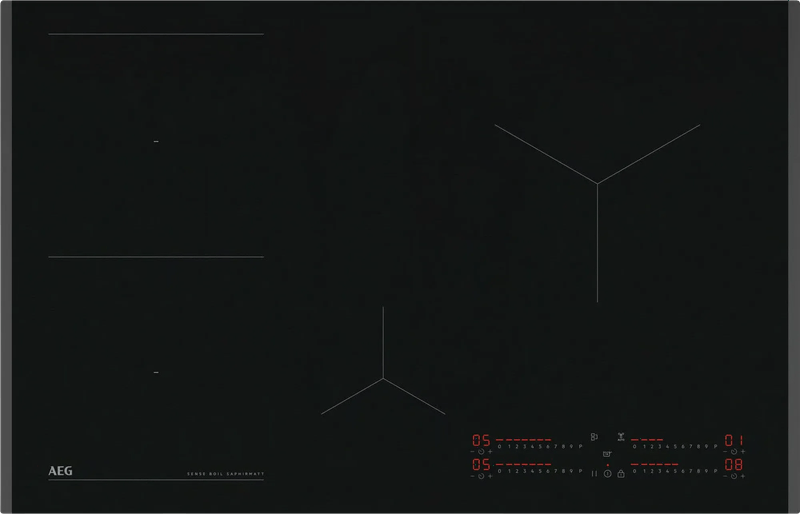
| AEG TII84B1FFZ | Appliance 810 × 520 mm | 4 zones, Bridge, setting scale, power adjustable from 1.5 to 7.35 kW | Older building with limited circuit protection |
| Miele KM 7474 FL | 80 cm, flush-mounted or surface-mounted | PowerFlex area 23 × 39 cm, ComfortSelect, 7.3 kW | Roasters and large pans |
| Bosch Series 6 PVQ811F15E | 80 cm, 223 mm installation height | 4 zones, 2 Combi Zones, integrated extraction, DirectSelect | Kitchens without room for a hood |
| Bosch Series 6 PVQ645HB1E | 60 cm, cutout 560 × 490 to 500 mm | 4 zones, 2 Combi Zones, DirectSelect, 7.4 kW | Replacement in a 60 cm cutout |
Bosch Series 6 PXE845HC1E
For the usual run of kitchen cabinets, a lot speaks in favor of this cooktop. Bosch combines a flexible zone with a 28-centimeter round zone that makes full use of large pans too. The stainless steel frame sits on top, and according to Bosch, countertops from 16 millimeters thick are suitable.
Siemens iQ700 EX875LYC1E
Four zones of equal size, 20 by 23 centimeters, which Siemens designs for placing cookware anywhere. According to the manufacturer, the expandable zone takes cookware up to 30 centimeters.
Neff N 90 T58PTF1L0
The magnetic control knob is the reason to choose this cooktop. Neff installs it flush, with a recess size of 796 by 516 millimeters. There is no flex zone, but there is a roaster zone instead. According to Neff, the automatic hood control only works with suitably equipped hoods and a connected Home Connect account.
AEG TII84B1FFZ
The cooktop for difficult household connections. The power limit ranges in ten steps from 1,500 to 7,350 watts. AEG describes the surface as scratch-resistant and points out that pots rubbing on this texture can make noise.
Miele KM 7474 FL
On the right-hand side, Miele connects two zones into a PowerFlex area that draws up to 7,300 watts with TwinBooster. The cooktop can be installed flush or surface-mounted. Direct pairing is provided for hoods with Con@ctivity.
Bosch Series 6 PVQ811F15E
A cooktop with extraction in the middle, designed for kitchen islands or kitchens under a sloping ceiling. It works in ducted or recirculation mode; recirculation requires accessories. Bosch specifies 69 dB at the highest normal level; whether that is sound power or sound pressure is worth asking before you buy. Plan for the installation height of 223 millimeters early on.
Bosch Series 6 PVQ645HB1E
The 60 cm solution. Four zones of 19 by 21 centimeters, two of which can be linked as a Combi Zone for large roasters. On this model, Bosch does not connect them automatically. It fits cutouts 560 millimeters wide, as found in many older kitchens.
How we would decide
- Standard run of kitchen cabinets, 80 cm cutout, mixed cookware: Bosch Series 6 PXE845HC1E.
- Old 60 cm ceramic glass cooktop out, countertop stays: Bosch Series 6 PVQ645HB1E.
- Older wiring, grid operator requires lower power: AEG TII84B1FFZ with adjustable limit, after consulting the electrician.
- Roasters, griddle plates, large family pans: Miele KM 7474 FL.
- Prefer a knob to a touch panel: Neff N 90 T58PTF1L0.
- No hood possible or wanted: Bosch Series 6 PVQ811F15E, if there is enough height free under the countertop.
Recirculation, ducted extraction and what is left of the base cabinet are covered in our guide to the cooktop with integrated extraction.
Frequently asked questions
Why does my induction cooktop turn a zone down?
A cooktop must never exceed its total power, so every two zones share a budget. If the zone switched on last demands more, the appliance turns the neighboring zone down or switches off its booster. A 7.4-kilowatt cooktop will not run all four zones on booster at the same time, and that is not a defect.
Do I need a cooktop with a flex zone?
If you only own pots up to 24 centimeters, you do not need a flexible area. For a fish roaster, griddle plate or two pans side by side, it is worth it. Several small coils form a rectangular area, and only the part covered by the cookware becomes active. Bosch calls this Flex, AEG Bridge, Miele PowerFlex.
Is an 80 cm induction cooktop worth it over 60 cm?
Mainly if you regularly have three pots on the cooktop at the same time. Bosch specifies 7.4 kilowatts for both the 60 and the 80 cm model, so more width means more space, not more power. The cutout is what matters: it can be enlarged, but hardly made smaller.
What can I do about weak circuit protection in an older building?
A power limit helps. On the AEG TII84B1FFZ, the total power can be set in the menu from 1,500 to 7,350 watts, and Miele also allows a reduction. The right level is determined by the qualified electrician who has to connect the cooktop anyway.
Which pots work on induction?
If a magnet sticks to the base, the pot is as a rule suitable, according to Miele and AEG. Cast iron, enameled steel and stainless steel with a magnetic base work; aluminum, copper, glass and ceramic do not. Both manufacturers describe crackling or whistling with multi-layer bases as normal.
Can people with a pacemaker cook on induction?
The information differs. AEG specifies a minimum distance of 30 centimeters, Miele considers interference unlikely, and Bosch advises getting confirmation from a doctor. The German Federal Office for Radiation Protection recommends that people with active implants consult their doctor, and to do so before buying.
Sources
- Bosch: PXE845HC1E, technical data
- Bosch: PVQ811F15E, technical data
- Bosch: PVQ645HB1E, technical data
- Bosch: operating instructions, Series 8 cooktop (Flex Zone, safety instructions)
- Siemens: EX875LYC1E, technical data
- Neff: T58PTF1L0, technical data
- AEG: user manual TII84B1FFZ (PDF)
- Miele: operating and installation instructions, KM 7… induction cooktops (PDF)
- Miele: data sheet KM 7474 FR (PDF)
- Miele: data sheet KMDA 7476 FL (PDF)
- German Federal Office for Radiation Protection (BfS): induction cooktops
Where to buy
- Bosch Serie 6 PXE845HC1ECheck price at Amazon.deCheck price at Amazon.co.ukCheck price at Amazon.nlCheck price at Amazon.com.beCheck price at Amazon.frCheck price at Amazon.itCheck price at Amazon.esCheck price at Amazon.plCheck price at Amazon.seAvailable in Germany: Amazon.de
- Siemens iQ700 EX875LYC1ECheck price at Amazon.deCheck price at Amazon.co.ukCheck price at Amazon.nlCheck price at Amazon.com.beCheck price at Amazon.frCheck price at Amazon.itCheck price at Amazon.esCheck price at Amazon.plCheck price at Amazon.seAvailable in Germany: Amazon.de
- Neff N 90 T58PTF1L0Check price at Amazon.deCheck price at Amazon.co.ukCheck price at Amazon.nlCheck price at Amazon.com.beCheck price at Amazon.frCheck price at Amazon.itCheck price at Amazon.esCheck price at Amazon.plCheck price at Amazon.seAvailable in Germany: Amazon.de
- AEG TII84B1FFZView at CoolblueAvailable in Germany: CoolblueCheck price at Amazon.deCheck price at Amazon.co.ukCheck price at Amazon.nlCheck price at Amazon.com.beCheck price at Amazon.frCheck price at Amazon.itCheck price at Amazon.esCheck price at Amazon.plCheck price at Amazon.seAvailable in Germany: Amazon.de
- Miele KM 7474 FLCheck price at Amazon.deCheck price at Amazon.co.ukCheck price at Amazon.nlCheck price at Amazon.com.beCheck price at Amazon.frCheck price at Amazon.itCheck price at Amazon.esCheck price at Amazon.plCheck price at Amazon.seAvailable in Germany: Amazon.de
- Bosch Serie 6 PVQ811F15ECheck price at Amazon.deCheck price at Amazon.co.ukCheck price at Amazon.nlCheck price at Amazon.com.beCheck price at Amazon.frCheck price at Amazon.itCheck price at Amazon.esCheck price at Amazon.plCheck price at Amazon.seAvailable in Germany: Amazon.de
- Bosch Serie 6 PVQ645HB1ECheck price at Amazon.deCheck price at Amazon.co.ukCheck price at Amazon.nlCheck price at Amazon.com.beCheck price at Amazon.frCheck price at Amazon.itCheck price at Amazon.esCheck price at Amazon.plCheck price at Amazon.seAvailable in Germany: Amazon.de