Contents14 sections
This guide was first published in German on handgetestet.de.
An infrared thermometer shows a number with a decimal place in half a second. Whether it is correct depends less on the price than on a setting many buyers never touch: emissivity. If you want to measure heating pipes, stainless steel or the pizza stone, you should therefore choose a device on which this value can be set freely. Among the models discussed here, we consider the Laserliner ThermoSpot Plus the most sensible purchase for the household.
Surface thermometer, not a fever thermometer
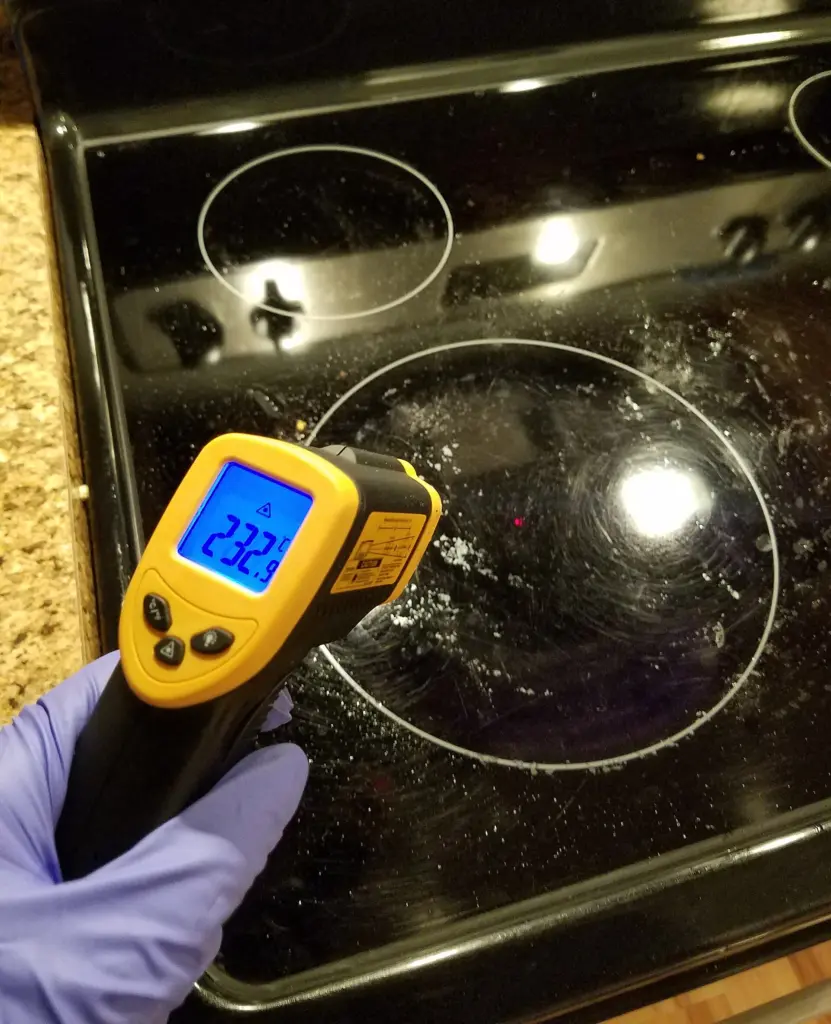
What we mean here are pistol-shaped handheld devices that determine the temperature of walls, pipes, engines or baking stones without contact. Some fever thermometers also work with infrared, but they belong to a separate device category and are not covered in this guide. In the manual for the UniversalTemp, Bosch explicitly states that the device must not be used to measure the temperature of people or animals or for medical purposes. Etekcity also labels its Lasergrip devices in its Amazon listing as not intended for humans. Body temperature, then, has no place in front of this lens.
What the device actually measures
Every surface radiates heat. The sensor captures this infrared radiation and converts it into a temperature. For the 62 MAX+, Fluke states a spectral response of 8 to 14 micrometers, the range in which objects around room temperature radiate most strongly. Such a device does not capture air, steam or liquids inside a pot. It only sees the outermost layer.
That also tells you what does not work. According to Bosch, measuring through glass is impossible by principle; the device then shows the temperature of the pane. Smoke, steam and dust between the device and the surface distort the value. Bosch therefore advises against measuring in the bathroom right after a shower.
Emissivity determines the reading
Emissivity describes how much thermal radiation a material emits compared with an ideal radiator. It lies between 0 and 1. Matte, dark or mineral surfaces are close to 1, bare metals far below. The table in the ThermoSpot Plus manual gives examples: ceramic 0.95, brick 0.93, white paint 0.90, oxidized copper 0.72, stainless steel 0.45, polished aluminum 0.05.
Many devices are fixed at 0.95 from the factory. That works for walls, wood and stone. Not for metal. Point such a device at a stainless steel pot, and it shows a much too low temperature, because the bare metal emits little radiation of its own and reflects its surroundings instead. Bosch warns of exactly this in the manual: objects could be displayed as too cold, and that can become dangerous if you touch them.
There are two ways out. Either you set the right value, which only works on devices with freely selectable emissivity. Or you stick a piece of matte, dark tape on the measuring spot, let it take on the temperature for a moment and then measure at 0.95. Bosch and Laserliner both describe this trick. It costs a few cents. And it beats every device class.
Measuring spot and laser: 12:1 does not mean pinpoint accuracy
According to the manufacturers, all five devices in this guide have 12:1 optics. The ratio describes distance to measuring spot. From 60 centimeters, the device thus measures an area about 5 centimeters in diameter; from 1.2 meters, it is already about 10 centimeters. Aiming at a 15-millimeter heating pipe from two meters away therefore gives a mixed value of pipe and wall. Moving closer helps more than a more expensive device.
The red laser, by the way, measures nothing. It only aims. A single dot marks the center of the measuring spot, a laser circle like on the ThermoSpot Plus marks its edge. That is handy at short distances, because you can see whether the spot still lies entirely on the pipe. Fluke and testo use two laser dots. On Bosch, Fluke and Laserliner devices, the laser is class 2. So never point it into anyone’s eyes, not even via reflective surfaces.
Checking the heating: supply, return, radiator
In winter, this is the most common task. A radiator that is warm at the top and cold at the bottom, or a return line that is barely cooler than the supply line even though the thermostat has been open for an hour and something should long since have happened in the room, can be spotted with two measurements in a few seconds. Painted radiators and painted pipes are grateful targets. Bosch assigns radiator paint to the high setting, and Laserliner gives 0.90 for white paint. Bare copper, on the other hand, varies widely depending on how oxidized it is. If you measure here without tape, you end up comparing two wrong values.
When looking for thermal bridges, a spot thermometer reaches its limits. You scan a wall spot by spot and easily miss the cold corner next to it. For a facade, window reveal or underfloor heating, a thermal imaging camera is the more suitable tool; our guide to thermal imaging cameras explains from which resolution it makes sense.
Pizza stone and oven: how hot can it get?
Now the measuring range counts. For the stone in the kitchen oven, the upper limit of every device in this guide is enough, as long as the oven stays below 400 degrees. A gas or wood-fired oven in the garden can go higher, and then a device with a 400-degree upper limit only shows an error message. For the garden oven, the upper limit should therefore be 500 degrees or higher. The manufacturers do not agree on emissivity. Laserliner lists ceramic at 0.95, while Bosch puts firebrick in the middle setting at 0.85. Both are guide values. If you want to know exactly, measure once with both settings and compare.
Two subtleties. Bosch writes that the UniversalTemp is intended for indoor use and not for measuring food. You may aim at the stone, but preferably not at the pizza itself. And the device does not belong directly against hot surfaces; the heat can damage it. If you are looking for an outdoor oven, you will find suitable models in the guide to the pizza oven for garden and balcony (in German). For the core temperature of steak and roasts, you need a probe thermometer anyway, as in the grill thermometer guide.
Five surface thermometers and their key specs
| Model | Measuring range | Emissivity | Laser | Best for |
|---|---|---|---|---|
| Laserliner ThermoSpot Plus | −38 to 600 °C | 0.01 to 1.00 adjustable | Laser circle (8 dots) | Household, heating, pizza stone |
| Bosch UniversalTemp | −30 to 500 °C | 3 settings: 0.95 / 0.85 / 0.75 | 1 dot | Occasional measurements around the house |
| Etekcity Lasergrip 1080 | −50 to 550 °C, depending on version up to 610 °C | 0.1 to 1.0 adjustable | 1 dot | Grill and garden oven |
| testo 830-T2 | −30 to 400 °C | adjustable | 2 dots | Trades, contact probe for cross-checking |
| Fluke 62 MAX+ | −30 to 650 °C | 0.10 to 1.00 adjustable | 2 dots | Workshop, construction site, harsh environments |
Laserliner ThermoSpot Plus
Emissivity can be set in hundredths from 0.01 to 1.00, and the manual comes with a long materials table. According to the manufacturer, the device measures from −38 to 600 degrees with ±2 degrees or ±2 percent, whichever is greater. The laser circle shows the measuring area, and a MAX display holds the highest value of a continuous measurement. Laserliner recommends having the device calibrated annually. Hardly anyone does that at home, but it matters for measurement records at work.
Bosch UniversalTemp
Instead of a free value, Bosch offers three settings: 0.95 for concrete, wood or glass, 0.85 for enamel, granite or cast iron, 0.75 for cork or white porcelain. That does not cover bare metal. Between 0 and 100 degrees, Bosch states a typical accuracy of ±1.8 degrees, measured from 0.75 to 1.25 meters. The device runs for about nine hours on two AA batteries. It measures radiators and walls in the house properly. Not the garden oven, though, because Bosch restricts the device to indoor use.
Etekcity Lasergrip 1080
Etekcity offers the Lasergrip 1080 in several versions. According to the listing, the measuring range goes up to 550 or 610 degrees, and the emissivity is adjustable from 0.1 to 1.0. Check which version you are ordering before you buy, because the manufacturer’s pages also list variants with only 380 degrees. On a hot pizza stone in the garden, that very difference is what matters.
testo 830-T2
This device comes from the professional range. testo states −30 to 400 degrees and an accuracy of ±1.5 degrees or ±1.5 percent above zero degrees. The real reason for the T2 is the socket for a contact probe. With it, an infrared measurement on bare metal can be cross-checked directly; according to testo, a surface probe is included in the set. On the garden oven, the upper limit can get tight.
Fluke 62 MAX+
Built for people whose device occasionally falls off the scaffolding. Fluke states a drop test from three meters and IP54 protection against dust and splashing water. The measuring range goes up to 650 degrees; according to the data sheet, accuracy is ±1 degree or ±1 percent, and it gets coarser below zero degrees. According to Fluke, a single AA battery lasts eight hours with laser and backlight. If you only check the radiator twice a year, you are paying here for features you will never need.
Which device suits which job
- Household with heating, kitchen and the occasional metal surface: Laserliner ThermoSpot Plus, because the freely adjustable emissivity prevents most false readings.
- Only walls, radiators and tiles in the house: the Bosch UniversalTemp is enough, provided you work with tape on bare surfaces.
- Pizza oven in the garden or griddle plate: Etekcity Lasergrip 1080 in the version with the high upper limit, or the Fluke 62 MAX+.
- Trades with documentation requirements and metal surfaces: testo 830-T2, because the contact probe backs up the infrared measurement.
- Construction site, car repair shop, dust and drops: Fluke 62 MAX+.
Whichever model you choose, the biggest source of error remains the person behind it. Keep the distance short, check the emissivity, tape over anything shiny.
Frequently asked questions
Why does an infrared thermometer show wrong values on metal?
Bare metals emit little thermal radiation of their own and reflect their surroundings. A device fixed at 0.95 therefore shows a much too low temperature on a stainless steel pot. Bosch warns that this can become dangerous if you touch it. The remedy is the right emissivity setting or matte tape on the measuring spot.
What does 12:1 mean on an infrared thermometer?
The ratio describes distance to measuring spot. From 60 centimeters, the device measures an area about 5 centimeters in diameter; from 1.2 meters, about 10 centimeters. A thin heating pipe measured from two meters gives a mixed value of pipe and wall; moving closer helps more than a more expensive device.
Which infrared thermometer is enough for a pizza oven in the garden?
A gas or wood-fired oven can exceed 400 degrees, so the upper limit should be 500 degrees or higher. Suitable choices are the Etekcity Lasergrip 1080 in the version with the high upper limit or the Fluke 62 MAX+. With the Etekcity, check the version before buying.
Can you take a fever with an infrared thermometer?
No, surface thermometers are not intended for that. In the manual for the UniversalTemp, Bosch states that the device must not be used on people or animals or for medical purposes. Etekcity also labels its Lasergrip devices as not intended for humans.
Does the laser measure the temperature?
The red laser measures nothing; it only aims. A single dot marks the center of the measuring spot, a laser circle like on the ThermoSpot Plus marks its edge. On Bosch, Fluke and Laserliner devices, the laser is class 2, so never point it into anyone's eyes, not even via reflective surfaces.
Is an infrared thermometer worth it for finding thermal bridges?
Only to a limited extent. A spot thermometer scans a wall spot by spot and easily misses the cold corner next to it. For a facade, window reveal or underfloor heating, a thermal imaging camera is the more suitable tool. An infrared thermometer, on the other hand, checks radiators, supply and return lines in a few seconds.
Sources
- Bosch: UniversalTemp operating instructions (PDF)
- Bosch: UniversalTemp, product page
- Laserliner: ThermoSpot Plus operating instructions (PDF)
- Fluke: 62 MAX+, product page and technical data
- testo: 830-T2, product page
- Etekcity: Lasergrip 1080, product page
Where to buy
- Laserliner ThermoSpot PlusCheck price at Amazon.deAvailable in Germany: Amazon.de
- Bosch UniversalTempCheck price at Amazon.deAvailable in Germany: Amazon.de
- Etekcity Lasergrip 1080Check price at Amazon.deAvailable in Germany: Amazon.de
- testo 830-T2Check price at Amazon.deAvailable in Germany: Amazon.de
- Fluke 62 MAX+Check price at Amazon.deAvailable in Germany: Amazon.de