Contents10 sections
This guide was first published in German on handgetestet.de.
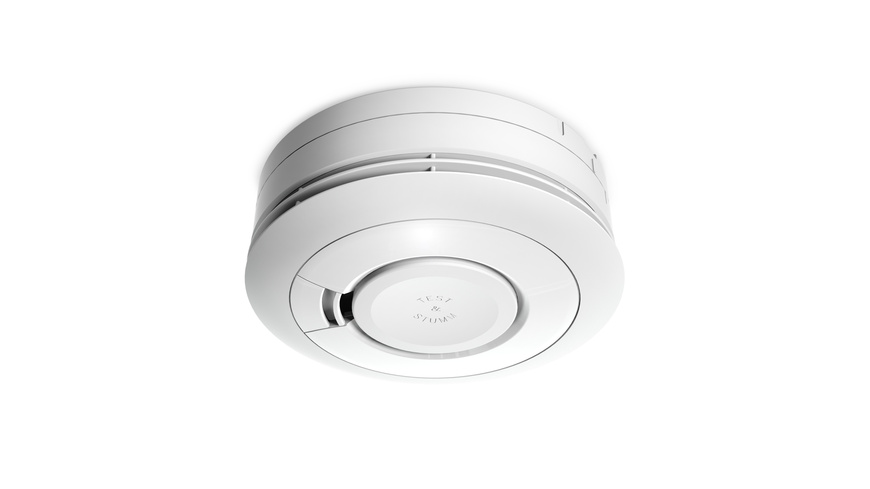
It is night, the child is asleep upstairs, the parents two floors below. If a single smoke alarm goes off in the child’s room, nobody may hear it. Interconnected alarms solve that problem: when one beeps, they all sound. If you do not run a smart home and simply want to protect a house, a radio alarm with a built-in module such as the Ei Electronics Ei650RF is a good choice. You do not need an app for it.
Things typically go wrong the other way around. People buy a „smart“ alarm for the push notification on their phone, and later it turns out that the devices do not alert one another at all. Or that nothing is interconnected without a hub.
What the law requires and what it does not
The smoke alarm requirement is set out in the building codes of the German federal states. It now applies in all 16 states to existing homes as well; the transition periods have expired everywhere, most recently in Saxony at the end of 2023. The Bavarian Building Code shows the core in Art. 46(4): bedrooms, children’s rooms and hallways leading to living spaces each need at least one smoke alarm. The owner has to install them. Keeping them operational is the job of the direct occupants, usually the tenants, unless the owner takes it on.
Berlin and Brandenburg go further. There, alarms are mandatory in all living spaces except the kitchen, the living room included. Stiftung Warentest, the German consumer testing organization, has compiled an overview of all states and their deadlines. The Bavarian text does not require interconnection. It is a question of safety, not of law.
How to recognize a good alarm
First, the Q. The Q label is a voluntary additional mark under the German vfdb guideline 14-01, awarded after testing by VdS or Kriwan. Requirements include a power supply for at least ten years and a design that makes false alarms less frequent. The mandatory standard DIN EN 14604 on its own says less about this.
Then interconnection. Some systems communicate directly from alarm to alarm, others need a hub, and without it each alarm stays on its own. Whether you need an app depends on your daily life. A push notification helps when nobody is home. If you only want to be woken at night, it gains you little.
And the battery. Built in means ten years of peace, then a new device. Replaceable means more maintenance.
Five alarms with radio or app
| Model | Interconnection | App and hub | Battery and Q label | Best for |
|---|---|---|---|---|
| Ei Electronics Ei650RF | Radio, module built in | no app, no hub | built in, at least 10 years; Q according to retailers | House or large apartment without a smart home |
| Hekatron Genius Plus X with Funkmodul Basis X | Radio via plug-in module | Status check via app, push only with the Genius Port gateway | built in, typically 10 years; Q according to retailers | If you want to expand a radio system later |
| Homematic IP Rauchwarnmelder HmIP-SWSD-2 | Homematic IP radio, up to eight groups | App, Access Point or CCU3 required | built in, up to 10 years; Q | Homematic IP households |
| Bosch Smart Home Rauchwarnmelder II | Zigbee 3.0 via the hub | App, Smart Home Controller required | replaceable, up to 5 years; no Q stated | Bosch Smart Home households |
| Netatmo Intelligenter Rauchmelder | Wi-Fi, no alarm network documented | Home + Security app, no hub | built in, about 10 years; no Q stated | Single apartment, push notification comes first |
Ei Electronics Ei650RF: radio without detours
According to the user manual, the radio module is already inside the device. Unpack it, pair it with the other alarms, screw it to the ceiling. According to the manufacturer, the lithium battery should last at least ten years, and a house code prevents the alarms from reacting to signals from the house next door. There is no app. For many households, that is exactly the advantage: no account, no cloud, nothing that has to be set up again after you replace the router. The AudioLINK smartphone diagnostics are reserved for the i-series models and, according to the manual, for professionals.
Hekatron Genius Plus X: the modular system
A standalone alarm with a module slot. Several Genius Plus X units only become interconnected with the separately sold Funkmodul Basis X (radio module), which according to the manufacturer works without any settings; for larger houses, there is the Pro X module with more lines. Battery and alarm are designed for typically ten years, after which the whole device is replaced. The Genius Home and Genius Pro apps read out the status. According to retailers, push notifications to your phone come exclusively through the Genius Port gateway. Flexible, then. However, each alarm needs two parts instead of one.
Homematic IP HmIP-SWSD-2: Q label and app
Homematic’s new alarm replaces its well-known predecessor, carries the Q label and, according to the manufacturer, runs for up to ten years on built-in batteries. The app shows operating time, test runs and alarms; on top of that come LED emergency lighting and dust compensation. If no groups are defined, all Homematic IP alarms pair automatically. There is one condition: an Access Point or the CCU3 hub is required for the app and setup. If you have neither, you are buying a piece of infrastructure along with it.
Bosch Smart Home Rauchwarnmelder II: strong in the system, weak on its own
The Bosch smoke alarm communicates via Zigbee 3.0 and requires the Smart Home Controller for the app and interconnection. Without it, it remains a simple standalone alarm. Within the system, on the other hand, an alarm can switch lights, roller shutters or cameras. The CR17450 battery is replaceable and, according to Bosch, lasts up to five years. Bosch does not mention a Q label, only compliance with the legal requirements. It makes sense in Bosch households. Otherwise, it is a detour.
Netatmo Intelligenter Rauchmelder: notification yes, network no
The Netatmo alarm (sold in Germany as „Intelligenter Rauchmelder“, smart smoke alarm) connects directly to the router via Wi-Fi, so there is no hub. The battery should last about ten years; Netatmo lists CE and NF as test marks, but no Q label. Something else weighs more heavily. Netatmo does not document that several Netatmo alarms trigger one another; each beeps on its own and sends a notification to your phone. In a small apartment, that can be enough. In a house with bedrooms on two floors, it is not.
Which alarm for which home?
In a single-family house without a smart home, everything points to the Ei Electronics Ei650RF. Radio built in, nothing to set up, nothing to maintain apart from the annual test. People building a house who want to expand later should choose the Hekatron Genius Plus X with Basis X: more effort, but in return a system with a gateway and expansion options.
If you already run Homematic IP, the HmIP-SWSD-2 with Q label, app and groups fits into your existing hub. Bosch Smart Home households should go for the Rauchwarnmelder II if the alarm is to control lights and roller shutters, and plan for the shorter battery life. Tenants in a small apartment for whom the notification on their phone matters more than the network? Netatmo.
Which hub suits your home is explained in the article Buying a smart home hub; actuators that let you link smoke alarms and lights are covered under smart light switches. One thing remains true even with the smartest alarm: press the test button once a year. Specialist companies inspect annually under DIN 14676, with three months of leeway.
Smoke alarms do not help against escaping gas. There are dedicated devices for that, presented in our guide to the gas detector for natural gas and LPG.
Frequently asked questions
Where are smoke alarms mandatory?
The requirement is set out in the building codes of the German federal states and applies in all 16 states to existing homes as well. Under the Bavarian Building Code, bedrooms, children's rooms and hallways leading to living spaces each need at least one alarm. Berlin and Brandenburg require alarms in all living spaces except the kitchen.
Do smoke alarms have to be interconnected?
Not by law; the Bavarian text does not require interconnection. It is a question of safety: if the child sleeps upstairs and the parents two floors below, nobody may hear a single alarm. Interconnected devices go off together.
What does the Q label on smoke alarms mean?
It is a voluntary additional mark under the German vfdb guideline 14-01, awarded after testing by VdS or Kriwan. Requirements include a power supply for at least ten years and a design that makes false alarms less frequent. The mandatory standard DIN EN 14604 on its own says less about this.
Do smart smoke alarms need a hub?
That depends on the system. The Ei650RF communicates directly from alarm to alarm. Homematic IP needs an Access Point or the CCU3, Bosch the Smart Home Controller. Netatmo connects to the router via Wi-Fi but does not document that several alarms trigger one another.
Is a Wi-Fi smoke alarm with an app enough?
In a small apartment it can be, if the notification on your phone is what matters most. With the Netatmo alarm, each unit beeps on its own and sends a push notification; the manufacturer does not document an interconnected network. In a house with bedrooms on two floors, that is not enough.
How often does a smoke alarm need to be tested?
Press the test button once a year, smart alarms included. Specialist companies inspect annually under DIN 14676, with three months of leeway. Keeping the alarms operational is usually the tenants' job, unless the owner takes it on.
Sources
- Bavarian Building Code, Art. 46(4) (gesetze-bayern.de)
- Stiftung Warentest: Smoke alarm requirements in the German states
- Hager: Standards for smoke alarms and the Q label
- Ei Electronics: User manual for the Ei650 range incl. i-series
- Hekatron: Installation instructions for Genius Plus and Genius Plus X
- Bosch Smart Home: Rauchwarnmelder II
- Netatmo: Intelligenter Rauchmelder (smart smoke alarm)
- ifun.de: Homematic IP introduces the HmIP-SWSD-2 smoke alarm
Where to buy
- Ei Electronics Ei650RFView at ELVAvailable in Germany: ELVCheck price at Amazon.deAvailable in Germany: Amazon.de
- Hekatron Genius Plus XCheck price at Amazon.deAvailable in Germany: Amazon.de
- Hekatron Funkmodul Basis XCheck price at Amazon.deAvailable in Germany: Amazon.de
- Homematic IP Rauchwarnmelder HmIP-SWSD-2View at ELVAvailable in Germany: ELVCheck price at Amazon.deAvailable in Germany: Amazon.de
- Bosch Smart Home Rauchwarnmelder IICheck price at Amazon.deAvailable in Germany: Amazon.de
- Netatmo Intelligenter RauchmelderCheck price at Amazon.deAvailable in Germany: Amazon.de