Contents14 sections
This guide was first published in German on handgetestet.de.
Few people buy a kitchen hutch for the love of furniture. Usually the kitchen is two meters of cabinet short, and the free wall opposite still has room. That is exactly where a few centimeters of depth decide things, along with the question of whether the piece can be fixed to the wall. Our starting point is the Home affaire Alby at 125 cm wide, because according to the retailer it brings solid pine, full-extension drawers and the highest shelf load in this comparison. That holds on condition that 38 cm of depth is enough for your dishes and that you can screw it to the wall. Smaller kitchens and budgets tend to end up with the Teramo at 86 cm.
For context: the hutch adds to a kitchen, it does not replace one. If it is about the sink, stove and connections, the kitchen unit is the right topic. If the piece stands in the dining room and mainly shows off glasses, a display cabinet is the better fit, and for low storage a sideboard.
Does the large plate fit?
It sounds trivial, but it is the question a hutch fails on. The Home affaire models are built shallow so they do not get in the way in the room. For the Oslo, the retailer gives 34 cm of depth for the lower compartments; at the top it is only 24 cm. On the Alby, the top section is 28 cm deep. Measure your largest plate and your casserole dish. What lies comfortably at the bottom with a 27 cm diameter may only fit upright in the top section. The wiho models are considerably deeper at the bottom at 50 cm, and on the Linz the top section measures 35 cm.
The extra depth does take up walking space, though. In a narrow kitchen, twelve centimeters more is the difference between a passage and a slalom, especially if the dishwasher folds open opposite. Mark the footprint on the floor with painter’s tape and open all the doors. One minute of effort, and afterwards you know more than any data sheet can tell you.
Storage surface or workspace
Should the lower section just hold the coffee machine, or do you want to chop on it? The working height is around 85 cm on the Linz and 86 cm on the Erla. According to Neff, the most common countertop height in kitchens is about 92 cm, and for a person who is 1.80 m tall the manufacturer’s calculation comes to 99 cm. For setting things down, the hutch is perfectly fine. For longer chopping sessions it sits too low for most adults.
Wiho fits a real countertop, 28 mm thick on the Linz and 38 mm on the Erla. Home affaire uses solid pine, stained and waxed. That feels warmer but is more delicate. The listings give no care instructions for waxed surfaces. The furniture maker Goldau & Noelle writes about its oiled surfaces that moisture penetrates the wood with prolonged exposure, and recommends coasters and wiping up immediately. We assume wax does not protect any better. A kettle that steams under the top section every day will leave marks.
Solid wood or engineered wood?
This is less a question of good or bad than of care. Goldau & Noelle names around 21 °C and 40 to 60 percent humidity as a normal indoor climate, advises against placing furniture directly next to a radiator and describes small drying cracks as normal. A kitchen does not always provide that, because humidity fluctuates more during cooking than in the living room. Engineered wood and MDF, as used by wiho, move less. The pine from Home affaire, on the other hand, visibly ages. If you want an evenly white front, the Erla serves you better; if you like grain, the Alby or Oslo.
The FSC mark that the retailer lists for all three Home affaire series concerns the forest. It has nothing to do with emissions, as the German Environment Agency (Umweltbundesamt) points out. For furniture made of engineered wood, German law sets a formaldehyde limit of 0.05 ppm in the test chamber. If you want to buy to a stricter standard, look for the Blue Angel (Blauer Engel), the German eco-label. None of the six listings mentions it. If a new piece of furniture keeps smelling strongly, that can be a defect according to the German consumer advice center (Verbraucherzentrale), even if no limits are exceeded. Air the room first, and otherwise contact the retailer.
What the shelves can hold
Here the figures differ more than the looks do. Alby: 15 kg per shelf. Oslo and Teramo: 10 kg. Erla: only 5 kg per adjustable shelf, and that over a length of 146.7 cm. A stack of dinner plates quickly weighs more. Put your stack on the kitchen scale (in German) once, which saves you the arithmetic. For the 126 cm Teramo, the listing also gives a total load of 90 kg, and 70 kg for the narrow one. For the Linz, the retailer gives no figure.
Narrow at the top, so onto the wall
Divide the height by the depth. The Alby and Teramo come to just under 5, the wiho Linz to 3.6 thanks to its deep lower section. That is our comparison figure, not a test standard. It shows why a narrow hutch with a full top section does not like to stand on its own. The German safety association Aktion Das Sichere Haus recommends fixing shelves and cabinets to the wall with metal brackets, and describes how toddlers climb up open drawers. The Deutsche Gütegemeinschaft Möbel, the German furniture quality association, considers additional wall mounting generally advisable.
None of the six listings mentions anti-tip protection. Ask about it, and plan brackets and wall plugs to suit your wall. For the Erla, buyers also report that the upper cabinet is only set on top and not connected to the lower section. You should clarify that before assembly, not after. Nobody states the type of glass behind the doors either. With children in the household, we would ask.
Six hutches, measured by depth and load
| Model | Material | W × H × D | Load per shelf | Best for |
|---|---|---|---|---|
| Home affaire Alby 125 | Solid pine, FSC | 125 × 185 × 38 cm, top section 28 cm | 15 kg | Storage space, heavy dishes |
| Home affaire Teramo 86 | Solid pine, FSC | 86 × 181 × 37 cm | 70 kg, reference unclear | Small kitchen, narrow wall |
| Home affaire Teramo 126 | Solid pine, FSC | 126.6 × 181.5 × 37 cm | 10 kg, 90 kg in total | Many doors, no drawers needed |
| Home affaire Oslo 125 | Solid pine, FSC | 125 × 185 × 38 cm | 10 kg | Country style, somewhat cheaper than Alby |
| wiho Linz 120 | Engineered wood, MDF | 120 × 180 × 50 cm | not stated | Countertop, deep lower section |
| wiho Erla 150 | Engineered wood, MDF | 150 × 181 × 50 cm | 5 kg | Wide wall, light dishes |
Home affaire Alby 125
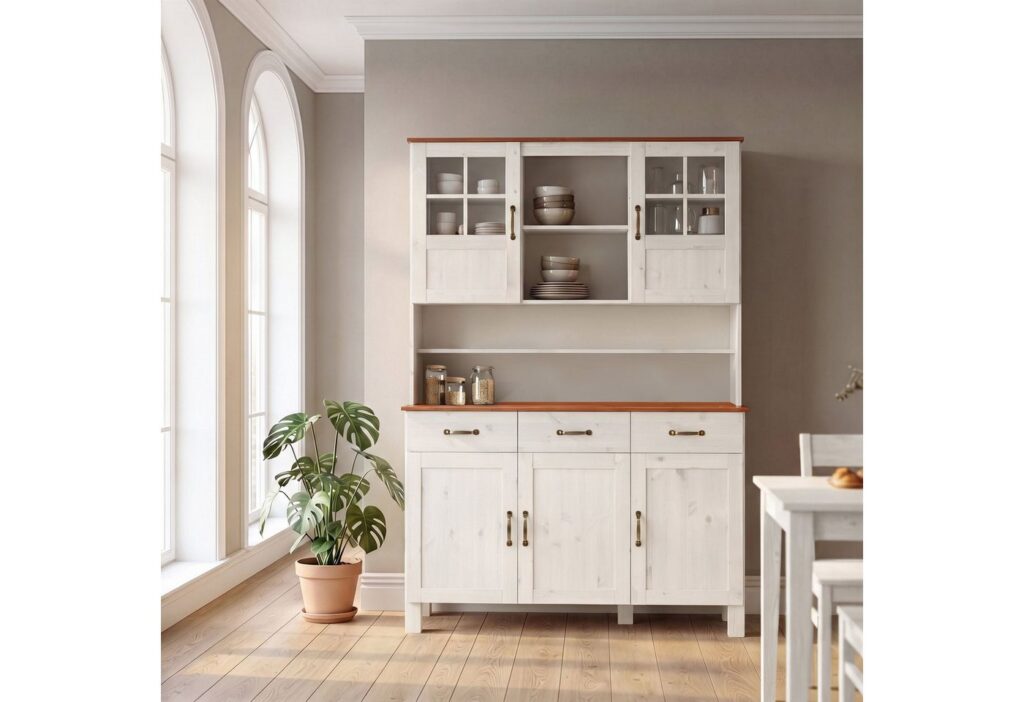
Five hinged doors, two of them with glass, plus two drawers with metal full-extension runners. The shelves are solid wood. According to the retailer, the wood comes from Estonia. You assemble it yourself or book the service for an extra charge. Drawbacks: the carcass walls are 1.5 cm thick, the back panel is MDF, and there is no information at all on the type of glass. Among the Home affaire models here, it is the most expensive.
Home affaire Teramo 86
Four doors, three shelves, no drawers. For a wall of just under a meter, it is the simplest solid wood solution. The retailer had it marked as almost sold out, and the 70 kg is listed there without a reference. Check the listing to see whether the size is still available.
Home affaire Teramo 126
The wide version with five doors and six shelves, five of them adjustable. According to the retailer, the back panel is pine and the origin is Brazil. Cutlery and small items need their own insert here, because there are no drawers.
Home affaire Oslo 125
Same outer dimensions as the Alby, two drawers, cup handles. According to the retailer, though, the shelves hold 10 kg instead of 15. If that is enough for you, you save money. Keep an eye on the 24 cm in the top section.
wiho Linz 120
Made in Germany, with 3 drawers, a countertop and glass doors with leaded decoration. At 50 cm deep, it stands more steadily than the shallow solid wood models. Buyers criticize imprecise assembly instructions, and the delivery time at the retailer was around four weeks.
wiho Erla 150
Paneled front in white, six doors, three drawers and the 38 mm countertop. At 150 cm, it needs a long wall, and the 5 kg per shelf does not suit heavy stoneware. For supplies and light dishes, it is enough.
Which hutch for which kitchen?
- Lots of dishes and a wall of 130 cm or more: Alby, screwed to the wall.
- Less than a meter of space: Teramo 86.
- You want to work on it and use the depth: Linz, but with a working height of around 85 cm.
- Children in the household: whichever you choose, sort out wall mounting first.
If you are looking for more work surface than storage and have the space, you will find freestanding units in the guide to the kitchen island.
Frequently asked questions
How deep should a kitchen hutch be?
Deep enough for your largest plate to fit. On the Oslo, the lower compartments are 34 cm deep, the top only 24 cm. The wiho models measure 50 cm at the bottom, but take up walking space in return. Mark the footprint on the floor with painter's tape and open all the doors.
Can I work on a kitchen hutch?
For setting things down, yes; for longer chopping sessions it sits too low for most people. The working height is around 85 cm on the Linz and 86 cm on the Erla. According to Neff, the most common countertop height in kitchens is about 92 cm.
How much can the shelves of a kitchen hutch hold?
That varies widely. According to the retailer, the Alby holds 15 kg per shelf, the Oslo and Teramo 10 kg, the Erla only 5 kg per adjustable shelf. A stack of dinner plates quickly weighs more. Put your stack on the kitchen scale once before you decide.
Does a kitchen hutch have to be fixed to the wall?
We recommend it. A narrow hutch with a full top section does not like to stand on its own, and toddlers climb up open drawers. The German safety association Aktion Das Sichere Haus recommends metal brackets on the wall. None of the six listings mentions anti-tip protection, so plan brackets and wall plugs yourself.
Solid wood or engineered wood in the kitchen?
A question of care. Solid wood moves with fluctuating kitchen humidity, small drying cracks are considered normal, and moisture penetrates the wood with prolonged exposure. Engineered wood and MDF, as used by wiho, move less. If you like visible grain, take the Alby or Oslo; if you want an even white, the Erla.
Sources
- Aktion Das Sichere Haus (German safety association): Fixing furniture securely
- Deutsche Gütegemeinschaft Möbel: Childproofing your home
- German Environment Agency (Umweltbundesamt): Chipboard and other engineered wood
- Verbraucherzentrale (German consumer advice center): Odors and emissions from furniture
- Neff: Ergonomics in kitchen planning
- Goldau & Noelle: Care instructions for solid wood
- BAUR (German retailer): Home affaire Alby (retailer information)
- BAUR: Home affaire Oslo (retailer information)
- BAUR: Home affaire Teramo 126 (retailer information)
- BAUR: Home affaire Teramo 86 (retailer information)
- BAUR: wiho Linz 120 (retailer information)
- BAUR: wiho Erla 150 (retailer information)
Where to buy
- Home affaire Alby 125View at OTTOAvailable in Germany: OTTO
- Home affaire Teramo 86View at OTTOAvailable in Germany: OTTO
- Home affaire Teramo 126View at OTTOAvailable in Germany: OTTO
- Home affaire Oslo 125View at OTTOAvailable in Germany: OTTO
- wiho Linz 120View at OTTOAvailable in Germany: OTTO
- wiho Erla 150View at OTTOAvailable in Germany: OTTO