Contents15 sections
This guide was first published in German on handgetestet.de.
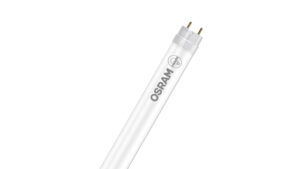
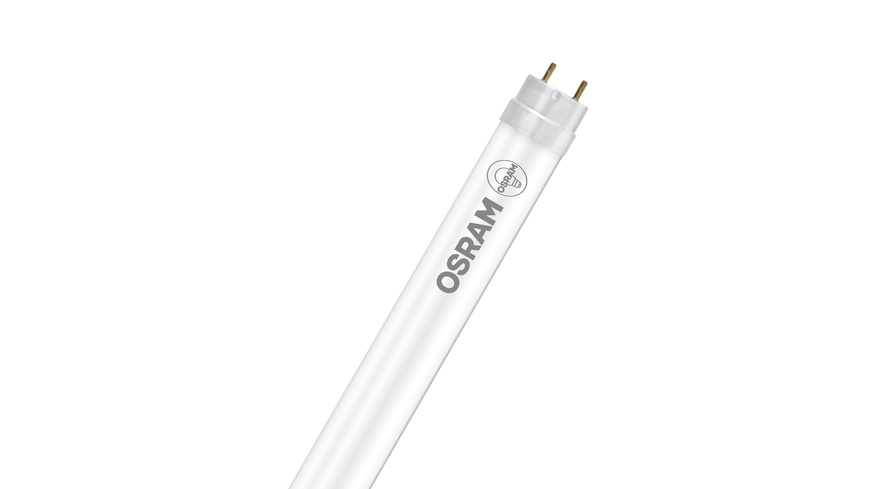
In the basement, the light switch clicks, up on the ceiling the tube flickers two or three times, and then it lights up. Or it no longer does. If you want to buy a new fluorescent tube now, you will only find leftover stock. That is not a bad thing. For a 120-centimeter fixture with a starter, we recommend the Osram LED TUBE T8 36 EM, because according to the data sheet it delivers 2,100 lumens at 10 watts and runs on the old ballast just as well as directly on the mains after a conversion.
Before you order, though, it pays to take a second look inside the fixture. Which LED tube fits is decided not by the tube but by what is inside the fixture.
Why there are no new fluorescent tubes anymore
Fluorescent tubes contain mercury. The EU RoHS Directive bans the heavy metal in electrical equipment, but lamps long had an exemption. In December 2021, the European Commission decided to let the exemptions for linear fluorescent lamps for general lighting expire, and the legal acts were published in February 2022. According to Signify, the company behind Philips lighting, T5 and T8 tubes may no longer be newly placed on the market since August 24, 2023. Existing stock may still be sold and used.
In practical terms, you can still find leftover stock, but no new supply. If you replace a tube today, you are better off switching to LED right away.
Check first: starter or no starter?
Power off, cover off. If there is a small cylinder on the side of the fixture, that is the starter. The fixture then works with a conventional magnetic ballast (CCG) or a low-loss ballast (LLG). Most LED tubes are made for exactly these fixtures. When converting, you replace only two parts: the tube comes out, the starter too, and in its place you insert the replacement starter supplied. The fixture itself stays unchanged.
If there is no starter, the fixture usually contains an electronic ballast (ECG), or it has already been converted. That calls for dedicated ECG tubes, and they do not get along with every ballast. Philips, for example, describes its InstantFit tubes as compatible with common electronic ballasts from brand manufacturers and refers to a compatibility list. Copy the manufacturer and type from the label on the ballast before you order.
A special case is tandem wiring, where two short tubes share one ballast. Blulaxa explicitly rules out this operation for its tubes in the manual. If you have two 60 cm tubes in a row in one fixture, check this beforehand.
Directly on the mains: cleaner, but not a DIY project
Some tubes for magnetic ballasts can also be run on 230 volts without a ballast. Philips states this for its LEDtube models for CCG/LLG, and Osram lists „CCG/LLG, mains voltage“ as the operating mode in the data sheet of the LED TUBE T8 EM. The ballast then no longer consumes any power. For this, however, the fixture has to be rewired. Osram states in the data sheet that all electrical connections may only be made by qualified specialists, and that is not a formality: an incorrectly converted fixture can endanger someone who knows nothing about it at the next tube change. Have a qualified electrician do it and label the fixture afterward.
Length, lumens, color temperature
T8 tubes are 26 millimeters in diameter and have the G13 bi-pin base. Common lengths are 60, 90, 120 and 150 centimeters. Measure the old tube without the pins. The Osram tube for 120 centimeters is 1,212 millimeters long with its base pins and exactly 1,200 without them.
When it comes to light output, the figures from the data sheets help. A 60 cm tube such as the Philips CorePro delivers 800 lumens, the 120 cm models in our list range from 2,000 to 2,500 lumens, and the 150 cm tubes reach 3,700. For a basement, garage or laundry room, the 120 cm tubes are usually quite sufficient. In the workshop (in German), where you saw and solder at the workbench, plan more generously.
With color temperature, many people trip over the terminology. 3,000 kelvins is warm white, 6,500 kelvins is close to daylight. Philips calls the 4,000 kelvins in between „neutral white,“ Osram „cool white.“ Both mean the same thing. Neutral light suits basement rooms and workbenches, while a hobby room where you also sit is better served by warm white. According to manufacturer and retailer information, all models here have a color rendering index of at least Ra 80 and are not dimmable.
Six tubes and one complete fixture
| Model | Operation | Data according to manufacturer | Best for |
|---|---|---|---|
| Osram LED TUBE T8 36 EM 1200 mm | CCG/LLG or mains | 120 cm, 10 W, 2,100 lm, 4,000 K, energy class A, 50,000 h | Basement, hallway, garage with starter fixture |
| Philips LEDtube UO 1200 mm CCG/LLG (2-pack) | CCG/LLG or mains | 120 cm, 15.5 W, 2,500 lm, 4,000 K, 60,000 h, replacement starter included | Anyone who wants more light per tube |
| Philips LEDtube InstantFit ECG 1500 mm (2-pack) | ECG only | 150 cm, 24 W, 3,700 lm, 6,500 K, 60,000 h | Fixtures without a starter |
| Philips CorePro LEDtube 600 mm | CCG/LLG or mains | 60 cm, 8 W, 800 lm, 4,000 K, 30,000 h | Short fixtures, mirror cabinet, shelf |
| Müller-Licht T8 LED tube 1200 mm warm white (2-pack) | CCG/LLG | 120 cm, 16.5 W, 2,000 lm, 3,000 K, 15,000 h | Hobby room with warmer light |
| Blulaxa T8 LED tube 17.6 W 1500 mm (2-pack) | CCG/LLG, only with the supplied starter | 150 cm, 17.6 W, 3,700 lm, 4,000 K, energy class A, 75,000 h | Long fixtures in workshop and garage |
| Osram TubeKIT LED 1200 mm warm white | Complete fixture with plug | 120 cm, 19 W, 1,900 lm, 3,000 K, 30,000 h | Anyone who wants to replace the old fixture entirely |
Osram LED TUBE T8 36 EM 1200 mm
Together with the Blulaxa, the most efficient tube on the list. According to the data sheet, it reaches 210 lumens per watt and thus energy class A, and Osram cites savings of up to 72 percent compared with a T8 fluorescent lamp. Glass tube, 50,000 hours, 200,000 switching cycles. There is little against it: ELV (German retailer) only carries it in 4,000 kelvins, and ELV does not list an LED replacement starter in the scope of delivery. According to Osram, it is not intended for emergency lighting.
Philips LEDtube UO 1200 mm CCG/LLG (2-pack)
Philips lists this tube in the data sheet as MASTER LEDtube Value. It delivers 2,500 lumens at 15.5 watts, so more light than the Osram, but it also uses more power. According to Philips, the replacement starter is in the box. Not suitable for DC voltage or electronic switches.
Philips LEDtube InstantFit ECG 1500 mm (2-pack)
The tube for fixtures with an electronic ballast. No conversion, no starter. On the other hand, according to Philips it does not run on 230 volts, and the ballast should be on the compatibility list. According to ELV, the rotating end caps allow the beam direction to be adjusted in steps of up to 90 degrees.
Philips CorePro LEDtube 600 mm
The short version for small fixtures. 8 watts, 800 lumens, a wide beam angle of 240 degrees. For service life, Philips states 30,000 hours, less than its bigger siblings. For a fixture above the basement shelf, that lasts a long time.
Müller-Licht T8 LED tube 1200 mm warm white (2-pack)
One of the few 120 cm tubes with 3,000 kelvins. At 121 lumens per watt, it is considerably less efficient than the Osram, and Müller-Licht states a service life of only 15,000 hours. If you want warm light, you accept that.
Blulaxa T8 LED tube 17.6 W 1500 mm (2-pack)
For the long 150 cm fixtures. According to Blulaxa, energy class A, 3,700 lumens, 75,000 hours. The manual is strict: only with the supplied LED starter, not on an electronic ballast, not in tandem wiring. Blulaxa also advises checking the lamp holders, because the weight of the glass tube may differ from the old one.
Osram TubeKIT LED 1200 mm warm white
Not a tube but a ready-made fixture with a switch and a 1.8-meter cable with plug. It makes sense if the old fixture has yellowed, hums or is due to go anyway. According to Osram, it saves up to 65 percent compared with a T8 fixture on a magnetic ballast. At 100 lumens per watt, however, it is not the most economical solution, and mounting it on the ceiling with fixed wiring again belongs in professional hands. For the kitchen, an under-cabinet light would usually be the better choice.
Where should the old tube go?
Not in household waste, not in the yellow recycling bin, not in the glass container. The German Environment Agency classifies linear fluorescent lamps as mercury-containing gas discharge lamps. In Germany, private households can drop them off free of charge at the municipal recycling center, often also at the mobile hazardous waste collection. Electronics stores and grocery retailers with at least 800 square meters of sales area that regularly sell electrical appliances must also take back old lamps. Transport the tube intact, ideally in the packaging of the new one.
If a tube does break, the Verbraucherzentrale, the German consumer advice center, advises, citing the German Environment Agency: air out the room for 15 minutes and leave it, sweep the shards together with a piece of cardboard rather than a vacuum cleaner, wear rubber gloves and put everything in an airtight glass jar. That also goes to the collection point.
Which tube for which fixture?
- 120 cm fixture with starter: the Osram LED TUBE T8 36 EM, or the Philips LEDtube UO if you want more light.
- 150 cm fixture with starter: Blulaxa, as long as there is no tandem wiring.
- Fixture without starter: Philips InstantFit ECG, after checking the compatibility list.
- Short 60 cm fixture: Philips CorePro.
- Old fixture defective or yellowed: Osram TubeKIT instead of a new tube.
For standard E27 or GU10 sockets, our guide to LED bulbs (in German) will help.
Frequently asked questions
Why are fluorescent tubes no longer available?
They contain mercury, and the EU has let the exemptions in the RoHS Directive for linear fluorescent lamps expire. According to Signify, T5 and T8 tubes may no longer be newly placed on the market since August 24, 2023. Existing stock may still be sold and used.
How do I know which LED tube fits my fixture?
Power off, cover off. If there is a small cylinder on the side, that is the starter, and the fixture works with a conventional magnetic ballast (CCG) or a low-loss ballast (LLG); most LED tubes are made for these. If there is no starter, there is usually an electronic ballast (ECG) inside, and you need ECG tubes. Note down the ballast's manufacturer and type.
Can you connect an LED tube directly to the mains?
Some tubes for magnetic ballasts also run on 230 volts without a ballast, such as the Osram LED TUBE T8 EM or the Philips LEDtube for CCG/LLG. This requires rewiring the fixture, which according to Osram may only be done by qualified specialists. The converted fixture should then be labeled.
What length and brightness does a T8 tube need?
Common lengths are 60, 90, 120 and 150 centimeters, measured without the pins. A 60 cm tube such as the Philips CorePro delivers 800 lumens, the 120 cm models in the comparison range from 2,000 to 2,500 lumens, and the 150 cm tubes reach 3,700. For a basement, garage or laundry room, the 120 cm tubes are usually enough.
Which color temperature suits a basement or hobby room?
3,000 kelvins is warm white and 6,500 kelvins is close to daylight; Philips calls the 4,000 kelvins in between "neutral white," Osram "cool white." Neutral light suits basement rooms and workbenches, while a hobby room where you also sit is better served by warm white, as with the Müller-Licht tube.
Where should the old fluorescent tube go?
Not in household waste, the yellow recycling bin or the glass container, because it contains mercury. In Germany, private households can drop it off free of charge at the municipal recycling center, often also at the mobile hazardous waste collection. Electronics stores and grocery retailers with at least 800 square meters of sales area that regularly sell electrical appliances also take them back.
Sources
- European Commission: RoHS Directive and mercury exemptions for lamps
- Signify: The end of the fluorescent lamp in 2023 (PDF)
- Canton of Zurich, Cantonal Laboratory: Lights out for mercury-containing fluorescent tubes
- German Environment Agency (Umweltbundesamt): Where to put broken lamps?
- Verbraucherzentrale: Disposing of defective lamps properly
- LEDVANCE: LED TUBE T8 36 EM data sheet (PDF)
- Philips: MASTER LEDtube Value CCG/LLG data sheet (PDF)
- Philips: MASTER LEDtube InstantFit ECG data sheet (PDF)
- Philips: CorePro LEDtube 600 mm data sheet (PDF)
- Müller-Licht: T8 LED tube 3,000 K data sheet (PDF)
- Blulaxa: Installation instructions for LED glass tubes (PDF)
- LEDVANCE: TubeKIT LED data sheet (PDF)
Where to buy
- Osram LED TUBE T8 36 EM 1200 mmView at ELVAvailable in Germany: ELV
- Philips LEDtube UO 1200 mm KVG/VVG (2er-Set)View at ELVAvailable in Germany: ELV
- Philips LEDtube InstantFit EVG 1500 mm (2er-Set)View at ELVAvailable in Germany: ELV
- Philips CorePro LEDtube 600 mmView at ELVAvailable in Germany: ELV
- Müller-Licht T8-LED-Röhre 1200 mm warmweiß (2er-Set)View at ELVAvailable in Germany: ELV
- Blulaxa T8-LED-Röhre 17,6 W 1500 mm (2er-Set)View at ELVAvailable in Germany: ELV
- Osram TubeKIT LED 1200 mm warmweißView at ELVAvailable in Germany: ELV
- Osram LED Tube T8 EM 1200 mmCheck price at Amazon.deCheck price at Amazon.co.ukCheck price at Amazon.nlCheck price at Amazon.com.beCheck price at Amazon.frCheck price at Amazon.itCheck price at Amazon.esCheck price at Amazon.plCheck price at Amazon.seAvailable in Germany: Amazon.de
- Philips CorePro LEDtube T8 1200 mmCheck price at Amazon.deCheck price at Amazon.co.ukCheck price at Amazon.nlCheck price at Amazon.com.beCheck price at Amazon.frCheck price at Amazon.itCheck price at Amazon.esCheck price at Amazon.plCheck price at Amazon.seAvailable in Germany: Amazon.de
- Philips MASTER LEDtube InstantFit EVG 1500 mmCheck price at Amazon.deCheck price at Amazon.co.ukCheck price at Amazon.nlCheck price at Amazon.com.beCheck price at Amazon.frCheck price at Amazon.itCheck price at Amazon.esCheck price at Amazon.plCheck price at Amazon.seAvailable in Germany: Amazon.de