Contents12 sections
This guide was first published in German on handgetestet.de.
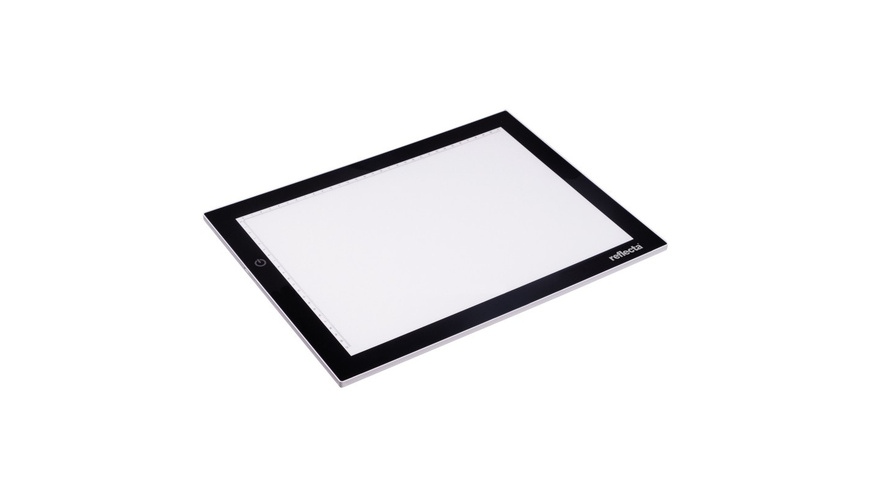
Sunday afternoon, kitchen table. A sketch needs to be transferred cleanly onto good paper, next to it lies a guide sheet for calligraphy practice, and in the cupboard a box of framed slides from 1987 is waiting. In the past, you would have taped the sheet to a windowpane. A flat LED light pad handles all three jobs at the table, and for most households the A4 format is enough. Our pick is the reflecta LED Leuchtplatte A4+ Super Slim (LED light pad), because it switches color temperature and the manufacturer states a color rendering index.
A4 or A3: what actually goes on the pad?
Don’t measure the housing, measure the illuminated area. The reflecta A4+ measures about 37 by 28 centimeters on the outside but lights up an area of 31 by 21 centimeters. An A4 sheet (DIN A4) measures 29.7 by 21 centimeters and so just fits. If you trace poster drafts, sewing patterns or large architectural drawings, you will quickly reach the limits of A4. Then you need A3 with an illuminated area of 44 by 29 centimeters. That takes space, though: the reflecta A3 pad weighs 1.6 kilograms and takes up almost half a meter of table width.
For slides, A4 is usually enough. According to reflecta, 24 framed 35 mm slides fit on the A4 illuminated area at once, in other words a complete archive sleeve.
Tracing, drawing, calligraphy: how bright does it need to be?
Less than you might think. With thin printer paper, the original already shows through at a low setting; with thick watercolor or drawing board, it gets tight, and then every bit of reserve counts. Unfortunately, most manufacturers don’t state a figure at all. Kaiser is the exception and specifies a luminance of about 600 to 750 candelas per square meter for its slimlite plano. Reflecta and Huion say nothing on the matter. All five pads in the table below can be dimmed, and that matters more than peak brightness. If you spend an hour tracing letters in the evening, you don’t want a glaring rectangle in front of you.
For calligraphy, place a guideline sheet under the writing paper and fix both in place with painter’s tape. A ruler along the edge of the pad helps with alignment. Huion and Kaiser print scales next to the illuminated surface for this purpose. And if you actually want to draw digitally, a light pad is the wrong purchase: for that, see our guide to the graphics tablet with or without a display.
Viewing slides and negatives, not scanning them
A light pad shows you which slides are worth keeping. It doesn’t digitize anything. For the box with 800 slide mounts, that means: first sort them on the pad with a loupe, then put only the good images into the scanner. Which device is suitable for that is covered in our guide to slide scanners and their real resolution.
When viewing, color temperature matters. Kaiser and reflecta describe roughly 5,000 kelvin as daylight-like light for accurate color rendering. The A4+ can also switch to about 3,000 and 8,000 kelvin, which can be more pleasant for drawing. According to reflecta, the color rendering index is at least 90; Kaiser’s is 95. If you want to photograph slides with a camera, go for the Kaiser: the manufacturer names exactly this use.
Power: adapter, USB or battery
This is where the pads differ most clearly. The reflecta A4+ runs from a 5-volt, 2-amp power adapter with a Micro-USB plug. Reflecta does not say whether it also runs from a power bank. The reflecta A3 needs a 12-volt power adapter with a barrel plug and is therefore tied to an outlet. Huion powers the L4S via USB-C and explicitly names a wall plug, power bank and laptop as sources. Kaiser builds in a battery. According to the manufacturer, it lasts about 3.5 hours at full brightness on the 32 by 22.8 centimeter pad, and only about 1.5 hours on the large version.
A battery sounds practical. At a desk with an outlet, however, it adds little and increases the weight. More important is a good work light from above when you switch between original and paper. You’ll find tips on this in our desk lamp guide (in German).
Five light pads compared
| Model | Illuminated area | Light | Power | Best for |
|---|---|---|---|---|
| reflecta LED Leuchtplatte A4+ Super Slim | 31 × 21 cm | dimmable, approx. 3,000/5,000/8,000 K, CRI ≥ 90 | 5 V power adapter, Micro-USB | Drawing and slides at the desk |
| reflecta LED Leuchtplatte A3 Super Slim | 44 × 29 cm | dimmable | 12 V power adapter, 18 W | Large originals, sewing patterns |
| Kaiser slimlite plano 32 x 22,8 cm | 32 × 22.8 cm | dimmable, 5,000 K, CRI 95, approx. 600 cd/m² | Battery or USB | Photographing slides, mobile use |
| Kaiser slimlite plano 42,9 x 30,9 cm | 42.9 × 30.9 cm | dimmable, 5,000 K, CRI 95, approx. 650 cd/m² | Battery or USB | Large-format photo archive |
| Huion L4S | A4 | dimmable with brightness memory | USB-C | Tracing and hobby use, small budget |
reflecta LED Leuchtplatte A4+ Super Slim
According to reflecta, the pad is 0.8 centimeters thick and weighs 640 grams. It dims continuously and switches between three color temperatures at the press of a button; the surface is made of polycarbonate. The manufacturer quotes a lifespan of around 50,000 hours for the LEDs. There are weaknesses, too: the Micro-USB port is no longer up to date, the data sheet lacks a luminance figure, and the pad has no battery.
reflecta LED Leuchtplatte A3 Super Slim
Twice the area, the same thickness. The A3 also dims, but reflecta states neither a switchable color temperature nor a color rendering index for it. For drawings, that hardly matters; for judging the colors of slides, it does. It makes sense if your originals are regularly larger than A4.
Kaiser slimlite plano 32 x 22,8 cm
Kaiser Fototechnik builds this pad for photographers. A fixed 5,000 kelvin, CRI 95, a battery and a touch switch that remembers the last brightness setting. The pad weighs 1,010 grams, considerably more than the reflecta. If you only trace, you are paying here for color accuracy you don’t need.
Kaiser slimlite plano 42,9 x 30,9 cm
The large slimlite plano has 90 LEDs and weighs 1,690 grams. According to Kaiser, the battery lasts only about an hour and a half at full output. On the power adapter, that doesn’t matter. For a large archive of medium-format negatives, it is the logical choice.
Huion L4S
Huion specifies a thickness of 5 millimeters and a weight of 0.6 kilograms for its pad, an acrylic glass surface and a touch button with brightness memory. Power comes via USB-C. The manufacturer gives no information on color temperature or color rendering. For tracing, textile designs and first perspective exercises, that is sufficient.
Which pad is right for you?
- Drawing, lettering and occasionally viewing slides: reflecta A4+. It covers both and switches color temperature.
- Originals larger than A4: reflecta A3, if the pad stays in a fixed spot.
- Digitizing slides with a camera or working without an outlet: Kaiser slimlite plano in the medium size.
- Tracing only, as cheaply as possible: Huion L4S with USB-C.
There is no single pad for everything. For home use, though, the A4+ comes closest.
Frequently asked questions
Is an A4 light pad enough, or do I need A3?
Measure the illuminated area, not the housing. The reflecta A4+ lights up an area of 31 by 21 centimeters, so an A4 sheet just fits. For poster drafts, sewing patterns or large architectural drawings, you need A3 with an illuminated area of 44 by 29 centimeters and considerably more space on the table.
How bright does a light pad need to be for tracing?
Less than you might think. With thin printer paper, the original already shows through at a low setting; with thick watercolor board, every bit of reserve counts. More important than peak brightness is dimming, which all the pads in our comparison offer. Only Kaiser states a brightness figure.
Can I digitize slides with a light pad?
No, it only shows you which slides are worth it. Sort them on the pad with a loupe, then put only the good images into the scanner. Kaiser explicitly names its slimlite plano for photographing slides with a camera; it offers 5,000 kelvin and CRI 95.
Which color temperature is suitable for slides?
Kaiser and reflecta describe roughly 5,000 kelvin as daylight-like light for accurate color rendering. The reflecta A4+ can also switch to about 3,000 and 8,000 kelvin, which can be more pleasant for drawing. The reflecta A3 lacks this switching option.
Light pad with battery or power adapter?
At a desk with an outlet, a battery adds little and increases the weight. According to the manufacturer, the smaller Kaiser slimlite plano lasts about 3.5 hours at full brightness. The Huion L4S also runs via USB-C from a power bank or laptop.
Sources
- reflecta: LED Leuchtplatte A4+ Super Slim (in German)
- reflecta: data sheet for the LED-Leuchtplatte A4+ Super Slim (PDF)
- reflecta: LED Leuchtplatte A3 Super Slim (in German)
- reflecta: LED Leuchtplatte L130 (color temperature for viewing slides, in German)
- ELV (German retailer): reflecta LED Leuchtplatte A4+ Super Slim, retailer specs
- Kaiser Fototechnik: LED light pad slimlite plano (in German)
- Huion: LED light pad
Where to buy
- reflecta LED Leuchtplatte A4+ Super SlimView at ELVAvailable in Germany: ELV
- reflecta LED Leuchtplatte A3 Super SlimView at ELVAvailable in Germany: ELV
- Kaiser slimlite plano 32 x 22,8 cmCheck price at Amazon.deCheck price at Amazon.co.ukCheck price at Amazon.nlCheck price at Amazon.com.beCheck price at Amazon.frCheck price at Amazon.itCheck price at Amazon.esCheck price at Amazon.plCheck price at Amazon.seAvailable in Germany: Amazon.de
- Kaiser slimlite plano 42,9 x 30,9 cmCheck price at Amazon.deCheck price at Amazon.co.ukCheck price at Amazon.nlCheck price at Amazon.com.beCheck price at Amazon.frCheck price at Amazon.itCheck price at Amazon.esCheck price at Amazon.plCheck price at Amazon.seAvailable in Germany: Amazon.de
- Huion L4SCheck price at Amazon.deCheck price at Amazon.co.ukCheck price at Amazon.nlCheck price at Amazon.com.beCheck price at Amazon.frCheck price at Amazon.itCheck price at Amazon.esCheck price at Amazon.plCheck price at Amazon.seAvailable in Germany: Amazon.de