Contents13 sections
This guide was first published in German on handgetestet.de.
Too cheap is rarely the problem. More often, someone buys a filter grinder when what they really want is to pull espresso shots. To do both, you need a model with fine steps you can read on the outside, such as the 1Zpresso K-Ultra. Just a pour-over in the morning? Then much less will do.
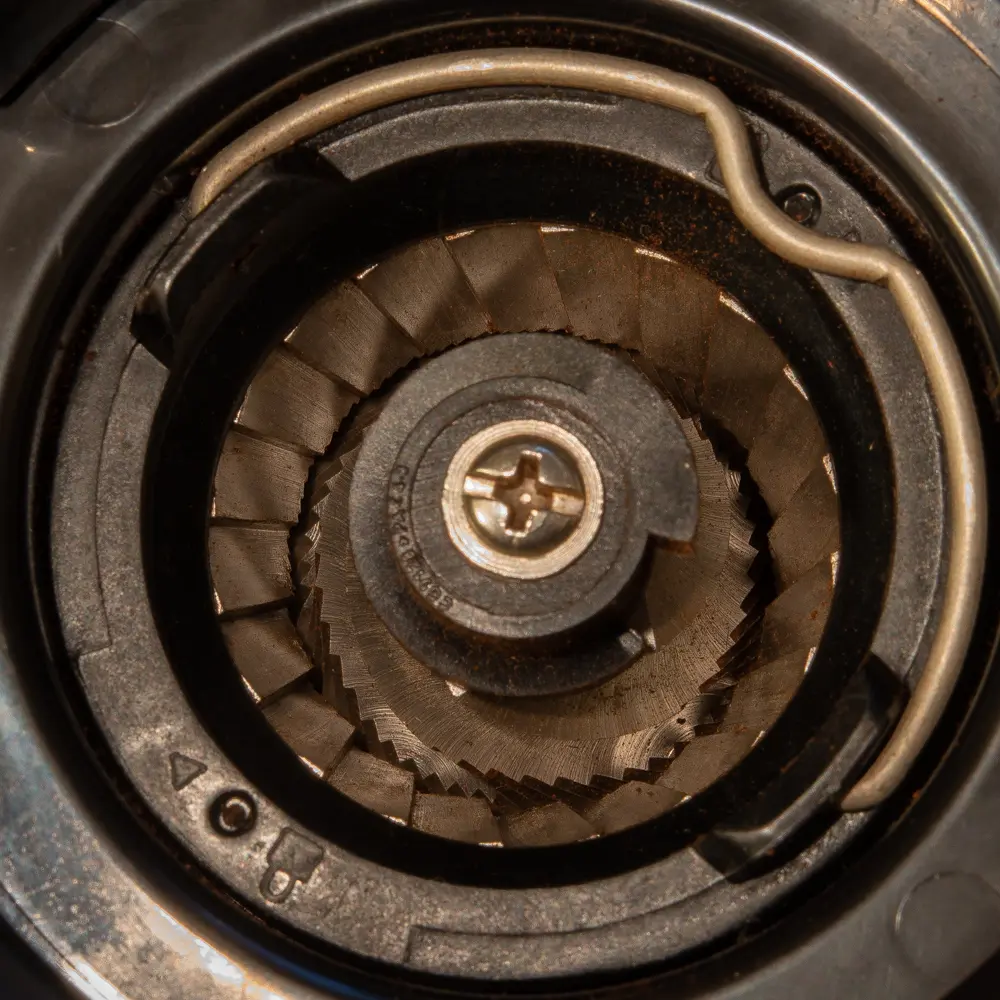
Almost all manual grinders work with a conical burr set. The differences lie in the material, the diameter, how the axle is supported and, above all, how finely the grind size can be adjusted. Electric models are covered in our guide to coffee grinders.
First fork in the road: espresso or filter?
For espresso, small steps matter. A grinder with 20 microns per click or stepless adjustment can be dialed in to the shot. Filter, French press or AeroPress get by with coarser steps.
The catch is that the specifications are hard to compare. Manufacturers give either microns per click or clicks per rotation, and the two only line up if you know the thread pitch. If the micron figure is missing, the recommended espresso settings reveal a lot.
Second fork: material and capacity
Almost all mid-range and premium grinders use stainless steel burrs. Ceramic is mostly found in inexpensive models. It does not rust, but it can break if dropped.
15 to 25 grams is enough for one large cup. A pot for two needs 30 to 40 grams, otherwise you grind twice.
Third fork: at home or on the road?
A dial under the burrs has to be taken out to adjust it. A scale on the outside of the body saves time if you often switch between espresso and filter. When traveling and camping, on the other hand, every gram counts, and a folding handle keeps the crank from breaking off in your bag.
Seven manual grinders and their key specs
| Model | Burrs | Steps as stated | Beans | Who it is for |
|---|---|---|---|---|
| 1Zpresso K-Ultra | Stainless steel, conical (heptagonal) | 20 µm per click, 100 clicks per rotation, external | 35–40 g | Espresso and filter |
| Comandante C40 MK4 Nitro Blade | Nitrogen steel, conical | about 30 µm per click (retailer figure) | 40 g | Filter, espresso with accessories |
| Kinu M47 Phoenix | Steel, 47 mm, coated | stepless | 35–40 g (retailer figures) | Espresso |
| Zassenhaus Expert 48S | Stainless steel, 48 mm, CNC-milled | 24 clicks per rotation | 34 g | Moka to French press, at home |
| Timemore Chestnut C3S Pro | Stainless steel, 38 mm (retailer figure) | about 83 µm per click (retailer figure) | 25 g | Filter, beginners |
| 1Zpresso Q2 S | Stainless steel, conical (heptagonal) | 30 clicks per rotation | 15–20 g | Travel, pour-over |
| Hario Mini Mill Slim Plus | Ceramic, conical | not stated | 24 g | Small budget, backpack |
1Zpresso K-Ultra
According to the manufacturer, the K-Ultra is designed for every brewing method. The steps back that up: 20 microns per click, 100 clicks per rotation, read off a numbered scale on the outside. According to the product listing, the magnetic catch cup holds 35 to 40 grams. At just under 700 grams, it is more of a kitchen grinder than a backpack grinder. Price-wise: premium class.
Comandante C40 MK4 Nitro Blade
The Comandante from Germany has been considered the benchmark among manual grinders for years. According to the manufacturer, the burrs are made of a high-alloy, nitrogen-rich stainless steel. Both included jars hold 40 grams. Retailers state about 30 microns per click; for espresso, Comandante offers the Red Clix axle, which according to retailers roughly halves the step size. That costs extra. Without Red Clix, it remains primarily a filter grinder.
Kinu M47 Phoenix
The Phoenix belongs to Kinu’s M47 series. Retailers describe a 47-millimeter cone made of coated steel and stepless adjustment with a fine thread. Retailers state a graduation of 0.01 millimeters per mark. For coarse grind sizes, you turn for a correspondingly long time. If you drink almost nothing but espresso, you get a lot of grinder for the money here.
Zassenhaus Expert 48S
Zassenhaus is known for wooden grinders with a drawer. The Expert 48S is built differently: a 48-millimeter conical burr set made of CNC-milled stainless steel, 24 clicks per rotation, a 34-gram bean hopper. Zassenhaus lists moka, espresso machines, French press and filter as its uses. At 0.98 kilograms, it stays at home.
Timemore Chestnut C3S Pro
Many people get into pour-over with the C3S Pro. Retailers describe a 38-millimeter steel burr set, an all-metal body, a folding handle and a 25-gram capacity. At about 83 microns per click, the steps are coarse. That is fine for filter. For espresso, only to a limited extent. If you are looking for a solid entry-level grinder to go with your pour-over dripper (in German), this is the right place.
1Zpresso Q2 S
The Q series is 1Zpresso’s travel grinder. According to the manufacturer, the Q2 S weighs 465 grams, has an aluminum body and a folding handle, and grinds 15 to 20 grams. The manufacturer does not mention espresso for this series. A cup of filter coffee in a hotel room or by the tent is well within its reach.
Hario Mini Mill Slim Plus
The slim Hario is the classic at the lower end of the price range. According to Hario, the inner and outer cones are made of ceramic, and the bean chamber holds 24 grams. It is adjusted via a nut under the burrs; there is no scale. For the occasional filter coffee on the road, that is enough. If you grind every day or need a fine grind for espresso, it will not keep you happy for long.
Where the forks lead
- Switching between espresso and filter: 1Zpresso K-Ultra, because of its fine steps that you can read on the outside.
- Almost only espresso: Kinu M47 Phoenix with stepless adjustment, or the Zassenhaus Expert 48S if you prefer to think in clicks.
- Almost only filter, for the long term: Comandante C40 MK4. Add the Red Clix axle later for espresso.
- Getting into pour-over: Timemore Chestnut C3S Pro.
- Travel and camping: 1Zpresso Q2 S; on a very tight budget, the Hario Mini Mill Slim Plus.
- Stovetop brewer: For moka from a stovetop espresso maker (in German), medium-fine steps are enough. A premium espresso grinder is not worth the extra cost here.
One rule of thumb to finish: if you only drink filter today but are toying with the idea of an espresso machine, buy the grinder for where you want to end up. Buying a second grinder later costs more than the extra money now.
Frequently asked questions
Which manual grinder is suitable for espresso?
For espresso, small steps matter: 20 microns per click or stepless adjustment. The 1Zpresso K-Ultra offers the fine steps, the Kinu M47 Phoenix stepless adjustment. The Zassenhaus Expert 48S lists moka and espresso machines among its uses, if you prefer to think in clicks.
Ceramic or stainless steel burrs?
Almost all mid-range and premium grinders use stainless steel burrs. Ceramic is mostly found in inexpensive models such as the Hario Mini Mill Slim Plus. It does not rust, but it can break if dropped.
How many beans should a manual grinder hold?
For one large cup, 15 to 25 grams is enough. A pot for two needs 30 to 40 grams, otherwise you grind twice. The 1Zpresso K-Ultra holds 35 to 40 grams, the Comandante C40 40 grams, and the Hario 24 grams.
Is the Comandante C40 also good for espresso?
Without accessories, it remains primarily a filter grinder; retailers state about 30 microns per click. For espresso, Comandante offers the Red Clix axle, which according to retailers roughly halves the step size. It costs extra and can be added later.
Which manual grinder suits travel and camping?
On the road, every gram counts, and a folding handle keeps the crank from breaking off. According to the manufacturer, the 1Zpresso Q2 S weighs 465 grams and grinds 15 to 20 grams, enough for one cup of filter coffee. On a very tight budget, the Hario Mini Mill Slim Plus will do.
Why are grind size specifications hard to compare?
Manufacturers give either microns per click or clicks per rotation. The two only line up if you know the thread pitch. If the micron figure is missing, the recommended espresso settings reveal a lot about the step size.
Sources
- 1Zpresso: K-Ultra
- 1Zpresso: Q series (Q2 S, Q Air)
- Hario: Ceramic Coffee Mill Mini-Slim +
- Zassenhaus (Küchenprofi, German retailer): Expert 48S
- Galaxus (Swiss retailer): Comandante C40 MK4 (manufacturer description)
- Kaffeemacher: Comandante Red Clix
- Slow Pour Supply: Timemore Chestnut C series compared
- Eight Ounce Coffee: Kinu M47 Phoenix
Where to buy
- 1Zpresso K-UltraCheck price at Amazon.deCheck price at Amazon.co.ukCheck price at Amazon.nlCheck price at Amazon.com.beCheck price at Amazon.frCheck price at Amazon.itCheck price at Amazon.esCheck price at Amazon.plCheck price at Amazon.seAvailable in Germany: Amazon.de
- Comandante C40 MK4 Nitro BladeCheck price at Amazon.deCheck price at Amazon.co.ukCheck price at Amazon.nlCheck price at Amazon.com.beCheck price at Amazon.frCheck price at Amazon.itCheck price at Amazon.esCheck price at Amazon.plCheck price at Amazon.seAvailable in Germany: Amazon.de
- Kinu M47 PhoenixCheck price at Amazon.deCheck price at Amazon.co.ukCheck price at Amazon.nlCheck price at Amazon.com.beCheck price at Amazon.frCheck price at Amazon.itCheck price at Amazon.esCheck price at Amazon.plCheck price at Amazon.seAvailable in Germany: Amazon.de
- Zassenhaus Expert 48SCheck price at Amazon.deCheck price at Amazon.co.ukCheck price at Amazon.nlCheck price at Amazon.com.beCheck price at Amazon.frCheck price at Amazon.itCheck price at Amazon.esCheck price at Amazon.plCheck price at Amazon.seAvailable in Germany: Amazon.de
- Timemore Chestnut C3S ProCheck price at Amazon.deCheck price at Amazon.co.ukCheck price at Amazon.nlCheck price at Amazon.com.beCheck price at Amazon.frCheck price at Amazon.itCheck price at Amazon.esCheck price at Amazon.plCheck price at Amazon.seAvailable in Germany: Amazon.de
- Hario Mini Mill Slim PlusCheck price at Amazon.deCheck price at Amazon.co.ukCheck price at Amazon.nlCheck price at Amazon.com.beCheck price at Amazon.frCheck price at Amazon.itCheck price at Amazon.esCheck price at Amazon.plCheck price at Amazon.seAvailable in Germany: Amazon.de