Contents13 sections
This guide was first published in German on handgetestet.de.
It is rarely the helmet itself. The wrong size, however, often is. Touring riders are usually best served by a full-face helmet with a built-in sun visor and ECE 22.06 approval; if you wear glasses or stop at gas stations often, go for a modular helmet with P/J approval. The brand comes only after that, because a Shoei that pinches helps less than an HJC that fits.
Full-face, modular or open-face: Which type suits me?
That depends on how you ride. The full-face helmet encloses the head completely and, according to the German automobile club ADAC, has the largest market share. The modular helmet protects like a full-face helmet, but only with the chin bar closed. The open-face helmet leaves the face exposed and is worn mainly on scooters and classic bikes.
How do I find the right size?
Measure your head circumference across the forehead, over the ears and around the back of the head. The number of centimeters is a starting value, nothing more, because every manufacturer cuts differently. One detail helps when comparing: a helmet with three outer shells is more compact on small heads than one that covers all sizes with thicker padding alone.
For the fitting, the ADAC recommends wearing the helmet in the store for at least ten minutes. It should fit snugly all around, rest on the crown of your head and move the skin of your forehead along with it when you turn it. With the chin strap fastened, it must not be possible to pull it off forward, even with force. If in doubt, try the smaller size, because the lining gives a little over time.
Sun visor, visor, weight: What counts in everyday riding?
An internal sun visor is more convenient in everyday riding than sunglasses under the helmet, which is also the ADAC’s advice. Tinted visors are only permitted in daylight. Against fogging, a Pinlock insert or a double visor helps more than any spray in the fall. And weight? You will hardly notice 100 grams on a short ride. After six hours on the highway, your neck certainly will. Manufacturer figures usually apply to a specific size and are therefore only roughly comparable.
ECE 22.06, labels and replacement: what is established
According to the ADAC, helmets have been tested under UN Regulation ECE 22.06 since June 2022, and since June 2023 no helmets may be produced to the older 22.05 version. New tests cover, among other things, the scratch resistance, optical quality and field of view of the visor. An existing 22.05 helmet may still be worn; when buying new, it should meet the current standard.
You can recognize the approval by the label on the chin strap or in the lining: an E in a circle and an approval number beginning with 06. On modular helmets, the suffix P/J shows that the helmet is also approved as an open-face helmet with the chin bar open. In Germany, Section 21a of the German Road Traffic Regulations (StVO) requires a „suitable protective helmet“; according to the ADAC, an ECE label is not explicitly required there, but it is checked in other European countries.
After a fall or accident, the helmet should be replaced, even if nothing is visible on the outside. The ADAC and the German Road Safety Council (DVR) explain this by the foam padding, which is permanently deformed on impact. Without a fall, the DVR cites five to seven years as the replacement interval, while the ADAC considers about five years appropriate with regular use. A used helmet of unknown origin is therefore no way to save money.
Which helmets are worth considering?
| Model | Type | Key data according to the manufacturer | Best for |
|---|---|---|---|
| Shark Spartan GT Pro Carbon | Full-face | ECE 22.06, internal sun visor, Pinlock-ready, around 1,465 g (smallest shell) | Touring and country roads, riders who pay attention to weight |
| Arai Quantic | Full-face | ECE R22-06, no internal sun visor, Pinlock included, sizes XS to XL | Sporty riders who can do without a sun visor |
| HJC i71 | Full-face | ECE 22.06, polycarbonate, three shells for six sizes, ready for Smart HJC | Beginners and commuters on a smaller budget |
| Schuberth C5 | Modular | ECE 22.06 with P/J, sun visor, ready for SC2, sizes 51 to 65 | High-mileage riders, glasses wearers, long tours |
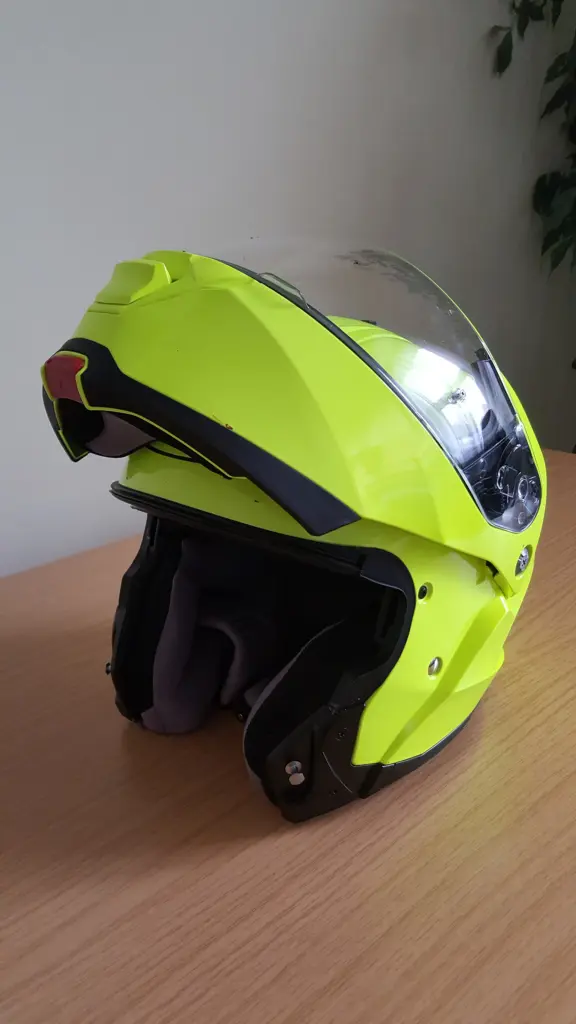
| Nolan N120-1 | Modular | ECE 22.06 with P/J, chin bar rotates 180 degrees to the back, sun visor, Pinlock included, around 1,670 g | Riders who often ride open, city and touring |
Shark Spartan GT Pro Carbon
A shell with carbon content, an internal sun visor and a Pinlock-ready visor of optical class 1. The stated weight of around 1,465 grams applies to the smallest shell. In terms of price, the Shark belongs in the upper mid-range, well below Arai and Schuberth. Touring riders looking for a full-face helmet with a sun visor get a sensible compromise here.
Arai Quantic
Arai deliberately does without a built-in sun visor on the Quantic. A dark visor and the Pro-Shade system are available as accessories. In return, the data sheet lists 13 ventilation openings, an included Pinlock insert and emergency removal of the cheek pads, but no weight. In changing light, you will quickly miss the sun visor.
Sporty riders who know the Arai fit get a very well thought-out helmet in the Premium class.
HJC i71
Polycarbonate shell, six sizes spread across three shells. That is not a given in this price range. The helmet is ready for HJC’s own intercom systems. Buyers‘ experiences with the fit vary. So trying it on counts double here. Whether all versions have an internal sun visor is best clarified directly with the retailer.
Schuberth C5
Schuberth calls the C5 its first helmet with dual approval to ECE 22.06 and P/J. It is ready for the SC2 communication system and available in eight sizes from 51 to 65. Schuberth states a noise level of 85 dB(A) at 100 km/h on an unfaired motorcycle, a manufacturer figure measured under its own conditions.
It remains expensive. If you only ride on weekends, you pay a lot here for comfort you will rarely make full use of.
Nolan N120-1
On the N120-1, the chin bar does not just flip up; it rotates 180 degrees to the back onto the shell. This turns it into an open-face helmet without a protruding bar, approved to P/J. A sun visor and Pinlock are included, and it is ready for N-Com. Nolan states around 1,670 grams. That makes it no lightweight, but it is priced well below the Schuberth.
Isn’t an open-face helmet enough?
On a scooter and at city speeds, an open-face helmet such as the Shoei J-Cruise 3 (1,400 grams according to the manufacturer, ECE 22.06, sun visor) is comfortable. It does not protect the chin and face. If you also ride on country roads, a P/J modular helmet is the better choice, because it can do both. The same applies to Shoei’s GT-Air 3 full-face helmet, for which Shoei states around 1,700 grams, three shell sizes and a sun visor; because of their particular fit, you should try on both Shoei models at a specialist dealer.
So which helmet is it?
For touring and country roads with a full-face helmet and sun visor, we name the Shark Spartan GT Pro Carbon. For a first helmet on a tight budget, the HJC i71 is an option, but only after a thorough fitting. Glasses wearers and high-mileage riders should go for the Schuberth C5 if the budget allows, otherwise the Nolan N120-1. With its P/J approval, we would also recommend the Nolan to anyone who often rides open in the city, rather than a pure open-face helmet. Sporty riders who don’t need a sun visor end up with the Arai Quantic.
Storing your old helmet over the winter? You will find useful tips under winterizing your motorcycle (in German). And if you want to film your rides, read the article on the action cam for motorcycling and travel before buying a chin mount.
Frequently asked questions
Which helmet type suits which riding style?
The full-face helmet encloses the head completely and, according to the German automobile club ADAC, has the largest market share. The modular helmet protects like a full-face helmet, but only with the chin bar closed. The open-face helmet leaves the face exposed and is worn mainly on scooters and classic bikes; it does not protect the chin and face.
How do I find the right helmet size?
Measure your head circumference across the forehead, over the ears and around the back of the head, but treat the figure only as a starting point. The ADAC recommends wearing the helmet in the store for at least ten minutes. It should fit snugly, rest on the crown of your head and, with the chin strap fastened, should not be able to be pulled off forward. If in doubt, try the smaller size.
How do I recognize the ECE 22.06 standard?
By the label on the chin strap or in the lining: an E in a circle and an approval number beginning with 06. On modular helmets, the suffix P/J shows that the helmet is also approved as an open-face helmet when open. Since June 2023, no helmets may be produced to the older 22.05 version.
May I keep wearing my old 22.05 helmet?
Yes, according to the ADAC, an existing 22.05 helmet may still be worn. When buying new, it should meet the current standard. In Germany, Section 21a of the German Road Traffic Regulations (StVO) requires a suitable protective helmet; an ECE label is not explicitly required there, but it is checked in other European countries.
When does a motorcycle helmet need to be replaced?
After every fall or accident, even if nothing is visible on the outside, because the foam padding is permanently deformed on impact. Without a fall, the German Road Safety Council (DVR) cites five to seven years, while the ADAC considers about five years appropriate with regular use. A used helmet of unknown origin is therefore no way to save money.
What helps against a fogged-up visor?
In the fall, a Pinlock insert or a double visor helps more than any spray. An internal sun visor is more convenient in everyday riding than sunglasses under the helmet, and tinted visors are only permitted in daylight. The Arai Quantic has no built-in sun visor, but a Pinlock insert is included.
Sources
- ADAC: Motorcycle helmets, buying, care and visors
- DVR: Motorcycle gear
- Shark: Spartan GT Pro Carbon
- Arai: Quantic data sheet
- HJC: i71
- Schuberth: C5
- Nolan: N120-1
- Shoei: GT-Air 3
- Shoei: J-Cruise 3
Where to buy
- Shark Spartan GT Pro Carbon (Carbon Skin, M)Check price at Amazon.deAvailable in Germany: Amazon.de
- HJC i71Check price at Amazon.deAvailable in Germany: Amazon.de
- Schuberth C5Check price at Amazon.deAvailable in Germany: Amazon.de
- Nolan N120-1 Classico N-Com (Größe wählbar)Check price at Amazon.deAvailable in Germany: Amazon.de
- Arai QuanticCheck price at Amazon.deAvailable in Germany: Amazon.de