Contents12 sections
This guide was first published in German on handgetestet.de.
A bridge with 3.20 m of clearance, a motorhome that is 3.10 m tall, plus a roof box that nobody entered into the GPS. That is exactly how the stories you hear at motorhome stopovers come about. A motorhome GPS calculates routes using your vehicle’s height, width, length and weight and avoids roads that are not suitable for it. For most motorhomes, we consider the Garmin Camper 895 the most well-rounded choice; if you want to save money, go for the second-generation TomTom GO Camper Tour.
Whether you need a dedicated GPS alongside your phone at all, and how car, truck and camper devices fundamentally differ, is covered in our guide to car GPS navigators (in German). This article sticks to motorhomes and caravans on the hitch.
What can a camper GPS do that a phone cannot?
At its core, it is the vehicle profile. Garmin describes it in the manual for the Camper 895 and 1095 as follows: when a motorhome or caravan profile is active, the device avoids roads that do not suit the dimensions and weight. Besides the motorhome, the manual for the Camper 795 also covers the combination of car and caravan, the motorhome with a trailer and even the boat trailer. For the GO Camper Tour, TomTom advertises that it avoids roads, bridges and tunnels that are unsuitable for your vehicle’s dimensions.
On top of that come directories of motorhome stopovers and campsites. According to its manual, Garmin lets you search by providers such as ACSI and Campercontact and filter by amenities, such as electricity or waste disposal. TomTom lists preinstalled camper destinations from ACSI, ADAC and ANWB, among others.
One warning you should take seriously. Garmin itself states that the profile data cannot be taken into account on every route, because map data has gaps. Traffic signs always take precedence over the screen. The GPS is a second opinion, not a free pass.
Which figures belong in the profile?
The right ones. It sounds trivial, but it is the most common weak point. Measure the height with everything that sits on the roof: air conditioner, satellite dish, solar panels, roof box. For weight, what counts for route planning is the gross vehicle weight rating from the vehicle documents, not the curb weight from the brochure.
Two limits from German law help put this in context. Under Section 6 of the German Driving License Regulations (Fahrerlaubnis-Verordnung), license class B covers vehicles up to 3,500 kg gross vehicle weight; above that, class C1 begins. Many motorhomes sit just at this mark, and heavier models are shut out sooner on routes with weight restrictions. Section 32 of the German Road Vehicle Registration and Licensing Regulations (StVZO) limits the height of motor vehicles to 4.00 m and the width generally to 2.55 m. These values are the legal maximum, not a guarantee that you will fit through.
And the low-emission zones?
All five devices in our selection can route around low-emission zones or warn you before entering them; Garmin’s manuals and TomTom’s product pages confirm this. In Germany, whether your vehicle is allowed in depends on the emissions sticker under the German 35th Federal Immission Control Ordinance (35. BImSchV). According to the German Environment Agency (Umweltbundesamt), the sticker is determined by the emission key number in the vehicle documents. Older diesel motorhomes with a yellow sticker benefit most from this function. Other countries have their own systems with their own vignettes; there, you should check the rules of your destination country in advance.
Five motorhome GPS navigators compared
| Model | Display | Maps and traffic | Best for |
|---|---|---|---|
| Garmin Camper 795 | 17.7 cm, 1024 × 600, battery up to 1 hr | Europe, traffic via Garmin Drive app | Car with caravan, small camper van |
| Garmin Camper 895 | 20.3 cm, 1280 × 800, battery up to 2 hrs | Europe, traffic via app, satellite imagery | semi-integrated and fully integrated motorhomes |
| Garmin Camper 1095 | 25.7 cm, 1280 × 800, battery up to 2 hrs | same as Camper 895 | large cockpits, weaker eyesight |
| TomTom GO Camper Max | 7 inches, 1024 × 600 | World map, traffic via smartphone | long-distance travel, voice control |
| TomTom GO Camper Tour 2 | 6 inches, 1280 × 720 | Europe (46 countries), traffic via smartphone | tight budget, Europe is enough |
Display sizes and resolutions according to manufacturer specifications. The price range extends from the lower mid-range (GO Camper Tour) up to the top end of navigation devices (Camper 1095).
Garmin Camper 795
The smallest Garmin has a 6.95-inch display with 1024 × 600 pixels and, according to the manufacturer, weighs just under 240 g. It can display BC 50 and BC 40 backup cameras, and traffic data comes from the phone via the Garmin Drive app. It is held in place by a suction cup. If you tow a caravan with a car, you rarely need more. In an over-cab motorhome with a low-set windshield, however, the screen looks small.
Garmin Camper 895
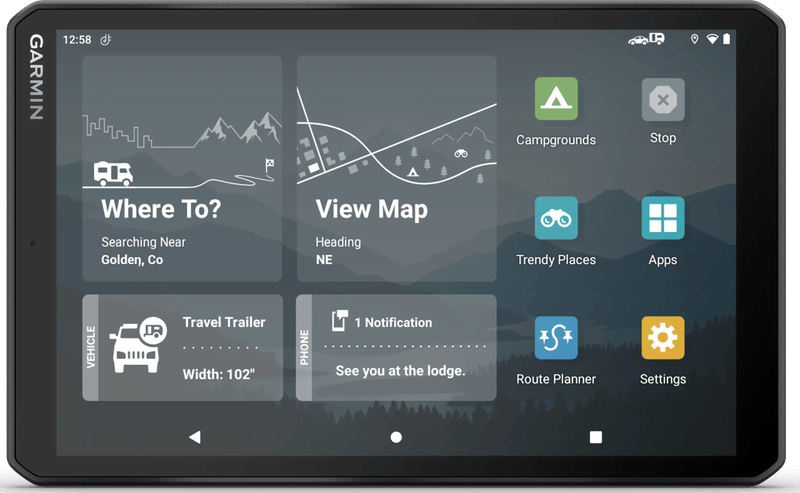
Eight inches, 1280 × 800 pixels, a magnetic mount with power supply. That means you can take the device off without fiddling with the cable and simply take it with you at the campsite. According to Garmin, a screw mount and a ball adapter with an AMPS plate are also included, which in a motorhome with a wide dashboard is often a cleaner solution than a suction cup on a distant windshield. Then there is BirdsEye satellite imagery, which genuinely helps when approaching an unfamiliar pitch. For semi-integrated and fully integrated motorhomes, we consider it the most balanced device.
Garmin Camper 1095
Technically the sibling of the 895, just with 10.1 inches and 554 g. The housing measures 24.5 × 15.4 cm. In a fully integrated motorhome with a large cockpit, that works. In a camper van, a slab like this quickly blocks part of the view ahead, and the extra cost compared with the 895 is noticeable. We would only choose it if small print is a real problem.
TomTom GO Camper Max
The second generation has a 7-inch display with 1024 × 600 pixels, 32 GB of storage and a world map. Voice control is on board, and map updates arrive monthly via Wi-Fi. Like all the devices here, it gets traffic information via the smartphone. The Premium Pack version adds a dual charger, adhesive mounting plates and a leather case and extends the trial period for the additional services from one to two years. For trips to Scandinavia, the Europe map is enough. The world map only becomes interesting if the vehicle is shipped overseas.
TomTom GO Camper Tour 2
Six inches, but at 1280 × 720 pixels a sharper resolution than the Max. The mount is permanently integrated and can be flipped. According to TomTom, there is no voice control, and the map covers 46 European countries. The manufacturer promises security updates until at least March 1, 2027. For occasional drivers with a rental motorhome or a small camper, this is the sensible entry point.
What about the speed camera warning?
TomTom offers warnings about radar cameras as a trial, and Garmin shows alerts for red-light and speed cameras. In Germany, Section 23 (1c) of the German Road Traffic Regulations (StVO) prohibits using such functions while driving. The device itself is legal, but the function must stay switched off. TomTom itself points out on its product page that the function is prohibited in some countries.
How we would decide
- Semi-integrated or fully integrated motorhome, regularly on the road: Garmin Camper 895. Large, sharp screen, powered magnetic mount, campsite search with filters.
- Car with caravan: Garmin Camper 795. It has the car-and-caravan profile too, and in a car you rarely need a bigger display.
- First GPS, rental motorhome or tight budget: TomTom GO Camper Tour 2.
- Trips outside Europe, or if you want voice control with TomTom: GO Camper Max.
- Large cockpit and trouble with small print: Garmin Camper 1095.
One last tip. A wireless backup camera can be paired with all three Garmin devices; which models are available is covered in our backup camera guide. Everything else that belongs on board, from leveling ramps to CEE cables, is collected in our article on motorhome accessories.
How useful a community-based warning device is in everyday driving is shown in our review of the OOONO Co-Driver NO2; in Germany, speed camera warnings while driving are prohibited.
Frequently asked questions
What can a camper GPS do that a phone cannot?
At its core, the vehicle profile: the device avoids roads, bridges and tunnels that do not suit your dimensions and weight. On top of that come directories of motorhome stopovers and campsites, for example from ACSI and Campercontact. Garmin itself states that map data has gaps. Traffic signs always take precedence over the screen.
Which values belong in the vehicle profile?
Measure the height with everything on the roof: air conditioner, satellite dish, solar panels, roof box. For weight, what counts is the gross vehicle weight rating from the vehicle documents, not the curb weight from the brochure. Incorrect figures in the profile are the most common weak point.
Which GPS suits a car towing a caravan?
The Garmin Camper 795. Its manual covers the car-and-caravan combination as well as a motorhome with a trailer. The 6.95-inch display is usually enough in a car, and traffic data comes from the phone via the Garmin Drive app. In an over-cab motorhome with a low-set windshield, however, the screen looks small.
Am I allowed to use the speed camera warning in a motorhome GPS?
In Germany, not while driving. Section 23 (1c) of the German Road Traffic Regulations (StVO) prohibits using such functions. The device itself is legal, but the function must stay switched off. TomTom offers radar warnings as a trial, and Garmin shows alerts for cameras, so switch them off on both.
Do I need a motorhome GPS with a world map?
Usually not, and certainly not for trips to Scandinavia. The world map of the TomTom GO Camper Max only becomes interesting if the vehicle is shipped overseas. The GO Camper Tour 2 covers 46 countries on the continent and is the sensible entry-level choice for occasional drivers.
Sources
- Garmin: Camper 795, 895, 1095, technical specifications and package contents
- Garmin: Camper 795 owner’s manual (PDF)
- Garmin: Camper 895 and 1095 owner’s manual (PDF)
- TomTom: GO Camper Max, technical specifications and comparison
- TomTom: GO Camper Tour, technical specifications
- German Driving License Regulations (FeV), Section 6
- German StVZO, Section 32
- German StVO, Section 23
- German Environment Agency: Low-emission zones in Germany
Where to buy
- Garmin Camper 895View at CoolblueAvailable in Germany: CoolblueCheck price at Amazon.deAvailable in Germany: Amazon.de
- TomTom GO Camper Tour 2View at CoolblueAvailable in Germany: Coolblue
- Garmin Camper 795View at CoolblueAvailable in Germany: Coolblue
- Garmin Camper 1095View at CoolblueAvailable in Germany: Coolblue
- TomTom GO Camper MaxView at CoolblueAvailable in Germany: Coolblue
- TomTom GO Camper Max Premium PackView at CoolblueAvailable in Germany: Coolblue