Contents14 sections
This guide was first published in German on handgetestet.de.
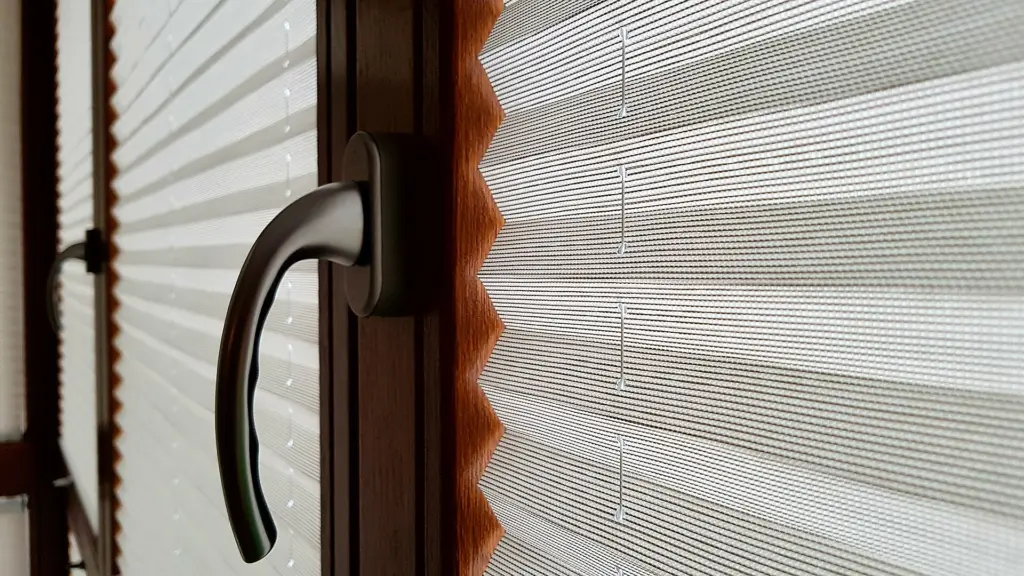
A new rental apartment, a bedroom facing east, and at half past five the sun is in the room. For a tilt-and-turn sash with a rubber seal, a tensioned clamp-fit pleated blind such as the Gardinia EASYFIX with two operating rails is the most straightforward answer, and for the bedroom in the thermal version with an aluminum-coated back. No drill hole, no wall plug in the plastic frame. When you move out, you simply unscrew the brackets.
Whether that works, however, is not decided by the fabric. It is decided by the window frame, and you should take a look at it with a folding ruler before you order.
Will a clamp bracket even fit my window?
Clamp brackets sit on the window sash, not in the window reveal. Liedeco describes the principle like this: slide the bracket onto the sash, tighten it with a screwdriver, hang the blind. Each bracket is built for a specific range of frame or rebate thickness. Gardinia states roughly 4 to 22 mm for the EASYFIX brackets and roughly 5 to 25 mm for the separate Concept clamp brackets. Lichtblick specifies 5 to 24 mm for its Klemmfix pleated blind, and the instructions for the Liedeco Klemmfix roller blind roughly 16 to 25 mm.
One sentence from Gardinia deserves special attention: according to the manufacturer, the Concept clamp brackets are only suitable for windows with a rubber seal. That rules out older wooden windows without a seal running all the way around. There, the options are an adhesive bracket or classic screw mounting in the glazing bead.
If you order made to measure, you need to measure more precisely. For clamp mounting, Lichtblick recommends measuring the width at the top, middle and bottom inside the glazing beads including the rubber seal, taking the smallest measurement and, with a straight rebate, subtracting 4 mm. The full sash height is measured. The rebate depth from the pane to the outer edge of the frame must be at least 15 mm, or 17 mm for cellular blinds.
Tensioned or free-hanging?
Tensioned. With this design, thin tension cords run down the sides from top to bottom, and the blind stays in place even when the window is tilted open. Gardinia and Liedeco cite exactly that as the reason for tensioning. A free-hanging pleated blind swings into the room when the sash is tilted. On a tilt-and-turn window, that quickly gets annoying.
Tensioned models have another practical advantage: the top and bottom rails can both be moved. That way you cover only the lower half and let light in at the top. A side-chain roller blind cannot do that.
How dark does it get with a thermal pleated blind?
The fabric itself lets little light through. Gardinia describes the EASYFIX Thermo pleated blind as opaque with an aluminum-coated back, and Liedeco calls its Thermo pleated blind room-darkening. Still, you should not expect total darkness. The blind runs inside the glazing beads, and with a straight rebate Lichtblick even has you subtract 4 mm from the measured width. A narrow strip of light therefore remains at the edges.
If you really need darkness for shift work or a nursery, combine the pleated blind with an opaque curtain in front of it. Which fabrics and hanging systems work for that is covered in our guide to curtains.
Does a cellular blind help with heating?
A cellular pleated blind consists of two layers of fabric. When you pull it open, they unfold into small air chambers, which Liedeco and Gardinia describe as an insulating layer in front of the glass. Gardinia puts it cautiously: in winter, the air layer could help reduce heat loss at the window. For its thermal products, Liedeco refers to a study by the Fraunhofer Institute for Building Physics commissioned by the Verband innenliegender Sicht- und Sonnenschutz, the German industry association for internal blinds and sun protection.
Our assessment remains sober. An industry study says little about what happens in your apartment with your windows, and the air layer can only work when the blind is closed. As a bonus on top of privacy and sun protection you need anyway, the cellular principle makes sense. If saving energy is the goal, you are better off starting with the heating controls, for example with smart radiator thermostats (in German).
Chain, cord or handle: what applies with children?
For internal sun protection, the European standard EN 13120 governs child safety. According to the information sheet of the Verband innenliegender Sicht- und Sonnenschutz, an operating loop with a breakaway system must release at a load of around 6 kg and may end no lower than 60 cm above the floor. Loops with a fixed tensioning device are secured to the wall at least 150 cm above the floor. The information sheet explicitly names tensioned products without an operating loop as an alternative.
This is exactly where pleated blinds and roller blinds differ. You operate the pleated blinds in this guide with handles on the rails, without a pull cord or chain. The Liedeco Klemmfix roller blind has a ball chain with overload protection that, according to the instructions, opens at about 6 kg. For a child’s room, we would still go for the pleated blind.
Six no-drill models side by side
| Model | Mounting (manufacturer specification) | Fabric and light | Best for |
|---|---|---|---|
| Gardinia EASYFIX pleated blind with 2 operating rails | 4 clamp brackets, approx. 4–22 mm, tensioned | Crushed fabric, privacy, lets light through | Living room, kitchen, rental apartment |
| Gardinia EASYFIX Thermo pleated blind | 4 clamp brackets, approx. 4–22 mm, tensioned | opaque, aluminum back | Bedroom with an east-facing window |
| Liedeco Klemmfix Thermo pleated blind, tensioned | 4 clamp brackets made of metal and plastic | Cellular fabric, room-darkening, thermal coating inside | Cellular fans, older buildings with cold windows |
| Lichtblick Klemmfix pleated blind (Nizza) | 4 clamp brackets, frame thickness 5–24 mm, tensioned | lets light through, largely opaque to view | Standard windows, color choice |
| Lichtblick Klemmfix pleated blind, made to measure | Clamp mounting, rebate depth from 15 mm (cellular 17 mm) | over 90 variants according to the manufacturer | Windows without standard dimensions |
| Liedeco Klemmfix roller blind (Thermo) | 2 clamp brackets, rebate approx. 16–25 mm | room-darkening with thermal back or light-filtering | if you want a roller blind instead of pleats |
Gardinia EASYFIX pleated blind with 2 operating rails
The basic model: crushed polyester fabric with 20 mm pleats, two aluminum rails with handles and four clamp brackets made of UV-resistant plastic. According to Gardinia, it can be shortened in width, which helps with odd window sizes. The manufacturer describes it as child-safe according to EN 13120.
Gardinia EASYFIX Thermo pleated blind
Same technology, different fabric. The back is aluminum-coated, and Gardinia speaks of blackout quality as well as protection against heat and cold. For a bedroom with morning sun, this is our first choice among the standard sizes.
Liedeco Klemmfix Thermo pleated blind, tensioned
A genuine cellular pleated blind with an internal thermal coating, made in Germany according to Liedeco. The top and bottom rails are made of white-painted metal, and you fold the handles out by 90 degrees before first use. The color choice is narrow: white, apple green and ecru.
Lichtblick Klemmfix pleated blind (Nizza)
Lichtblick supplies four clamp brackets with covers, two operating handles and spare tensioning feet. According to the manufacturer, the frame may be 5 to 24 mm thick. The fabric lets light through and is largely opaque to view, so it is more suited to living spaces than to the bedroom.
Lichtblick Klemmfix pleated blind, made to measure
If no standard size fits, for example on a balcony door or a narrow bathroom window, made to measure is the clean solution. According to its own information, Lichtblick manufactures in Germany, states a delivery time of about four to five working days and does not accept returns. So a measuring error remains your problem. Measure twice.
Liedeco Klemmfix roller blind (Thermo)
If you prefer smooth fabric to pleats, you get a side-chain roller blind with two clamp brackets here. The room-darkening version has a thermally coated back, and the ball chain can be mounted on the left or right. One drawback compared with the pleated blind: the roller blind only unrolls from the top.
Which model for which window?
- Plastic window with a seal in the living room: Gardinia EASYFIX with two operating rails or Lichtblick Klemmfix.
- Bedroom that gets light early: Gardinia EASYFIX Thermo, with a curtain in front if needed.
- Cellular principle wanted: Liedeco Thermo pleated blind, tensioned; check the rebate depth first.
- Unusual size: Lichtblick made to measure, with careful measuring.
- Wooden window without a rubber seal: do not use clamp brackets; better to stick or screw.
Frequently asked questions
Do clamp brackets fit every window?
No. Each bracket is built for a specific range of frame thickness, about 4 to 22 mm for Gardinia EASYFIX, for example, and 5 to 24 mm for Lichtblick. Gardinia states that its Concept clamp brackets are only suitable for windows with a rubber seal. For older wooden windows without a seal, adhesive brackets or screw mounting remain the options.
How do I measure for a made-to-measure pleated blind?
Lichtblick recommends measuring the width at the top, middle and bottom inside the glazing beads including the seal, taking the smallest measurement and, with a straight rebate, subtracting 4 mm. The full sash height is measured. The rebate depth must be at least 15 mm, or 17 mm for cellular blinds. Returns are not accepted.
Tensioned or free-hanging: which is better for a tilt window?
Tensioned. Side tension cords keep the blind in place even when the window is tilted open. A free-hanging pleated blind swings into the room. With tensioned models, the top and bottom rails can also both be moved, so you can cover just the lower half.
Will a thermal pleated blind make the room completely dark?
Not entirely. The fabric lets little light through; Gardinia describes the EASYFIX Thermo as opaque. But because the blind runs inside the glazing beads, a narrow strip of light remains at the edges. For shift work or a nursery, an opaque curtain in front of it helps.
Does a cellular blind save on heating costs?
Liedeco and Gardinia describe the air chambers as an insulating layer; Gardinia cautiously says they can reduce heat loss at the window. That can only work when the blind is closed. As a bonus on top of sun protection it makes sense, but if saving energy is the goal, you are better off starting with the heating controls.
Which pleated blind is child-safe?
The European standard EN 13120 governs child safety for internal blinds, and the information sheet of the industry association names tensioned products without an operating loop as an alternative to cords. You operate the pleated blinds in this guide with handles, without a pull cord or chain. Gardinia describes the EASYFIX as child-safe according to EN 13120.
Sources
- Gardinia: EASYFIX pleated blind with 2 operating rails
- Gardinia: EASYFIX Thermo pleated blind
- Gardinia: Concept Thermo cellular blind with clamp brackets
- Gardinia: Saving energy with roller blinds, pleated blinds or cellular blinds
- Liedeco: Klemmfix Thermo pleated blind, tensioned
- Liedeco: Klemmfix pleated blind, tensioned
- Liedeco: Klemmfix roller blind
- Liedeco: Klemmfix roller blind mounting instructions (PDF)
- Liedeco: LiedecoKlima, energy-saving sun protection
- Verband innenliegender Sicht- und Sonnenschutz: Child safety information sheet (PDF)
- Lichtblick: Nizza pleated blind with clamp brackets
- Lichtblick nach Maß: Measuring for a pleated blind
- Lichtblick nach Maß: Frequently asked questions
Where to buy
- Gardinia EASYFIX Plissee mit 2 BedienschienenCheck price at Amazon.deCheck price at Amazon.co.ukCheck price at Amazon.nlCheck price at Amazon.com.beCheck price at Amazon.frCheck price at Amazon.itCheck price at Amazon.esCheck price at Amazon.plCheck price at Amazon.seAvailable in Germany: Amazon.de
- Gardinia EASYFIX Thermo-PlisseeCheck price at Amazon.deCheck price at Amazon.co.ukCheck price at Amazon.nlCheck price at Amazon.com.beCheck price at Amazon.frCheck price at Amazon.itCheck price at Amazon.esCheck price at Amazon.plCheck price at Amazon.seAvailable in Germany: Amazon.de
- Liedeco Klemmfix Thermo-Plissee verspanntCheck price at Amazon.deCheck price at Amazon.co.ukCheck price at Amazon.nlCheck price at Amazon.com.beCheck price at Amazon.frCheck price at Amazon.itCheck price at Amazon.esCheck price at Amazon.plCheck price at Amazon.seAvailable in Germany: Amazon.de
- Lichtblick Plissee KlemmfixCheck price at Amazon.deCheck price at Amazon.co.ukCheck price at Amazon.nlCheck price at Amazon.com.beCheck price at Amazon.frCheck price at Amazon.itCheck price at Amazon.esCheck price at Amazon.plCheck price at Amazon.seAvailable in Germany: Amazon.de
- Lichtblick Plissee Klemmfix nach MaßCheck price at Amazon.deCheck price at Amazon.co.ukCheck price at Amazon.nlCheck price at Amazon.com.beCheck price at Amazon.frCheck price at Amazon.itCheck price at Amazon.esCheck price at Amazon.plCheck price at Amazon.seAvailable in Germany: Amazon.de
- Liedeco Klemmfix-Rollo ThermoCheck price at Amazon.deCheck price at Amazon.co.ukCheck price at Amazon.nlCheck price at Amazon.com.beCheck price at Amazon.frCheck price at Amazon.itCheck price at Amazon.esCheck price at Amazon.plCheck price at Amazon.seAvailable in Germany: Amazon.de