Contents14 sections
This guide was first published in German on handgetestet.de.
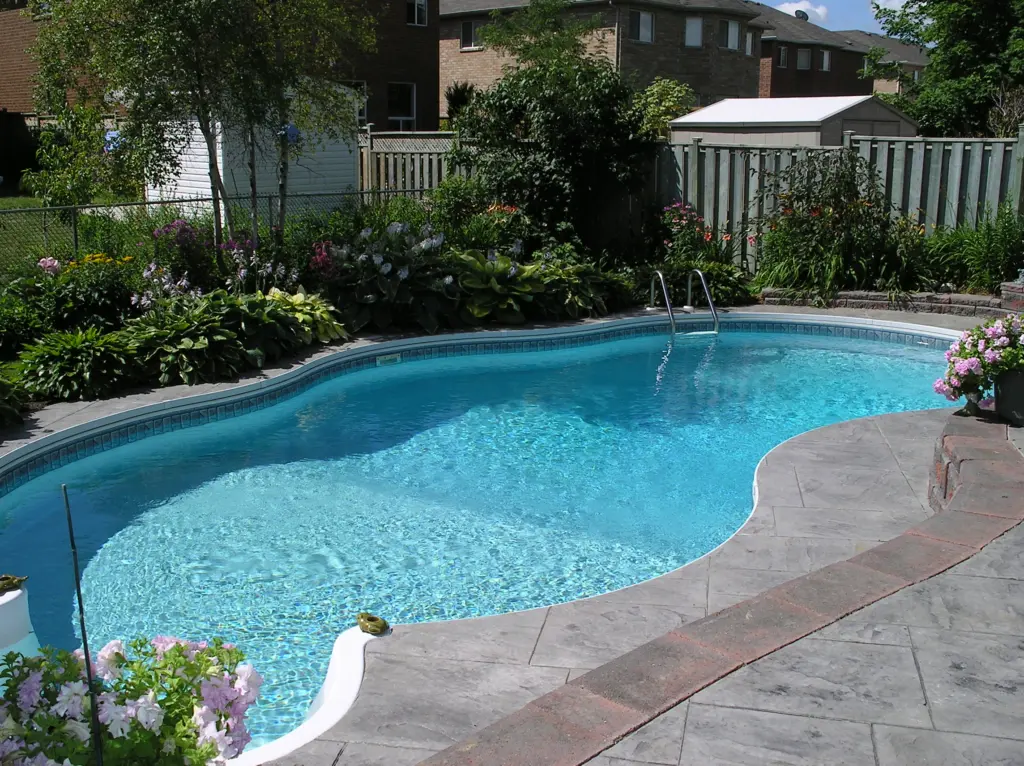
Rectangle or kidney? That question rarely decides the purchase of a pool robot. Things get difficult where the pool changes shape: at the entry steps, on the sun ledge, in tight curves and with the surface. For an in-ground pool up to 12 meters long, we consider the Dolphin E40i the sensible choice among the devices compared here: Maytronics lists rectangular, freeform and kidney shapes for it, it cleans the walls and waterline, and its cable is protected against twisting. If the pool has tiles or mosaic, we look at the Zodiac CNX 30 iQ first. Battery or cable, filter and runtime are covered in our general pool robot guide. Here, the focus is only on your pool.
Rectangle, kidney, freeform: what does the data sheet really say?
Maytronics lists the pool shape as a separate specification. For the E40i, the LIBERTY 400 and the large M600, the list is the same: rectangular, freeform, kidney-shaped. Oval and round are missing. That does not mean a Dolphin fails in an oval pool. But it is not confirmed either, so the question belongs with the retailer before you order.
Zodiac commits further and lists all swimming pool shapes for the CNX 30 iQ, albeit for private pools with straight walls. That qualifier matters. For its models with wall cleaning, Steinbach puts it even more clearly: the walls must be flat, smooth and vertical. So the floor plan alone says little; the wall is what decides.
Tight curves: when does a bend become a problem?
Ecovacs describes the cause in the troubleshooting table for the ULTRAMARINE P1. If the curve radius is too small or the corner too sharp, the drive tracks have too little contact with the wall, and the robot does not climb. The instructions do not state a minimum radius. Steinbach at least gives an order of magnitude for round pools: at around 3.50 meters in diameter, the curvature can cause a wide robot to no longer adhere properly.
With a freeform pool, measure the narrowest point, not the overall length. According to its data sheet, a Dolphin E40i is about 40 centimeters wide and 44 long, and the CNX 30 iQ measures 43 by 40. In a narrow bay, we expect manual work.
Steps and sun ledge: this is where automation ends
Plan on the steps being a job for the brush from the start. Ecovacs states openly that the P1 is not designed to clean steps. On sun ledges or steps less than 50 centimeters below the water surface, it can get stuck, and that applies to the upper steps of every entry staircase. Steinbach also expects limitations with built-in steps. Maytronics and Zodiac state the floor, walls and waterline as the cleaning area. There is no mention of steps, and none on Aiper’s page for the Scuba V3 either.
Then there is the minimum depth. The P1 requires 50 centimeters, and the Maytronics safety sheet for corded devices 40 centimeters. A shallower platform is outside what these devices are approved for. Floor drains are the next obstacle: according to Ecovacs, the P1 can get over them up to a height of about 5.5 centimeters; anything higher can leave it stuck.
Waterline: does your pool even have an edge?
According to the manufacturers, all five devices below clean the waterline. With an overflow pool, that does not help much, because Steinbach rules out such pools for its wall-cleaning robots: the water level has to be below the pool edge. With this type of pool, ask each manufacturer individually.
If a robot appears not to climb, that is not necessarily a defect. Zodiac writes that the CNX does not climb systematically and recommends watching it for about 20 minutes. If it really does slide off, Zodiac and Ecovacs point to the same culprit: algae that cannot be seen with the naked eye. A pH meter (in German) shows whether the water values are right.
Tile, liner, polyester: which robot handles which surface?
This is where the specifications differ most. Zodiac lists all floor types and surfaces for the CNX. For the LIBERTY 400, Maytronics lists liner, shotcrete and fiberglass; tiles do not appear in the list. For the E40i, the information is missing entirely, and the product sheet even describes the small E20 as unsuitable for GRP (fiberglass-reinforced plastic) and smooth surfaces. For the P1, Ecovacs speaks of fiberglass to gravel and, if there is too little grip on the wall, refers to additional climbing rings. Steinbach warns that wall cleaning may be limited with GRP, stainless steel or tiles.
Owners of liner pools should read Zodiac’s warnings. If there are wrinkles, pebbles, roots or damaged spots, the robot should not go into the pool at all until a professional has repaired the liner. Patterned liners can fade from the contact. Zodiac accepts no liability for such wear, the warranty does not cover it, and the same applies to scratches on stainless steel or polypropylene.
Does better navigation help in pools with lots of nooks?
Somewhat. According to Ecovacs, the P1 plans its paths using a position and motion sensor, and on the Scuba V3 Aiper combines image recognition and distance measurement to steer around obstacles. Maytronics advertises intelligent navigation but does not explain the technology. For its simple model, Steinbach concedes that purely mechanical bumping and reversing is less efficient in complex pool shapes. That sounds plausible. Ecovacs‘ 99 percent floor and wall coverage nevertheless remains a manufacturer figure with no information on how it was determined, and we are not aware of any independent measurement in freeform pools.
Five robots, sorted by pool
| Model | Pool shape according to the manufacturer | Surface according to the manufacturer | Power, weight | Limit |
|---|---|---|---|---|
| Dolphin E40i | rectangular, freeform, kidney, up to 12 m | not specified | Cable 17 m, 7.9 kg | Check surface with the retailer |
| Zodiac CNX 30 iQ | all shapes, straight walls, up to 12 × 6 m | all floors and surfaces | Cable 18 m, tracks, 8 kg | permanently installed pools only |
| Dolphin LIBERTY 400 | rectangular, freeform, kidney, up to 10 m | Liner, shotcrete, fiberglass | Battery, 8.1 kg | Tiles not listed |
| Aiper Scuba V3 | not specified | not specified | Battery, 8.2 kg | Ask about suitability first |
| ULTRAMARINE P1 | various shapes, up to 180 m² floor | fiberglass to gravel | Battery, tracks, weight not stated | no steps, from 50 cm depth |
Dolphin E40i
A well-balanced device for the classic in-ground pool. The floor, walls and waterline are covered, an app and weekly timer are included, and the swivel on the 17-meter cable is designed to prevent twisting. Maytronics gives a 3-year warranty. Its weakness is the missing information on the surface. According to the safety sheet, the power supply has to be at least 3 meters from the edge of the pool, so plan for the power outlet as well.
Zodiac CNX 30 iQ
On paper, it has the broadest approval, which is why we look at it first for tile and mosaic. Tracks, a 4-liter filter basket, filtration down to 60 micrometers. The instructions only permit it in permanently installed pools and show the control box at least 3.5 meters from the pool. An above-ground pool that you take down is therefore ruled out.
Dolphin LIBERTY 400
No cable at the pool edge. In return, it tops out at 10 meters, and at 8.1 kilos it is no lightweight. For liner, shotcrete and fiberglass, it has the clearest specification among the battery-powered devices here.
Aiper Scuba V3
Technically interesting for pools with built-in features, because according to Aiper it detects obstacles optically and comes to the waterline to be lifted out. At 8.2 kilos, it is on a par with the others. However, the product page says nothing about pool shapes, surfaces or steps. For our question, it therefore remains a device with open points.
ULTRAMARINE P1
Ecovacs openly states the limits in the instructions, and they are narrow: no steps, a minimum depth of 50 centimeters, no operation while the pool filter is running. So plan a time slot alongside the sand filter system. The specifications do not quite match: the shop states 5,200 mAh and IP68, the instructions 4,600 mAh and IPX8, and no weight is given. In a large, deep pool without a sun ledge, it is an option. For pools with lots of nooks and shallow zones, we would rather advise against it.
How we would decide by pool
- Rectangle, kidney or freeform with a liner, in-ground, up to 12 meters: Dolphin E40i, have the surface confirmed beforehand.
- Tiles, mosaic or an oval in-ground pool: Zodiac CNX 30 iQ.
- Liner, shotcrete or fiberglass without a cable, 10 meters at most: Dolphin LIBERTY 400.
- Many built-in features and an interest in camera technology: Aiper Scuba V3 after checking with the manufacturer.
- Large pool that is deep throughout, without a sun ledge: ULTRAMARINE P1.
- Overflow channel: the manufacturer’s approval first, then the order.
In each of these cases, you will still be brushing the steps yourself. If the pool itself is still to be chosen, our guide to the above-ground pool helps with the type of construction.
Frequently asked questions
Which pool robot suits a freeform pool?
For the E40i and LIBERTY 400, Maytronics lists rectangular, freeform and kidney-shaped; oval and round are missing from the list. Zodiac lists all shapes for the CNX 30 iQ, but only with straight walls. With a freeform pool, measure the narrowest point, not the overall length.
Does a pool robot also clean the steps?
You should not count on it. Ecovacs writes that the P1 is not designed for steps and can get stuck on sun ledges shallower than 50 centimeters. Maytronics and Zodiac list the floor, walls and waterline, with no mention of steps. The steps remain a job for the brush.
Why does the pool robot not climb the wall?
According to Ecovacs, in tight curves the drive tracks have too little contact with the wall. Zodiac also writes that the CNX does not climb systematically and recommends watching it for about 20 minutes. If it really does slide off, Zodiac and Ecovacs name invisible algae as the cause.
Which pool robot can handle tiles?
Zodiac lists all floor types and surfaces for the CNX 30 iQ. For the LIBERTY 400, Maytronics lists liner, shotcrete and fiberglass; tiles are missing. For the E40i, there is no surface information at all. Steinbach warns that wall cleaning may be limited on tiles.
What should you watch out for with a liner pool?
According to Zodiac, if there are wrinkles, pebbles, roots or damaged spots, the robot should not go into the pool until the liner has been repaired. Patterned liners can fade from the contact, and the warranty does not cover that. The LIBERTY 400 explicitly lists liner.
Does a pool robot work in an overflow pool?
That is an open question. Steinbach rules out overflow pools for its wall-cleaning robots, because the water level has to be below the pool edge. With this type of pool, get the manufacturer's approval first, then order.
Sources
- Maytronics: Dolphin E40i
- Maytronics: Dolphin LIBERTY 400
- Maytronics: Dolphin M600
- Maytronics: Dolphin E20, product sheet (PDF)
- Maytronics: Safety instructions for corded devices (PDF)
- Zodiac: CNX 30 iQ
- Zodiac: CNX 30 iQ brochure (PDF)
- Zodiac: CNX user manual (PDF)
- Zodiac: Warnings for corded robots (PDF)
- Steinbach: Poolrunner SMART RXB 450, limitations in wall cleaning
- Steinbach: Navigation compared
- Aiper: Scuba V3
- Ecovacs: ULTRAMARINE P1
- Ecovacs: ULTRAMARINE P1 operating instructions (PDF)
Where to buy
- Dolphin E40iCheck price at Amazon.deCheck price at Amazon.co.ukCheck price at Amazon.nlCheck price at Amazon.com.beCheck price at Amazon.frCheck price at Amazon.itCheck price at Amazon.esCheck price at Amazon.plCheck price at Amazon.seAvailable in Germany: Amazon.de
- Zodiac CNX 30 iQCheck price at Amazon.deCheck price at Amazon.co.ukCheck price at Amazon.nlCheck price at Amazon.com.beCheck price at Amazon.frCheck price at Amazon.itCheck price at Amazon.esCheck price at Amazon.plCheck price at Amazon.seAvailable in Germany: Amazon.de
- Dolphin LIBERTY 400Check price at Amazon.deCheck price at Amazon.co.ukCheck price at Amazon.nlCheck price at Amazon.com.beCheck price at Amazon.frCheck price at Amazon.itCheck price at Amazon.esCheck price at Amazon.plCheck price at Amazon.seAvailable in Germany: Amazon.de
- Aiper Scuba V3Check price at Amazon.deCheck price at Amazon.co.ukCheck price at Amazon.nlCheck price at Amazon.com.beCheck price at Amazon.frCheck price at Amazon.itCheck price at Amazon.esCheck price at Amazon.plCheck price at Amazon.seAvailable in Germany: Amazon.de
- ULTRAMARINE P1View at EcovacsAvailable in Germany: EcovacsCheck price at Amazon.deCheck price at Amazon.co.ukCheck price at Amazon.nlCheck price at Amazon.com.beCheck price at Amazon.frCheck price at Amazon.itCheck price at Amazon.esCheck price at Amazon.plCheck price at Amazon.seAvailable in Germany: Amazon.deView at CoolblueAvailable in Germany: Coolblue