Contents13 sections
This guide was first published in German on handgetestet.de.
Almost every box shows the same number. Manufacturers list 2,900 or 3,000 strokes per minute at no load for five of the six large models in this overview, so the stroke rate hardly helps you tell them apart. If you are starting without existing batteries and want to handle both demolition and garden work, the Bosch Professional GSA 18V-28 is a well-documented candidate with orbital action that can be switched off. If you already own batteries from another brand, stay in your platform.
Stroke length beats stroke rate
More interesting is the distance the blade travels with each stroke. Bosch states a 28 mm stroke for the GSA 18V-28, while Makita, Milwaukee, Metabo and Einhell reach 32 mm with their large models. A longer stroke means more teeth engaged per movement and fewer chips stuck in the cut. The compact Makita DJR183, by contrast, works with 13 mm. That is enough for branches and thin pipes. You would not want to cut through a squared timber beam in a roof structure with it.
Then there is orbital action. Here the blade also swings slightly forward and clears material more aggressively. In its manual, Bosch recommends orbital action for soft and medium-hard materials such as softwood, tree wood, insulation and plastics; for sheet metal, steel and clean edges, it is switched off. If you take apart a lot of wood, look out for it. Not every manufacturer lists this function for its model; Bosch, Metabo and Einhell do.
The battery works the same way as with any other tool in the workshop. The large saws in this overview are available as bare tools without battery and charger. If you do not have a platform yet, first decide which one suits you in the long run; our guide to battery platforms will help. For full performance of the GSA 18V-28, Bosch recommends batteries of 5.5 Ah or more, by the way.
Seven reciprocating saws with manufacturer specs
| Model | Stroke and stroke rate | Orbital action | Cutting depth according to manufacturer | Best for |
|---|---|---|---|---|
| Bosch Professional GSA 18V-28 | 28 mm, 0–2,900/min | yes, on/off | Wood 230 mm, pipe 150 mm | Newcomers to the Bosch platform, wood and metal |
| Makita DJR187 | 32 mm, two ranges up to 2,300 or 3,000/min | not stated | Wood 255 mm, pipe 130 mm | Makita users, demolition and renovation |
| Milwaukee M18 FSZ | 32 mm, 0–3,000/min | not stated | Softwood 300 mm, metal pipe 150 mm | Milwaukee users, heavy work |
| Metabo SSEP 18 LT BL | 32 mm, 0–3,000/min | yes, selectable | not specified | CAS users, longer jobs |
| Einhell TP-AP 18/32 Li BL | 32 mm, up to 3,000/min | yes, switchable | Wood 300 mm, steel 20 mm | Power X-Change users, home and garden |
| DeWalt DCS382 | 29 mm | not stated | not specified | DeWalt users, installation and flush cuts |
| Makita DJR183 | 13 mm, 0–3,000/min | not stated | Wood 50 mm, pipe 50 mm | Branches, overhead work, tight spots |
Bosch Professional GSA 18V-28
The Bosch has a lever for orbital action, controls the stroke rate steplessly via the trigger and, according to the manufacturer, weighs 3.2 kg without battery. Bosch lists a cutting depth of 230 mm in wood, 20 mm in unalloyed steel and 150 mm diameter for pipes. The pivoting shoe plate can be adjusted in length with a hex key, which helps with plunge cuts in drywall. It cannot be done without a tool.
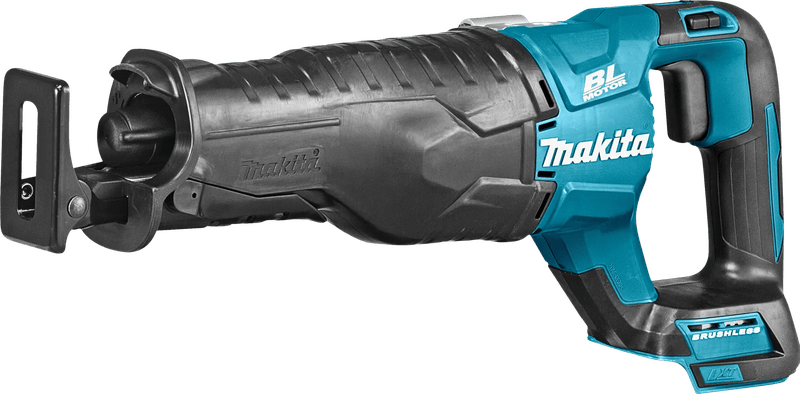
Makita DJR187
Makita relies on a 32 mm stroke and a brushless motor. The stroke rate is preselected in two ranges, up to 2,300 or up to 3,000 per minute; the low range suits metal and plastic. With battery, the saw weighs 3.4 to 3.8 kg according to Makita. The blade and shoe can be changed and adjusted without tools.
Milwaukee M18 FSZ
Milwaukee lists a cutting depth of 300 mm in softwood, 150 mm for metal pipes and 20 mm in steel. According to the manufacturer, a clutch is meant to prevent the machine from kicking back when the blade binds. That is a manufacturer claim, not a free pass. If you own M18 batteries, this gets you a machine for heavy work.
Metabo SSEP 18 LT BL
Metabo combines a 32 mm stroke with selectable orbital action and a brushless motor; the tool weighs 3 kg without battery. For vibration, Metabo lists 14.5 m/s² for chipboard and 14.3 m/s² for wooden beams. Among the models here with published values, that is the lowest. The blade can be inserted rotated by 180 degrees, which is handy for cuts close to the ceiling. The saw runs on all 18-volt batteries of the CAS alliance.
Einhell TP-AP 18/32 Li BL
On paper, the Einhell is hardly behind the professional brands. A 32 mm stroke, switchable orbital action, 300 mm in wood and 20 mm in steel. The stroke rate is preselected in six steps on a wheel and finely controlled with the trigger. Einhell states 3.42 kg. The manufacturer does not publish vibration and noise values online.
DeWalt DCS382
DeWalt describes the DCS382 as a compact saw for construction and demolition with a 29 mm stroke and brushless motor. The blade clamp has two positions, which allows flush cuts against a wall or floor. DeWalt gives no figures for cutting depth or weight on the product page, so a comparison by numbers is only possible to a limited extent.
Makita DJR183
The small Makita is a different class of tool. With battery, it weighs 1.5 to 1.8 kg, and the stroke is only 13 mm. Makita lists a cutting capacity of 50 mm in wood and pipe and vibration values of 7 to 8 m/s², roughly half of the values stated for the large models. For branches along the fence or a drain pipe under the sink, that works well. For demolition, it does not.
Demolition or pruning: the blade has a say
Many disappointments have little to do with the machine. Old beams often contain nails, and a pure wood blade quickly loses its sharpness on them. For this kind of work, Bosch offers the bi-metal blade S1210VF, for example: 300 mm long, 1.6 mm thick, with hardened teeth for wood with nails. In the garden, it is the other way around. The green wood blade S 1531 L has a 5 mm tooth pitch and large gullets so that the moist wood does not clog the blade; Bosch lists a cutting capacity of up to 190 mm.
Trunks thicker than the blade is long do not belong under a reciprocating saw. That is what a chainsaw is made for; more on this in our guide to cordless chainsaws. For curves and clean edges in panels, the jigsaw (in German) remains the more suitable tool.
Kickback, hidden lines, noise
Reciprocating saws are popular for demolition work on walls. That is exactly where hidden lines lurk. In its manual, Bosch requires locating electrical, gas and water lines beforehand with a suitable detector and holding the saw by its insulated gripping surfaces. According to the manual, kickback can occur when the blade catches: only bring the saw to the workpiece when it is running, always keep the shoe plate against the workpiece, and clamp the workpiece instead of supporting it with your hand or foot. The running blade must not touch the ground either. That applies especially to pruning.
Vibration is often underestimated. Manufacturers list values between 14 and just over 21 m/s² for their large models. For comparison: the German Noise and Vibration Occupational Safety Ordinance sets an exposure action value of 2.5 m/s² and a limit value of 5 m/s² for hand-arm vibration, each averaged over an eight-hour day. Longer sawing jobs should therefore be split into stages. For noise, Bosch lists a sound pressure of 89 dB(A) and requires hearing protection; the ordinance requires employees to wear hearing protection from a daily average of 85 dB(A). When cutting oak or beech, Bosch also recommends a class P2 respirator mask.
How we would decide
- No battery platform yet, mixed work in wood and metal: Bosch Professional GSA 18V-28, because of its orbital action that can be switched off, 230 mm cutting depth in wood and 150 mm in pipe.
- Makita batteries on hand, renovation and demolition: Makita DJR187 with a 32 mm stroke.
- Milwaukee M18 batteries on hand: M18 FSZ with a 300 mm cutting depth in softwood.
- CAS batteries on hand and longer jobs planned: Metabo SSEP 18 LT BL with the lowest published vibration values among the large models here.
- Einhell batteries on the shelf, DIY and garden: TP-AP 18/32 Li BL with orbital action.
- Mainly branches and overhead work: Makita DJR183. It does not replace a large saw.
The Makita DJR187 is available as the DJR187ZK without battery in a carrying case; Makita lists a 32 mm stroke, two ranges up to 3,000 strokes per minute and a cutting capacity of 255 mm in wood.
Frequently asked questions
What should you look for when buying a reciprocating saw?
Less at the stroke rate, because five of the six large models list 2,900 or 3,000 strokes per minute. Stroke length says more: Bosch states 28 mm, while Makita, Milwaukee, Metabo and Einhell state 32 mm. A longer stroke means more teeth engaged and fewer chips left in the cut.
What is orbital action on a reciprocating saw for?
With orbital action, the blade also swings slightly forward and clears material more aggressively. Bosch recommends it for softwood, tree wood, insulation and plastics; for sheet metal, steel and clean edges, it is switched off. Bosch, Metabo and Einhell list the function.
Is a small reciprocating saw enough for garden work?
For branches and thin pipes, yes. With battery, the Makita DJR183 weighs 1.5 to 1.8 kg, has a 13 mm stroke and, according to Makita, cuts 50 mm in wood and pipe. Its vibration values are roughly half those of the large models. It is not meant for demolition or squared timber beams.
Which blade do I need for wood with nails?
A bi-metal blade, because a pure wood blade quickly loses its sharpness on nails. Bosch offers the S1210VF with hardened teeth, for example. For green wood, the S 1531 L with 5 mm tooth pitch and large gullets is designed so that the moist wood does not clog the blade.
How dangerous is the vibration of a reciprocating saw?
Manufacturers list 14 to just over 21 m/s² for large models. The German Noise and Vibration Occupational Safety Ordinance sets an exposure action value of 2.5 and a limit value of 5 m/s², averaged over an eight-hour day. Longer sawing jobs should therefore be split into stages, and hearing protection is a must.
What should you watch for when cutting into walls?
Hidden lines lurk there. Bosch requires locating electrical, gas and water lines beforehand with a detector and holding the saw by its insulated gripping surfaces. To prevent kickback: only bring the saw to the workpiece when it is running, keep the shoe plate against the workpiece and clamp the workpiece.
Sources
- Bosch Professional: GSA 18V-28
- Bosch: original operating instructions GSA 18V-28 (PDF)
- Makita: DJR187
- Makita: DJR183
- Milwaukee: M18 FSZ
- Metabo: SSEP 18 LT BL
- Einhell: TP-AP 18/32 Li BL
- DeWalt: DCS382
- Bosch: reciprocating saw blade S1210VF Demolition
- Bosch: reciprocating saw blade S 1531 L for green wood
- German Noise and Vibration Occupational Safety Ordinance
Where to buy
- Bosch Professional GSA 18V-28Check price at Amazon.deCheck price at Amazon.co.ukCheck price at Amazon.nlCheck price at Amazon.com.beCheck price at Amazon.frCheck price at Amazon.itCheck price at Amazon.esCheck price at Amazon.plCheck price at Amazon.seAvailable in Germany: Amazon.de
- Makita DJR187Check price at Amazon.deCheck price at Amazon.co.ukCheck price at Amazon.nlCheck price at Amazon.com.beCheck price at Amazon.frCheck price at Amazon.itCheck price at Amazon.esCheck price at Amazon.plCheck price at Amazon.seAvailable in Germany: Amazon.de
- Milwaukee M18 FSZ-0X (ohne Akku)Check price at Amazon.deCheck price at Amazon.co.ukCheck price at Amazon.nlCheck price at Amazon.com.beCheck price at Amazon.frCheck price at Amazon.itCheck price at Amazon.esCheck price at Amazon.plCheck price at Amazon.seAvailable in Germany: Amazon.de
- Metabo SSEP 18 LT BLCheck price at Amazon.deCheck price at Amazon.co.ukCheck price at Amazon.nlCheck price at Amazon.com.beCheck price at Amazon.frCheck price at Amazon.itCheck price at Amazon.esCheck price at Amazon.plCheck price at Amazon.seAvailable in Germany: Amazon.de
- Einhell TP-AP 18/32 Li BLCheck price at Amazon.deCheck price at Amazon.co.ukCheck price at Amazon.nlCheck price at Amazon.com.beCheck price at Amazon.frCheck price at Amazon.itCheck price at Amazon.esCheck price at Amazon.plCheck price at Amazon.seAvailable in Germany: Amazon.de
- DeWalt DCS382N (ohne Akku)Check price at Amazon.deCheck price at Amazon.co.ukCheck price at Amazon.nlCheck price at Amazon.com.beCheck price at Amazon.frCheck price at Amazon.itCheck price at Amazon.esCheck price at Amazon.plCheck price at Amazon.seAvailable in Germany: Amazon.de
- Makita DJR183Check price at Amazon.deCheck price at Amazon.co.ukCheck price at Amazon.nlCheck price at Amazon.com.beCheck price at Amazon.frCheck price at Amazon.itCheck price at Amazon.esCheck price at Amazon.plCheck price at Amazon.seAvailable in Germany: Amazon.de
- Makita DJR187ZK (ohne Akku)View at CoolblueAvailable in Germany: Coolblue