Contents13 sections
This guide was first published in German on handgetestet.de.
Open the shutter box first. The shaft in there decides which motor fits at all, and only after that do the newton meters count. For the typical window or patio door with a 60 mm shaft and a plastic curtain, we consider the Schellenberg Maxi PREMIUM with 20 Nm the right motor. It does, however, need a transmitter and, in any case, a qualified electrician for the connection.
This guide is about the motor inside the shaft. If you already have a motor and only want to control it smartly, or if a strap winder is enough, you will find the routes to that in our guide to smart roller shutter control (in German).
Tube motor instead of a strap: when the conversion makes sense
The tube motor sits out of sight inside the shaft in the box. The strap goes away, and Rademacher names exactly that as the difference from an electric strap winder. In return, the effort goes up: the box has to be accessible, and you need power right at the window. If there is no cable, chiseling a channel into the wall or installing a cable duct comes before the motor.
Which shaft is in the box?
Schellenberg divides its motors into two systems. Mini goes with 40 mm octagonal shafts and slats 37 mm high, Maxi with 60 mm and slats of 52 mm. In technical literature, these are called SW40 and SW60. Selve also lists SW50 and SW70, so those exist as well. Do not confuse the shaft size with the diameter of the motor: at Jarolift, a 45 mm motor tube goes into the 60 mm shaft and a 35 mm one into the 40 mm shaft. Whether a motor fits is determined by the shaft profile and the adapter.
Also measure the length. Schellenberg calculates it like this: the clear distance between the wall bearings minus 70 mm gives you the required shaft length. The Maxi with 20 Nm has an installation length of 555 mm, the one with 40 Nm 620 mm. On narrow windows, that can get tight. For the SLDM 20/16PZ, Rademacher lists an overall length of 487 mm.
Your shaft does not have an octagonal profile? Then the Schellenberg motors will not fit, because the manufacturer designs them explicitly for octagonal shafts. For the RolloTube Basis, Rademacher offers interchangeable adapters for common shaft types.
From curtain weight to torque
Newton meters alone do not tell you much. In the end, the motor has to lift the weight of the shutter curtain, and that grows with the area. Schellenberg’s table provides the conversion: 20 Nm corresponds to 34 kg or 8.5 m² of plastic curtain, 40 Nm to 60 kg or 15 m². That works out to roughly 4 kg per square meter.
Three sample calculations using this value:
- Window 1.60 × 1.50 m: 2.4 m², so about 10 kg.
- Patio door 2.40 × 2.30 m: 5.5 m², so about 22 kg.
- Wide front 3.50 × 2.50 m: 8.75 m², so about 35 kg.
The third example is just above the limit of the 20 Nm motor and calls for the stronger one. As a general rule, Schellenberg advises choosing the next size up at the load limit, because that extends service life.
Aluminum is heavier. The plastic area figure does not apply here, and you should not assume a flat rate. Ask the manufacturer of the curtain or weigh it when you take it out.
Be careful, too, when comparing brands: Jarolift states a pulling force of 42 kg for the TDEF 20/13 with 20 Nm, while Schellenberg states 34 kg for the same 20 Nm. So compare kilograms and area, not just Nm.
The models at a glance
| Model | Torque | Shaft | Pulling force or area | Best for |
|---|---|---|---|---|
| Schellenberg Maxi PREMIUM 20 Nm | 20 Nm | SW60 | 34 kg, 8.5 m² | Windows and patio doors |
| Schellenberg Maxi PREMIUM 40 Nm | 40 Nm | SW60 | 60 kg, 15 m² | large, heavy curtains |
| Rademacher RolloTube S-line DuoFern SLDM 20/16PZ | 20 Nm | SW60 | no manufacturer figure | if you want obstacle detection |
| Rademacher RolloTube S-line DuoFern SLDS 10/16PZ | 10 Nm | SW40 | no manufacturer figure | small boxes with a 40 mm shaft |
| Jarolift TDEF 20/13 | 20 Nm | SW60 (motor tube 45 mm) | 42 kg | radio control with push-up protection |
| Rademacher RolloTube Basis RTBM 20/16Z | 20 Nm | SW60 | no manufacturer figure | wall switch instead of radio |
Standard window, 60 mm shaft: Schellenberg Maxi PREMIUM 20 Nm
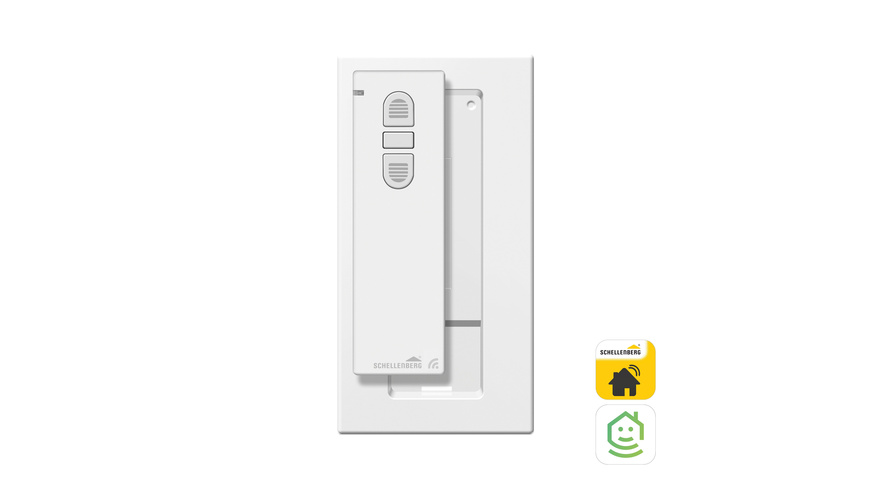
According to the manufacturer, the motor covers 8.5 m², you set the end positions by radio, and Schellenberg gives a 5-year warranty. The adapter set and the quiet-running wall bearing are included. The transmitter is not: you buy the radio hand transmitter separately, and without it or a smart home system, the end positions cannot be set.
You should know the limits. The radio protocol on 868.4 MHz is proprietary, and the range indoors is about 20 meters. The cable is only 2 meters long; at Jarolift and Rademacher it is 3. Schellenberg does not mention obstacle detection; what it lists is overload protection. According to ELV (German electronics retailer), the motor integrates into the Schellenberg and Smart Friends systems, and with a radio stick also into Magenta SmartHome. A hub from another manufacturer from our guide to smart home hubs will therefore not control it without further ado.
Heavy curtain: Schellenberg Maxi PREMIUM 40 Nm
Technically the same motor with more power: 228 instead of 161 watts and an installation length of 620 mm. It makes sense from about 7 m² of plastic if you follow the recommendation to keep a margin from the limit, and for aluminum depending on the weight.
Obstacles in the way: RolloTube S-line DuoFern SLDM 20/16PZ
If a flowerpot regularly sits on the windowsill, that argues for this motor. Rademacher lists blocking and obstacle detection; the motor then reverses. It learns the end points on its own. For that, however, it requires rigid shaft connectors or mounting springs and stoppers. It is controlled in Rademacher’s DuoFern system, which, as with Schellenberg, means you are locked in.
Tight box with a 40 mm shaft: RolloTube S-line DuoFern SLDS 10/16PZ
For SW40, this is the version with 10 Nm and the same functions. Rademacher also offers 6 Nm. The manufacturer does not give an area figure on the product page, so calculate cautiously or ask.
Radio without the Schellenberg system: Jarolift TDEF 20/13
Jarolift lists push-up protection, blocking detection and overload protection, plus a 7-year warranty and a 3-meter cable. Jarolift sells it as a motor for SW60 shafts. The 45 mm in the technical data is the diameter of the motor tube, not the size of the shaft. It is operated with Jarolift radio transmitters. The keyword push-up protection matters to anyone who is also thinking about burglary protection; more on that in the guide to window security.
A wall switch is enough: RolloTube Basis RTBM 20/16Z
No radio, no learning function. You set the end points mechanically with screws on the motor head, and the motor is operated with a standard roller shutter switch, a timer or a radio actuator. With a flush-mounted actuator (in German), you can integrate this motor into your existing smart home, too, instead of locking yourself into a motor manufacturer’s radio system.
End positions and everyday use
With the Schellenberg motor, you run the shutter about 90 percent of the way, switch to jog mode and save the position. You do this separately for the top and the bottom. Temperature swings between summer and winter can shift the positions slightly; a fine adjustment then helps. According to the manual, the device is designed for 4 minutes of continuous operation; if it overheats, it switches off and needs a break of at least 20 minutes. In winter, you should watch out for icing.
Up to five motors may be connected to one supply line. According to the manufacturer, each draws 1 watt in standby.
What you may do yourself and what you may not
The mechanical part is doable if you are handy. Secure the curtain against falling before you detach it from the shaft, push the motor and drive ring in as far as they will go, and do not drive any screw into the shaft in the motor area.
The 230-volt connection, on the other hand, belongs in the hands of a qualified electrician. Schellenberg says so explicitly, and Rademacher also recommends a qualified professional for the installation. It must be possible to disconnect the line, the cable must not be routed outdoors, and in bathrooms the requirements of the German standard DIN VDE 0100 also apply.
Which motors the Homematic IP actuators require is explained in the guide to the Homematic IP shading set.
How much pulling force a strap drive really needs is calculated in the guide to the electric strap winder.
Frequently asked questions
Which shaft do I have in my shutter box?
Schellenberg distinguishes two systems: Mini for 40 mm octagonal shafts and slats 37 mm high, Maxi for 60 mm and slats of 52 mm. In technical literature, these are called SW40 and SW60; SW50 and SW70 also exist. Without an octagonal profile, the Schellenberg motors do not fit; Rademacher offers adapters for the RolloTube Basis.
How much torque does a roller shutter motor need?
That depends on the weight of the shutter curtain. According to Schellenberg, 20 Nm corresponds to 34 kg or 8.5 m² of plastic curtain, and 40 Nm to 60 kg or 15 m², so roughly 4 kg per square meter. A patio door of 5.5 m² thus weighs about 22 kg. Aluminum is heavier; ask the manufacturer or weigh it.
Can I compare newton meters across manufacturers?
Only to a limited extent. Jarolift states a pulling force of 42 kg for the TDEF 20/13 with 20 Nm, Schellenberg 34 kg for the same 20 Nm. So compare kilograms and area, not just Nm. At the load limit, Schellenberg advises going one size up, which extends service life.
Which roller shutter motor detects obstacles?
The Rademacher RolloTube S-line DuoFern SLDM 20/16PZ lists blocking and obstacle detection and reverses afterward; it learns the end points on its own. For this, it requires rigid shaft connectors or mounting springs and stoppers. The Jarolift TDEF 20/13 lists blocking detection and push-up protection. For the Maxi PREMIUM, Schellenberg only mentions overload protection.
Can I install a roller shutter motor myself?
The mechanical part, yes, if you are handy: secure the curtain against falling, push the motor in as far as it will go, and do not drive any screw into the shaft in the motor area. According to Schellenberg, the 230-volt connection is explicitly a job for a qualified electrician. In bathrooms, the requirements of the German standard DIN VDE 0100 also apply.
Which roller shutter motor fits into an existing smart home?
The Rademacher RolloTube Basis RTBM 20/16Z without radio. It works with a standard roller shutter switch, timer or radio actuator; with a flush-mounted actuator, you integrate it into your system. Radio motors such as Schellenberg on 868.4 MHz or DuoFern, on the other hand, lock you into the motor manufacturer's system.
Sources
- Schellenberg: Manual for the PREMIUM radio roller shutter motor (PDF)
- Schellenberg: PREMIUM comparison table (PDF)
- Schellenberg: Manual for the radio hand transmitter (PDF)
- Schellenberg: Roller shutter motors
- ELV: Maxi PREMIUM 20 Nm
- Rademacher: RolloTube S-line SLDM 20/16PZ
- Rademacher: RolloTube Basis RTBM 20/16Z
- Rademacher: Roller shutter guide
- Jarolift: Roller shutter motors
- Jarolift: Manual for TDEF tube motors (PDF)
- Selve: Drives
Where to buy
- Schellenberg Maxi PREMIUM 20 NmView at ELVAvailable in Germany: ELV
- Schellenberg Maxi PREMIUM 40 NmView at ELVAvailable in Germany: ELV
- Schellenberg Funk-Handsender 1-KanalView at ELVAvailable in Germany: ELV
- Rademacher RolloTube S-line DuoFern SLDM 20/16PZCheck price at Amazon.deCheck price at Amazon.co.ukCheck price at Amazon.nlCheck price at Amazon.com.beCheck price at Amazon.frCheck price at Amazon.itCheck price at Amazon.esCheck price at Amazon.plCheck price at Amazon.seAvailable in Germany: Amazon.de
- Rademacher RolloTube S-line DuoFern SLDS 10/16PZCheck price at Amazon.deCheck price at Amazon.co.ukCheck price at Amazon.nlCheck price at Amazon.com.beCheck price at Amazon.frCheck price at Amazon.itCheck price at Amazon.esCheck price at Amazon.plCheck price at Amazon.seAvailable in Germany: Amazon.de
- Jarolift TDEF 20/13Check price at Amazon.deCheck price at Amazon.co.ukCheck price at Amazon.nlCheck price at Amazon.com.beCheck price at Amazon.frCheck price at Amazon.itCheck price at Amazon.esCheck price at Amazon.plCheck price at Amazon.seAvailable in Germany: Amazon.de
- Rademacher RolloTube Basis RTBM 20/16ZCheck price at Amazon.deCheck price at Amazon.co.ukCheck price at Amazon.nlCheck price at Amazon.com.beCheck price at Amazon.frCheck price at Amazon.itCheck price at Amazon.esCheck price at Amazon.plCheck price at Amazon.seAvailable in Germany: Amazon.de