Contents14 sections
This guide was first published in German on handgetestet.de.
The spec sheet says „12x zoom,“ yet in the video the license plate at the gate is still just a gray blur. That is rarely down to a faulty device. It is because zoom on security cameras can mean three different things, and only one of them delivers new detail. For driveways and large properties, we recommend the Imou Cruiser Pano Z because it combines a fixed panorama with a pan-and-tilt telephoto lens. This background piece explains why that matters more than the number in front of the „x.“
How pan-tilt heads, patrols and auto-tracking work is covered in our guide to the pan-and-tilt security camera. This one is about the optics.
Three kinds of zoom, and only one brings detail
Digital zoom crops a section out of the finished image and blows it up. On a 4K camera with a width of 3,840 pixels, a fourfold enlargement leaves only 960 pixels. No additional information is created.
Optical zoom moves lenses inside the lens assembly. The sensor always uses all of its pixels; only the field of view narrows. According to the manufacturer, the Reolink RLC-811A has a lens with a focal length of 2.7 to 13.5 mm, which is fivefold optical zoom. The field of view shrinks from 105 to 31 degrees. Motorized zoom lenses like this are rare on home cameras.
Hybrid zoom is the common middle ground. The camera has two fixed lenses, a wide-angle and a telephoto, and calculates the intermediate steps digitally. On the Imou Cruiser Z, these are 2.8 mm and 12 mm. Purely optically, the jump therefore corresponds to a factor of about 4.3. The camera only reaches the „12x“ that Imou specifies as mixed zoom when it also enlarges digitally. Not false labeling, but good to know.
Pixels per meter: the number that really counts
Whether you can recognize a face does not depend on megapixels. It depends on how many pixels fall on one meter of width at the scene. The standard DIN EN 62676-4 (internationally IEC 62676-4) defines levels for this. According to the 2014 edition, you need 25 pixels per meter to detect a person at all, 125 pixels per meter to recognize them and 250 pixels per meter to identify them. That corresponds to about 40 pixels across a face 16 centimeters wide. The new 2025 edition uses finer subdivisions and even requires 1,500 pixels per meter for reading license plates.
The math is easy. The image width in meters follows from distance and field of view, and the pixels per meter from the sensor width divided by that image width. An example with a 5-megapixel camera that delivers 2,880 pixels in width, using the fields of view of the Cruiser Z:
- Wide-angle at 95 degrees: about 130 pixels per meter at 10 meters; mathematically, identification only works up to just over 5 meters.
- Telephoto at 24 degrees: about 670 pixels per meter at 10 meters, and still around 265 at 25 meters.
- For comparison, the RLC-811A at the telephoto end with 31 degrees and 3,840 pixels: identifiable up to about 27 meters.
That shows the core point. A telephoto lens multiplies the range for faces by five; a higher-resolution sensor alone does not. And in practice, light, optics and compression push the result down further, as Axis emphasizes in its explanation of the standard. At night, calculated values only apply with good lighting. What cameras manage then is described in our guide to the security camera with color night vision.
Panorama is not zoom
Cameras with 180 degrees like to advertise 16 megapixels. According to the data sheet, the Reolink Duo 3 PoE spreads 7,680 pixels across 180 degrees. That is just under 43 pixels per degree. A 4K camera with a 94-degree field of view comes to just under 41. Here, more megapixels mean more area, hardly more detail. For a license plate at 20 meters, that does not help.
Wide-angle plus telephoto: why two heads are better than one
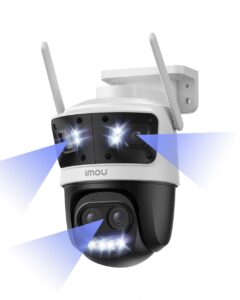
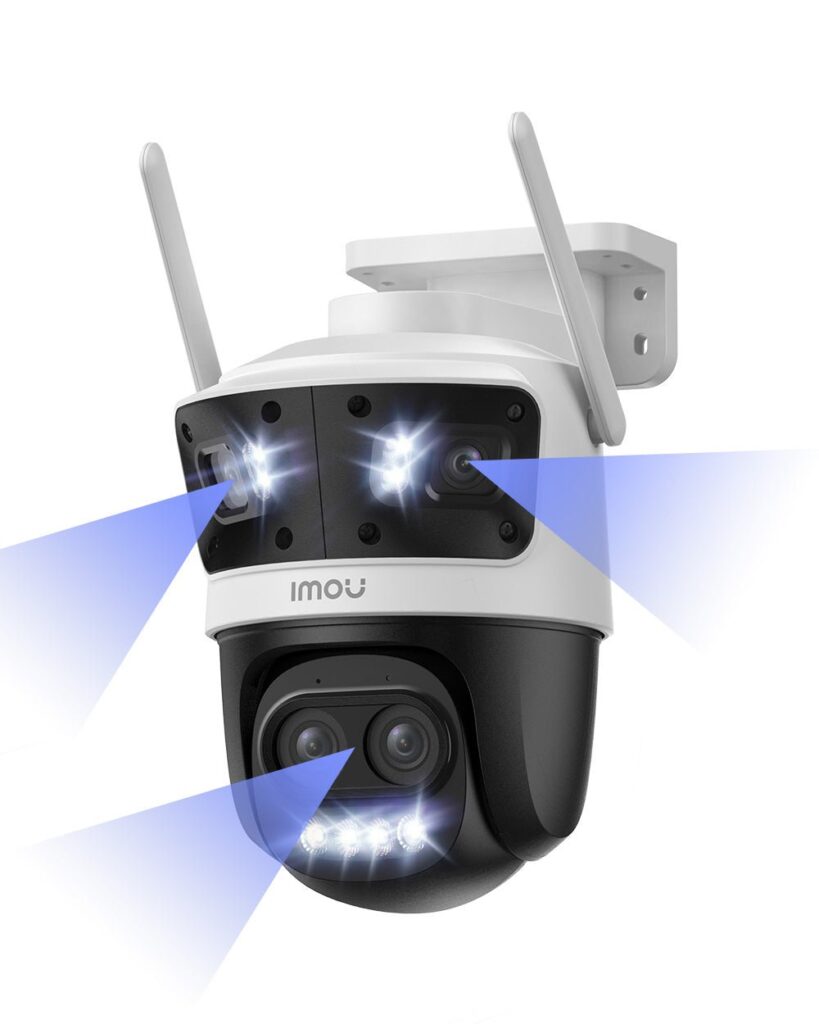
On the Cruiser Z, both lenses sit in the same pan-tilt head. When it zooms in on the gate, the wide-angle looks there too, and the rest of the property briefly goes unwatched. The Imou Cruiser Pano Z separates the two. Two fixed lenses with 4 megapixels each deliver a stitched 158-degree panorama. Below them, a 5-megapixel head with the same focal lengths of 2.8 and 12 mm pans. When the panorama detects a person, according to Imou the telephoto automatically aims at them and follows. Tap a spot in the panorama in the app, and the telephoto moves there. The TP-Link Tapo C545D works on the same principle, with a 165-degree wide-angle and a 6 mm telephoto, though at 2K resolution.
Six cameras that really bring things closer
| Model | Optics according to manufacturer | Power and network | Best for |
|---|---|---|---|
| Imou Cruiser Pano Z | Panorama 158° (2 × 4 MP) plus pan-and-tilt telephoto 2.8/12 mm (5 MP) | PoE+ or 12 V, Wi-Fi 6, LAN | long driveway, large property |
| Imou Cruiser Z | 2.8 mm (95°) and 12 mm (24°), 5 MP, pan-and-tilt | 12 V, Wi-Fi 6, LAN | a single access road, smaller budget |
| Reolink RLC-811A | 2.7 to 13.5 mm, fivefold optical, 4K | PoE or 12 V | gate at a fixed distance, recorder |
| Reolink E1 Outdoor Pro | 2.8 to 8 mm, threefold optical, 4K, pan-and-tilt | 12 V, Wi-Fi 2.4/5 GHz, LAN | Wi-Fi households with medium distances |
| TP-Link Tapo C545D | 165° wide-angle plus 6 mm telephoto, 2K each | 12 V, Wi-Fi, Ethernet | Tapo households, yard up to the garden fence |
| Reolink Duo 3 PoE | 180° panorama, 16 MP, no zoom | PoE or 12 V | wide overview instead of detail |
Imou Cruiser Pano Z
Our recommendation for driveways from about 20 meters and properties with several entrances. The panorama always stays fixed while the telephoto zooms in. According to Imou, power comes over a network cable via PoE+ (802.3at) or from a power adapter; two card slots each take up to 512 GB, and there is also ONVIF, recorder and cloud support. Weaknesses: a maximum of 15 frames per second, power consumption of up to 18 watts and a large housing about 20 centimeters tall. An older 802.3af switch does not deliver enough power for PoE+.
Imou Cruiser Z
The same focal lengths as the Pano Z, but without the fixed panorama. According to Imou, it recognizes details in infrared night mode at a distance of at least 56 meters, operates from minus 30 to plus 50 degrees Celsius and supports ONVIF. If you only want to monitor one access road, this is the better value. Imou does not list PoE for it; the network port is for data.
Reolink RLC-811A
Alongside the E1 Outdoor Pro, the only camera here with continuous optical zoom, and it does not pan. For a fixed task such as the yard gate, that is an advantage, because the frame stays where it legally belongs. 4K at up to 25 frames per second, PoE to 802.3af, IP67 protection rating according to Reolink.
Reolink E1 Outdoor Pro
A pan-and-tilt camera with real threefold zoom for Wi-Fi households. According to the data sheet, it pans 355 degrees, tilts 50 degrees and, if you want, records around the clock to the card. The telephoto ends at 50 degrees, which is considerably wider than on the Imou models; mathematically, it identifies faces up to about 16 meters. Protection rating only IP65.
TP-Link Tapo C545D
The panorama-plus-telephoto principle on a smaller scale. According to TP-Link, the wide-angle can be aimed by hand, while the telephoto pans automatically. There are also privacy zones that exclude areas from recording, and an Ethernet port. With 2K and a 6 mm telephoto, it is enough for yard and garden, less so for long driveways. Cloud storage runs through the Tapo Care service.
Reolink Duo 3 PoE
Included deliberately as a counterexample. No optical zoom, but 180 degrees in one piece and up to 20 frames per second. It shows that someone is walking across the yard, not who. For details, you need a second camera.
Zoom and the law: the farther, the trickier
A powerful telephoto lens sees far beyond your own fence. But that is exactly where what is permitted ends. Private cameras may only capture your own property; sidewalks, the street and neighbors‘ gardens are generally off-limits, writes the Verbraucherzentrale (German consumer advice center). As soon as a camera captures public space, the General Data Protection Regulation (GDPR) applies, in the view of the German Data Protection Conference. In its guidance on video surveillance, it explicitly names panning, tilting and zooming as functions that intensify the intrusion and are generally not permissible. As a retention period, it usually considers 72 hours sufficient.
In practice, that means: set up the telephoto so that even the longest focal length ends on your own ground. Use privacy zones where the camera offers them. And after every firmware update, check whether saved positions are still correct. A fixed zoom camera such as the RLC-811A makes this easier than any pan-tilt head.
How we would decide
- Long driveway and several entrances: Imou Cruiser Pano Z.
- One access road up to about 25 meters, Wi-Fi: Imou Cruiser Z.
- Yard gate at a fixed distance, cable available: Reolink RLC-811A, ideally on a recorder.
- Medium distances with panning: Reolink E1 Outdoor Pro.
- Small property, Tapo app already in use: TP-Link Tapo C545D.
- Overview only, no details: Reolink Duo 3 PoE.
If the Wi-Fi does not reach the driveway, a Wi-Fi access point on the outside wall of the house helps more than any antenna on the camera.
Frequently asked questions
What is the difference between optical, hybrid and digital zoom?
Digital zoom crops a section and enlarges it; no new information is created. Optical zoom moves lenses, and the sensor keeps using all of its pixels. Hybrid zoom combines a wide-angle and a telephoto lens and calculates the intermediate steps digitally. On the Imou Cruiser Z, the optical jump corresponds to a factor of about 4.3.
How many pixels do you need to recognize a face?
What matters is pixels per meter at the scene. According to the 2014 edition of the standard DIN EN 62676-4, you need 25 pixels per meter to detect a person, 125 to recognize them and 250 to identify them. The 2025 edition even requires 1,500 pixels per meter for license plates.
Does a 16-megapixel panoramic camera replace a zoom?
No. The Reolink Duo 3 PoE spreads 7,680 pixels across 180 degrees, which is just under 43 pixels per degree, barely more than a 4K camera with 94 degrees. Here, more megapixels mean more area, hardly more detail. It shows that someone is walking across the yard, not who.
Why does a camera with panorama and telephoto make sense?
On cameras with both lenses in the same pan-tilt head, the rest of the property briefly goes unwatched as soon as they zoom in on the gate. The Imou Cruiser Pano Z separates the two: the 158-degree panorama stays fixed, and below it, according to Imou, the telephoto automatically aims at detected people.
What do you need to consider legally when zooming?
According to the Verbraucherzentrale (German consumer advice center), private cameras may only capture your own property. The German Data Protection Conference lists panning, tilting and zooming as functions that intensify the intrusion. Set up the telephoto so that even the longest focal length ends on your own ground, and use privacy zones where available.
Sources
- Imou: Cruiser Pano Z, product page
- Imou: Cruiser Pano Z, data sheet
- Imou: Cruiser Z, product page
- Imou: Cruiser Z, data sheet
- Reolink: RLC-811A
- Reolink: E1 Outdoor Pro
- Reolink: Duo 3 PoE
- TP-Link: Tapo C545D
- Axis Communications: Pixel density according to IEC 62676-4:2014 (PDF)
- Axis Communications: Pixel density according to IEC 62676-4:2025 (PDF)
- Verbraucherzentrale (German consumer advice center): Only film your own property with security cameras
- German Data Protection Conference: Guidance on video surveillance by non-public bodies (PDF)
Where to buy
- Imou Cruiser Pano ZView at ImouAvailable in Germany: Imou
- Imou Cruiser ZView at ImouAvailable in Germany: Imou
- Reolink RLC-811ACheck price at Amazon.deCheck price at Amazon.co.ukCheck price at Amazon.nlCheck price at Amazon.com.beCheck price at Amazon.frCheck price at Amazon.itCheck price at Amazon.esCheck price at Amazon.plCheck price at Amazon.seAvailable in Germany: Amazon.de
- Reolink E1 Outdoor ProCheck price at Amazon.deCheck price at Amazon.co.ukCheck price at Amazon.nlCheck price at Amazon.com.beCheck price at Amazon.frCheck price at Amazon.itCheck price at Amazon.esCheck price at Amazon.plCheck price at Amazon.seAvailable in Germany: Amazon.de
- TP-Link Tapo C545DView at CoolblueAvailable in Germany: CoolblueCheck price at Amazon.deCheck price at Amazon.co.ukCheck price at Amazon.nlCheck price at Amazon.com.beCheck price at Amazon.frCheck price at Amazon.itCheck price at Amazon.esCheck price at Amazon.plCheck price at Amazon.seAvailable in Germany: Amazon.de
- Reolink Duo 3 PoECheck price at Amazon.deCheck price at Amazon.co.ukCheck price at Amazon.nlCheck price at Amazon.com.beCheck price at Amazon.frCheck price at Amazon.itCheck price at Amazon.esCheck price at Amazon.plCheck price at Amazon.seAvailable in Germany: Amazon.de