Contents14 sections
This guide was first published in German on handgetestet.de.
A split air conditioner cools a room far more effectively than a portable unit with an exhaust hose. But you can’t just carry it home in a box and switch it on in the evening. For a bedroom or home office, we consider a finely modulating 2.5 kW unit with a high SEER such as the Daikin Perfera FTXM25A the most sensible choice, installed by a certified refrigeration contractor and only after written consent from the landlord or homeowners‘ association.
What happens in the two boxes
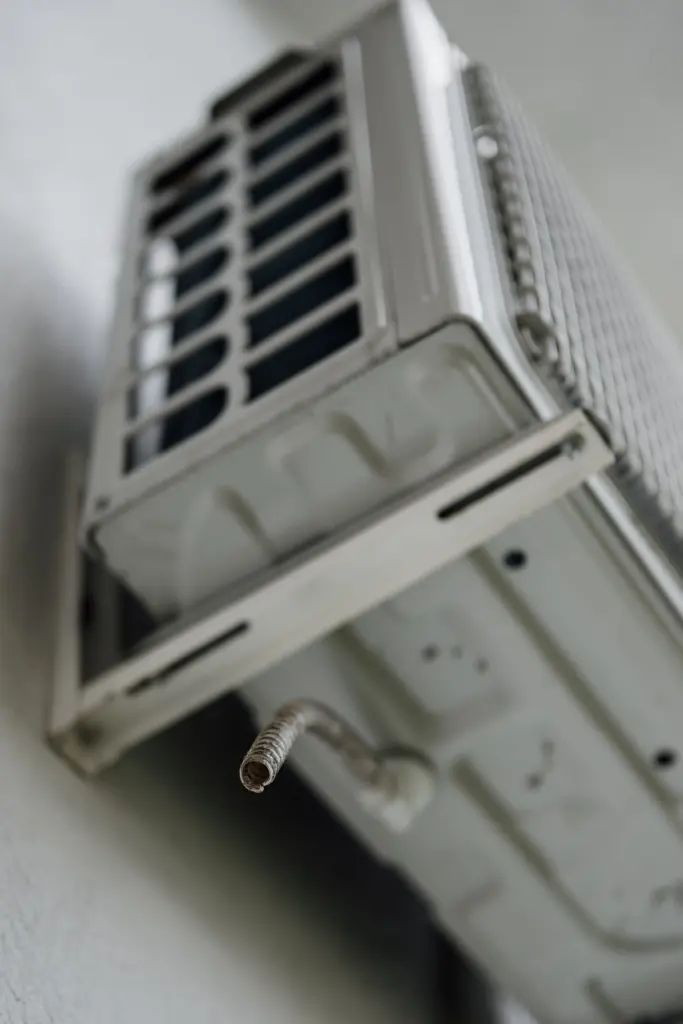
In the indoor unit, the refrigerant evaporates and absorbs heat from the room air. Outside, it is compressed, liquefied again and releases the heat to the surroundings. That is how the German Environment Agency (Umweltbundesamt, UBA) describes the principle. Between the two units run two copper lines, a control cable and a hose for the condensate that forms at the indoor unit and has to be drained away.
In winter, the cycle runs in reverse. The air conditioner then becomes a small air-to-air heat pump, which is why every spec sheet lists two capacities and two efficiency ratings. The inverter controls the compressor continuously instead of just switching it on and off. How far that goes is shown in the line with minimum and maximum values: for the Daikin FTXM25A, the manufacturer states 0.9 to 3.8 kW of cooling capacity, 2.5 kW nominal.
Kilowatts: room size is only part of the calculation
Nominal cooling capacity is measured under fixed conditions. Daikin specifies 35 °C outside and 27 °C inside with five meters of piping. Your attic room under the roof tiles in July doesn’t stick to that.
The German consumer advice center Verbraucherzentrale therefore advises sizing the capacity to the room: window size, wall condition and existing sun protection count just as much as the square meters. The estimate should be left to a contractor. Manufacturers rarely give fixed room sizes for wall units. Midea states up to 42 square meters for the 3.5 kW PortaSplit, a guideline and not a promise. A unit that can modulate down a long way is more forgiving of a somewhat generous choice than one with a narrow range.
SEER, SCOP and what the label actually says
The EU energy label for air conditioners ranges from A+++ to D. For cooling, it shows the class, the design capacity Pdesign in kW, the SEER, the annual consumption in kWh and the sound power indoors and outdoors. For heating, up to three climate zones appear on a map of Europe, each with its own SCOP. If you want to know more, the EU product database EPREL has the detailed values, including the refrigerant.
According to the Verbraucherzentrale, the annual consumption on the label is based on 350 operating hours. The calculation is easy to follow: Pdesign times 350 hours, divided by the SEER. For the Daikin FTXM25A with 2.5 kW and a SEER of 9.47, that gives around 92 kWh, exactly the value in the spec sheet. The entry-level Midea Xtreme Save Lite 09 with 2.8 kW and a SEER of 7.4 comes to 132 kWh. The difference sounds small. But if you cool through tropical nights, you’ll be well above 350 hours, and then the SEER gap makes itself felt every week.
For heating, the SCOP applies to the average climate. Values around 5 roughly mean five parts of heat from one part of electricity.
R32 today, propane tomorrow: what the F-gas regulation changes
According to the UBA, new split units mostly contain R32, with a global warming potential (GWP) of 675. Previously, R410A dominated, whose GWP the agency puts at 2088. Portable units have only been allowed to use refrigerants below GWP 150 since 2020. Under Regulation (EU) 2024/573, this limit will also apply to split units from 2029, as the UBA summarizes. The regulation’s bans apply to placing new units on the market.
According to the UBA, propane (R290) has a GWP of 0.02; units with the Blauer Engel (Germany’s eco-label) use it. In split units, it is still not widespread in Germany. If you buy in 2026, you will therefore almost always end up with R32. In that case, at least pay attention to the charge quantity: Mitsubishi Electric states 0.55 kg for the MSZ-AY35, which corresponds to 0.37 tonnes of CO₂.
Quick connector doesn’t mean DIY
On sets with quick connectors, the German Environment Agency is unambiguous. Split units assembled with quick-connect couplings are not considered hermetically sealed, even if the connection is permanent afterward. Connecting two refrigerant-carrying lines is an installation, and that requires a certified company regardless of the charge quantity. Laypeople may not set up such units. They may only be sold to end customers with proof that a company certified under Article 10 of the regulation will install them. That explicitly also applies to units from a home improvement store.
So find the contractor first. Order afterward.
One exception is the portable split unit. According to the manual, the Midea PortaSplit’s circuit is sealed at the factory; the refrigerant hose is two meters long and can be neither disconnected nor extended. If nothing in the circuit is opened, the UBA does not consider it an installation. If the unit is to be mounted permanently, Midea itself requires a qualified installer.
Landlords, neighbors and 40 decibels at midnight
According to the Verbraucherzentrale, tenants in Germany need the landlord’s permission because the wall is drilled through. Consent is also required for a portable split unit whose outdoor part hangs on the facade or balcony. In apartment buildings, according to the UBA, the homeowners‘ association or property management must also approve the outdoor unit, because it changes the appearance of the facade.
Then comes the noise. The German noise regulation TA Lärm allows 40 dB(A) at night in general residential areas and 35 dB(A) in purely residential areas. Night there means 10 p.m. to 6 a.m. How to estimate this before buying is shown in the 2023 guideline of the German federal/state working group on pollution control (LAI). You take the sound power of the outdoor unit, subtract 5 dB if the line of sight is blocked, add 3 dB in front of a building wall, 6 dB in a corner or under a canopy, and another 3 dB if the tonality is unknown. The reference point is half a meter in front of the nearest window.
An example with the Mitsubishi MUZ-AY35VG and its 61 dB(A). In front of a building wall with a clear line of sight to the neighbor’s window, that gives 67 dB; according to the guideline’s table, a distance of 17.6 meters is then required in a general residential area. If the unit sits around the corner of the house, the value drops to 62 dB and 9.7 meters. On the balcony of a row house, that quickly gets tight. The UBA considers outdoor units with a sound power below 55 dB in cooling mode to be low-noise. None of the four units in our table with a published outdoor value reaches that. According to the guideline, the label value is not always the maximum, and a whisper mode only counts if it runs reliably at night.
Five units whose spec sheets we analyzed
| Model | Cooling / heating (nominal) | SEER / SCOP | Indoor quietest value / outdoor sound power | Best for |
|---|---|---|---|---|
| Daikin Perfera FTXM25A + RXM25A | 2.5 / 2.8 kW | 9.47 / 5.2 | 19 dB(A) / not stated by manufacturer | Bedroom and home office |
| Mitsubishi Electric MSZ-AY35VGKP + MUZ-AY35VG | 3.5 / 4.0 kW | 8.7 / 4.7 | 18 dB(A) / 61 dB(A) | Living room, attic |
| Bosch Climate CL7000i-Set 20 E | 2.0 / 2.3 kW | 9.4 / 5.1 | 19 dB(A) / 59 dB cooling, 63 dB heating | Small rooms, heating in spring and fall |
| Midea Xtreme Save Lite 12 | 3.6 / 3.8 kW | 7.0 / 4.2 | 22 dB(A) / 62 dB(A) | Larger rooms, basic features |
| Midea PortaSplit | 3.5 / 3.5 kW | 6.1 / 4.0 | 39 dB(A) / 62 dB | Rented apartment without drilling through the wall |
All figures according to the manufacturers. Indoors, the sound pressure at the quietest setting is given; outdoors, the sound power. The two values are not directly comparable.
Daikin Perfera FTXM25A + RXM25A
A SEER of 9.47 and a SCOP of 5.2 are the highest values in our table; both classes are A+++. Indoors, Daikin states 19 dB(A) in quiet mode. According to the spec sheet, no refrigerant needs to be added for piping up to ten meters.
Mitsubishi Electric MSZ-AY35VGKP + MUZ-AY35VG
The 3.5 kW version is aimed at larger or sunny rooms. Indoors, it starts at 18 dB(A) according to the manufacturer; outdoors, Mitsubishi states a sound power of 61 dB(A), and a night mode lowers the outdoor unit’s sound pressure by 3 dB(A).
Bosch Climate CL7000i-Set 20 E
Small, but very economical with a SEER of 9.4 and a SCOP of 5.1. Bosch states 59 dB outdoors when cooling and 63 dB when heating. If you let the unit heat at night in winter, plan with the higher value.
Midea Xtreme Save Lite 12
Midea itself calls the series its affordable entry-level model. A SEER of 7.0 and a SCOP of 4.2 are noticeably below Daikin and Bosch, but in return the unit offers 3.6 kW. For a room that is only cooled for a few weeks a year, we consider that a reasonable trade-off.
Midea PortaSplit
The outdoor part sits on a bracket at the window, and the circuit stays closed. A SEER of 6.1 is less than a fixed system. Compared with conventional portable units, Midea states three times the efficiency. Indoors, it’s 39 dB(A) in silent mode, much louder than a wall unit. If you want to do without an outdoor part entirely, you’ll find the limits of that design in our guide to portable air conditioners (in German).
How we would decide
- Owner-occupied, bedroom, quiet matters: Daikin Perfera FTXM25A with RXM25A.
- Large or very sunny room: Mitsubishi Electric MSZ-AY35; calculate the distance to the neighbors beforehand.
- Small room, also for heating in spring: Bosch CL7000i 20 E.
- Leaner features are enough: Midea Xtreme Save Lite 12.
- Rented apartment, landlord only allows the window: Midea PortaSplit.
- Only a few hot nights a year: often a fan (in German) is enough, and the UBA advises not cooling below 26 °C anyway.
Once you know the consumption, also check the price per kilowatt-hour. Notice periods, special termination rights and the typical bonus traps are explained in our guide Switching electricity providers (in German).
Frequently asked questions
Can I install a split air conditioner myself?
No. According to the German Environment Agency (UBA), split units with quick-connect couplings are not considered hermetically sealed; connecting the refrigerant lines counts as an installation and requires a certified company. That also applies to units from a home improvement store. So find the contractor first and order afterward.
How many kilowatts of cooling capacity does my room need?
Square meters are only part of the calculation. The German consumer advice center Verbraucherzentrale advises also taking into account window size, wall condition and sun protection and leaving the estimate to a contractor. A unit that can modulate down a long way is more forgiving of a generous choice. For the Daikin FTXM25A, the range runs from 0.9 to 3.8 kW according to the manufacturer.
What does the SEER rating of an air conditioner tell you?
SEER describes cooling efficiency and determines the annual consumption on the label, which is based on 350 operating hours. For the Daikin FTXM25A that comes to around 92 kWh, for the Midea Xtreme Save Lite 09 with a SEER of 7.4 around 132 kWh. If you cool through tropical nights, you'll be well above 350 hours, and then the gap makes itself felt every week.
Do I need permission as a tenant for a split air conditioner?
Yes. According to the Verbraucherzentrale, the landlord's permission is required because the wall is drilled through. Consent is also needed for a portable split unit with an outdoor part on the facade or balcony. In apartment buildings, according to the UBA, the homeowners' association or property management must also approve the outdoor unit.
How loud may an air conditioner's outdoor unit be at night?
The German noise regulation TA Lärm allows 40 dB(A) at night in general residential areas and 35 dB(A) in purely residential areas, measured half a meter in front of the nearest window. For the Mitsubishi MUZ-AY35VG at 61 dB(A), placed in front of a building wall with a clear line of sight, the guideline gives a required distance of 17.6 meters. Do the math before you buy.
Which refrigerant is used in split air conditioners?
New split units mostly use R32 with a global warming potential of 675; previously R410A dominated, with 2088. From 2029, according to the UBA, the GWP 150 limit will also apply to split units. Propane has a GWP of 0.02 but is still not widespread in split units in Germany. With R32, pay attention to the charge quantity.
Sources
- UBA: Beating the heat
- UBA: Building air conditioning
- UBA: F-gas FAQ, certification
- UBA: F-gas FAQ, definitions
- UBA: F-gas FAQ, placing on the market
- Verbraucherzentrale: installing an air conditioner
- European Commission: energy label for air conditioners
- TA Lärm, immission guide values
- LAI guideline on noise from stationary equipment, 2023
- Daikin: technical data FTXM-A / RXM-A
- Daikin: data sheet FTXM-A + RXM-A
- Mitsubishi Electric: MSZ-AY wall unit
- Bosch Home Comfort: Climate 7000i
- Midea: data sheet Xtreme Save Lite
- Midea: EU data sheet Xtreme Save Lite 09
- Midea: data sheet PortaSplit
- Midea: PortaSplit instructions for use
Where to buy
- Daikin Perfera FTXM25A + RXM25ACheck price at Amazon.deAvailable in Germany: Amazon.de
- Mitsubishi Electric MSZ-AY35VGKP + MUZ-AY35VGCheck price at Amazon.deAvailable in Germany: Amazon.de
- Bosch Climate CL7000i-Set 20 ECheck price at Amazon.deAvailable in Germany: Amazon.de
- Midea Xtreme Save Lite 12Check price at Amazon.deAvailable in Germany: Amazon.de
- Midea PortaSplitCheck price at Amazon.deAvailable in Germany: Amazon.de