
Contents14 sections
This guide was first published in German on handgetestet.de.
A subwoofer is rarely bought too weak. Much more often, it is in the wrong spot, poorly set up or does not match the soundbar it was meant for. For a system with an AV receiver or amplifier in a normal living room, we consider the sealed SVS SB-1000 Pro the most sensible choice: compact, rated down to 20 Hz and finely adjustable via app. If you like things simple and have the space, take a look at the Klipsch R-121SW. Owners of a Sonos soundbar, on the other hand, do not need to search long, because only a Sonos Sub works there.
Sealed or bass reflex: what is the difference?
A sealed enclosure has no opening. The air inside acts like a spring on the cone, the bass rolls off gently below its limit and barely rings on. A bass reflex enclosure, by contrast, has a port or opening through which additional sound escapes. For the same enclosure size, that delivers more output in the deepest bass, but usually requires a larger enclosure and drops off more steeply below the tuning frequency.
SVS illustrates this well. The sealed SB-1000 Pro and its bass reflex sibling, the PB-1000 Pro, share the same 12-inch driver and the same amplifier with 325 watts of continuous power. The sealed cube measures around 33 × 34 × 35 cm and weighs just under 12 kg. At 48 × 38 × 51 cm and a good 19 kg, the PB-1000 Pro is considerably bulkier and, according to the manufacturer, reaches down to 17 Hz instead of 20 Hz. Its two ports can be closed with foam plugs, and then, with the matching app setting, it works like a sealed sub.
Our rule of thumb: in rooms up to about 25 square meters, a sealed sub is generally sufficient, because small rooms boost deep bass anyway. Bass reflex pays off in large, open living areas and wherever lots of movies with explosions are played.
How large can the room be?
Manufacturers rarely give specific room sizes. Teufel states up to 40 square meters for its T 10 Mk2, which is a useful guide for a 25 cm bass reflex sub with 150 watts. More cone area and more enclosure volume mean more air that can be moved. A living and dining area of 45 square meters with an open kitchen therefore calls for 30 cm and a bass reflex port rather than a compact cube.
Small is not automatically bad. Especially in a rented apartment with neighbors below, a sealed sub is often the smarter choice.
Does a subwoofer work wirelessly with my soundbar?
Usually only with the matching partner from the same brand. The Sonos Sub Mini connects via Wi-Fi to the Beam, Ray, Era 100, One and One SL; the larger Sub 4 additionally to the Arc, Arc Ultra, Five and Era 300. An Arc Ultra can even run two Sub 4 units. Neither has an RCA input for third-party devices. With Teufel, the wireless module is built into the T 10 Mk2 and works with the company’s own soundbars and receivers; with devices from Denon, Marantz or Yamaha, a separate wireless transmitter is needed.
A conventional subwoofer with an RCA input can only be connected to a soundbar if it has a subwoofer output. That is listed in the datasheet under connections. If there is no output, the soundbar manufacturer’s wireless sub is the only option. Which soundbars can be expanded at all is covered in our soundbar guide (in German).
Where should the subwoofer go?
In its manual, Klipsch recommends a corner on the same wall as the front speakers. In the corner, the output rises; in the middle of the wall or freestanding in the room, it drops. But more bass does not mean better bass. In many rooms, the corner booms at a certain pitch while other notes almost disappear.
An old trick helps: place the sub at your own listening position as a test, play a passage with even bass and walk slowly along the walls. Where it sounds most balanced is where the sub belongs. It takes ten minutes and often saves more frustration than any setting.
What does room calibration do?
The room shapes the bass more than the subwoofer itself. That is why room calibration matters. Sonos measures with Trueplay using an iOS device, and Nubert offers automatic room adjustment for the nuSub XW-900 via the X-Remote app. SVS takes a different approach: instead of a microphone, there is a low-pass filter between 30 and 200 Hz, a three-band parametric equalizer and a room correction that flattens the rise in small rooms from 25, 31 or 40 Hz. It is powerful, but it is manual work. The reviewer at Secrets of Home Theater and High Fidelity used it to smooth out a dip at 60 Hz; in his room, which had no pronounced bass boost, the room correction did, however, cost some low-end extension.
With an AV receiver, its room calibration does most of the work, i.e. level, distance and crossover frequency. How that works with Denon, Marantz and Yamaha is explained in our AV receiver guide. For the crossover frequency, Klipsch gives a simple guideline: 50 to 90 Hz with floor-standing speakers, 90 to 150 Hz with small satellites or bookshelf speakers (in German).
Six subwoofers, six use cases
| Model | Design | Driver, power | Connection | Best for |
|---|---|---|---|---|
| SVS SB-1000 Pro | sealed, 20–270 Hz (±3 dB) | 30 cm, 325 W continuous | RCA/LFE, speaker level; app via Bluetooth | Receiver or amplifier, rooms up to about 25 m² |
| SVS PB-1000 Pro | bass reflex, two closable ports | 30 cm, 325 W continuous | Cable; app via Bluetooth | large rooms, lots of movies |
| Klipsch R-121SW | bass reflex, rear port, 28–120 Hz | 30 cm, 200 W continuous | RCA/LFE | Receiver with room calibration, space available |
| Nubert nuSub XW-900 | bass reflex, down-firing | 26.7 cm, 220 W rated power | RCA, wireless to Nubert X devices | Nubert active speakers, living room |
| Sonos Sub Mini | sealed, down to 25 Hz | 2 × 15 cm, opposing | Wi-Fi/Ethernet to Sonos only | Sonos Beam or Ray, small rooms |
| Sonos Sub 4 | bass reflex, down to 25 Hz, 15.8 cm slim | 2 × 13 × 20 cm, opposing | Wi-Fi/Ethernet to Sonos only | Sonos Arc and Arc Ultra |
SVS SB-1000 Pro
In our view, this sealed cube is the best match for a receiver or stereo amplifier. SVS specifies 20 to 270 Hz at ±3 dB, and the near-field measurement at Secrets of Home Theater and High Fidelity confirmed this figure. Alongside the RCA input, there are speaker-level connections in case the amplifier has no sub output. Presets in the app allow separate settings for movies and music.
SVS PB-1000 Pro
Same technology, larger enclosure with two front ports. According to SVS, it reaches down to 17 Hz. If you are unsure whether the room can handle that much low end, close the ports and select sealed mode in the app. At a good 19 kg and 51 cm deep, it is worth measuring the space beforehand.
Klipsch R-121SW
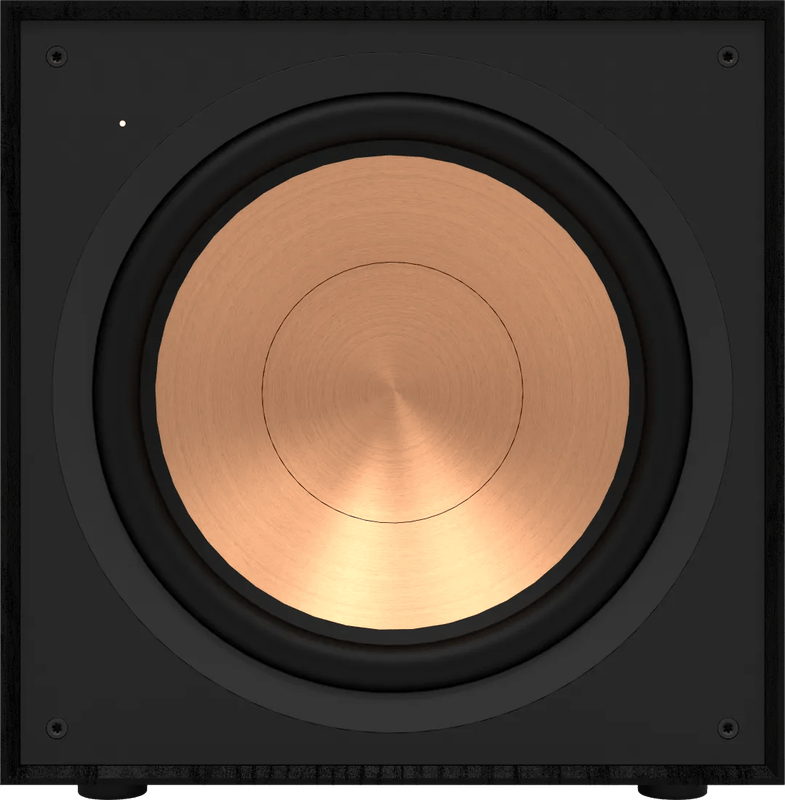
The Klipsch is the simplest candidate: knobs for volume and low-pass, a phase switch for 0 or 180 degrees, automatic power-on. No app, no room calibration. In return, Klipsch states a maximum output of 118 dB and a frequency range of 28 to 120 Hz. The port is at the back, so place it with some distance from the wall. With an AV receiver that has its own room calibration, it lacks little.
Nubert nuSub XW-900
In the XW-900, the driver and ports fire downward, so the enclosure remains a calm box. Nubert built it to work with its active nuPro X speakers: it receives the signal from them wirelessly and time-aligned. With any other amplifier, it connects the conventional way via RCA cable. At 19.5 kg and 48 cm tall, it is no lightweight.
Sonos Sub Mini
Two 6-inch drivers face each other in a sealed cylinder so that their forces cancel out and nothing vibrates. Sonos states 25 Hz as the lower limit. As partners, Sonos lists the Beam, Ray, Era 100, One and One SL. At 6.35 kg and 30.5 cm tall, it disappears next to the sideboard.
Sonos Sub 4
The Sub 4 is only 15.8 cm deep and, according to Sonos, can also lie flat under the sofa. Inside, two elliptical drivers work against each other, and the design is bass reflex. It pairs with the Arc Ultra, Arc, Beam and Ray. Without a Sonos system, however, it is useless; there is no input for other devices.
How we would decide
- AV receiver or stereo amplifier, room up to about 25 m²: SVS SB-1000 Pro.
- Large, open living space with a home theater: SVS PB-1000 Pro, with closed ports if necessary.
- Receiver with room calibration already in place, no app needed: Klipsch R-121SW.
- Nubert X series active speakers: nuSub XW-900, then without a cable across the room.
- Sonos Beam or Ray: Sub Mini. Sonos Arc or Arc Ultra: Sub 4.
We advise against a second sub at first. Sort out placement and settings first, then add more.
Frequently asked questions
What is the difference between a sealed subwoofer and a bass reflex subwoofer?
A sealed enclosure has no opening; the air inside acts like a spring, the bass rolls off gently and barely rings on. Bass reflex uses a port or opening and delivers more output in the very lowest range, but usually requires a larger enclosure and drops off more steeply below its tuning frequency.
Which subwoofer is enough for a small living room?
In rooms up to about 25 square meters, a sealed sub is generally sufficient, because small rooms boost deep bass anyway. In a rented apartment with neighbors below, it is often the smarter choice. An open living and dining area of 45 square meters calls more for a 30 cm driver and a bass reflex port.
Can you connect any subwoofer wirelessly to a soundbar?
Usually only with the matching partner from the same brand. The Sonos Sub Mini and Sub 4 pair via Wi-Fi only with Sonos devices and have no RCA input. A conventional subwoofer with RCA only works with a soundbar that has a subwoofer output; whether it does is listed in the datasheet under connections.
Where should the subwoofer go?
Klipsch recommends a corner on the same wall as the front speakers, where the output rises. But more bass does not mean better bass; corners often boom. An old trick: place the sub at the listening position as a test, play even bass and walk along the walls. Where it sounds most balanced is where it belongs.
Which crossover frequency should you set on the subwoofer?
Klipsch gives a simple guideline: 50 to 90 Hz with floor-standing speakers, 90 to 150 Hz with small satellites or bookshelf speakers. With an AV receiver, its room calibration does most of the work, i.e. level, distance and crossover frequency.
Is a second subwoofer worth it?
Not at first. The room shapes the bass more than the subwoofer itself, so placement and settings should be sorted out before adding more. Room calibration helps, such as Trueplay from Sonos or room adjustment via the app from Nubert.
Sources
- Secrets of Home Theater and High Fidelity: SVS SB-1000 Pro (April 2021)
- AV NIRVANA: SVS PB-1000 Pro (July 2021)
- Klipsch: R-121SW datasheet
- Klipsch: Reference subwoofer manual
- Nubert: nuSub series press release
- Sonos: Sub Mini
- Sonos: Sub 4
- Teufel: T 10 Mk2
Where to buy
- SVS SB-1000 ProCheck price at Amazon.deCheck price at Amazon.co.ukCheck price at Amazon.nlCheck price at Amazon.com.beCheck price at Amazon.frCheck price at Amazon.itCheck price at Amazon.esCheck price at Amazon.plCheck price at Amazon.seAvailable in Germany: Amazon.de
- Klipsch R-121SWView at CoolblueAvailable in Germany: CoolblueCheck price at Amazon.deCheck price at Amazon.co.ukCheck price at Amazon.nlCheck price at Amazon.com.beCheck price at Amazon.frCheck price at Amazon.itCheck price at Amazon.esCheck price at Amazon.plCheck price at Amazon.seAvailable in Germany: Amazon.de
- SVS PB-1000 ProCheck price at Amazon.deCheck price at Amazon.co.ukCheck price at Amazon.nlCheck price at Amazon.com.beCheck price at Amazon.frCheck price at Amazon.itCheck price at Amazon.esCheck price at Amazon.plCheck price at Amazon.seAvailable in Germany: Amazon.de
- Nubert nuSub XW-900 (weiß)Check price at Amazon.deCheck price at Amazon.co.ukCheck price at Amazon.nlCheck price at Amazon.com.beCheck price at Amazon.frCheck price at Amazon.itCheck price at Amazon.esCheck price at Amazon.plCheck price at Amazon.seAvailable in Germany: Amazon.de
- Sonos Sub MiniCheck price at Amazon.deCheck price at Amazon.co.ukCheck price at Amazon.nlCheck price at Amazon.com.beCheck price at Amazon.frCheck price at Amazon.itCheck price at Amazon.esCheck price at Amazon.plCheck price at Amazon.seAvailable in Germany: Amazon.de
- Sonos Sub 4Check price at Amazon.deCheck price at Amazon.co.ukCheck price at Amazon.nlCheck price at Amazon.com.beCheck price at Amazon.frCheck price at Amazon.itCheck price at Amazon.esCheck price at Amazon.plCheck price at Amazon.seAvailable in Germany: Amazon.de