Contents14 sections
This guide was first published in German on handgetestet.de.
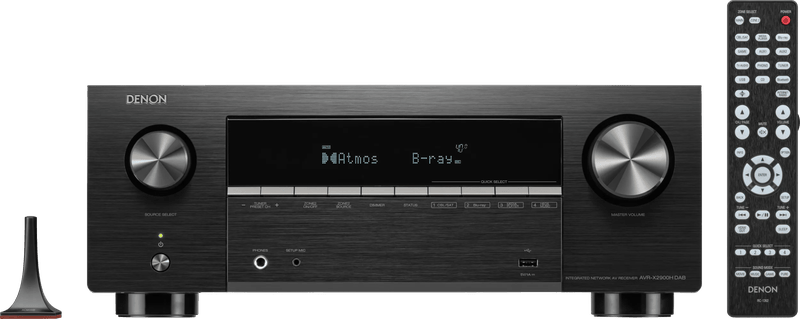
Most bad AV receiver purchases don’t go wrong on sound but on the number printed on the box. A 9.4 unit sounds like more cinema than a 7.2 unit, but it does little good if the living room only has space for five speakers and two ceiling speakers. For a typical home with 5.1.2, we consider the Denon AVR-X2900H DAB the most sensible buy, because it brings seven amplifier channels, an optional Dirac calibration later on and two HDMI outputs. If you want to spend less, the Denon AVR-X1800H will serve you well. Below we explain, one by one, what the terms mean.
What the three numbers in 5.1.2 and 7.1.4 mean
The notation comes from Dolby. The first number counts the speakers at ear level, the second the low-frequency channel, the third the height speakers. So 5.1.2 means: front left and right, center, two surround speakers, a subwoofer and two speakers overhead. With 7.1.4 you add two rear surround speakers and two more height channels. If a unit shows „.2“ or „.4“ in the second position, it has two or four subwoofer outputs. According to its installation guidelines, Dolby still generates only a single effects signal for the bass; several subwoofers spread the bass more evenly around the room, but they are not additional channels.
The key is the difference between amplification and processing. A receiver can process more channels than it powers itself. The Denon AVC-X3900H has nine amplifier channels, but according to the manufacturer it processes 11.4 channels and sends all of them out as preamp outputs. Add an extra stereo power amplifier and you get a 7.1.4 system. The AVR-X2900H DAB has seven amplifier channels and seven processed channels. More than 5.1.2 or 7.1 is not possible here, whatever you add later.
Sounds like a detail. It isn’t.
Height channels: measure the ceiling before you buy channels
Whether Dolby Atmos and DTS:X are worth it depends on the room. For ceiling speakers, Dolby recommends an elevation angle of 45 degrees from the listening position, with 30 to 55 degrees acceptable. The speakers should hang two to three times as high as the ear-level speakers, which Dolby puts at a typical 1.2 meters. Upfiring add-on speakers need a flat, acoustically reflective ceiling between 2.3 and 4.3 meters; according to Dolby they work best up to 3.66 meters. Under a sloped attic ceiling or a wooden beam ceiling with acoustic panels, the result is uncertain. These speakers should also be at least 0.9 meters, better 1.5 meters, from the nearest seat.
That leads to a simple rule. In a living room with the sofa against the back wall, there is often no room for rear surround speakers, and 5.1.2 is the sensible goal. If you have a dedicated home theater room with a clear ceiling, plan for 7.1.4 and buy a unit with at least eleven processed channels. Anything in between is often money spent on connections that never get used.
HDMI 2.1 and eARC: where the console belongs
Since HDMI 2.1, 4K at 120 Hz and 8K at 60 Hz pass through the receiver. For game consoles, what counts is VRR (variable refresh rate against stutter and tearing), ALLM (the TV switches automatically to its low-latency mode) and QFT (faster frame transport). For up to 48 Gbps, the HDMI Forum introduced dedicated Ultra High Speed cables with HDMI 2.1. If 4K120 does not come through, an old cable from the drawer is a typical culprit.
Also check which inputs accept the fast signals. On the two smaller Denon models and the Marantz Cinema 70s, only three of the six inputs are 8K-capable; on the Yamaha RX-V6A it is inputs 1 to 3. The console, a fast PC and the 4K player belong there, the cable box goes on one of the remaining inputs.
eARC is the return path from the TV to the receiver. It brings audio from the TV’s apps across in full quality; for its eARC outputs, Denon explicitly lists Dolby TrueHD, DTS-HD Master Audio and Dolby Atmos. That only works, however, if the TV also supports eARC on at least one port. If it only has the older ARC, you are left with compressed audio. How to tell on the TV is explained in our guide to OLED TVs. And if you are toying with the idea of a projector: the second HDMI output of the X2900H DAB feeds both the TV and a 4K projector (in German) without swapping cables.
Room calibration: Audyssey, YPAO, Dirac Live
Denon and Yamaha include a measurement microphone. The automatic setup measures distances, levels and room resonances and corrects for them. Denon and Marantz rely on Audyssey MultEQ XT, which on the X1800H evaluates up to eight listening positions. Yamaha calls its system YPAO.
The alternative is Dirac Live. According to Denon, the X2900H DAB and the AVC-X3900H are prepared for it, but the upgrade is not included. In an older home with echoing floorboards it can pay off; in a furnished living room the Audyssey measurement already achieves a lot. Take your time measuring and keep the microphone at ear height, otherwise the automatic setup works with the wrong values.
4-ohm speakers and the hidden setting
Many floorstanding speakers have a nominal impedance of 4 ohms, but receivers leave the factory set to 8 ohms. According to the manual, Denon allows 4 to 16 ohms but requires the matching setting in the hidden setup menu for 4 or 6 ohms. On the Yamaha RX-V6A, 4 ohms are permitted only on the front channels, all other speakers need at least 6 ohms, and the switch is then set to „6Ω MIN“. Forget the setting and you risk the protection circuit shutting down at high volume.
The wattage figures on the box are of little help for comparison, because every manufacturer chooses different conditions. The only meaningful value is the one at 8 ohms, 20 to 20,000 hertz and two channels driven. That is the one we used in the table.
Streaming and power consumption in everyday use
Denon and Marantz come with HEOS, Yamaha with MusicCast. Each is a closed ecosystem: multiroom works most conveniently with speakers from the same family, for example from our soundbar guide (in German) or matching wireless speakers. The X1800H and the Yamaha list AirPlay 2 in the spec sheet, the Marantz AirPlay. If you are used to sending music from an Android phone via Chromecast, check carefully before buying. The manufacturers mainly push their own apps here.
Power consumption deserves a second look. In true standby all models are frugal; Denon and Yamaha state 0.1 watts. With network standby enabled, so the app can wake the unit, it is under 2 watts for Denon and 2.0 watts for the Yamaha. Idle matters more: according to the spec sheet, the X2900H DAB draws 35 watts without sound with ECO mode and 75 watts without it. If the receiver runs four hours a day in the background, that is a difference of around 58 kilowatt-hours a year. So switch ECO on.
Five current receivers compared
| Model | Amplifier channels / processing | HDMI and video | Calibration, streaming | Best for |
|---|---|---|---|---|
| Denon AVR-X1800H | 7 × 80 W (8 Ω), up to 5.2.2 | 6 in (3 × 8K), 1 out with eARC; 4K120, VRR, ALLM, QFT | Audyssey MultEQ XT; HEOS, AirPlay 2 | Entry into 5.1.2 in the living room |
| Denon AVR-X2900H DAB | 7 × 95 W (8 Ω), 7.1 channels | 6 in (3 × 8K), 2 out (1 × eARC); 4K120, VRR, ALLM | Audyssey MultEQ XT, Dirac Live ready; HEOS | 5.1.2 with TV and projector |
| Denon AVC-X3900H | 9 × 10⁵ W (8 Ω), 11.4 channels with preamp outputs | 6 in (8K), eARC; VRR, ALLM | Audyssey, Dirac Live ready; HEOS, Auro-3D | Home theater room with 7.1.4 |
| Marantz Cinema 70s | 7 × 50 W (8 Ω) | 6 in (3 × 8K), 1 out with eARC | Audyssey MultEQ; HEOS, AirPlay | Slim unit for the sideboard |
| Yamaha RX-V6A | 7 × 100 W (8 Ω) | 7 in (8K on 1–3), 1 out with eARC; 4K120 | YPAO; MusicCast, AirPlay 2 | Homes with Yamaha multiroom |
Denon AVR-X1800H
The least expensive route to 5.2.2 at Denon. Seven amplifier channels, AirPlay 2 and HDMI features that, according to the spec sheet, cover 4K120, VRR, ALLM and QFT. There is only one HDMI output. That is enough for a living room with one TV, but not for a TV plus a projector.
Denon AVR-X2900H DAB
Our recommendation for most living rooms. Compared with the X1800H, it adds a second HDMI output, a phono input for turntables with an MM cartridge and readiness for Dirac Live. If you want to expand to more channels later with an external power amplifier, this is the wrong unit: the receiver processes only 7.1 channels.
Denon AVC-X3900H
This is where home theater gear begins. Nine built-in amplifier channels are enough for 5.1.4 or 7.1.2, and the preamp outputs for 11.4 make 7.1.4 possible with an additional power amp. Four independent subwoofer outputs help in large rooms. At idle without sound, Denon states 60 watts with ECO, significantly more than the smaller models.
Marantz Cinema 70s
The Marantz belongs to the manufacturer’s slim series and fits into furniture where a normal receiver won’t. With 50 watts per channel, it is meant for smaller rooms and efficient speakers. Marantz now lists the first edition only as limited stock; the successor, the Cinema 70s Series 2, is prepared for Dirac Live.
Yamaha RX-V6A
Seven HDMI inputs is a lot in this class. Network setup runs through the MusicCast app, which is convenient for homes with Yamaha speakers. Watch the impedance: only the front speakers may be 4 ohms.
How we would decide
- Living room, one TV, 5.1 or 5.1.2: Denon AVR-X1800H.
- Living room with TV and projector or with a turntable: Denon AVR-X2900H DAB.
- Dedicated cinema room with a clear ceiling and plans for 7.1.4: Denon AVC-X3900H with a stereo power amp.
- Little height in the low TV cabinet: Marantz Cinema 70s, while it is still available.
- Yamaha speakers with MusicCast in the house: Yamaha RX-V6A.
- Sonos in the house: none of the five talks to Sonos directly. According to the manufacturer, Onkyo integrates some receivers via a Sonos Port; in that case, check the current lineup.
One last word. More channels don’t make a better movie; well-placed speakers do. When in doubt, invest in the subwoofer rather than in amplifier channels that stay unused.
Frequently asked questions
What do 5.1.2 and 7.1.4 mean on an AV receiver?
The first number counts the speakers at ear level, the second the low-frequency channel, the third the height speakers. So 5.1.2 means front left and right, center, two surround speakers, a subwoofer and two speakers overhead. With 7.1.4 you add two rear surround speakers and two more height channels.
Which AV receiver is enough for a living room?
With one TV and 5.1 or 5.1.2, the Denon AVR-X1800H. If a projector or a turntable comes into play, the AVR-X2900H DAB with its second HDMI output and phono input. It is not designed for more than 7.1 channels, though.
Is Dolby Atmos with ceiling speakers worth it?
The room decides. Dolby recommends an elevation angle of 45 degrees from the listening position. Upfiring add-on speakers need a flat, acoustically reflective ceiling between 2.3 and 4.3 meters high. Under a sloped attic ceiling, the result is uncertain.
What do I need for 4K at 120 Hz from a game console?
A receiver with HDMI 2.1, an Ultra High Speed cable and the right input. On the smaller Denon models and the Marantz Cinema 70s, only three of the six inputs are 8K-capable. If 4K120 does not come through, an old cable is often the reason.
Can I run 4-ohm speakers on an AV receiver?
Usually yes, but not with the factory settings. Denon allows 4 to 16 ohms but requires the matching setting in the hidden setup menu for 4 or 6 ohms. On the Yamaha RX-V6A, 4 ohms are permitted only on the front channels. Otherwise the protection circuit may shut the unit down.
How much power does an AV receiver use?
In true standby only 0.1 watts. At idle, however, the X2900H DAB draws 35 watts with ECO mode and 75 watts without, according to the spec sheet. If it runs four hours a day in the background, that is a difference of around 58 kilowatt-hours a year. So switch ECO on.
Sources
- Denon AVR-X1800H, manufacturer page
- Denon AVR-X2900H DAB, manufacturer page
- Denon AVC-X3900H, manufacturer page
- Denon AVR-X2900H, owner’s manual: connecting speakers
- Marantz Cinema 70s, manufacturer page
- Marantz Cinema 70s Series 2, manufacturer page
- Yamaha RX-V6A, owner’s manual: specifications
- Yamaha RX-V6A, owner’s manual: speaker requirements
- Dolby Atmos Home Theater Installation Guidelines (PDF)
- HDMI Forum: HDMI specification
Where to buy
- Denon AVR-X2900H DABView at CoolblueAvailable in Germany: CoolblueCheck price at Amazon.deCheck price at Amazon.co.ukCheck price at Amazon.nlCheck price at Amazon.com.beCheck price at Amazon.frCheck price at Amazon.itCheck price at Amazon.esCheck price at Amazon.plCheck price at Amazon.seAvailable in Germany: Amazon.de
- Denon AVR-X1800HCheck price at Amazon.deCheck price at Amazon.co.ukCheck price at Amazon.nlCheck price at Amazon.com.beCheck price at Amazon.frCheck price at Amazon.itCheck price at Amazon.esCheck price at Amazon.plCheck price at Amazon.seAvailable in Germany: Amazon.deView at CoolblueAvailable in Germany: Coolblue
- Denon AVC-X3900HView at CoolblueAvailable in Germany: CoolblueCheck price at Amazon.deCheck price at Amazon.co.ukCheck price at Amazon.nlCheck price at Amazon.com.beCheck price at Amazon.frCheck price at Amazon.itCheck price at Amazon.esCheck price at Amazon.plCheck price at Amazon.seAvailable in Germany: Amazon.de
- Marantz Cinema 70sCheck price at Amazon.deCheck price at Amazon.co.ukCheck price at Amazon.nlCheck price at Amazon.com.beCheck price at Amazon.frCheck price at Amazon.itCheck price at Amazon.esCheck price at Amazon.plCheck price at Amazon.seAvailable in Germany: Amazon.de
- Yamaha RX-V6ACheck price at Amazon.deCheck price at Amazon.co.ukCheck price at Amazon.nlCheck price at Amazon.com.beCheck price at Amazon.frCheck price at Amazon.itCheck price at Amazon.esCheck price at Amazon.plCheck price at Amazon.seAvailable in Germany: Amazon.de