Contents12 sections
This guide was first published in German on handgetestet.de.
Portioning ground meat twice a month and buying an expensive chamber sealer for it? That misses the actual need. In most households, a solid external vacuum sealer with a double seal and a roll compartment is enough, such as the Caso VRH 690 advanced. A chamber only pays off if soups, stocks or marinades regularly go into the bag.
What goes into the bag: dry or liquid?
That determines the type. An external vacuum sealer draws the air directly out of the bag, whose open end sits in a trough. With meat, cheese and vegetables, that works well. With liquids, however, the pump also pulls juice along with it, which then ends up in the drip tray or, worse, in the pump. In a chamber sealer, the entire bag sits under a lid, and the air is drawn out of the chamber. That way the soup stays where it belongs.
That comes at a cost. According to the manufacturer, a chamber sealer such as the Caso VacuChef 40 weighs 8.4 kilograms, takes up permanent space on the countertop and costs about four to five times as much as a simple external sealer in the Caso online shop. If you mainly seal dry foods, you are paying for a capability you rarely need.
How much and how often?
Twenty bags in a row after a big shopping trip? Then the vacuum sealer has to keep going and must not demand a break after just a few cycles. For the pump, values between 9 and 20 liters per minute are common for external sealers; more power mainly saves time with large quantities. A double seal is more forgiving of a crumb or a bit of moisture at the edge of the bag than a single one.
Two more details. With a pulse function, you stop the vacuum by hand before berries or bread get crushed. And a roll compartment with cutter sounds like an accessory, but in everyday use it decides whether bags can be conveniently cut to size.
Vacuum bags: the underestimated consumable
External sealers need bags with an embossed texture. Otherwise the air cannot find its way to the pump. Status, a manufacturer from Slovenia, requires a ribbed profile of at least 0.2 millimeters for its bags. Smooth bags from the supermarket will not work for this. Factor the bags into your costs, because over the years they end up costing more than the device itself. With chamber sealers, the chamber also limits the bag size; on the VacuChef 40, to bags up to 25 centimeters wide.
How long does vacuum-sealed food really keep?
Manufacturers advertise with big multipliers. Caso and Solis talk about food staying fresh up to eight times longer. Those are manufacturer claims, not storage rules.
What matters is a notice from the German Federal Institute for Risk Assessment (BfR): the bacterium Clostridium botulinum only grows in the absence of air. Vacuum-packed foods can allow it to grow if stored unrefrigerated. So the vacuum does not replace the fridge; it requires one. For packaged meat, the Verbraucherzentrale (German consumer advice center) recommends following the refrigeration instructions on the package, such as +2 to +4 degrees, and 4 to 7 degrees for cold cuts and sausage. For longer storage, the freezer remains the safe place, where the bag mainly protects against freezer burn. A suitable fridge with a reliable temperature zone is therefore at least as important as the vacuum sealer.
Five vacuum sealers from Caso and Solis
| Model | Type | Pump and seal (manufacturer specification) | Best for |
|---|---|---|---|
| Caso VC 10 | External | 9 l/min, single seal up to 30 cm | Occasional portioning |
| Caso VRH 690 advanced | External | 20 l/min, -0.9 bar, double seal up to 30 cm | Regular food storage |
| Caso VRH 790 advanced Pro | External with Liquid-Stopp | 20 l/min, -0.9 bar, double seal up to 30 cm | Sauces and stocks now and then |
| Solis Vac Prestige (Typ 575) | External | 12 l/min, -0.8 bar, 2.5 mm seal | Moderate use, marinating |
| Caso VacuChef 40 | Chamber (3 liters) | 70 l/min, double seal, bags up to 25 cm | Liquids, sous vide prep |
Caso VC 10: small and modest
The VC 10 has been around for years, and according to Caso it weighs only 1.4 kilograms. The pump manages 9 liters per minute, and the seal is single. The vacuum strength can be limited by hand. Stiftung Warentest (the German consumer testing organization) rated it GUT (good, 2.0) in issue 01/2018, a result that is now dated. If you seal rarely and do not need speed, it will do the job.
Caso VRH 690 advanced: the solid middle ground
Dual-piston pump with 20 liters per minute, a double seal of 2.5 millimeters each and, according to Caso, up to 150 sealing cycles in a row without overheating. Add to that a roll compartment, a cutter, three sealing times for dry and moist foods and a removable drip tray. At 2.8 kilograms, it stays easy to handle. If a family buys meat in large packs, it is the sensible solution.
Caso VRH 790 advanced Pro: external sealer with a liquid brake
Technically, the sibling of the VRH 690. On top of that comes a function Caso calls Liquid Stop: it ends the suction in time, before liquid is drawn into the device. Bags with a stand-up bottom are included in the box, and according to the manufacturer, 200 cycles in a row are possible. If you only occasionally freeze soup, you can manage without a chamber sealer. Because it stops earlier, however, more air remains in the bag with liquids than in a chamber.
Solis Vac Prestige (Typ 575): Swiss alternative
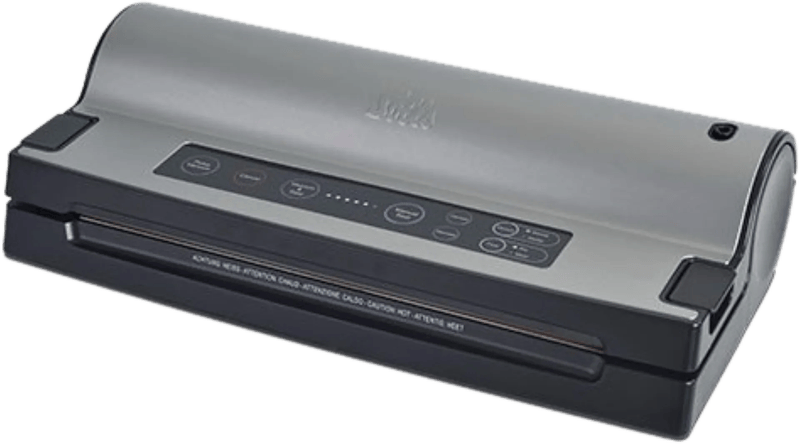
In its spec sheet, Solis lists a suction power of 12 liters per minute and a vacuum of up to -0.8 bar. At 2.5 millimeters, the seal is thick. Pulse and marinating functions, drip tray, roll compartment and bag cutter are included. The pump is weaker than on the VRH 690, while the features are similar.
Caso VacuChef 40: the smallest chamber
The chamber measures 26.5 by 26.5 by 6 centimeters, and according to Caso the four-piston pump delivers 70 liters per minute. Liquids, marinades and moist dishes stay in the bag. Using a hose, containers and textured bags can also be vacuum-sealed outside the chamber. A whole roast? Too flat. If you prepare a lot for sous vide cooking, you still gain the most convenience here.
Which vacuum sealer suits which household
Only sealing cheese or meat every now and then: the Caso VC 10 is enough for that. It costs little, but it cannot do much either. If you portion food regularly, go for the Caso VRH 690 advanced or, as an alternative, the Solis Vac Prestige.
Soups and sauces only occasionally? Then choose the Caso VRH 790 advanced Pro instead of a chamber sealer.
We see the Caso VacuChef 40 for frequent liquids and lots of sous vide. For everyone else, the chamber offers too little for its price.
If you portion food, you usually weigh it too. An accurate kitchen scale helps you pack bags of equal size that later thaw equally fast.
According to the manufacturer, the Solis Vac Prestige 575 has 130 W, up to -0.8 bar, a suction power of 12 liters per minute and a 2.5 mm wide seal.
Frequently asked questions
What is the difference between external and chamber vacuum sealers?
An external vacuum sealer draws the air directly out of the bag. With liquids, the pump also pulls juice along with it, which ends up in the drip tray or in the pump. In a chamber sealer, the entire bag sits under a lid, the air is drawn out of the chamber, and the soup stays in the bag.
Can you seal liquids with an external vacuum sealer?
Only to a limited extent. The Caso VRH 790 advanced Pro has a Liquid Stop that ends the suction before liquid is drawn into the device. For occasional soups, that is enough without a chamber sealer. Because it stops earlier, however, more air remains in the bag with liquids than in a chamber.
Which bags does a vacuum sealer need?
External sealers need bags with an embossed texture; otherwise the air cannot find its way to the pump. Smooth bags from the supermarket will not work. Factor the bags into your costs, because over the years they end up costing more than the device. With chamber sealers, the chamber limits the bag size.
Do vacuum-sealed foods need to go in the fridge?
Yes. The German Federal Institute for Risk Assessment (BfR) points out that Clostridium botulinum only grows in the absence of air and that vacuum-packed foods can allow it to grow if stored unrefrigerated. So the vacuum does not replace the fridge. For longer storage, the freezer remains the safe place.
What should you look for if you vacuum-seal a lot at once?
The vacuum sealer has to manage many bags in a row without needing a break. The manufacturer rates the Caso VRH 690 advanced for up to 150 sealing cycles in a row without overheating. A double seal is more forgiving of crumbs or moisture at the edge. A pulse function protects berries or bread from being crushed.
Sources
- Caso: VC 10
- Caso: VRH 690 advanced
- Caso: VRH 790 advanced Pro
- Caso: VacuChef 40
- Caso: Tips on vacuum sealing
- Solis: Vac Prestige Typ 575 spec sheet (PDF)
- Status: Notes on vacuum bags
- BfR: Questions and answers on botulism (as of 06/15/2023)
- Verbraucherzentrale: Meat in modified atmosphere packaging
- Verbraucherzentrale: Storing ham and sausage
Where to buy
- Caso VRH 690 advancedCheck price at Amazon.deCheck price at Amazon.co.ukCheck price at Amazon.nlCheck price at Amazon.com.beCheck price at Amazon.frCheck price at Amazon.itCheck price at Amazon.esCheck price at Amazon.plCheck price at Amazon.seAvailable in Germany: Amazon.de
- Caso VC 10Check price at Amazon.deCheck price at Amazon.co.ukCheck price at Amazon.nlCheck price at Amazon.com.beCheck price at Amazon.frCheck price at Amazon.itCheck price at Amazon.esCheck price at Amazon.plCheck price at Amazon.seAvailable in Germany: Amazon.de
- Caso VRH 790 advanced ProCheck price at Amazon.deCheck price at Amazon.co.ukCheck price at Amazon.nlCheck price at Amazon.com.beCheck price at Amazon.frCheck price at Amazon.itCheck price at Amazon.esCheck price at Amazon.plCheck price at Amazon.seAvailable in Germany: Amazon.de
- Solis Vac Prestige (Typ 575)Check price at Amazon.deCheck price at Amazon.co.ukCheck price at Amazon.nlCheck price at Amazon.com.beCheck price at Amazon.frCheck price at Amazon.itCheck price at Amazon.esCheck price at Amazon.plCheck price at Amazon.seAvailable in Germany: Amazon.de
- Caso VacuChef 40Check price at Amazon.deCheck price at Amazon.co.ukCheck price at Amazon.nlCheck price at Amazon.com.beCheck price at Amazon.frCheck price at Amazon.itCheck price at Amazon.esCheck price at Amazon.plCheck price at Amazon.seAvailable in Germany: Amazon.de
- Solis Vac Prestige 575View at CoolblueAvailable in Germany: Coolblue