Contents14 sections
This guide was first published in German on handgetestet.de.
Vinyl or laminate? The question sounds like a matter of taste. The room decides it. For living rooms, bedrooms and home offices, we consider a laminate in usage class 32 with an eco-label the solid choice, such as the Egger NatureSense in 8 mm. Vinyl with a rigid SPC core belongs where water gets on the floor, meaning the bathroom, the kitchen or the entrance hall. Glue-down vinyl is for flawless subfloors.
First the room, then the decor
At its core, laminate is a wood fiber board. HARO describes the structure of its Tritty 100 like this: an impregnated protective layer on top, the decor paper below it, an HDF core board with moisture protection in the middle, and a backing layer at the bottom. That makes laminate hard and dimensionally stable. However, it only tolerates standing water at the joints to a limited extent. Egger states no water protection at all for the regular NatureSense line, 24 hours for the Aqua versions and 72 hours for Aqua+.
Three quite different floors are sold as „vinyl“. Click vinyl on an HDF core is more a relative of laminate: Parador states water resistance of 24 hours for the 9.4 mm Basic 30. Rigid vinyl with an SPC core, such as the Basic 5.3, is waterproof according to EN 317, as stated in the data sheet. And 2 mm glue-down vinyl is bonded across the full surface instead of clicked together. So if you are looking for „vinyl for the bathroom“, you have to look at the core. The word alone says nothing.
What the usage class really tells you
The two-digit number is printed on every package. The first digit indicates the area, the second the level of wear. According to the data sheets from HARO and Parador, class 23 stands for residential use with intensive wear, 31 for commercial spaces with light wear and 32 for commercial spaces with normal wear. For laminate, EN 13329 applies; for vinyl, manufacturers state the class according to ISO 10874.
Formally, then, class 23 is enough for a home. For laminate, we would still go with 32. At Egger, more than a label depends on it: class 31 requires at least 2,000 revolutions in the abrasion test (AC3), class 32 at least 4,000 (AC4), class 33 at least 6,000 (AC5). The manufacturer’s warranty for residential use rises accordingly from 15 to 20 and 25 years. We consider class 33 unnecessary in private homes.
Underfloor heating: include the underlay in your calculation
A floor over the heating slows down the heat. How much is indicated by the thermal resistance in m²K/W. Parador and HARO both state 0.15 m²K/W as the upper limit, for the flooring and underlay together. The values of the floors here vary widely. According to Parador, the glue-down vinyl Basic 2.0 comes to 0.012 and the SPC vinyl Basic 5.3 to 0.024. The HARO laminate is at 0.065, the Parador Basic 30 with cork backing at 0.068.
A sample calculation from the Egger data sheet: 8 mm NatureSense has 0.06 m²K/W, the Egger underlay Silenzio easy 0.057. Together that makes 0.117. That works. A second insulation layer on top would quickly tip the calculation. Then there is the surface temperature. Egger allows a maximum of 28 °C, HARO 29 °C. Egger rules out night storage underfloor heating, and Parador advises against systems from before 2000.
Impact sound is not room sound
The decibel figure on the packaging almost always describes impact sound, meaning what the neighbors below hear. In your own room, something else counts: the hollow clacking as you walk. HARO illustrates the difference very clearly. The Silent Pro option delivers around 18 dB of impact sound reduction and about 30 percent less room sound. Silent CT only manages around 14 dB but reduces room sound by about 60 percent. On a ground floor with no neighbors below, the second figure is the more important one.
With vinyl, the insulation is often already bonded to the underside of the plank. Parador measures an integrated 17 dB for the Basic 5.3 and 15 or 16 dB for the Basic 30, depending on the underlay. Double insulation brings little benefit here. For planks with cork backing, Parador nevertheless requires a PE film underneath on every subfloor.
PVC, plasticizers and the eco-labels
This is where the real difference lies. The Verbraucherzentrale, the German consumer advice center, advises against PVC floor coverings because, in addition to plasticizers, they often contain other substances. The Blauer Engel (Blue Angel), Germany’s eco-label, only awards resilient floor coverings under DE-UZ 120 if no halogenated organic compounds and no plasticizers from the phthalate or organophosphate groups are used in production. That rules out classic PVC vinyl. For its vinyl floors, Parador states the French emission class A+ and a TÜV Rheinland certificate. The manufacturer does not state online which plasticizers are contained.
Laminate has an easier time here. Egger describes NatureSense as free of PVC and plasticizers, with the EU Ecolabel, emission class A+ and M1. For the Tritty 100, HARO documents emissions for the Blue Angel under RAL UZ 176 and states a maximum of 0.05 ppm formaldehyde. If you have to glue, the Verbraucherzentrale advises using only adhesive with the Blue Angel or EMICODE EC1PLUS.
Five floors and their key specs
| Model | Type and thickness | Usage class | Thermal resistance | Best for |
|---|---|---|---|---|
| Egger NatureSense 8/32 Classic | Click laminate, 8 mm, PVC-free | 32 (AC4) | 0.06 m²K/W | Living rooms and bedrooms, also with underfloor heating |
| HARO Tritty 100 Gran Via 4V | Click laminate, 8 mm, 2.20 m country-style plank | 23/32 (AC4) | 0.065 m²K/W | Large rooms, Blue Angel wanted |
| Parador Vinyl Basic 5.3 | Click vinyl, SPC core, 5.3 mm, integrated underlay | 23/31 | 0.024 m²K/W | Bathroom, kitchen, entrance hall |
| Parador Vinyl Basic 30 | Click vinyl on HDF, 9.4 mm, cork backing | 23/31 | 0.068 m²K/W | Living spaces with a soft, quiet feel underfoot |
| Parador Vinyl Basic 2.0 | Glue-down vinyl, 2 mm | 23/31 | 0.012 m²K/W | Low build-up height, level screed, professional installer |
Egger NatureSense 8/32 Classic
For dry living spaces, we consider this floor the most consistent choice. The planks measure 1,292 x 193 mm, use the CLIC it! click system and, according to Egger, have a wood content of around 85 percent. Usage class 32 here means AC4 and a 20-year manufacturer’s warranty for residential use. Water protection is missing; for bathrooms and kitchens, Egger offers the Aqua lines. The decor Livingston Eiche natur (Livingston natural oak) comes without a bevel.
HARO Tritty 100 Gran Via 4V
Planks 2.20 m long and 243 mm wide with a bevel on all four sides. On 30 square meters, that means fewer end joints, and the room looks calmer. HARO gives a 25-year warranty for residential use, documents the Blue Angel and offers the Silent Pro or Silent CT underlay factory-fitted. Long planks are unwieldy when laying them alone, though. With two people, it is much easier.
Parador Vinyl Basic 5.3
The floor for wet rooms. According to Parador, the rigid SPC core is waterproof, and the impact sound insulation is laminated on and delivers 17 dB. At 0.024 m²K/W, it passes on the heat from the heating almost unhindered. The R10 slip resistance from the data sheet suits bathrooms and entrances. For living spaces, we would still choose laminate, because of the eco-labels.
Parador Vinyl Basic 30
A 9.4 mm build with an HDF core and cork backing. That gives a feel underfoot that is softer than laminate. It withstands water for 24 hours, which is too short for bathrooms with a shower. According to the data sheet, it cannot be glued across the full surface. If you lay it, put a PE film underneath on a mineral subfloor.
Parador Vinyl Basic 2.0
Only 2 mm thick and, according to Parador, intended exclusively for full-surface gluing. This is the solution for older buildings where doors and transitions do not allow a single extra millimeter of build-up height. Every unevenness in the screed shows through. We see this as a job for a professional installer.
Laying it yourself without trouble
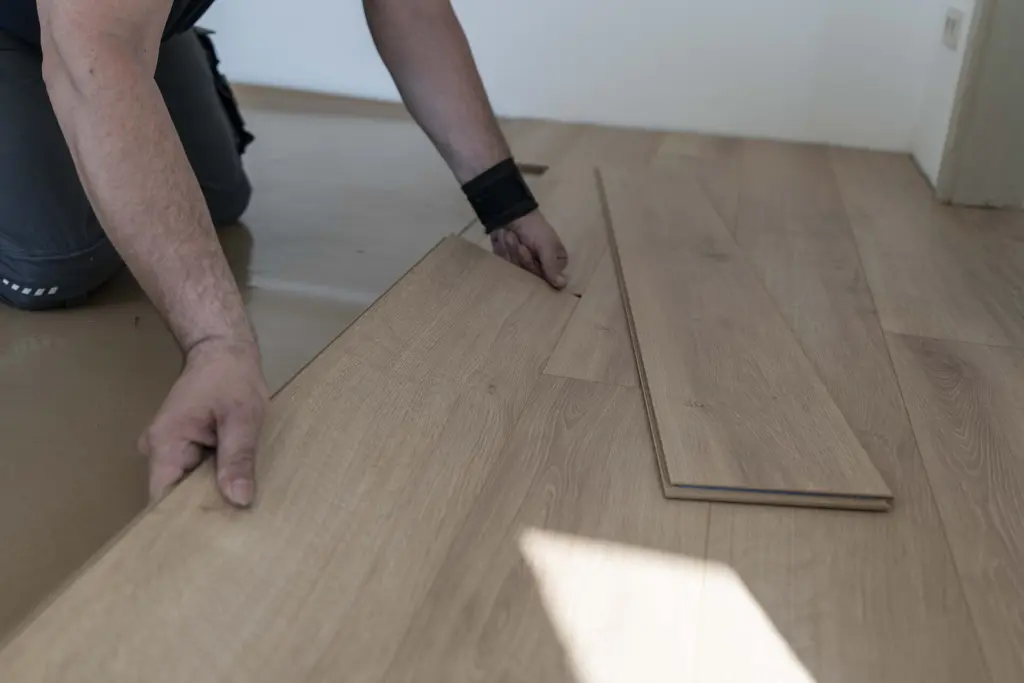
Click floors are made for DIYers. The mistakes happen before the first plank. HARO requires the closed packages to be stored in the room for 24 hours at a minimum of 18 °C. Egger recommends 48 hours, lying flat and 50 cm away from the walls. On screed, laminate needs a 0.2 mm PE film, whose strips HARO has you overlap by 30 cm. Parador’s Akustik-Protect 50, 100 and 500 underlays already have the vapor barrier built in.
Leave an expansion gap of 10 to 15 mm all around, including at heating pipes and door frames. From a room length or width of 12 m, HARO requires a movement joint. For clean crosscuts, a miter saw (in German) is the right tool, and cutouts around pipes are best done with a jigsaw (in German). And when cleaning: a wet-dry floor cleaner must not flood laminate that has no water protection.
Which floor for which room?
- Living room, bedroom, children’s room: laminate in class 32 with a PVC-free structure, such as Egger NatureSense. With the Blue Angel and long planks: HARO Tritty 100.
- Bathroom, kitchen, entrance: click vinyl with an SPC core such as the Parador Basic 5.3, because it is waterproof according to the manufacturer.
- Older building with limited build-up height: glue-down vinyl Basic 2.0, laid by a professional installer with low-emission adhesive.
- Quiet walking on an upper floor: laminate with factory-fitted underlay or vinyl with cork backing, and with underfloor heating, add up the thermal resistance.
Frequently asked questions
Is vinyl flooring always waterproof?
No, three different floors are sold as "vinyl". Click vinyl on an HDF core such as the Parador Basic 30 withstands water for 24 hours according to the manufacturer. Rigid vinyl with an SPC core such as the Basic 5.3 is waterproof according to EN 317. Glue-down vinyl is bonded across the full surface. For the bathroom, it is the core that counts, not the word.
Which usage class do I need for my home?
Formally, class 23 is enough for residential use. For laminate, we still think 32 makes sense: at Egger, it requires at least 4,000 revolutions in the abrasion test (AC4), and the warranty for residential use rises to 20 years. We consider class 33 unnecessary in private homes.
Is laminate suitable for underfloor heating?
Yes, if the thermal resistance of the flooring and underlay together is no more than 0.15 m²K/W, as Parador and HARO both state. Egger calculates 0.117 for 8 mm NatureSense with the Silenzio easy underlay. Egger allows a maximum surface temperature of 28 °C, HARO 29 °C.
What is the difference between impact sound and room sound?
The decibel figure on the package usually describes impact sound, meaning what the neighbors below hear. In your own room, what counts is room sound, the hollow clacking as you walk. At HARO, Silent Pro reduces impact sound more, while Silent CT reduces room sound by about 60 percent.
Does vinyl flooring contain plasticizers?
The Verbraucherzentrale (German consumer advice center) advises against PVC floors because, in addition to plasticizers, they often contain other substances. The German Blue Angel eco-label for resilient floor coverings excludes halogenated compounds and certain plasticizers, which rules out classic PVC vinyl. Parador does not state online which plasticizers are contained.
What should I watch for when laying laminate myself?
Let the packages acclimatize in the room beforehand: 24 hours at a minimum of 18 °C for HARO, 48 hours for Egger. On a screed subfloor, lay a 0.2 mm PE film with a 30 cm overlap. Leave an expansion gap of 10 to 15 mm all around; from a room length of 12 m, HARO requires a movement joint.
Sources
- Egger: EL2822 Livingston Eiche natur (NatureSense)
- Egger: NatureSense technical data sheet
- Egger: NatureSense, Aqua and Aqua+
- Egger: Water-resistant floors
- HARO: Tritty 100 Gran Via 4V
- HARO: Tritty 100 data sheet
- HARO: Top Connect laminate installation instructions
- Parador: Vinyl Basic 5.3 and data sheet
- Parador: Vinyl Basic 30 and data sheet
- Parador: Vinyl Basic 2.0 and data sheet
- Parador: Questions about subfloors
- Parador: Vinyl floors and underfloor heating
- Tarkett: Data sheet with usage class according to ISO 10874
- Blauer Engel (German Blue Angel eco-label): Award criteria DE-UZ 120 for resilient floor coverings
- Verbraucherzentrale: Avoiding harmful substances at home
Where to buy
- Egger NatureSense 8/32 ClassicCheck price at Amazon.deCheck price at Amazon.co.ukCheck price at Amazon.nlCheck price at Amazon.com.beCheck price at Amazon.frCheck price at Amazon.itCheck price at Amazon.esCheck price at Amazon.plCheck price at Amazon.seAvailable in Germany: Amazon.de
- HARO Tritty 100 Gran Via 4VCheck price at Amazon.deCheck price at Amazon.co.ukCheck price at Amazon.nlCheck price at Amazon.com.beCheck price at Amazon.frCheck price at Amazon.itCheck price at Amazon.esCheck price at Amazon.plCheck price at Amazon.seAvailable in Germany: Amazon.de
- Parador Vinyl Basic 5.3Check price at Amazon.deCheck price at Amazon.co.ukCheck price at Amazon.nlCheck price at Amazon.com.beCheck price at Amazon.frCheck price at Amazon.itCheck price at Amazon.esCheck price at Amazon.plCheck price at Amazon.seAvailable in Germany: Amazon.de
- Parador Vinyl Basic 30Check price at Amazon.deCheck price at Amazon.co.ukCheck price at Amazon.nlCheck price at Amazon.com.beCheck price at Amazon.frCheck price at Amazon.itCheck price at Amazon.esCheck price at Amazon.plCheck price at Amazon.seAvailable in Germany: Amazon.de
- Parador Vinyl Basic 2.0Check price at Amazon.deCheck price at Amazon.co.ukCheck price at Amazon.nlCheck price at Amazon.com.beCheck price at Amazon.frCheck price at Amazon.itCheck price at Amazon.esCheck price at Amazon.plCheck price at Amazon.seAvailable in Germany: Amazon.de