Contents12 sections
This guide was first published in German on handgetestet.de.
A wet/dry vacuum with a stainless steel drum picks up sanding dust from an oak board just as easily as water from a basement window well. That does not automatically make it healthy, though. Fine wood dust needs a filter that holds back more than a household device. For a hobby workshop where hardwood is sanded regularly, we consider a dust class M vacuum the right choice, for example the Makita VC3012M. If it is only about shavings, drilling dust and the occasional puddle, you can get by with a device without a dust class such as the Kärcher WD 6 P S.
L, M or H: what the letters mean
The dust classes come from the European standard EN 60335-2-69. Kärcher summarizes them as follows: an L vacuum lets through no more than 1 percent of the dust and is intended for dusts with an occupational exposure limit above 1 mg/m³, such as lime and gypsum. Class M is below 0.1 percent permeability and covers dusts with a limit value from 0.1 mg/m³. Beech and oak wood dust as well as paint, ceramic and plastic dust are explicitly named there. Class H, with less than 0.005 percent, is intended for carcinogenic dusts.
With wood, it gets specific. Kärcher advises removing wood shavings and wood dust only with devices that meet at least class M, because hardwood dusts are suspected of causing nasal cancer. The operating instructions of the Bosch GAS 35 L SFC+ are even clearer. They prohibit using this L vacuum to pick up beech or oak wood dust, stone dust or asbestos. That is a sentence you should know before you buy.
For businesses, the situation is clear. Circular 24 of the Bundesverband Farbe Gestaltung Bautenschutz, a German trade association, published by BG BAU, the German statutory accident insurance for the construction industry, states: vacuums without an L, M or H rating do not belong in businesses, L vacuums may not be used there, and the BG BAU occupational safety bonus is only available for dust extractors from class M upward. M devices, for their part, have an acoustic and visual warning as soon as suction power drops too much. These rules do not apply to a private workshop. Your airways, however, do not make that distinction.
Old building? Then think about asbestos first
According to BG BAU, asbestos must generally be expected in buildings whose construction began before October 31, 1993, including in plasters, fillers and tile adhesives. Only a sample can rule it out. Such work belongs in the hands of a specialist company with expertise under the German technical rule TRGS 519 that works with class H dust extractors. None of the vacuums in this guide is intended for this. Not even an M device.
Outlet, container, filter cleaning: what counts in everyday workshop use
The power tool outlet is what sets a workshop vacuum apart from a household vacuum. If the sander is plugged into the vacuum, the vacuum starts with the tool and runs on briefly so the hose empties. Bosch states up to 15 seconds of run-on and allows tools from 100 to 2,200 watts. Kärcher states 2,100 watts, Makita and Festool 2,400 watts. Any of these outlets is enough for a random orbital sander. Which sander suits your projects is covered in our guide to random orbital sanders. With a plunge saw or circular saw (in German), compare the wattage on its rating plate first.
When it comes to the container, the liter figure on the box is misleading. The Bosch has 35 liters gross, but according to its manual only holds 19 liters of liquid or a 19-liter dust bag. For its 30-liter tank, Makita states 24 liters for dust and 19 liters for water.
Fine sanding dust quickly clogs filters, and then suction power drops. The solutions differ considerably. Kärcher and Makita clean the filter with bursts of air at the push of a button, Bosch semi-automatically with a hand lever. With the iPulse, Starmix measures the pressure in front of and behind the filter and, when needed, taps both filters clean on its own in about 3.5 seconds. A practical tip from the Bosch manual applies to all devices with filter cleaning: with sanders and jigsaws, open the bypass air opening on the extraction adapter fully, otherwise the filter cleaning will not work properly.
One more word about data sheets. Bosch measures 74 liters per second at the turbine; at the vacuum with a three-meter hose, 36 remain. Starmix states 75 liters at the motor head and 45 at the end of the hose. Only compare values measured at the same point.
Six workshop vacuums side by side
| Model | Dust class | Container, weight | Outlet and filter cleaning | Best for |
|---|---|---|---|---|
| Kärcher WD 6 P S V-30/6/22/T | none | 30 l stainless steel, 9.3 kg | up to 2,100 W, cleaning at the push of a button | Basement, garage, shavings and water |
| Bosch GAS 35 L SFC+ | L | 35 l gross, 11.6 kg | 100 to 2,200 W, semi-automatic (SFC+) | Gypsum, lime, softwood |
| Makita VC3012L | L | 30 l plastic, 11.0 kg | up to 2,400 W, cleaning at the push of a button | Workshop with a long hose |
| Makita VC3012M | M | 30 l plastic, 11.0 kg | up to 2,400 W, cleaning at the push of a button | Sanding hardwood, paint, plastic |
| Festool CTL 26 EI | L | 26 l, 13.7 kg | up to 2,400 W, Bluetooth start, self-cleaning filter bag | Festool tools and Systainers |
| Starmix iPulse L-1635 Basic | L | 35 l plastic, 15.6 kg | Power tool outlet, automatic pulse cleaning | long sanding jobs with fine dust |
Kärcher WD 6 P S V-30/6/22/T
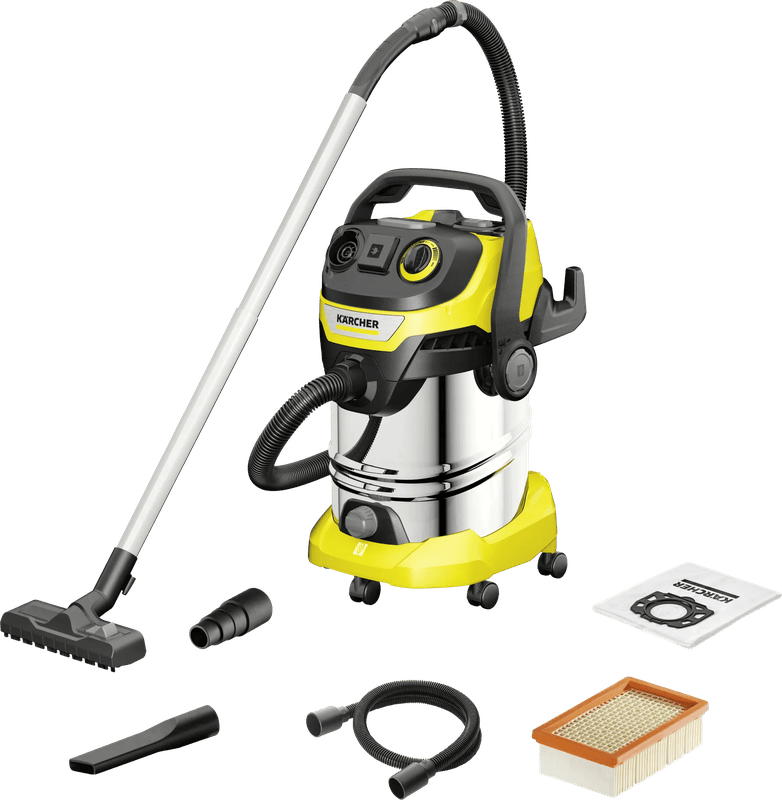
The Kärcher is a wet/dry vacuum for house and yard, with a 30-liter stainless steel container, a flat pleated cellulose filter, a filter cleaning button and an outlet with automatic on/off. Kärcher states 280 mbar vacuum and 75 liters per second. The manufacturer does not give a dust class. That is why it is not our choice for beech or oak sanding dust.
Bosch GAS 35 L SFC+
Bosch builds the GAS 35 L SFC+ for commercial use, with an L-BOXX mount on the lid and a filter cleaning function that can be triggered with one hand. The manual approves it for dusts with a limit value above 1 mg/m³. It explicitly excludes hardwood dust. If you work with drywall and softwood, you get a rugged L device here.
Makita VC3012L
The Makita comes with a four-meter antistatic hose with a 32-millimeter diameter and a 7.5-meter cord. You clean the filter during operation at the push of a button. Makita states 250 mbar and 3.7 cubic meters per minute. Class L is fine for gypsum and lime; for hardwood, you are better off with its sister model.
Makita VC3012M
Same housing, same hose, same 2,400-watt outlet, but approved for dust class M. That means it meets the minimum class Kärcher specifies for wood dust. According to Makita, the tank holds 24 liters of dust or 19 liters of liquid, and it weighs 11 kilograms without the cord. For a hobby workshop with a random orbital sander, router and hardwood, this is our recommendation.
Festool CTL 26 EI
According to the manufacturer, the Festool starts not only via its outlet but also via Bluetooth with Festool cordless tools or an optional remote control. It is operated via a touch panel with five suction levels. Instead of filter cleaning, Festool relies on a SELFCLEAN filter bag in the CTL 26 EI, which collapses when switched off and sheds dust that way. Festool offers automatic cleaning of the main filter in the AC versions. Systainers can be docked on top via the SYS-DOCK, which makes it interesting for Festool users.
Starmix iPulse L-1635 Basic
With the Starmix, the device takes care of the filter itself. As soon as the pressure difference at the filter reaches a threshold, electromagnetic pulses tap both filter cassettes clean without interrupting work. A rotary slide lets you choose between a PE disposal bag and a fleece filter bag. At 15.6 kilograms, it is the heaviest vacuum here, and it remains an L device.
Which vacuum suits which workshop
- Basement, garage, water damage, coarse shavings: Kärcher WD 6 P S.
- Hobby workshop where beech, oak, paint or plastic is sanded: Makita VC3012M.
- Drywall, gypsum, lime and softwood: Bosch GAS 35 L SFC+ or Makita VC3012L.
- Sanding filler for hours on end: Starmix iPulse L-1635 Basic, because the filter cleaning runs on its own.
- If you already use Festool tools: Festool CTL 26 EI.
- Suspected asbestos: not your own vacuum, but a specialist company.
Whatever extraction at the source does not capture stays in the air. A suitable mask helps against that; more in our guide to dust masks.
Frequently asked questions
What is the difference between dust class L, M and H?
The classes come from the standard EN 60335-2-69. An L vacuum lets through no more than 1 percent of the dust and is intended for lime and gypsum, for example. Class M is below 0.1 percent and covers beech and oak wood dust, paint and plastic. Class H is intended for carcinogenic dusts.
Can you vacuum wood dust with an L vacuum?
Softwood yes, hardwood no. For wood dust, Kärcher recommends at least class M, because hardwood dusts are suspected of causing nasal cancer. The manual of the Bosch GAS 35 L SFC+ explicitly prohibits using it to vacuum beech or oak wood dust.
Why does a workshop vacuum need a power tool outlet?
If the sander is plugged into the vacuum, the vacuum starts with the tool and runs on briefly so the hose empties. Bosch allows tools from 100 to 2,200 watts, Makita and Festool 2,400 watts. Any of these outlets is enough for a random orbital sander; with saws, check the rating plate first.
How much really fits in a 35-liter vacuum?
Less than the box promises. According to its manual, the Bosch with 35 liters gross only holds 19 liters of liquid or a 19-liter dust bag. For its 30-liter tank, Makita states 24 liters for dust and 19 liters for water.
Why is automatic filter cleaning useful?
Fine sanding dust quickly clogs filters, and then suction power drops. The Starmix iPulse measures the pressure at the filter and taps both filters clean on its own without interrupting work. Kärcher and Makita clean at the push of a button, Bosch semi-automatically with a hand lever.
Can I remove dust in an old building with an M vacuum?
According to BG BAU, the German statutory accident insurance for the construction industry, asbestos must be expected in buildings whose construction began before October 31, 1993, including in plaster and tile adhesive. Such work belongs with a specialist company with expertise under the German technical rule TRGS 519 and class H dust extractors. No M device is intended for this.
Sources
- Kärcher: WD 6 P S V-30/6/22/T
- Bosch Professional: GAS 35 L SFC+
- Bosch: original operating instructions GAS 35 L SFC+ (PDF)
- Makita: VC3012L
- Makita: VC3012M
- Festool: CTL 26 EI mobile dust extractor
- Starmix: iPulse L-1635 Basic
- Kärcher: Removing construction dust properly (dust classes, German)
- Kärcher: Extracting wood shavings and wood dust (German)
- BG BAU / Bundesverband Farbe: Circular 24, minimizing dust in construction (German, PDF)
- BG BAU aktuell: New rules for handling asbestos (German)
Where to buy
- Makita VC3012MCheck price at Amazon.deAvailable in Germany: Amazon.de
- Kärcher WD 6 P S V-30/6/22/TView at CoolblueAvailable in Germany: CoolblueCheck price at Amazon.deAvailable in Germany: Amazon.de
- Bosch Professional GAS 35 L SFC+Check price at Amazon.deAvailable in Germany: Amazon.de
- Makita VC3012LCheck price at Amazon.deAvailable in Germany: Amazon.de
- Festool CTL 26 EICheck price at Amazon.deAvailable in Germany: Amazon.de
- Starmix iPulse L-1635 BasicCheck price at Amazon.deAvailable in Germany: Amazon.de