Contents14 sections
This guide was first published in German on handgetestet.de.
Anyone buying a random orbital sander usually looks at the wattage. Far more important is a figure that is often printed small on the data sheet: the orbit. For furniture, doors and shutters in everyday DIY, a model with a 125 mm pad and an orbit of around 3 mm is enough, such as the Makita BO5041. A second, small tool takes care of corners.
Why that is comes down to the mechanics. That is why they come first here.
Two motions, two scratch patterns
An orbital sander moves a rectangular plate back and forth in small circles. The plate itself does not rotate. So each abrasive grain traces the same tiny loop over and over. The result is even, but with coarse grits you will later see those loops under the finish. Einhell describes exactly this in its guide: if you do not keep the orbital sander moving constantly, you get circular scratches. In return, the angular plate reaches right up to edges and into angles.
On a random orbital sander, the round pad sits off-center on the drive shaft. It orbits around this axis and at the same time spins freely on its own. No grain follows the same path twice. That is why no regular pattern forms, and that is why the tool removes significantly more material at the same grit. The price is the shape. A round pad cannot reach an inside corner.
A detail sander is essentially an orbital sander with a triangular tip. It is built for window frames, muntins and drawer corners. Large surfaces are not its job.
What the orbit really means
Stroke, orbit, orbit diameter or oscillation circle: manufacturers mean the same thing. It is the diameter of the circle the pad describes with each revolution. The larger it is, the farther each grain travels per cycle and the faster material comes off. And the coarser the scratch pattern. Einhell puts the rule succinctly: the smaller the orbit, the finer the result.
In practice, the tools fall into three groups. With a 2 mm orbit, as on the Festool ETS 125 REQ-Plus, you mainly sand between two coats of finish and do the final fine sanding before oiling. You can also get old paint off a pine dresser with it; it just takes noticeably longer. At 5 mm, as on the Metabo SXE 150-5.0 BL and the Mirka DEROS II, it is the other way around. These machines are built for stock removal: paint residue, filler on a drywall, a weathered tabletop. If you want to apply a finish afterward, go over it again with a finer grit.
In between lie 2.5 to 4 mm. That is the range in which most DIY tools work. Makita states 2.8 mm for the BO5041, Einhell 3.2 mm for the TP-RS 18/32 Li BL cordless sander, Bosch 4 mm for the PEX 300 AE. If you only want to own one tool, this is the right place to land. A pure finishing sander with 2 mm tends to test the patience of occasional users.
125 or 150 mm pad?
Doing the math helps. A 150 mm pad has about 44 percent more surface area than a 125 mm pad. On a dining tabletop or an interior door, that makes a difference you notice in minutes. On narrow trim, chair legs or edges, however, the large pad becomes unwieldy and tips more easily.
Before you commit, check at the home improvement store or online which sanding discs you can get. 125 mm is the most widely available. At 150 mm there are more different hole patterns, and the holes in the disc have to match those in the pad; otherwise the extraction barely pulls in any dust. Mirka solves the question on the DEROS II 5650 with two pads in the box, 125 and 150 mm.
Dust: box, bag or vacuum
Sanding dust is finer than you think. It settles on shelves, in carpets and in lungs. Almost every tool has its own dust box or bag. Bosch uses a microfilter box on the PEX 300 AE, Einhell a box with a pleated filter, Makita a paper bag. That is enough for a shelf board. On a whole door, the box fills up quickly and suction drops off.
It only gets truly clean with a connected shop vacuum. Pay attention to the diameter of the port. Festool states 27 mm, Makita 25 mm inside and 31 mm outside, Einhell 35 mm. Not every vacuum hose fits without an adapter. When sanding old paint or varnish, we also recommend a suitable respirator; what the filter classes mean is explained in our guide to dust masks.
Seven sanders, sorted by orbit
| Model | Pad | Orbit | Power | Best for |
|---|---|---|---|---|
| Bosch PDA 180 | Triangle, 92 mm corner to corner | 1.5 mm | Corded, 180 W | Corners, muntins, window frames |
| Festool ETS 125 REQ-Plus | 125 mm | 2 mm | Corded, 250 W | Fine sanding, sanding between coats |
| Makita BO5041 | 125 mm | 2.8 mm | Corded, 300 W | One tool for almost everything |
| Einhell TP-RS 18/32 Li BL | 125 mm | 3.2 mm | Battery 18 V (Power X-Change) | Einhell battery users, work without an outlet |
| Bosch PEX 300 AE | 125 mm | 4 mm | Corded, 270 W | Small budget, occasional projects |
| Metabo SXE 150-5.0 BL | 150 mm | 5 mm | Corded, 350 W, brushless | Large surfaces, heavy stock removal |
| Mirka DEROS II 5650 | 125 and 150 mm | 5 mm | Corded | Renovators, drywall, prep work before painting |
Bosch PDA 180: detail sander for the corners
The detail sander complements a random orbital sander but does not replace it. Bosch states 180 W, a 1.5 mm orbit and 18,400 oscillations per minute. The plate measures 92 mm corner to corner, and according to the manufacturer the tool weighs 1.1 kg. For window sashes with muntins, a triangle like this is indispensable. If you often work in tight gaps, also take a look at an oscillating multi-tool, which works similarly with a sanding attachment and can also saw; more on that in our guide to oscillating multi-tools.
Festool ETS 125 REQ-Plus
A compact finishing sander with a 2 mm orbit, 250 W and 6,000 to 12,000 rpm. Festool states 1.5 kg without accessories and mentions control electronics designed to hold the speed under load, plus edge protection on the pad. For furniture makers who varnish or oil surfaces, that makes sense. As the only tool for renovation work, the orbit is too small and the price too high.
Makita BO5041
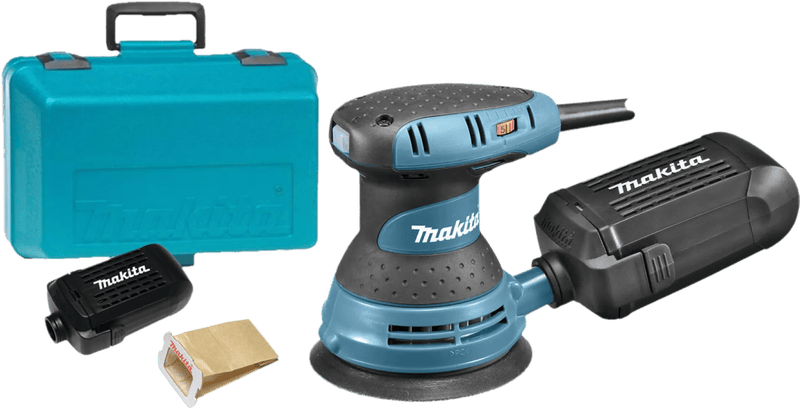
The BO5041 has been in Makita’s lineup for years, and for good reason. 300 W, a 2.8 mm orbit, 4,000 to 12,000 rpm and 1.4 kg according to the manufacturer. Makita also mentions a motor brake that stops the pad after switching off. The orbit sits right in the middle between stock removal and finish. If you only want to keep one sander in the cabinet, this tool will take you the furthest.
Einhell TP-RS 18/32 Li BL
This cordless random orbital sander works with a brushless motor, a 3.2 mm orbit and a 125 mm pad. Einhell states 1.11 kg without battery. It is mainly interesting for anyone who already owns batteries from the Power X-Change system, because as a tool-only unit it comes without battery and charger. When sanding, a battery lasts a limited time depending on its capacity; for a whole patio door, a second one makes sense. How to choose a battery system wisely is shown in our guide to battery systems.
Bosch PEX 300 AE
The green entry-level tool has 270 W, a 4 mm orbit and adjustable speed. Bosch states 1.5 kg. The microfilter box is included. For occasional projects, such as a garden chair in spring, that is enough. If you sand regularly, you will be less satisfied with the box and the simpler mechanics than with the Makita.
Metabo SXE 150-5.0 BL
A large pad, a 5 mm orbit, 350 W and a brushless motor. Metabo states a weight of just 1 kg without cable, a 4.3 m long, replaceable cable, a pad brake and a dead man’s switch. On floorboards, tabletops and doors, this removes a lot of material. On a nightstand or stool, however, the large pad tends to get in the way.
Mirka DEROS II 5650
Mirka comes from the abrasives business and builds its machines for low-dust work with an extractor. The DEROS II 5650 has a 5 mm orbit and comes with 125 mm and 150 mm pads. It is more for painters, finishers and ambitious renovators who fill and sand entire apartments. For a weekend project, it is oversized.
How we would decide
- One tool for furniture, doors and shutters: Makita BO5041 with a 2.8 mm orbit.
- Small budget and infrequent projects: Bosch PEX 300 AE.
- Einhell batteries already in the basement: TP-RS 18/32 Li BL as a tool-only unit.
- Lots of surface, lots of old paint: Metabo SXE 150-5.0 BL or Mirka DEROS II with a shop vacuum.
- Fine surfaces before varnish or oil: Festool ETS 125 REQ-Plus.
- Corners and muntins: the Bosch PDA 180 in addition.
One last tip from workshop practice: place the random orbital sander on the wood first, then switch it on, and do not press. Its own weight is enough. More pressure slows the pad, and then even a random orbital sander leaves swirls.
According to the manufacturer, the Makita BO5031 has a 125 mm sanding pad, a 2.8 mm orbit and 300 W; the BO5031K version comes in a carrying case.
Frequently asked questions
What is the difference between a random orbital sander and an orbital sander?
An orbital sander moves a rectangular plate in small circles without rotating it. With coarse grits, that leaves visible swirl marks, but the plate does reach into corners. On a random orbital sander, the round pad orbits off-center and spins freely at the same time, so no grit follows the same path twice. It removes more material but cannot reach an inside corner.
What does the orbit mean on a random orbital sander?
It is the diameter of the circle the pad describes with each revolution. The larger it is, the faster material comes off and the coarser the scratch pattern. A 2 mm orbit is mainly for sanding between coats of finish, while 5 mm is built for stock removal. Most DIY models are in the 2.5 to 4 mm range.
Random orbital sander with a 125 or 150 mm pad?
A 150 mm pad has about 44 percent more surface area, which saves minutes on tabletops and doors. On narrow trim or chair legs, however, it becomes unwieldy. Sanding discs in 125 mm are the most widely available; at 150 mm there are more hole patterns, which have to match the pad.
Is the dust box on a random orbital sander enough?
For a shelf board, yes. On a whole door, the box fills up quickly and suction drops off. It only gets truly clean with a shop vacuum. Pay attention to the port: Festool states 27 mm, Makita 25 mm inside and 31 mm outside, Einhell 35 mm.
How hard do you need to press a random orbital sander?
Not at all. Place the sander on the wood first, then switch it on; its own weight is enough. More pressure slows the pad, and then even a random orbital sander leaves swirls. When sanding old paint or varnish, a suitable respirator is also a must.
What do you need a detail sander for?
For window frames, muntins and drawer corners that the round pad of a random orbital sander cannot reach. The Bosch PDA 180 has a triangular plate measuring 92 mm corner to corner and a 1.5 mm orbit. It complements a random orbital sander but does not replace it, because large surfaces are not its job.
Sources
- Makita: BO5041 random orbital sander
- Festool: ETS 125 REQ-Plus
- Metabo: SXE 150-5.0 BL
- Mirka: DEROS II 5650
- Einhell: TP-RS 18/32 Li BL Solo
- Bosch: PEX 300 AE
- Bosch: PDA 180
- Einhell: Orbital sanders and random orbital sanders explained simply
- Makita BO5031K: product information
Where to buy
- Makita BO5041Check price at Amazon.deAvailable in Germany: Amazon.de
- Bosch PEX 300 AECheck price at Amazon.deAvailable in Germany: Amazon.de
- Festool ETS 125 REQ-PlusCheck price at Amazon.deAvailable in Germany: Amazon.de
- Einhell TP-RS 18/32 Li BLCheck price at Amazon.deAvailable in Germany: Amazon.de
- Metabo SXE 150-5.0 BLCheck price at Amazon.deAvailable in Germany: Amazon.de
- Mirka DEROS II 5650Check price at Amazon.deAvailable in Germany: Amazon.de
- Bosch PDA 180 (Deltaschleifer für Ecken)Check price at Amazon.deAvailable in Germany: Amazon.de
- Makita BO5031KView at CoolblueAvailable in Germany: Coolblue