Contents14 sections
This guide was first published in German on handgetestet.de.
Seven small jars or one large container? This question decides whether a yogurt maker ends up in the cupboard after three weeks. For set plain yogurt in individual portions, a simple device such as the Severin JG 3510 is enough. If you want to strain Greek yogurt or make a batch with soy drink, you are better served by the Rommelsbacher JG 80 Jona: two large glass containers, a draining strainer and its own program for vegan batches.
What does a device like this actually do?
Surprisingly little. A yogurt maker keeps milk and starter culture evenly warm for hours so the lactic acid bacteria can do their work. Rommelsbacher specifies 42 °C for plain yogurt and 38 °C for vegan or lactose-free batches. Severin calculates five to six hours for milk prewarmed to 37 to 40 °C; if it goes into the device at room temperature, it takes eight to nine.
None of the devices can cool. Once the program has finished, the jars go into the refrigerator, where, according to the instructions from Severin and Rommelsbacher, the yogurt continues to ripen for a few more hours. Only then does it become properly firm.
Many individual jars or one large pot?
Do the math for a moment. Seven 150 ml jars hold just over a liter, which is roughly what you get from one carton of milk plus a little starter. The twelve jars of the Steba JM 2, by contrast, hold 2.4 liters. That suits a family of four who eat muesli in the morning. A single-person household first has to finish that amount before the next batch is due.
Small jars have a practical advantage: lid on, into your bag for the office. A large container, on the other hand, has the edge as soon as you want to strain the yogurt or cook or bake with it. If you want both, the JG 80 gives you two glass containers of 1.2 liters each plus four 125 ml ceramic cups.
Do you need a timer?
The Severin JG 3510 does not have one. The device has a rocker switch, an indicator light and nothing else; you have to switch it off yourself. That works fine as long as the batch starts on a Saturday morning. If you start it in the evening, however, the device simply keeps running overnight, and the yogurt gets more sour with every hour.
The other devices in our comparison switch off once the set time has elapsed. The Rommelsbacher JG 40 allows up to 18 hours, the JG 80 up to 24 hours in one-hour steps, each with an audible signal. Steba states that the JM 2 has a timer with automatic shut-off. If you work and start your yogurt in the morning, you should not do without this function.
How does yogurt become Greek?
By straining, not with a special program. Greek yogurt is finished yogurt from which part of the whey has been removed, which is why it is creamier and firmer. In its instructions, Severin describes the simple method: line a sieve with a cotton cloth, add the yogurt and let it drain in the refrigerator for a few hours. Rommelsbacher includes a draining strainer with the JG 80 that fits on the second glass container, and specifies four to six hours in the refrigerator. The Steba JM 4 FERMENT comes with a 1.3-liter jar with a strainer, which the manufacturer intends for cream cheese.
So a strainer in the box is a convenience, not a requirement. It does, however, spare you fiddling with a cloth, a bowl and a dripping refrigerator shelf.
Does it work with oat or almond drink too?
Only to a limited extent. In the instructions for the JG 3510, Severin states clearly that soy and coconut milk are suitable for vegan yogurt, but oat and almond milk are not. Rommelsbacher is somewhat more open and lists soy, almond, coconut and lupin, but warns that the result tends to be creamy rather than set and that not every plant-based alternative works without a thickener. Both manufacturers therefore recommend cooking in one to two spoonfuls of starch. According to Severin, the ripening time for plant-based drinks increases by around two hours.
The easiest starter is a store-bought soy yogurt. In our comparison, only the JG 80 and the Steba JM 4 FERMENT have a dedicated program with a lower temperature.
What about hygiene and shelf life?
Raw milk from the farm or from a milk vending machine must be boiled beforehand. The German Federal Institute for Risk Assessment (BfR) explicitly names homemade yogurt as an example, because raw milk can contain Campylobacter bacteria; according to the BfR, they die off when a core temperature of 70 °C is reached for at least two minutes. According to Rommelsbacher, fresh pasteurized milk from the refrigerated aisle and UHT milk need no pretreatment. According to the instructions, homemade plant-based drinks should also be heated to at least 70 °C. Severin recommends UHT milk because it works best, and calls for clean, dry jars.
Rommelsbacher states that homemade yogurt keeps for a good week in the refrigerator. The Verbraucherzentrale, the German consumer advice center, recommends storing yogurt on the middle shelf of the refrigerator at 5 to 7 °C. Mold means: throw it away. According to the Verbraucherzentrale, bubbles and a fermented taste indicate yeasts. The often-quoted weeks beyond the best-before date refer to store-bought products still sealed in their original packaging, not to jars from your own kitchen.
Five yogurt makers, soberly compared
| Model | Containers | Time and programs | Best for |
|---|---|---|---|
| Severin JG 3510 | 7 jars of 150 ml each | no timer, rocker switch, 18 W | Beginners making plain yogurt, small budget |
| Rommelsbacher JG 40 | 8 jars of 150 ml each, up to 1,200 g | Timer up to 18 h with shut-off, 1 program, 40 W | Portion-size yogurt with a timer, stainless steel housing |
| Rommelsbacher JG 80 Jona | 2 glass containers of 1.2 l each, 4 ceramic cups of 125 ml each, draining strainer | 4 programs (42, 38, 30, 55 °C), timer up to 24 h, 20 W | Greek and vegan yogurt, cream cheese |
| Steba JM 2 | 12 jars of 0.2 l each, 2.4 l total | Timer with automatic shut-off, LCD, 2 buttons | Families with high consumption |
| Steba JM 4 FERMENT | 1 jar of 2 l, 1 jar of 1.3 l with strainer | 5 automatic programs plus free setting, 20 W | Large quantities, fermenting, cream cheese |
All specifications come from the manufacturers. The price classes range from the low end (Severin) to the upper range (JG 80, JM 4 FERMENT).
Severin JG 3510: simple and without a clock
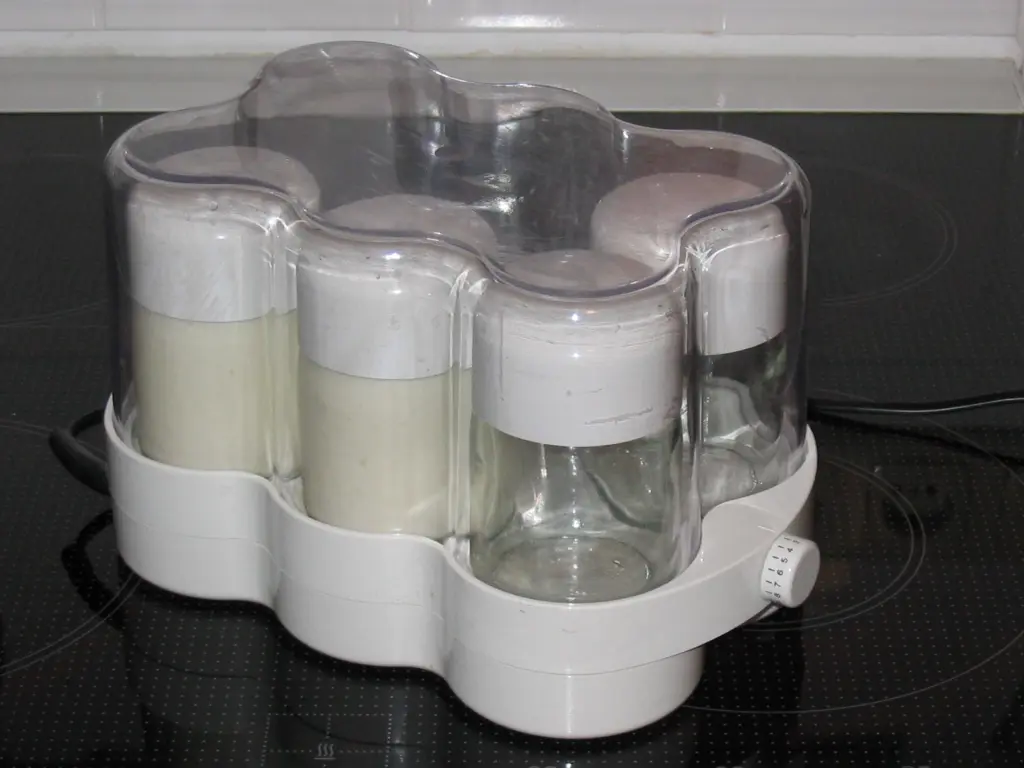
Seven jars with screw caps, a clear cover, one switch. In its own shop, Severin lists the device clearly below the other models in this comparison. The instructions describe Greek-style yogurt via straining in a cloth. Without a timer, it remains a device for people who are at home when the time is up.
Rommelsbacher JG 40: the classic with a timer
A rectangular stainless steel housing, eight 150 ml jars and a timer of up to 18 hours that switches off with an audible signal. That is enough for cow’s milk yogurt in individual portions. There is no strainer and no program for plant-based drinks.
Rommelsbacher JG 80 Jona: for Greek and vegan
Four fixed programs cover plain yogurt, vegan and lactose-free batches, cream cheese and herbal extracts; according to the manufacturer, the run time can be adjusted, for example for sourdough. On top of that come two large glass containers, the draining strainer and four ceramic cups. That is more equipment than any other device here, and it costs accordingly. If you only eat plain yogurt, you pay for functions you will never need.
Steba JM 2: twelve jars in one go
With 2.4 liters, the JM 2 is designed for volume. According to Steba, it is operated with two buttons and an LCD display, and the timer switches off at the end. The manufacturer does not state a temperature or programs for plant-based batches on the product page. A solid choice for families, too big for small households.
Steba JM 4 FERMENT: large container, many programs
Instead of individual jars, you get a 2-liter jar and a 1.3-liter jar with a strainer. Five automatic programs range from plain yogurt and vegan yogurt to cream cheese and herb oil, and a free program lets you set your own temperature and time. According to Steba, the fermentation program also handles kimchi, sauerkraut or pickles. For portion-size yogurt to take along, you have to transfer it yourself afterward.
Which device suits which household
- You simply want plain yogurt from cow’s milk and are at home on weekends: Severin JG 3510.
- You start your batch in the morning and do not want to think about switching it off: Rommelsbacher JG 40.
- Greek yogurt, soy yogurt or cream cheese are regularly on the menu: Rommelsbacher JG 80 Jona.
- Four or more people eat yogurt every day: Steba JM 2.
- Besides yogurt, kimchi and sauerkraut appeal to you: Steba JM 4 FERMENT.
Before you buy another appliance, it is worth checking the manuals you already have. Some ice cream makers come with a yogurt function; more on this in our ice cream maker guide. With a multicooker (in German), too, you should check whether it has a yogurt program. Then nobody needs a second appliance in the cupboard.
Soaked porridge goes well with homemade yogurt; our base for overnight oats is described in the review of the dmBio Früchte Porridge.
Frequently asked questions
How long does yogurt take in a yogurt maker?
Severin calculates five to six hours for milk prewarmed to 37 to 40 °C, and eight to nine hours for milk at room temperature. After that, the jars go into the refrigerator, where the yogurt continues to ripen for a few more hours. Only then does it become properly firm.
Does a yogurt maker need a timer?
Yes, for anyone who is not at home when the time is up. The Severin JG 3510 only has a rocker switch. If it keeps running overnight, the yogurt gets more sour with every hour. The Rommelsbacher JG 40 switches off after up to 18 hours, the JG 80 after up to 24 hours.
How do you make Greek yogurt in a yogurt maker?
By straining, not with a special program. Severin describes the simple method: line a sieve with a cotton cloth, add the finished yogurt and let it drain in the refrigerator for a few hours. Rommelsbacher includes a draining strainer with the JG 80 and specifies four to six hours in the refrigerator.
Can you make vegan yogurt from oat or almond drink?
Only to a limited extent. Severin names soy and coconut milk as suitable, but not oat and almond milk. Rommelsbacher also lists almond and lupin, but warns that the result tends to be creamy rather than set. Both recommend cooking in one to two spoonfuls of starch. The easiest starter is store-bought soy yogurt.
Do you have to boil milk for homemade yogurt?
Raw milk from the farm or from a milk vending machine, yes. The German Federal Institute for Risk Assessment (BfR) explicitly names homemade yogurt as an example, because raw milk can contain Campylobacter, which die off at a core temperature of 70 °C for at least two minutes. According to Rommelsbacher, fresh pasteurized milk and UHT milk need no pretreatment.
How long does homemade yogurt keep?
According to Rommelsbacher, a good week in the refrigerator. The Verbraucherzentrale (German consumer advice center) recommends storing it on the middle shelf at 5 to 7 °C. Mold means throw it away; bubbles and a fermented taste indicate yeasts. The often-quoted weeks beyond the best-before date only apply to products that are still sealed in their original packaging.
Sources
- Severin: JG 3510 yogurt maker
- Severin: JG 3510 user manual (PDF)
- Rommelsbacher: JG 40 yogurt maker
- Rommelsbacher: JG 80 Jona yogurt and cream cheese maker
- Rommelsbacher: JG 80 user manual (PDF)
- Steba: JM 2 yogurt maker
- Steba: JM 4 FERMENT yogurt maker
- German Federal Institute for Risk Assessment (BfR): Campylobacter (PDF)
- Verbraucherzentrale: Shelf life and storage of dairy products
Where to buy
- Severin JG 3510Check price at Amazon.deAvailable in Germany: Amazon.de
- Rommelsbacher JG 40Check price at Amazon.deAvailable in Germany: Amazon.de
- Rommelsbacher JG 80 JonaCheck price at Amazon.deAvailable in Germany: Amazon.de
- Steba JM 2Check price at Amazon.deAvailable in Germany: Amazon.de
- Steba JM 4 FERMENTCheck price at Amazon.deAvailable in Germany: Amazon.de