Contents11 sections
This guide was first published in German on handgetestet.de.
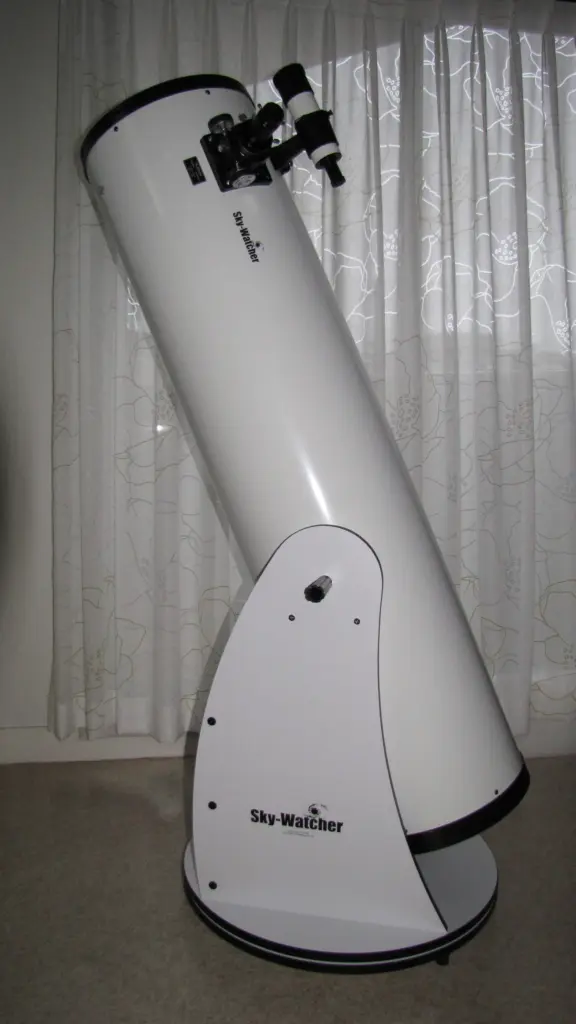
The box of a first telescope almost always shows off one big number: the magnification. Under the night sky, it counts for little. What matters is the aperture, meaning the diameter of the lens or mirror, and a mount that does not wobble. For beginners with a bit of space, we therefore recommend a Dobsonian with a 200-millimeter mirror such as the Sky-Watcher Skyliner 200P. If you live in the city and would rather collect images than look through an eyepiece, a smart telescope is the more likely choice.
Why aperture matters more than magnification
How much light a telescope gathers and how fine the details it can resolve depends on the aperture. A 200-millimeter mirror has four times the area of a 100-millimeter objective lens. With star clusters and galaxies, that is the difference between a gray smudge and an object with structure.
And magnification? It results solely from the focal length and the eyepiece. Many manufacturers give about twice the aperture in millimeters as the sensible upper limit. Anything above that makes the image bigger, but not sharper.
Besides the optics, a few practical things decide whether the instrument actually gets used:
- Mount: A Dobsonian sits on a simple rotating base, and you push the tube by hand. Alt-azimuth tripods move just as intuitively up, down, left and right. Equatorial mounts do follow the Earth’s rotation, but they need to be polar-aligned and balanced with a counterweight. For beginners, that is a hurdle at which many give up.
- Weight and the trip outside: If a telescope cannot be set up on the balcony or in the yard within a few minutes, it stays in the closet on clear evenings. Measure your stairs, car trunk and storage space before you reach for the largest aperture.
- Accessories: The included eyepieces are a start, not the final setup. One or two better eyepieces belong in the budget later on.
- Finding aid: A red-dot finder, a smartphone app or a motor. Many people give up after three unsuccessful evenings. A good finding aid is therefore more important than a few extra millimeters.
Lens, mirror or camera in a housing?
A refractor works with lenses. Its tube is enclosed, practically maintenance-free and ready to use after a short time. It shows the Moon and planets with high contrast, although simple achromats show a slight color fringe on bright objects. Per millimeter of aperture, the lens is the most expensive solution.
Behind the name Dobsonian is a Newtonian reflector on a plain wooden base. No other design gets you more aperture for the same money. You pay for it with bulk and occasional mirror alignment.
The smart telescope is a completely different story. It has no eyepiece. A motor slews to the target, a camera exposes many individual frames and stacks them, and the result appears on your smartphone. That makes nebulae visible in color, which the eye at the eyepiece never sees in color, even under a light-polluted city sky. The common models, however, have an aperture of only 50 millimeters. If you are after that moment at the eyepiece, it will not make you happy.
The Sun only with a certified filter in front of the objective
A telescope concentrates sunlight. According to the filter manufacturer Omegon, looking without a filter can cause blindness. The solar filter must therefore sit firmly in front of the main aperture and, according to Omegon, must not be mounted anywhere else. Old solar filters that screw into the eyepiece therefore have no place on a telescope. Before each use, hold the filter film up to a bright lamp, not to the Sun, and check it for holes and tears. If it is damaged, the telescope stays unused. Remove the finder scope beforehand. The same principle applies to smart telescopes: ZWO includes a magnetic solar filter with the Seestar S50 Pro and prohibits pointing the device at the Sun without it.
Five beginner telescopes with manufacturer specs
| Model | Design and aperture | Mount | Best for |
|---|---|---|---|
| Sky-Watcher Skyliner 200P | Reflector, 200 mm | Dobsonian base, by hand | Beginners with a yard or a car |
| Sky-Watcher Heritage 130P FlexTube | Reflector, 130 mm, 650 mm focal length | Tabletop Dobsonian, by hand | Balcony, small apartment, families |
| Celestron StarSense Explorer DX 102AZ | Refractor, 102 mm, 660 mm focal length | Alt-azimuth on tripod, app-based finding aid | Moon and planets, help with finding objects |
| ZWO Seestar S50 Pro | Smart telescope, 50 mm, 260 mm focal length | Motorized, finds targets on its own | City skies, images without prior knowledge |
| Vaonis Vespera II | Smart telescope, 50 mm, 250 mm focal length | Motorized, finds targets on its own | Wide-field mosaics, bigger budget |
Sky-Watcher Skyliner 200P
A classic Dobsonian with a 200-millimeter mirror. According to Sky-Watcher, it comes with a 2-inch focuser, a 9×50 finder and two eyepieces. No other design is easier to operate; you simply push the tube toward the object. The problem is the size. Tube and base have to be carried and stored, and every now and then the mirrors need aligning. If you can live with that, you get the most aperture in this overview.
Sky-Watcher Heritage 130P FlexTube
The little brother for the table: 130-millimeter mirror, 650-millimeter focal length, red-dot finder and two eyepieces. The tube collapses and, according to Sky-Watcher, measures around 37 centimeters when retracted, with the alignment supposedly staying intact. According to the manufacturer, the whole thing weighs under 6.4 kilograms. You do need a sturdy table or a wall as a base, though. Buyers also report that stray light from streetlights gets in through the partly open tube.
Celestron StarSense Explorer DX 102AZ
A refractor with 102 millimeters of aperture and a 660-millimeter focal length, plus 25 and 10 millimeter eyepieces that, according to Celestron, give 26x and 66x magnification. What sets it apart is the smartphone holder. Using the starry sky, the StarSense app recognizes where the tube is pointing and guides you on the display to the selected object. Celestron lists Android 12 or iOS 18 as the minimum requirement. The complete set weighs 6.44 kilograms.
ZWO Seestar S50 Pro
The successor to the popular Seestar S50, which ZWO lists as sold out in its store. According to the manufacturer, the Pro version works with 50 millimeters of aperture, four-element optics with ED glass, an 8.3-megapixel sensor and an additional wide-angle camera. A built-in dual-band filter counters light pollution, and the solar filter is included. ZWO states up to nine hours of battery life at 2.8 kilograms. Everything you see, you see on the display. Not in an eyepiece.
Vaonis Vespera II
Also 50 millimeters of aperture, here with a 250-millimeter focal length and an 8.3-megapixel Sony sensor. In mosaic mode, according to Vaonis, the Vespera II stitches images of up to 24 megapixels, which helps with large nebulae. It weighs around five kilograms with its tripod, and battery life is about four hours according to the manufacturer. For a whole night of exposures, you need an external power source, such as a portable power station (in German). The solar filter is not included in the basic package; Vaonis sells it in the Solar Pack.
Which telescope suits whom
You want to look through the eyepiece yourself and have the space? Then the Skyliner 200P. Beginners will hardly find more aperture, and you can learn to operate it in one evening.
With little space, on a balcony or with kids who want to join in, the Heritage 130P FlexTube is a good fit. Small, quick to set up, with considerably less light than its big brother. The StarSense Explorer DX 102AZ is designed for the Moon and planets with guidance in finding them.
City skies and the wish for colorful nebulae on your phone lead to the Seestar S50 Pro. The Vespera II plays to its strengths with wide-field mosaics. As long as you do not need the mosaic function, the extra cost over the Seestar is hard to justify.
If you later want to photograph through the telescope with your own camera, our guide to mirrorless cameras (in German) covers the basics. For the walk across a dark field, a flashlight (in German) with a low setting helps more than any display that dazzles your eyes at full brightness. And for a quick look without setting anything up, binoculars are often enough; what matters there is in our binoculars guide.
Frequently asked questions
What matters more in a telescope, aperture or magnification?
Aperture. It determines how much light a telescope gathers and how fine the details it can resolve. A 200-millimeter mirror has four times the area of a 100-millimeter objective lens. Many manufacturers give about twice the aperture in millimeters as the sensible upper limit for magnification.
Which mount is suitable for beginners?
A Dobsonian sits on a simple rotating base and you push the tube by hand; alt-azimuth tripods are similarly intuitive. Equatorial mounts follow the Earth's rotation, but they need to be polar-aligned and balanced with a counterweight, a hurdle at which many beginners give up.
Is a smart telescope worth it?
For city skies and colorful nebulae on your smartphone, yes. A motor slews to the target and a camera stacks many individual frames. But there is no eyepiece, and the common models have an aperture of only 50 millimeters. If you are after that moment at the eyepiece, it will not make you happy.
How do I observe the Sun safely?
Only with a certified filter fixed firmly in front of the main aperture. According to Omegon, looking without a filter can cause blindness. Before each use, check the film against a bright lamp for holes and tears, and remove the finder scope. A solar filter comes with the ZWO Seestar S50 Pro; with the Vaonis Vespera II, it is not included in the basic package.
Which telescope fits on a balcony?
If space is tight, the Sky-Watcher Heritage 130P FlexTube is a good fit, a tabletop Dobsonian whose tube, according to the manufacturer, collapses to around 37 centimeters. You need a sturdy table or a wall as a base. Buyers report that stray light from streetlights gets in through the partly open tube.
What is the difference between a refractor and a reflector telescope?
A refractor works with lenses, is enclosed, practically maintenance-free and shows the Moon and planets with high contrast, but it is the most expensive per millimeter of aperture. A Dobsonian is a reflector on a simple wooden base and offers the most aperture for the money, but it requires space and occasional mirror alignment.
Sources
- Sky-Watcher: Classic 200P Dobsonian
- Sky-Watcher: Heritage P130
- Sky-Watcher USA: Heritage 130 Tabletop Dobsonian
- Celestron: StarSense Explorer DX 102AZ
- ZWO: Seestar S50 Pro
- Seestar: S50 (availability)
- Vaonis: Vespera II
- Vaonis: Vespera Solar Pack
- Omegon: Objective solar filter user manual (PDF, in German)
Where to buy
- Sky-Watcher Skyliner 200P (Classic 200 Dobson)Check price at Amazon.deCheck price at Amazon.co.ukCheck price at Amazon.nlCheck price at Amazon.com.beCheck price at Amazon.frCheck price at Amazon.itCheck price at Amazon.esCheck price at Amazon.plCheck price at Amazon.seAvailable in Germany: Amazon.de
- Sky-Watcher Heritage 130P FlexTubeCheck price at Amazon.deCheck price at Amazon.co.ukCheck price at Amazon.nlCheck price at Amazon.com.beCheck price at Amazon.frCheck price at Amazon.itCheck price at Amazon.esCheck price at Amazon.plCheck price at Amazon.seAvailable in Germany: Amazon.de
- Celestron StarSense Explorer DX 102AZCheck price at Amazon.deCheck price at Amazon.co.ukCheck price at Amazon.nlCheck price at Amazon.com.beCheck price at Amazon.frCheck price at Amazon.itCheck price at Amazon.esCheck price at Amazon.plCheck price at Amazon.seAvailable in Germany: Amazon.de
- ZWO Seestar S50 ProCheck price at Amazon.deCheck price at Amazon.co.ukCheck price at Amazon.nlCheck price at Amazon.com.beCheck price at Amazon.frCheck price at Amazon.itCheck price at Amazon.esCheck price at Amazon.plCheck price at Amazon.seAvailable in Germany: Amazon.de
- Vaonis Vespera IICheck price at Amazon.deCheck price at Amazon.co.ukCheck price at Amazon.nlCheck price at Amazon.com.beCheck price at Amazon.frCheck price at Amazon.itCheck price at Amazon.esCheck price at Amazon.plCheck price at Amazon.seAvailable in Germany: Amazon.de