Contents12 sections
This guide was first published in German on handgetestet.de.
You don’t buy a bench power supply for the volts. You buy it for the current limit, which saves a board connected with the wrong polarity before you smell burning electronics. For repairs, soldering projects and microcontrollers, a single-channel unit with 30 V and 5 A is enough: the linear PeakTech P 6173 regulates quietly and cleanly, and if you want to save space and money, go for the PeakTech P 6225 A switching supply.
You rarely need more. Three channels, 60 V or 10 A are tools for specific tasks, not a general mark of quality.
Set the voltage, limit the current: how the unit works
Every bench power supply has two operating modes. In constant voltage mode (CV), it holds the set voltage as long as the load draws less current than allowed. If the current rises above the limit, it switches to constant current mode (CC) and lowers the voltage just far enough that no more than the set current limit flows. That is exactly what protects a freshly soldered circuit. Take a microcontroller board at 5 V that should draw no more than 300 mA in operation. If the limit is set to exactly that value, a solder bridge on the board amounts to nothing more than the CC indicator lighting up briefly.
For 12 V LED strips, car stereos on the bench (13.8 V) or small motors, 30 V and 5 A are enough as well. Only with 36 or 48 V battery packs, e-bike components or power amplifiers does it get tight. Check the power supply’s display now and then with a decent multimeter, because a three-digit LED display only shows tenths of a volt above 10 V.
Linear or switching: the difference you can hear and weigh
A linear power supply steps down the mains voltage with a transformer and regulates the rest via power transistors that turn excess energy into heat. The result is a very clean output voltage. PeakTech specifies a ripple of at most 1 mV RMS for the P 6173, Rigol under 350 µV RMS for the DP832. The price shows up on the scale: 4.5 kg for the PeakTech, 10.5 kg for the Rigol.
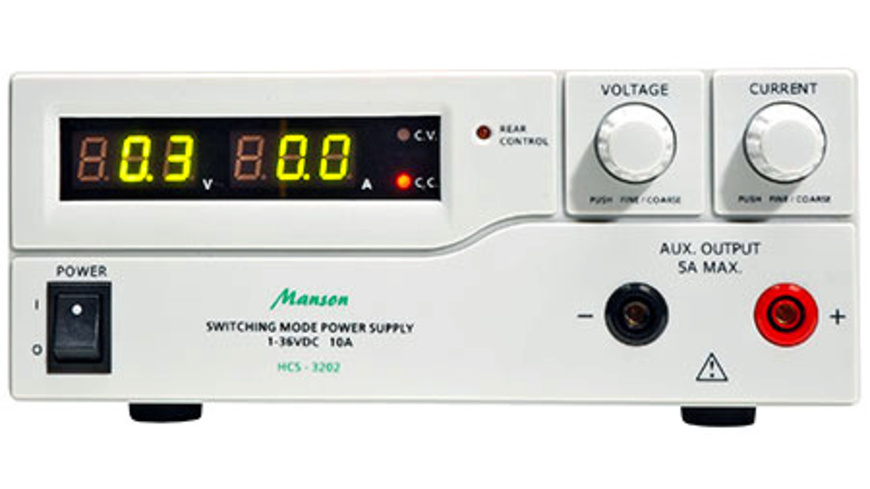
Switching power supplies operate at a high switching frequency; Manson specifies 100 to 120 kHz for the HCS-32xx series. They are light, efficient and cheaper to manufacture, but have more noise at the output. For the Manson HCS-3202, the data sheet lists 5 mV RMS and 50 mV peak-to-peak. For motors, LEDs, automotive electronics and charging experiments, that doesn’t matter. For audio amplifiers, radio receivers or measurement circuits with sensors in the millivolt range, it does. If you work with analog circuitry, buy linear and accept the extra kilos.
USB, SCPI, USB-C and batteries: what counts
On most units, „programmable“ means two things: memory slots for fixed values on the device and an interface to the PC. For hobby use and repairs, two or three stored voltages are usually enough. PC control becomes interesting when you repeat procedures, such as a load change over several hours or a voltage profile for testing. Check whether the manufacturer only supplies its own Windows software or whether the unit understands commands based on the SCPI standard. SCPI lets you write scripts in Python or LabVIEW, regardless of the operating system.
USB-C with Power Delivery now shows up on small power supply modules that draw their energy from a charger. Since USB PD 3.1, up to 240 W at 48 V is possible according to the USB-IF; before that, 100 W was the limit. But such a module never delivers more than the charger provides. As the only bench power supply on your desk, a setup like this is a compromise; as a second unit for on the go, it is quite usable.
And batteries? PeakTech states explicitly in its manuals that its bench power supplies are not designed for charging batteries. Joy-IT, on the other hand, advertises a dedicated charging function for the RD6006. If you charge batteries regularly, you are better served by a suitable charger.
Six bench power supplies compared
| Model | Design | Output according to manufacturer | Ripple according to manufacturer | For whom |
|---|---|---|---|---|
| PeakTech P 6173 | linear, safety transformer | 0–30 V, 0–5 A, plus fixed 5 V/1 A | ≤ 1 mV RMS | Electronics, audio, training |
| PeakTech P 6225 A | switching supply | 0–30 V, 0–5 A | ≤ 3 mV RMS | Beginners, small bench |
| Manson HCS-3202 | switching supply with PFC | 1–36 V, 0–10 A | 5 mV RMS, 50 mV peak | Automotive, LED, higher currents |
| Rigol DP832 | linear, 3 channels | 2 × 30 V/3 A, 1 × 5 V/3 A, 195 W | < 350 µV RMS | Lab, development, analog |
| OWON SPE3102 | not specified by manufacturer | 0–30 V, 0–10 A, 200 W | no clear specification | Automation via SCPI |
| Joy-IT JT-RD6006 | built-in module, requires DC input | 0–60 V, 0–6 A, 360 W | 100 mV peak at full load | Makers with their own power supply |
PeakTech P 6173: the quiet workhorse
Linear regulation, a safety transformer and, according to the manual, designed for schools, vocational training and the lab. Voltage and current limit can be preset with the output switched off, and the display also shows power in watts. The fixed 5 V output with 1 A is handy for a microcontroller on the side, but according to the manufacturer it always stays active, even when the main output is off. The USB software with timed programs runs only on Windows.
PeakTech P 6225 A: small, light, no frills
At 1.5 kg and 8 cm wide, this switching supply fits next to any soldering station. It has coarse and fine controls (1 V/100 mA and 10 mV/1 mA) and an output switch. There is no remote control, and no memory slots either. For getting started, that is honest enough.
Manson HCS-3202: power for the automotive workbench
Ten amps at up to 36 V, three factory presets at 5, 13.8 and 25 V, and via USB up to 20 presets with time intervals and up to 999 cycles. A second output on the front delivers up to 5 A, but together with the main output no more than 10 A. The display has only three digits. That suits car stereos, control units and LED technology, less so delicate analog circuits.
Rigol DP832: three channels for development
Two channels with 30 V/3 A and a third with 5 V/3 A, 195 W in total, linear regulation. That lets you set up symmetrical supplies for op-amps and a logic voltage at the same time. USB is standard; LAN and RS232 cost extra on the DP832 and only come as standard on the DP832A. At 10.5 kg, it is a unit that stays where it is put. For occasional repairs, it is too much of a good thing.
OWON SPE3102: compact and scriptable
30 V and 10 A at 200 W, a setting resolution of 10 mV and 1 mA, a 2.8-inch color display and USB with SCPI commands. According to OWON, the unit outputs timed voltage sequences via lists. Because OWON explicitly names the SCPI standard, writing your own scripts involves no guesswork. OWON gives no clear information online about the design or exact ripple of this model.
Joy-IT JT-RD6006: a 60-volt kit
The RD6006 is a regulator module, not a finished benchtop unit. It requires a DC input of 6 to 70 V; Joy-IT offers a matching power supply separately. In return, it regulates up to 60 V and 6 A, stores nine values and can be controlled via USB; Wi-Fi is only available with an add-on module. The ripple of 100 mV peak-to-peak at full load shows what it is meant for: power, not sensitive measurement equipment.
How we would decide
- Electronics, repair, audio: PeakTech P 6173. Heavy but clean, and the current limit can be set before switching on.
- First unit on a small budget: PeakTech P 6225 A, as long as no sensitive analog circuitry is connected to the output.
- Automotive electronics and higher currents: Manson HCS-3202 with its 13.8 V preset.
- Development with several voltages: Rigol DP832, if you have the space and budget for it.
- Test procedures on the PC: OWON SPE3102 because of SCPI.
- Tinkering with 48 V technology: Joy-IT JT-RD6006 together with its own power supply.
If you want to see ripple or switching edges, you need an oscilloscope. What matters with bandwidth, probe and ground is explained in our guide to the oscilloscope for beginners.
For test signals instead of supply voltage, see our guide to the function generator (in German).
Frequently asked questions
What is the difference between CV and CC on a bench power supply?
In constant voltage mode, the unit holds the set voltage as long as the load draws less current than allowed. If the current rises above the limit, it switches to constant current mode and lowers the voltage. That is exactly what protects a freshly soldered circuit from a short.
Linear or switching power supply?
A linear power supply delivers a very clean output voltage but is heavy; the PeakTech P 6173 weighs 4.5 kg. Switching power supplies are light, efficient and cheaper but have more noise. For motors, LEDs and automotive electronics, that doesn't matter; for audio and measurement circuits, it does.
Are 30 volts and 5 amps enough?
For most tasks, yes: 12 V LED strips, car stereos on the bench at 13.8 V or small motors. It only gets tight with 36 or 48 V battery packs, e-bike components or power amplifiers. Three channels, 60 V or 10 A are tools for specific tasks.
What does SCPI add to a bench power supply?
Commands based on the SCPI standard let you write scripts in Python or LabVIEW, regardless of the operating system. That becomes interesting when you repeat procedures, such as load changes over several hours. The OWON SPE3102 explicitly lists SCPI, while the USB software of the PeakTech P 6173 runs only on Windows.
Can you charge batteries with a bench power supply?
PeakTech states explicitly that its bench power supplies are not designed for charging batteries. Joy-IT, on the other hand, advertises a dedicated charging function for the RD6006. If you charge batteries regularly, you are better served by a suitable charger.
Sources
- PeakTech: operating manual P 6170 to P 6173
- PeakTech: operating manual P 6225 A / P 6226
- PeakTech: P 6225 A product page
- Manson: manual HCS-3200/3202/3204
- ELV (German retailer): Manson HCS-3202 (retailer information)
- Rigol: DP800 series data sheet
- OWON: SPE series
- Joy-IT: JT-RD6006
- USB-IF: USB Power Delivery
Where to buy
- PeakTech P 6173Check price at Amazon.deCheck price at Amazon.co.ukCheck price at Amazon.nlCheck price at Amazon.com.beCheck price at Amazon.frCheck price at Amazon.itCheck price at Amazon.esCheck price at Amazon.plCheck price at Amazon.seAvailable in Germany: Amazon.de
- PeakTech P 6225 ACheck price at Amazon.deCheck price at Amazon.co.ukCheck price at Amazon.nlCheck price at Amazon.com.beCheck price at Amazon.frCheck price at Amazon.itCheck price at Amazon.esCheck price at Amazon.plCheck price at Amazon.seAvailable in Germany: Amazon.de
- Manson HCS-3202Check price at Amazon.deCheck price at Amazon.co.ukCheck price at Amazon.nlCheck price at Amazon.com.beCheck price at Amazon.frCheck price at Amazon.itCheck price at Amazon.esCheck price at Amazon.plCheck price at Amazon.seAvailable in Germany: Amazon.deView at ELVAvailable in Germany: ELV
- Rigol DP832Check price at Amazon.deCheck price at Amazon.co.ukCheck price at Amazon.nlCheck price at Amazon.com.beCheck price at Amazon.frCheck price at Amazon.itCheck price at Amazon.esCheck price at Amazon.plCheck price at Amazon.seAvailable in Germany: Amazon.de
- OWON SPE3102Check price at Amazon.deCheck price at Amazon.co.ukCheck price at Amazon.nlCheck price at Amazon.com.beCheck price at Amazon.frCheck price at Amazon.itCheck price at Amazon.esCheck price at Amazon.plCheck price at Amazon.seAvailable in Germany: Amazon.de
- Joy-IT JT-RD6006Check price at Amazon.deCheck price at Amazon.co.ukCheck price at Amazon.nlCheck price at Amazon.com.beCheck price at Amazon.frCheck price at Amazon.itCheck price at Amazon.esCheck price at Amazon.plCheck price at Amazon.seAvailable in Germany: Amazon.de