Contents14 sections
This guide was first published in German on handgetestet.de.
Bright does not mean legal. The glaring lamp without approval is the classic bad buy when it comes to bike lights. It dazzles oncoming traffic and simply may not be used on public roads in Germany. The most carefree option for daily riding is a hub dynamo with an approved dynamo headlight such as the Busch & Müller Lumotec IQ-X. Bikes without a dynamo need a battery light with a test mark, such as the Busch & Müller Ixon Core 2 or the Sigma Aura 100 Link.
What does § 67 StVZO actually require?
The rules are set out in § 67 of the German Road Vehicles Registration and Licensing Regulations (StVZO). Bicycles need a white headlight at the front for low beam that does not dazzle anyone, plus a white reflector. At the rear, a red tail light and a red category „Z“ reflector are mandatory; both may be housed in a single unit. Yellow reflectors on the pedals and side markings on both wheels are also required. Flashing headlights and flashing tail lights are not permitted.
As a power source, the law allows a dynamo, disposable batteries and rechargeable batteries. Removable lights are permitted, but they must be fitted at dusk, in the dark or in poor visibility. On pedelecs, the lights may run off the drive battery if they keep shining for at least two hours after the motor has been switched off. And high beam? This is where a misconception persists. Under § 67 (3), headlights on any bicycle may additionally have daytime running lights and high beam; the legal text contains no restriction to fast e-bikes. Switching must be automatic or via a control on the handlebar. High beam is nonetheless found almost exclusively on e-bike headlights, because it uses a lot of power. S-pedelecs up to 45 km/h are not bicycles in legal terms, and § 67 does not apply to them.
A brake light is also explicitly allowed. Tail lights may have a red brake light function, but it is not mandatory.
How can I tell an approved light?
Approved lights carry a wavy line, the letter K and a test number. Type approval is granted by the German Federal Motor Transport Authority (Kraftfahrt-Bundesamt). If a listing only says „StVZO-compliant“ or „according to StVZO“ without stating a K number, you should ask. A claim in the product title is no substitute for the mark.
How bright does it need to be?
Look at lux, not lumens. Lux describes how much light reaches the road, lumens the total amount of light emitted by the LED, and for comparing approved headlights, lux is the more meaningful figure. Lezyne, for example, mainly advertises the Hecto Pro StVZO 400+ with 400 lumens.
In town with streetlights, 30 to 50 lux will serve you well. On unlit bike paths between two towns, 70 to 100 lux makes a noticeable difference. With battery lights, the runtime of the weakest setting is often advertised prominently; what matters is how long the full setting lasts. And dynamo lights should keep shining at a traffic light.
Dynamo or battery?
A hub dynamo provides light as long as the wheel is turning. No charging, no dead battery in November. Commuters and trekking bikes have an easier time with it, partly because lights that are firmly bolted on hardly attract thieves. If the bike has no dynamo, though, retrofitting costs money and workshop time. Road bikes, gravel bikes and second bikes without a dynamo get battery lights. They come off in seconds. That protects against theft when parked at the train station, but it requires discipline, because the light has to be back on the bike at dusk. If you often forget to charge, you are buying yourself trouble here.
Seven approved lights compared
| Model | Power | Brightness according to the manufacturer | Best for |
|---|---|---|---|
| Busch & Müller Lumotec IQ-X | Hub dynamo | 100 lux, no high beam | Commuters on dark routes |
| AXA Blueline 50-T Steady Auto | Dynamo | 50 lux | City and everyday bikes without a motor |
| Busch & Müller Ixon Core 2 | Battery, USB-C | 70 / 35 / 15 lux | Bikes without a dynamo, long battery life |
| Sigma Aura 100 Link + Blaze Link | Battery, USB-C and Micro-USB | up to 100 lux, tail light with brake light | Anyone who wants a matched set |
| Trelock LS 760 I-Go Vision | Battery, USB | 100 lux, five settings | High-mileage riders who want to see the remaining runtime |
| Sigma Aura 170 HB Link | Battery, USB-C | up to 150 lux low beam, switchable high beam | Fast rides on unlit paths |
| Busch & Müller Toplight Line brake plus | Hub dynamo | Tail light with brake light | Dynamo bikes upgrading at the rear |
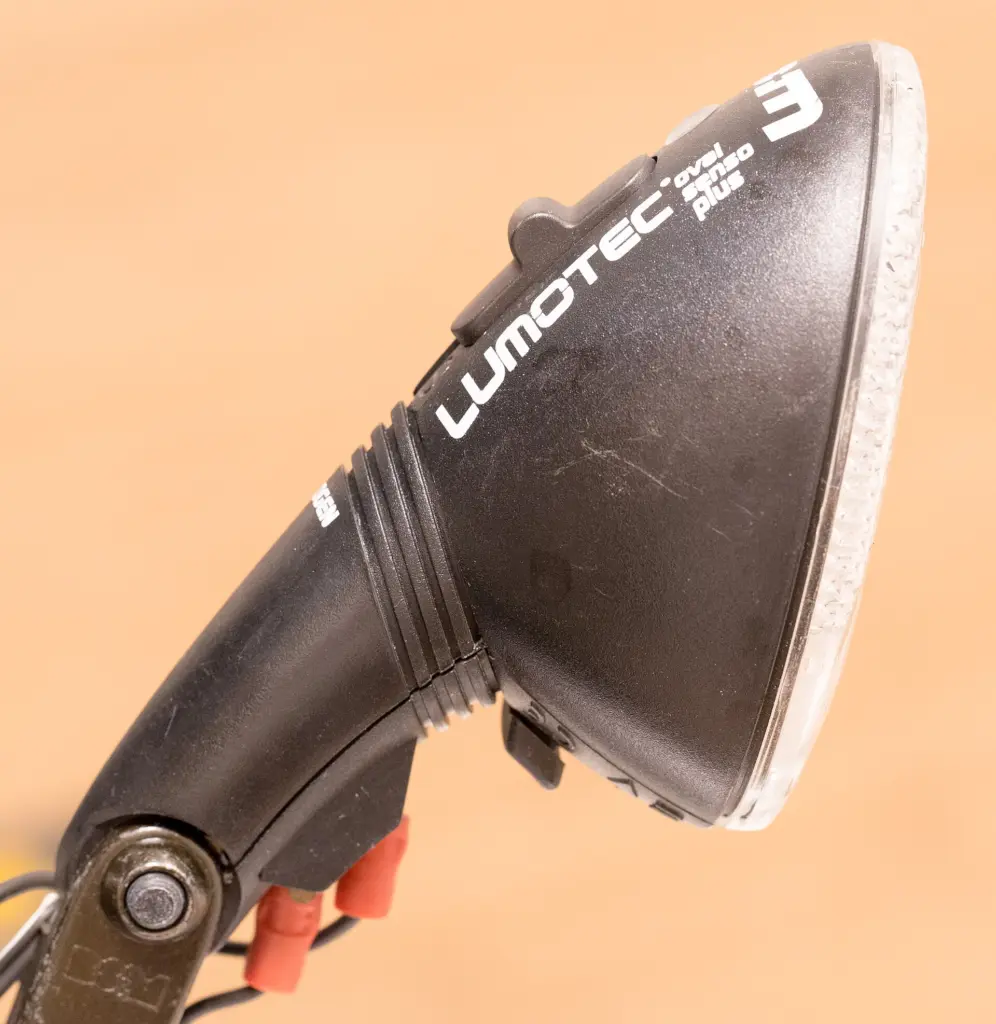
Busch & Müller Lumotec IQ-X
According to Busch & Müller, the IQ-X is a dynamo headlight with 100 lux low beam, a standlight and automatic sensor control. It has no high beam.
In terms of price, it belongs to the upper segment of dynamo lighting. That pays off if you regularly ride through the countryside. For town riding alone, it is more light than you need.
AXA Blueline 50-T Steady Auto
AXA specifies 50 lux, a light sensor and a standlight of around four minutes. The headlight fits hub and sidewall dynamos. According to the manufacturer, it does not belong on e-bikes. A solid, affordable choice for the classic everyday bike.
Busch & Müller Ixon Core 2
According to the manufacturer, the successor to the well-known Ixon Core delivers 70 lux in the bright setting for about 2.5 hours, and around 18 hours in the lowest setting. It charges via USB-C. The 3,000 mAh battery also works as a power bank. At 125 grams, the light stays lightweight.
Sigma Aura 100 Link with Blaze Link
According to Sigma, the front light delivers up to 100 lux and lasts about three hours in the brightest setting, and up to twelve in eco mode. The Blaze Link tail light uses an acceleration sensor to detect when you slow down and then shines brighter for about three seconds. The two lights pair via Bluetooth.
The only pity: the tail light still charges via Micro-USB.
Trelock LS 760 I-Go Vision
Trelock specifies 100 lux, five brightness settings and up to nine hours of runtime. A display shows the remaining burn time, and a power bank function is built in. In addition to the StVZO, the light is also approved in the Netherlands. In terms of price, it plays near the top.
Sigma Aura 170 HB Link
This one shows that high beam is not purely an e-bike topic. According to Sigma, the battery light offers up to 150 lux of low beam and a high beam that is switched on via the wireless Remote HB control. With high beam on, however, the battery lasts no more than 2.5 hours, and there is no charging cable in the box. For everyday rides between home and the office, you are paying for reserves you will hardly ever use.
Busch & Müller Toplight Line brake plus
According to the manufacturer, this dynamo tail light registers significant deceleration and then shines brighter. It requires a hub dynamo and the lights to be switched on. If you want to upgrade the rear of your dynamo bike, you get the brake light without another battery.
Which light suits my bike?
Trekking bike or city bike with a hub dynamo: Lumotec IQ-X for country roads, AXA Blueline 50-T for town, and the Toplight Line brake plus at the rear. If you are still undecided about the bike itself, you will find help on the trekking bike and the city bike.
Commuting without a dynamo? Ixon Core 2.
With around 18 hours in the lowest setting, its battery covers everyday use. Sigma Aura 100 Link and Blaze Link make up a matched set from a single brand, including a brake light. For many kilometers in the dark, the remaining runtime display speaks for the Trelock LS 760 I-Go Vision.
On an e-bike, first check whether the motor has a light connection. If so, a matching e-bike headlight usually makes more sense than a battery light; background information is in our e-bike guide. You will be seen even better with a helmet with reflectors; more on that in our guide to bike helmets.
For cars, strict approval rules apply to LED retrofit bulbs; they are covered in our guide retrofitting H7 LEDs.
Frequently asked questions
What does § 67 StVZO require for bike lights?
At the front, a white headlight that does not dazzle anyone and a white reflector; at the rear, a red tail light and a red category "Z" reflector. Plus yellow pedal reflectors and side markings on both wheels. Flashing headlights and tail lights are not permitted; a brake light is allowed.
How can you tell an approved bike light?
Approved lights carry a wavy line, the letter K and a test number; type approval is granted by the German Federal Motor Transport Authority (KBA). If a listing only says "StVZO-compliant" without a K number, you should ask. A claim in the product title is no substitute for the mark.
How many lux does a bike headlight need?
In town with streetlights, 30 to 50 lux will serve you well. On unlit bike paths between two towns, 70 to 100 lux makes a noticeable difference. Look at lux rather than lumens, because lux describes how much light actually reaches the road.
Dynamo or battery light on a bike?
A hub dynamo provides light as long as the wheel is turning, with no charging and little risk of theft. Commuters and trekking bikes have an easier time with it. Battery lights suit road bikes and gravel bikes without a dynamo and are quickly removed, but they require discipline with charging and mounting.
Is high beam allowed on a regular bicycle?
Yes. Under § 67 (3) StVZO, headlights on any bicycle may additionally have daytime running lights and high beam, switched automatically or via a control on the handlebar. The Sigma Aura 170 HB Link offers switchable high beam, but with high beam on, the battery lasts no more than 2.5 hours.
What should I look for in the runtime of battery lights?
The runtime of the weakest setting is often advertised prominently; what matters is how long the full setting lasts. According to the manufacturer, the Busch & Müller Ixon Core 2 delivers 70 lux for about 2.5 hours and around 18 hours in its lowest setting. The Trelock LS 760 shows the remaining runtime on its display.
Sources
- § 67 StVZO, gesetze-im-internet.de (in German)
- Busch & Müller: Lumotec IQ-X
- Busch & Müller: Ixon Core 2
- Busch & Müller: Toplight Line brake plus
- AXA: Blueline 50-T Steady Auto
- Sigma: Aura 100 / Blaze Link
- Sigma: Aura 170 HB Link
- Trelock: LS 760 I-Go Vision
- Lezyne: Hecto Pro StVZO 400+
- t-online: The test mark on bike lights (in German)
Where to buy
- Busch & Müller Lumotec IQ-XCheck price at Amazon.deCheck price at Amazon.co.ukCheck price at Amazon.nlCheck price at Amazon.com.beCheck price at Amazon.frCheck price at Amazon.itCheck price at Amazon.esCheck price at Amazon.plCheck price at Amazon.seAvailable in Germany: Amazon.de
- AXA Blueline 50-T Steady AutoCheck price at Amazon.deCheck price at Amazon.co.ukCheck price at Amazon.nlCheck price at Amazon.com.beCheck price at Amazon.frCheck price at Amazon.itCheck price at Amazon.esCheck price at Amazon.plCheck price at Amazon.seAvailable in Germany: Amazon.de
- Busch & Müller Ixon Core 2Check price at Amazon.deCheck price at Amazon.co.ukCheck price at Amazon.nlCheck price at Amazon.com.beCheck price at Amazon.frCheck price at Amazon.itCheck price at Amazon.esCheck price at Amazon.plCheck price at Amazon.seAvailable in Germany: Amazon.de
- Sigma Aura 100 Link + Blaze LinkCheck price at Amazon.deCheck price at Amazon.co.ukCheck price at Amazon.nlCheck price at Amazon.com.beCheck price at Amazon.frCheck price at Amazon.itCheck price at Amazon.esCheck price at Amazon.plCheck price at Amazon.seAvailable in Germany: Amazon.de
- Trelock LS 760 I-Go VisionCheck price at Amazon.deCheck price at Amazon.co.ukCheck price at Amazon.nlCheck price at Amazon.com.beCheck price at Amazon.frCheck price at Amazon.itCheck price at Amazon.esCheck price at Amazon.plCheck price at Amazon.seAvailable in Germany: Amazon.de
- Sigma Aura 170 HB LinkCheck price at Amazon.deCheck price at Amazon.co.ukCheck price at Amazon.nlCheck price at Amazon.com.beCheck price at Amazon.frCheck price at Amazon.itCheck price at Amazon.esCheck price at Amazon.plCheck price at Amazon.seAvailable in Germany: Amazon.de
- Busch & Müller Toplight Line brake plusCheck price at Amazon.deCheck price at Amazon.co.ukCheck price at Amazon.nlCheck price at Amazon.com.beCheck price at Amazon.frCheck price at Amazon.itCheck price at Amazon.esCheck price at Amazon.plCheck price at Amazon.seAvailable in Germany: Amazon.de