Contents10 sections
This guide was first published in German on handgetestet.de.
When buying a CNC router, the first thing people look at is the work area. What really counts, though, is what you can actually cut cleanly in wood or aluminum, and that is determined by the spindle, the drive and the frame. For the home workshop, we consider the Genmitsu PROVerXL 4030 V2 the most sensible middle ground: ball screws, stepper motors with feedback and 110 mm of Z travel. If you first want to find out whether CNC is the right hobby for you at all, start smaller.
Material first, then the machine
Picture an oak sign, 35 cm wide, with lettering routed into it. You do not need a huge machine for that. You need a spindle that does not stall the bit in hardwood and a frame that does not flex while it works. This is exactly where the machines differ more than the product photos suggest.
According to the data sheet, the small Genmitsu models 3018-PROVer V2 and 4040-PRO use a 775-type DC motor, 12 to 24 V, running at up to 9,000 rpm. That is enough for engraving, circuit boards, acrylic and softwood at shallow depths of cut. We would not count on such a motor for aluminum. One step up are spindles with 400 W (PROVerXL 4030 V2) or a 710 W router motor in the style of a trim router (3020-PRO Ultra). That is the range where hardwood becomes fun and soft aluminum becomes at least feasible in shallow passes.
The second point is the drive. Trapezoidal lead screws („ACME T8“ or „T10“ at Genmitsu) are simple in design. Ball screws run with less backlash and hold their accuracy longer, which you notice with tight-fitting tenons or inlays. Then there is the Z height. 40 mm on the 3018-PROVer V2 means that a 19 mm board with hold-down clamps and a longer bit quickly reaches the limit.
And the software? All four Genmitsu machines run on the open GRBL controller; for operating them, the manufacturer names Candle and Universal Gcode Sender (UGS). The actual design is created in a CAM program. For the PROVerXL 4030 V2, Genmitsu lists Easel, Vectric VCarve and Carveco Maker. Snapmaker comes with its own program, Luban, for printing, laser and routing. When starting out, allow yourself a few evenings until zero point, tool selection and feed rate are second nature. Some jobs go faster with a handheld router; when it remains the better choice is explained in our router guide (in German).
Dust, chips and laser light
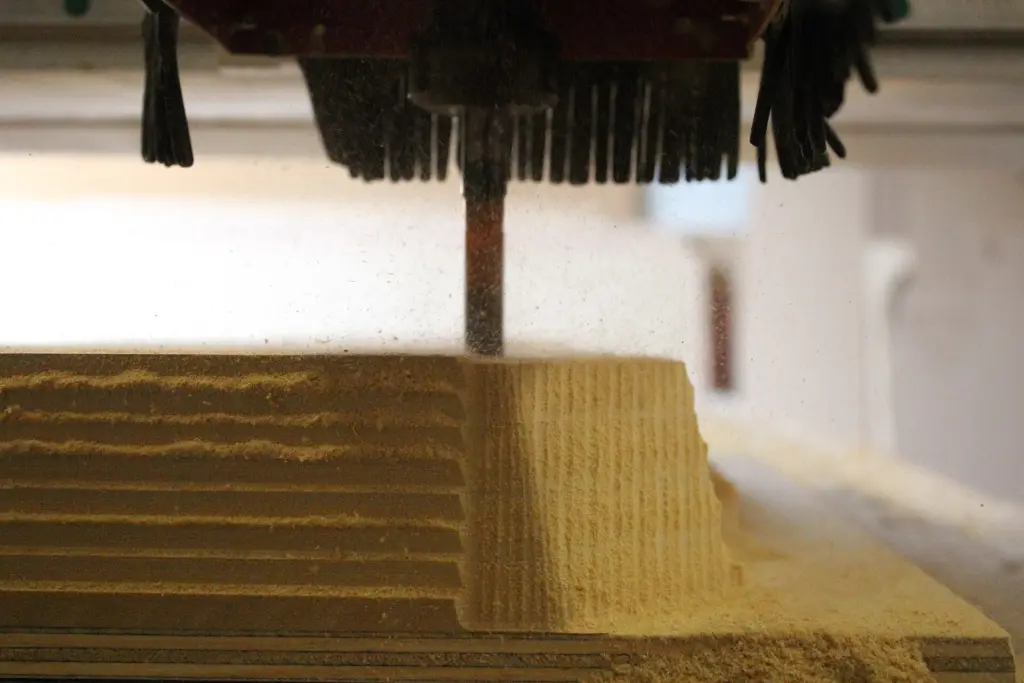
Wood dust is not a side issue. The German Technical Rule for Hazardous Substances TRGS 553 classifies hardwood dusts, such as oak and beech, as carcinogenic; it specifically names cancer of the inner nose. The rule applies to businesses but works as a benchmark for the hobby workshop. For CNC routers, it describes extraction through a hood that encloses the tool as completely as possible, usually with a brush, plus at least partial enclosure. Cleanup is done with a dust extractor of dust class M. Blowing off and dry sweeping are expressly not permitted there.
For respiratory protection, the TRGS names particle-filtering half masks from FFP2 upward and stresses that the highest class should be chosen against carcinogenic dusts. Which masks fit is explained in our dust mask guide. According to TRGS 553, wood dust is also combustible. So a chip bag next to the workbench should not sit there for weeks.
As soon as a laser comes into play, the situation changes. The Swiss accident insurer Suva writes that class 4 lasers pose a high risk to eyes and skin and may only be operated enclosed as class 1 or in a marked, supervised laser area. An open laser module on a gantry router therefore needs at least suitable safety glasses and a shielded spot. Snapmaker states that the Artisan’s enclosure lowers the hazard from class 4 to class 1. More on laser classes and exhaust is in our laser engraver guide.
Five CNC routers side by side
| Model | Work area (X × Y × Z) | Spindle according to manufacturer | Drive | Best for |
|---|---|---|---|---|
| Genmitsu PROVerXL 4030 V2 | 400 × 300 × 110 mm | up to 400 W, 10,000 rpm | Ball screws, NEMA 23 with feedback | Hardwood, signs, furniture parts |
| Genmitsu 3020-PRO Ultra | 300 × 205 × 78 mm | 710 W router motor (230 V) | NEMA 17, all-aluminum frame | Small workpieces, first attempts in aluminum |
| Genmitsu 4040-PRO | 400 × 400 × 80 mm | 775 motor, 9,000 rpm | Trapezoidal lead screws T10/T8 | Large, thin sheets, engraving |
| Genmitsu 3018-PROVer V2 | 284 × 180 × 40 mm | 775 motor, 9,000 rpm | Trapezoidal lead screw T8 | Getting started, circuit boards, acrylic |
| Snapmaker Artisan | 400 × 400 × 400 mm | 200 W, 18,000 rpm; laser 10 or 40 W | 3-in-1 with enclosure | Printing, laser and routing in one machine |
Genmitsu PROVerXL 4030 V2
Here the mechanics and the spindle match. The data sheet lists ball screws on all three axes, NEMA 23 closed-loop stepper motors, travel speeds of up to 5,000 mm/min and a repeatability of ±0.05 mm. The 110 mm of Z travel leaves room for thick boards and clamps. Genmitsu offers extensions to 600 × 600 mm and larger.
Genmitsu 3020-PRO Ultra
Compact but powerfully motorized. Instead of the small DC motor, the holder carries a 710 W router motor, and ER11 collets for 1/8 and 1/4 inch are included. According to the manufacturer, the frame is made entirely of aluminum. With a 300 × 205 mm area, it is limited to small parts. For engraving plates, handles or spare parts made of soft aluminum, we consider it the more interesting choice than the larger lead screw models.
Genmitsu 4040-PRO
Lots of area, little power. 400 × 400 mm is tempting, but the 775 motor is the same as on the smallest model. That works for large-area engraving in MDF or plywood. If you want to cut hardwood regularly, you are more likely to end up with the PROVerXL 4030 V2.
Genmitsu 3018-PROVer V2
The learning machine. With 284 × 180 × 40 mm, GRBL control and Candle, you learn zero point, toolpath and feed rate without a mistake immediately costing you a large workpiece. It is enough for circuit boards and acrylic signs. Expect, however, to upgrade soon if you develop a real interest in wood.
Snapmaker Artisan
One machine for three processes: 3D printing with two nozzles, a laser with 10 or 40 W and a 200 W CNC module with up to 18,000 rpm. With an ER11 collet and 4 mm bits, Snapmaker also lists brass and aluminum. The enclosure with exhaust fan is included. As a pure router, it would be too underpowered for us. The Artisan becomes interesting if you need a laser and a printer anyway and only have one spot in the workshop.
How we would decide
- Hardwood, signs and furniture parts: Genmitsu PROVerXL 4030 V2, plus a hood with brush and a class M vacuum.
- Small parts, occasionally aluminum: Genmitsu 3020-PRO Ultra.
- Large, flat engravings in sheet material: Genmitsu 4040-PRO.
- Just getting a taste: Genmitsu 3018-PROVer V2.
- Printer, laser and router under one roof: Snapmaker Artisan.
Frequently asked questions
Is a 775 motor enough for hardwood and aluminum?
The small Genmitsu models work with a 775-type DC motor running at up to 9,000 rpm. That is enough for engraving, circuit boards, acrylic and softwood at shallow depths of cut. You should not count on such a motor for aluminum; that calls for a 400 W spindle or a 710 W router motor.
What is the difference between a trapezoidal lead screw and a ball screw?
Trapezoidal lead screws, called "ACME T8" or "T10" at Genmitsu, are simple in design. Ball screws run with less backlash and hold their accuracy longer. You notice that with tight-fitting tenons or inlays.
Why does the Z height matter?
The Z height determines how thick a workpiece, including clamps, can fit under the bit. With 40 mm on the 3018-PROVer V2, a 19 mm board with hold-down clamps and a longer bit quickly reaches the limit. The PROVerXL 4030 V2 offers 110 mm of Z travel.
What software do you need for a CNC router?
The Genmitsu machines run on the open GRBL controller, operated for example with Candle or Universal Gcode Sender. Designs are created in a CAM program; for the PROVerXL 4030 V2, Genmitsu lists Easel, Vectric VCarve and Carveco Maker. Snapmaker comes with its own program, Luban.
How do you protect yourself from wood dust when routing?
The German technical rule TRGS 553 classifies hardwood dusts such as oak and beech as carcinogenic. It describes extraction through a hood with a brush, partial enclosure and a dust extractor of dust class M. Blowing off and dry sweeping are not permitted, and respiratory protection must be at least FFP2.
Is a combination of 3D printer, laser and router worth it?
The Snapmaker Artisan combines printing, laser and a 200 W CNC module; according to the manufacturer, the enclosure lowers laser class 4 to class 1. As a pure router, it is underpowered. It becomes interesting if you need the laser and printer anyway and only have room for one machine.
Sources
- Genmitsu: PROVerXL 4030 V2 user manual (PDF)
- SainSmart: PROVerXL 4030 V2 resources
- Genmitsu: 3020-PRO Ultra user manual (PDF)
- Genmitsu: 4040-PRO user manual (PDF)
- Genmitsu: 3018-PROVer V2 user manual (PDF)
- Snapmaker: Artisan
- TRGS 553 Wood Dust, version of Feb. 28, 2025 (PDF, BGW, in German)
- Suva: Protective measures for lasers (in German)
Where to buy
- Genmitsu PROVerXL 4030 V2Check price at Amazon.deCheck price at Amazon.co.ukCheck price at Amazon.nlCheck price at Amazon.com.beCheck price at Amazon.frCheck price at Amazon.itCheck price at Amazon.esCheck price at Amazon.plCheck price at Amazon.seAvailable in Germany: Amazon.de
- Genmitsu 3020-PRO UltraCheck price at Amazon.deCheck price at Amazon.co.ukCheck price at Amazon.nlCheck price at Amazon.com.beCheck price at Amazon.frCheck price at Amazon.itCheck price at Amazon.esCheck price at Amazon.plCheck price at Amazon.seAvailable in Germany: Amazon.de
- Genmitsu 4040-PROCheck price at Amazon.deCheck price at Amazon.co.ukCheck price at Amazon.nlCheck price at Amazon.com.beCheck price at Amazon.frCheck price at Amazon.itCheck price at Amazon.esCheck price at Amazon.plCheck price at Amazon.seAvailable in Germany: Amazon.de
- Genmitsu 3018-PROVer V2Check price at Amazon.deCheck price at Amazon.co.ukCheck price at Amazon.nlCheck price at Amazon.com.beCheck price at Amazon.frCheck price at Amazon.itCheck price at Amazon.esCheck price at Amazon.plCheck price at Amazon.seAvailable in Germany: Amazon.de
- Snapmaker ArtisanCheck price at Amazon.deCheck price at Amazon.co.ukCheck price at Amazon.nlCheck price at Amazon.com.beCheck price at Amazon.frCheck price at Amazon.itCheck price at Amazon.esCheck price at Amazon.plCheck price at Amazon.seAvailable in Germany: Amazon.de