Contents12 sections
This guide was first published in German on handgetestet.de.
A crimping tool cannot rescue badly stripped stranded wire. If you are just starting out, buy a good automatic wire stripper such as the Knipex PreciStrip16 first, and only then the crimping tool that matches your own ferrules. For wire ferrules, a self-adjusting tool such as the Knipex 97 53 14 is the most worry-free choice; red-blue-yellow cable lugs need a separate tool.
Sounds like two purchases instead of one. It is. The combination pliers with a built-in crimping recess found in many sets squeeze a 0.75 ferrule together somehow, but rarely so that it sits securely in the terminal.
First question: what ends up in the tool?
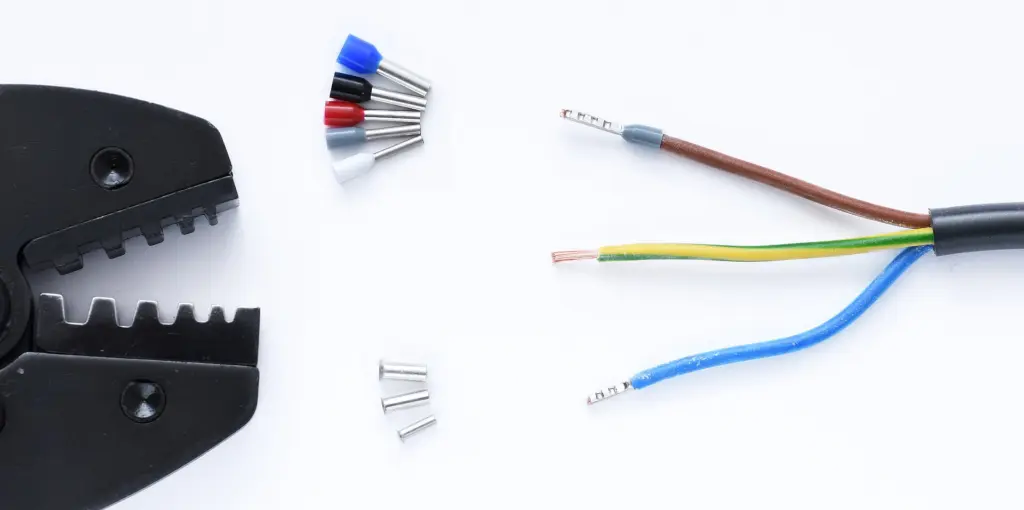
Wire ferrules, non-insulated cable lugs and insulated cable connectors look similar but require completely different crimp shapes. A ferrule crimper presses the sleeve into a square, hexagonal or trapezoidal profile. For the color-coded cable lugs (red 0.5 to 1 mm², blue 1.5 to 2.5 mm², yellow 4 to 6 mm²), the tool uses oval crimping with three color-marked zones. If you need both, you can hardly avoid two tools.
- Cross-section: speaker and LED cables are usually between 0.5 and 2.5 mm². A tool up to 16 mm² does no harm, but you pay for reserves many people never use.
- Ratchet lock: the tool only opens once full crimping pressure has been reached. That practically rules out half-crimped ferrules.
- Insertion: from the side or from the front. In cramped distribution boxes, a rotating die is more convenient; on the workbench, it hardly matters.
- For stripping: automatic adjustment to the cross-section, a length stop and replaceable blades.
One more point that product descriptions like to skip. Wire ferrules are standardized in the German standard DIN 46228, and manufacturers such as Knipex state that their tools crimp according to parts 1 and 4 of this standard. Cheap ferrules without a stated standard often do not fit cleanly into the profile.
House wiring is a job for a qualified electrician
Good tools do not make you an electrician. A joint statement by VDE, DKE, the German employers‘ liability insurance association for precision mechanics and electrical engineering, the electrical trade association ZVEH and other organizations puts it unmistakably: electrical installations may only be built, extended, modified and maintained by authorized qualified electricians, meaning businesses listed in the register of installers kept by the local grid operator. According to the statement, this also applies to builders, landlords and tenants. Anyone who does it themselves anyway risks not only electric shock and fire but also their insurance coverage.
For laypeople, that means: outlets, distribution boards and permanently installed cables remain off-limits. The tools in this guide are intended for extra-low voltage, such as speakers, LED strips with a power supply, model railways or control cables in the workshop. And for professionals who use them in their trade.
Seven tools, sorted by task
| Model | Task | Range according to the manufacturer | Special feature | Best for |
|---|---|---|---|---|
| Knipex PreciStrip16 (12 52 195) | Stripping, automatic | 0.08 to 16 mm² | Cutting depth readjustable, blade cassette replaceable | Anyone who wants to handle everything from fine strands up to 16 mm² with one tool |
| Jokari Super 4 plus (20050) | Stripping, automatic | 0.2 to 6 mm² | Light at 93 g, length stop 6 to 15 mm | Beginners with PVC cables |
| Jokari Secura 2K (20100) | Stripping, automatic | 0.2 to 6 mm² | Cutting depth adjustable for hard and soft insulation | Workshops with mixed cables |
| Knipex 97 53 14 | Wire ferrules, self-adjusting | 0.08 to 16 mm², twin up to 2 × 10 mm² | Hexagonal, side insertion, ratchet lock | Frequent work with many cross-sections |
| Weidmüller PZ 6 Roto (9014350000) | Wire ferrules | 0.14 to 6 mm² | Trapezoidal crimp, rotating die | Control cabinets and tight spots |
| Knipex PreciForce (97 52 36) | Insulated cable lugs and connectors | 0.5 to 6 mm² | Calibrated, ratchet lock | Red, blue, yellow cable lugs |
| Wiha crimping tool (45957) | Insulated cable lugs and contacts | 0.5 to 6 mm² | Oval crimping, emergency release | Cable lugs, if you are not set on Knipex |
Knipex PreciStrip16: one tool for almost everything
According to Knipex, the PreciStrip16 covers everything from wafer-thin 0.08 strands up to 16 mm². The automatic mechanism controls the cutting depth, and its zero point can be adjusted in fine steps for unusual insulation or cold conditions. A cable cutter sits on top, and the blade cassette is replaced when worn. For very hard halogen-free cables, the manufacturer offers a separate blade block.
Jokari Super 4 plus: the lightweight entry point
93 grams. According to Jokari, that is all this pistol-grip stripper made of glass-fiber-reinforced polyamide weighs, and it strips solid and fine-stranded PVC conductors from 0.2 to 6 mm² without adjustment. The length stop ranges from 6 to 15 mm, and the side cutter handles up to 2.5 mm². According to the manufacturer, it is designed for PVC insulation, such as single-core NYM-J or H07V-K. Finer strands below 0.2 mm² do not belong in it.
Jokari Secura 2K: when the insulation is sometimes soft, sometimes hard
Same cross-section range, but with integrated cutting depth adjustment. That helps when softer or harder sheaths come up alongside PVC. The stop goes up to 18 mm, and at 156 g the tool weighs noticeably more than the Super 4 plus.
Knipex 97 53 14: wire ferrules without thinking
According to the data sheet, the tool adjusts itself to the ferrule size, from 0.08 to 16 mm², with twin ferrules up to 2 × 10 mm². The crimping pressure is calibrated at the factory, and the ratchet lock can be released in an emergency. You insert the ferrule from the side and squeeze through. Done. If you prefer a square crimp, the 97 53 04 is a sibling with the same range; there, twin ferrules end at 2 × 6 mm².
Weidmüller PZ 6 Roto: the control cabinet classic
According to the manufacturer, the PZ 6 Roto crimps wire ferrules from 0.14 to 6 mm² with a trapezoidal profile. Its die rotates, so the ferrule goes in from the front or the side. For control cabinet builders, that is an argument. At the hobby bench, less so, and it cannot handle 16 mm².
Knipex PreciForce 97 52 36: for the color-coded cable lugs
Insulated cable lugs, plug connectors and butt connectors from 0.5 to 6 mm² are its territory. The tool is calibrated and only opens after full crimping pressure. According to Knipex, changing the die is not intended. For wire ferrules, it is the wrong choice.
Wiha 45957: cable lugs with emergency release
For this crimping tool, Wiha lists three color-coded zones from red to yellow, oval crimping and crimping pressure that adjusts itself. A lever lets you abort the crimping process at any time if the cable lug sits crooked. At 220 mm, it is as long as the Knipex. The choice between the two comes down to grip shape rather than technology.
And Wera? The Wuppertal-based company is at home with screwdrivers and bits. To our knowledge, the brand does not offer its own crimping or stripping tool. If you already have Wera screwdrivers in the drawer, they combine without any problem with one of the tools above.
Which type of workshop needs what?
- You occasionally wire speakers or LED strips: the Jokari Super 4 plus is enough for stripping. Add a simple ferrule crimper if the terminals require wire ferrules.
- You regularly work with stranded wire in many gauges: PreciStrip16 and Knipex 97 53 14. The pair is expensive but takes all the guesswork out of cross-section and crimping nest.
- You build control cabinets: Weidmüller PZ 6 Roto with a rotating die, plus the Secura 2K for varying insulation.
- Your project uses red-blue-yellow cable lugs: Knipex PreciForce or Wiha 45957, depending on which grip suits your hand better.
A word on combination solutions. If you handle finer work with a soldering iron, our soldering station guide offers the right complement. Side cutters, combination pliers and water pump pliers come in the sets from our guide to pliers sets. For model railways and small parts, take a look at our guide to model-making tools (in German).
For connections outdoors and underground, a crimp sleeve alone is not enough; gel joints and gel boxes are compared in our guide to outdoor cable connectors (in German).
Frequently asked questions
Can one crimping tool crimp both wire ferrules and cable lugs?
Hardly. A ferrule crimper presses the sleeve into a square, hexagonal or trapezoidal profile, while for color-coded cable lugs the tool uses oval crimping with three color-marked zones. If you need both, you can hardly avoid two tools. The crimping recess in combination pliers rarely crimps ferrules so that they hold securely.
What should you look for when buying a crimping tool?
What matters is the right cross-section, a ratchet lock and the way the terminal is inserted. The ratchet lock only opens the tool once full crimping pressure has been reached, which practically rules out half-crimped ferrules. A rotating die helps in cramped distribution boxes; on the workbench, it hardly matters.
Which cross-section is enough for speakers and LED strips?
These cables are usually between 0.5 and 2.5 mm². A tool up to 16 mm² does no harm, but you pay for reserves many people never use. For occasional jobs, the Jokari Super 4 plus is enough for stripping; it strips PVC conductors from 0.2 to 6 mm² without adjustment.
May I do my own house wiring with a crimping tool?
No. According to a joint statement by VDE, DKE, the employers' liability insurance association and ZVEH (German electrical engineering and trade bodies), electrical installations may only be built, extended and modified by authorized qualified electricians. Outlets, distribution boards and permanently installed cables remain off-limits for laypeople. The tools presented are intended for extra-low voltage and for professionals.
Does the quality of wire ferrules matter?
Yes. Wire ferrules are standardized in the German standard DIN 46228, and manufacturers such as Knipex state that their tools crimp according to parts 1 and 4 of this standard. Cheap ferrules without a stated standard often do not fit cleanly into the tool's profile.
What is the difference between the Jokari Super 4 plus and the Secura 2K?
Both strip 0.2 to 6 mm². The Secura 2K additionally has cutting depth adjustment, helpful with softer or harder sheaths, and a length stop up to 18 mm. In return, at 156 g it weighs noticeably more than the 93 g Super 4 plus.
Sources
- Knipex: product information PreciStrip16 12 52 195
- Knipex: product information 97 53 14
- Knipex: product information 97 53 04
- Knipex: product information PreciForce 97 52 36
- Jokari: Super 4 plus
- Jokari: Secura 2K
- Wiha: crimping tool 45957
- Weidmüller: PZ 6 Roto
- VDE et al.: Joint statement on the safe handling of electricity
Where to buy
- Knipex PreciStrip16 12 52 195Check price at Amazon.deAvailable in Germany: Amazon.de
- Jokari Super 4 plus 20050Check price at Amazon.deAvailable in Germany: Amazon.de
- Jokari Secura 2K 20100Check price at Amazon.deAvailable in Germany: Amazon.de
- Knipex 97 53 14 Crimpzange AderendhülsenCheck price at Amazon.deAvailable in Germany: Amazon.de
- Weidmüller PZ 6 RotoCheck price at Amazon.deAvailable in Germany: Amazon.de
- Knipex PreciForce 97 52 36Check price at Amazon.deAvailable in Germany: Amazon.de
- Wiha Crimpwerkzeug 45957Check price at Amazon.deAvailable in Germany: Amazon.de