Contents10 sections
This guide was first published in German on handgetestet.de.
Many electronics sets end up back in the cupboard after two evenings. That is rarely due to missing parts; usually it is the wrong starting point. The twelve-year-old who wants to understand why a lamp lights up suddenly finds himself in front of program code, and the adult who actually wanted to learn soldering just plugs wires into a board. For the path to microcontrollers, we consider the official Arduino Starter Kit with its German project book the most solid choice. If you want to handle a soldering iron first, the Roboter-Lötwerkstatt (robot soldering workshop) from Franzis is the better choice.
Plugging together, soldering or programming?
The word „kit“ covers three very different things. When plugging together, circuits are built on a breadboard; nothing gets hot and everything can be taken apart again. With soldering, you end up with a finished device, but it takes patience and a steady hand. With programming, a small computer such as the Arduino Uno controls the components. Here the appeal lies in the code rather than in the circuit itself.
Before you order, it pays to look at these points:
- The manufacturer’s age rating. Franzis and ELV approve their sets from age 14, while Kosmos aims Der große Elektro-Workshop at 10- to 14-year-olds. Arduino itself gives no minimum age for the Starter Kit.
- What is not in the box. The Roboter-Lötwerkstatt needs two AA batteries, the ELV set a 5-volt USB power supply with a Micro-USB plug, and the Joy-IT sensor kit an Arduino or Raspberry Pi of your own.
- The language of the instructions. The Arduino Starter Kit comes in several language versions. According to the Amazon listing, the German edition carries the number K040007; the Spanish one (K030007) looks exactly the same in the box.
- Original or compatible. Elegoo builds its own boards that run with the Arduino software. For the code, that makes no difference; for spare parts and forums, it sometimes does.
Sooner or later, an inexpensive measuring device becomes part of the kit. Which devices are good enough for hobbyists is covered in our guide to multimeters.
Six sets, six ways in
| Model | Focus | Soldering required | Age according to manufacturer | Best for |
|---|---|---|---|---|
| Arduino Starter Kit K040007 | Programming, 15 projects, Arduino Uno | no | not stated | Teens and adults interested in code |
| Elegoo UNO R3 Super Starter Kit | Programming, compatible board, instructions as a download | no | from 10 (according to the listing) | Beginners on a smaller budget |
| Franzis Roboter-Lötwerkstatt 67189 | Learning to solder, line-following robot | yes, soldering iron included | from 14 | Soldering novices who want a finished result |
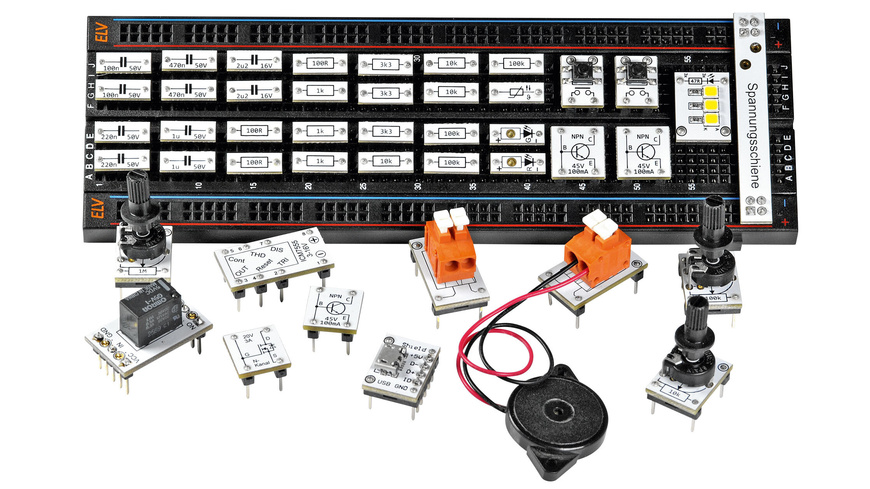
| ELV Experimentier-Set-Prototypenadapter | Basic circuits on the breadboard, 44 adapters | no | from 14 | Anyone who wants to understand components before programming |
| Joy-IT Sensorkit X40 | 40 sensor and actuator modules | no, optional | not stated | Expansion for an existing Arduino or Raspberry Pi |
| Kosmos Der große Elektro-Workshop 620820 | Circuits, more than 130 experiments | no | 10 to 14 | Children who want to grasp electricity |
Arduino Starter Kit K040007: the classic with a book
In the box are an Arduino Uno, a breadboard with 400 contacts, a 16×2 text display, a servo, a small DC motor, a TMP36 temperature sensor and a handful of phototransistors. According to Arduino, the 170-page project book guides you through 15 projects, from a blinking light to motor control with an H-bridge. Nothing is soldered. Compared with clones from the Far East, the set is expensive; you are paying for a printed textbook whose lessons build on each other and for the original board. According to the Amazon listing, Arduino now also sells a version with the newer Uno R4 WiFi and 13 projects. Check the language of the book there before you buy.
Elegoo UNO R3 Super Starter Kit: lots of material, less guidance
Elegoo includes its own board, compatible with the Arduino software, plus a power supply module, relay, servo and expansion board. According to the listing, the instructions are available in German; the current version including sample code is downloaded from Elegoo. The listing mentions a good twenty lessons and an age of 10 and up. If you like working your way through datasheets and forums on your own, you will get far with it. Children without an adult alongside, less so.
Franzis Roboter-Lötwerkstatt 67189: soldering with a purpose
Here, soldering takes center stage. According to the datasheet, the set includes a soldering iron, solder, practice material and all the parts for a robot of about 15 × 10 × 7 cm that follows a black line. You practice on the practice material first, then move on to the actual circuit board. Along the way, the 48-page manual explains what each component in the robot does. Buyers report, however, that the included iron heats up slowly and the solder pads are delicate. With a decent station, it goes more smoothly; we have put together separately what makes a good soldering station.
ELV Experimentier-Set-Prototypenadapter: components you can touch
ELV has mounted each component on a small board with labeled pins: resistors, capacitors, trimmers, transistors, a MOSFET, an NTC, a relay and the ICM7555 timer chip. 44 of these adapters, a breadboard with 830 contacts and a cable set are included. Power comes in at 5 volts via Micro-USB. The set was developed together with Make magazine; the matching special issue „Make: Elektronik Special“ (electronics special) with 84 pages of fundamentals is sold separately by ELV. Without the issue, there are no instructions. With it, this is the most honest way to learn electronics from the ground up.
Joy-IT Sensorkit X40: fresh supplies for the second month
Not a starter set in the strict sense, since there is no board. Instead, the box holds 40 modules, from an ultrasonic distance sensor and humidity and temperature sensors to a heartbeat sensor, joystick and relay. Joy-IT names Arduino, Raspberry Pi and micro:bit as platforms and provides circuit diagrams and sample code in an online database. Once the project book is finished at the latest, a kit like this gets exciting. For the Raspberry Pi itself, take a look at our Raspberry Pi guide.
Kosmos Der große Elektro-Workshop 620820: understanding electricity, no code at all
For children between 10 and 14, Kosmos lists more than 130 experiments on direct and alternating current with Der große Elektro-Workshop (the big electrical workshop). Components are plugged together; according to the listing, a current meter, a generator and a timer module are included. You have to buy batteries separately. Nothing is programmed here, and that is often exactly right for ten-year-olds.
How we would decide
- You want to learn programming and appreciate a printed book: Arduino Starter Kit K040007.
- Same goal, but money is tight and English-language forums do not put you off: Elegoo UNO R3 Super Starter Kit.
- At the end, something soldered should be standing on the table: Franzis Roboter-Lötwerkstatt, ideally with a better soldering iron.
- You first want to understand what a transistor does: the ELV set with the Make special issue.
- The first set is done: Joy-IT Sensorkit X40.
- A child between 10 and 14 wants to experience electricity: Kosmos Der große Elektro-Workshop.
Our rule of thumb: better a set one level too easy than one level too hard. Success on the first evening carries you further than any parts list.
Frequently asked questions
What is the difference between plugging together, soldering and programming?
When plugging together, circuits are built on a breadboard; nothing gets hot and everything can be taken apart again. With soldering, you end up with a finished device, but it takes patience and a steady hand. With programming, a small computer such as the Arduino Uno controls the components.
Which electronics kit is suitable for children?
Kosmos aims Der große Elektro-Workshop 620820 at children between 10 and 14, with more than 130 experiments on direct and alternating current. Components are plugged together, nothing is programmed, and that is often exactly right for ten-year-olds. Franzis and ELV only approve their sets from age 14.
Is an Arduino-compatible set such as Elegoo an alternative?
Elegoo includes its own board that runs with the Arduino software, plus plenty of material. The instructions are downloaded. If you like working your way through datasheets and forums on your own, you will get far with it; for children without an adult alongside, it is less suitable.
How do you recognize the German edition of the Arduino Starter Kit?
According to the Amazon listing, the German edition carries the number K040007. The Spanish version, K030007, looks exactly the same in the box. With the newer version featuring the Uno R4 WiFi, you should also check the language of the project book before buying.
What is missing from many electronics kits?
The Roboter-Lötwerkstatt needs two AA batteries, the ELV set a 5-volt USB power supply with a Micro-USB plug. The Joy-IT Sensorkit X40 lacks a board; it requires an Arduino or Raspberry Pi. For the ELV set, the instructions are only available in the separately sold Make special issue.
Sources
- Arduino: Arduino Starter Kit Multi-Language
- Elegoo: instructions and code for the UNO R3 Super Starter Kit
- Franzis/ELV: datasheet Die Roboter-Lötwerkstatt (67189)
- ELV: Experimentier-Set-Prototypenadapter
- ELVjournal: kit description Experimentierset-Prototypenadapter
- Joy-IT: datasheet Sensorkit X40 (SEN-Kit02)
- Kosmos: Der große Elektro-Workshop
Where to buy
- Arduino Starter Kit K040007Check price at Amazon.deAvailable in Germany: Amazon.de
- Elegoo UNO R3 Super Starter KitCheck price at Amazon.deAvailable in Germany: Amazon.de
- Franzis Roboter-Lötwerkstatt 67189Check price at Amazon.deAvailable in Germany: Amazon.de
- ELV Experimentier-Set-PrototypenadapterView at ELVAvailable in Germany: ELVCheck price at Amazon.deAvailable in Germany: Amazon.de
- Joy-IT Sensorkit X40Check price at Amazon.deAvailable in Germany: Amazon.de
- Kosmos Der große Elektro-Workshop 620820Check price at Amazon.deAvailable in Germany: Amazon.de