Contents9 sections
This guide was first published in German on handgetestet.de.
Most bad buys with flush-mounted relays happen before anyone has even opened the switch box. People buy by brand or app, yet what decides is the wiring in the wall. If there is a neutral wire, the Shelly 1PM Gen4 is, in our view, the obvious choice for a single light or appliance; in older buildings without a neutral, the Shelly 1L Gen3 is the better fit, and for roller shutters the Shelly 2PM Gen4. And all of this is installed by a qualified electrician. Not by you.
If you only want to control roller shutters and a visibly new switch on the wall is fine, a ready-made roller shutter switch is often the simpler solution. You will find those in the guide to smart roller shutter switches.
Behind the switch there are 230 volts
A relay sits in the switch box between the supply line, the lamp and the switch. Working there means working on the fixed electrical installation. The manual from Homematic IP maker eQ-3 is unambiguous: work on the 230 V mains may only be carried out by a qualified electrician in accordance with VDE 0100, the installation regulations under VDE 0100, HD 384 or IEC 60364 must be observed, and improper installation risks fire and danger to life. Fibaro states in its manual that all work on the device is reserved for qualified electricians, and Sonoff requires installation and maintenance by an electrician.
Then there is the law. Under Section 13 of the German Low Voltage Connection Ordinance (Niederspannungsanschlussverordnung, NAV), installing, extending and modifying the system behind the main service fuse may only be done by the grid operator or by an electrical contractor listed in a grid operator’s installer register. Responsibility stays with the connection owner, even if the apartment is rented out. That is why you deliberately will not find installation instructions here. This guide helps with choosing, so that the electrician brings the right device.
What the electrician should clarify first
- Is there a neutral wire in the box? Without one, five of the seven devices below are ruled out.
- How deep is the box, and how much room is left behind the switch insert? According to the manufacturers, installation depths range from 16 mm (Shelly) to 41 mm (Homematic IP).
- What load is connected? An LED ceiling light, a fan heater or a roller shutter motor make very different demands.
- Which wireless standard suits the house? Wi-Fi needs no hub; Zigbee, Z-Wave and Homematic IP need one.
Seven flush-mounted relays compared
| Model | Neutral wire | Load and metering (according to the manufacturer) | Wireless | Best for |
|---|---|---|---|---|
| Shelly 1PM Gen4 | required | 16 A, with power metering | Wi-Fi, Zigbee, Matter | Light or appliance, homeowners with N |
| Shelly 2PM Gen4 | required (on 230 V mains) | 2 × 10 A, 16 A combined, metering per channel | Wi-Fi, Zigbee, Matter | Roller shutters, two lighting circuits |
| Shelly 1L Gen3 | not required, bypass included | up to 200 W, no metering | Wi-Fi, Matter via update | Lights in older buildings without N |
| Homematic IP HmIP-FSM16 | required | 16 A, metering 0 to 3,680 W | Homematic IP (868 MHz) | Existing Homematic system |
| Aqara Single Switch Module T1 (No Neutral) | not required | 3 to 1,250 W, lights only | Zigbee 3.0, hub required | Aqara households without N |
| Fibaro Roller Shutter 4 | required | Motors up to 2 A, with energy metering | Z-Wave | Roller shutters on a Z-Wave network |
| Sonoff MINIR4M | required | 10 A resistive, no metering stated | Wi-Fi, Matter | Simple switching without a hub |
Path 1: You rent
The wiring in the wall belongs to the landlord. So ask them first. If they allow the conversion, hire a registered electrical contractor and plan for removal when you move out at the same time. Without consent, you are left with solutions that require no intervention: smart bulbs, plug-in adapters or stick-on wireless buttons. What a smart switch on the wall can do and when it is the better choice is covered in our guide to smart light switches.
Path 2: Your own home with a neutral wire
This is where the selection is widest. Whether the blue wire really reaches the switch box, however, only becomes clear once the electrician opens it.
Shelly 1PM Gen4
One channel, up to 16 A according to the manufacturer, plus power metering. The module measures 37 × 42 × 16 mm and communicates via Wi-Fi, Zigbee and Matter; Matter is active out of the box, and pressing the button five times switches to Zigbee. On Wi-Fi it needs no hub. For a ceiling light, a water heater or a pump with consumption readout, this is our first choice, because hardly any device is this small and this open to third-party systems.
Homematic IP HmIP-FSM16
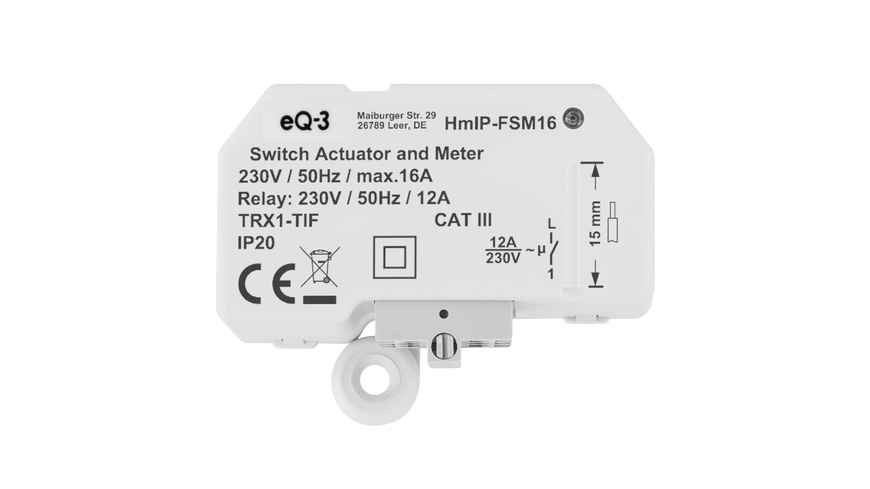
According to the data sheet, this switch and metering relay (Schalt-Mess-Aktor) measures from 0 to 3,680 W with 1% accuracy and switches 2,760 W continuously, 3,680 W for 20 minutes. It is approved for resistive loads. It needs a neutral wire and a Homematic IP Access Point or a partner solution. At 54 × 33 × 41 mm, it is considerably deeper than the competition. If you already have Homematic thermostats in the house, you get everything in one app; as a standalone entry point, it would mean too much system lock-in for our taste.
Sonoff MINIR4M
Very compact: 39.5 × 33 × 16.8 mm. According to the manufacturer, it switches a 10 A resistive load, speaks Wi-Fi and Matter and has terminals for L and N. Sonoff does not mention power metering. If all you want is switching, it does the job.
Path 3: Older building without a neutral wire
Common in older houses: only the live wire and the lamp wire arrive in the switch box. Conventional relays are then left without power. Devices designed to run without N draw their energy through the lamp, and that is exactly what makes low-wattage LED lights temperamental.
Shelly 1L Gen3
Shelly includes a bypass that sits in parallel with the lamp; according to the manufacturer, it is mandatory with LED lights, and with it lamps from 5 W can be switched. Maximum load: 200 W. The module communicates via Wi-Fi, and Matter is supposed to arrive via a firmware update. There is no power metering. That is enough for a ceiling light in an older building. Not for a fan heater.
Aqara Single Switch Module T1 (No Neutral)
According to the manual, the module works with Zigbee 3.0, switches 3 to 1,250 W of resistive load and is only suitable for lights from 3 W. Without a compatible Aqara or Zigbee hub, nothing works. At 21.4 mm deep, it is thicker than the Shelly. It makes sense if an Aqara hub is already running.
Path 4: Roller shutters
A roller shutter motor needs two outputs, one for up and one for down, and limit switches in the motor. Both relays here explicitly require electronic or mechanical end positions. You can read more about belt winders and wireless motors in our guide to smart roller shutter control (in German).
Shelly 2PM Gen4
Two channels at 10 A each, 16 A combined, metering per channel. In roller shutter mode, the device detects obstacles according to Shelly and supports blinds with slats. Same dimensions as the 1PM, same range of wireless standards. Usable without a hub, which makes it the simpler solution for most households.
Fibaro Roller Shutter 4
Z-Wave with an 800-series chip, motors up to 2 A, energy metering. According to the manual, it needs a box 50 mm in diameter and at least 60 mm deep. That is quite a demand. Without a Z-Wave hub, nothing works; if you have one, you get a device that also acts as a repeater in the wireless network.
How we would decide
- Neutral wire present, one light or appliance, want to see consumption: Shelly 1PM Gen4.
- No neutral wire, LED ceiling light: Shelly 1L Gen3 with bypass; in an Aqara household, the T1 (No Neutral).
- Roller shutters without a hub: Shelly 2PM Gen4; with a Z-Wave network: Fibaro Roller Shutter 4.
- Homematic already in the house: HmIP-FSM16, provided the box is deep enough.
- Rented apartment: the landlord first, then the electrical contractor.
With Zigbee, Z-Wave and Homematic IP, the hub belongs in the cost calculation. Which hub speaks which wireless standards is sorted out in our guide buying a smart home hub. And once more, because it matters: the electrician does the installation. They also check whether the circuit breaker and box suit the relay.
If a new build or a full renovation is coming up, the wired option is worth a look: relays in the distribution board are explained in the guide to Homematic IP Wired.
If the cables end in the distribution board, the guide smart home in the fuse box (in German) is the better place to start.
Frequently asked questions
Can I install a flush-mounted relay myself?
No. Under Section 13 of the German Low Voltage Connection Ordinance (NAV), only the grid operator or a registered electrical contractor may make changes to the installation behind the main service fuse. eQ-3, Fibaro and Sonoff also require installation by a qualified electrician. Improper installation risks fire and danger to life.
What is a neutral wire and why does it matter?
Without a neutral wire in the switch box, five of the seven relays compared are ruled out, because conventional relays are then left without power. Devices designed to run without N draw their energy through the lamp, which makes low-wattage LED lights temperamental. Whether the wire is in the box only becomes clear once the electrician opens it.
Which flush-mounted relay works without a neutral wire?
The Shelly 1L Gen3 with the included bypass, which according to the manufacturer is mandatory for LED lights. It switches lamps from 5 W up to a maximum of 200 W; there is no power metering. The Aqara Single Switch Module T1 (No Neutral) also works without N but needs a Zigbee hub.
Which relay is suitable for roller shutters?
A roller shutter motor needs two outputs and limit switches in the motor. The Shelly 2PM Gen4 offers two channels at 10 A each, detects obstacles according to Shelly and runs without a hub. If you already have a Z-Wave network, go for the Fibaro Roller Shutter 4, though it needs a deep box.
Do flush-mounted relays need a smart home hub?
That depends on the wireless standard. Wi-Fi devices such as Shelly or Sonoff work without a hub. Zigbee, Z-Wave and Homematic IP need one, and the hub then belongs in the cost calculation. The Homematic IP HmIP-FSM16 is mainly worth it if you already have Homematic devices in the house.
What should renters do?
The wiring in the wall belongs to the landlord, so ask them first. If they allow the conversion, a registered electrical contractor does the installation; plan for removal when you move out at the same time. Without consent, you are left with smart bulbs, plug-in adapters or stick-on wireless buttons.
Sources
- Shelly: 1PM Gen4, technical specifications
- Shelly: 2PM Gen4, technical specifications
- Shelly: 1L Gen3, technical specifications
- Homematic IP: Schalt-Mess-Aktor (16 A) flush-mounted
- eQ-3: HmIP-FSM16 data sheet
- eQ-3: HmIP-FSM16 installation and operating manual
- Aqara: Single Switch Module T1 (No Neutral) manual
- Fibaro: Roller Shutter 4 (FGR-224) manual
- Sonoff: MINIR4M, product documentation
- German Low Voltage Connection Ordinance (NAV), Section 13 Electrical installation
Where to buy
- Shelly 1PM Gen4Check price at Amazon.deCheck price at Amazon.co.ukCheck price at Amazon.nlCheck price at Amazon.com.beCheck price at Amazon.frCheck price at Amazon.itCheck price at Amazon.esCheck price at Amazon.plCheck price at Amazon.seAvailable in Germany: Amazon.de
- Shelly 2PM Gen4Check price at Amazon.deCheck price at Amazon.co.ukCheck price at Amazon.nlCheck price at Amazon.com.beCheck price at Amazon.frCheck price at Amazon.itCheck price at Amazon.esCheck price at Amazon.plCheck price at Amazon.seAvailable in Germany: Amazon.de
- Shelly 1L Gen3Check price at Amazon.deCheck price at Amazon.co.ukCheck price at Amazon.nlCheck price at Amazon.com.beCheck price at Amazon.frCheck price at Amazon.itCheck price at Amazon.esCheck price at Amazon.plCheck price at Amazon.seAvailable in Germany: Amazon.de
- Homematic IP Schalt-Mess-Aktor HmIP-FSM16View at ELVAvailable in Germany: ELV
- Aqara Single Switch Module T1 (No Neutral)Check price at Amazon.deCheck price at Amazon.co.ukCheck price at Amazon.nlCheck price at Amazon.com.beCheck price at Amazon.frCheck price at Amazon.itCheck price at Amazon.esCheck price at Amazon.plCheck price at Amazon.seAvailable in Germany: Amazon.de
- Fibaro Roller Shutter 4Check price at Amazon.deCheck price at Amazon.co.ukCheck price at Amazon.nlCheck price at Amazon.com.beCheck price at Amazon.frCheck price at Amazon.itCheck price at Amazon.esCheck price at Amazon.plCheck price at Amazon.seAvailable in Germany: Amazon.de
- Sonoff MINIR4MCheck price at Amazon.deCheck price at Amazon.co.ukCheck price at Amazon.nlCheck price at Amazon.com.beCheck price at Amazon.frCheck price at Amazon.itCheck price at Amazon.esCheck price at Amazon.plCheck price at Amazon.seAvailable in Germany: Amazon.de