Contents10 sections
This guide was first published in German on handgetestet.de.
Many hair oils carry argan in their name and contain very little of it. If you read the ingredient list on the back, well-known brands often list Dimethicone or Cyclomethicone first, which are silicones, with argan oil only in third or fourth place. Our recommendation for most people: a pure, certified plant oil in a glass bottle, applied sparingly to the ends. It goes further than the price per liter suggests, and it contains no silicones, no fragrance and no parabens.
That does not apply to everyone. If you have very frizzy hair that you straighten and blow-dry every day, you will appreciate the instant shine of silicones. That is why we present both approaches and say what is in each product.
What a hair oil can do
An oil coats the hair fiber, makes it more supple and adds shine. Hair builds up less static, and the brush glides more easily. That is all. Split ends do not grow back together, even if some packaging promises to “repair split ends.” Care products can smooth split ends and help prevent them; only scissors remove them for good. The US professional association of dermatologists recommends conditioning after washing and regular trims, not miracle products.
Argan oil also calls for a sober view. According to a review in the journal Frontiers in Nutrition, it consists mainly of oleic acid and linoleic acid and contains vitamin E, mostly in the form of gamma-tocopherol. For cosmetic argan oil, the kernels are cold-pressed unroasted; roasting is only done for the culinary oil. Clinical studies on its effect on hair are scarce. Only using it shows what an oil does for your own hair.
Reading the ingredient list: four terms are enough
Every cosmetic product carries an INCI list, the international nomenclature for its ingredients. It is sorted by quantity, with the most important ingredients first. There are four groups you should be able to recognize.
- Silicones: names ending in -cone, -conol and -siloxane, such as Dimethicone, Dimethiconol, Amodimethicone, Phenyl Trimethicone, Cyclomethicone, Cyclopentasiloxane and Trisiloxane. They smooth instantly but break down poorly in the environment. The Verbraucherzentrale, Germany’s consumer advice center, includes them in its list of plastics in cosmetics.
- Fragrances: “Parfum” or “Fragrance” stands for a scent blend that the manufacturer does not have to disclose. Allergens such as Linalool, Limonene, Citral, Coumarin or Hexyl Cinnamal must be listed individually. For leave-in products, EU Regulation 2023/1545 lowers the threshold for this to 0.001 percent.
- Parabens: preservatives ending in -paraben. Five of them have been banned in the EU since 2014 (EU Regulation 358/2014); others are permitted up to maximum concentrations. A pure oil contains no water and needs no preservatives.
- Petroleum-based ingredients: Isododecane, Isohexadecane, Paraffinum Liquidum or C13-14 Isoparaffin make an oil feel lighter and are of fossil origin.
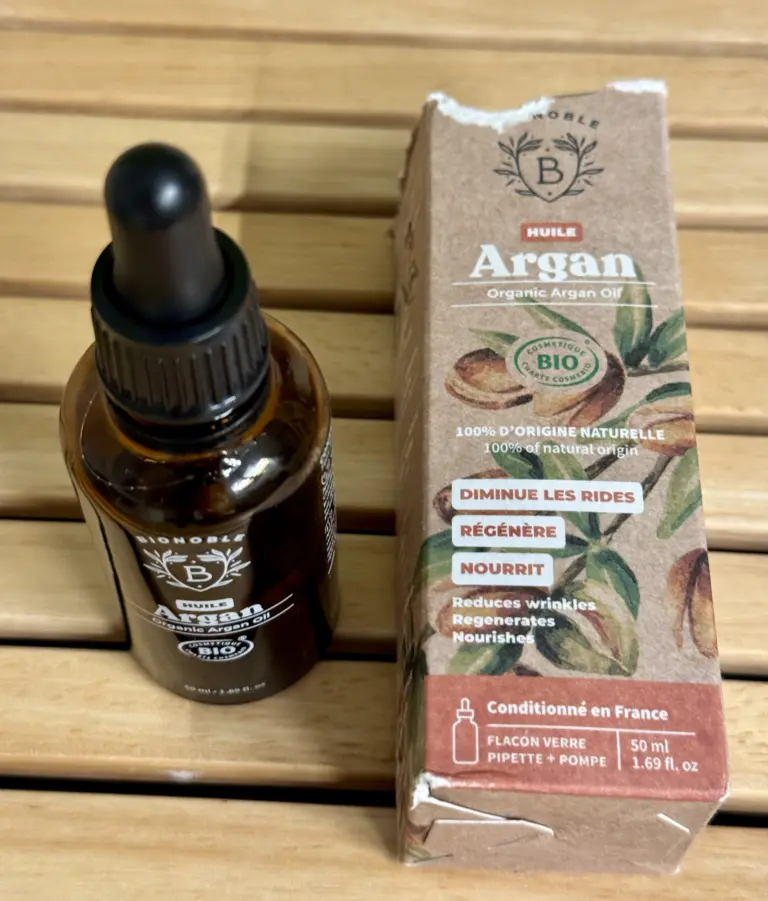
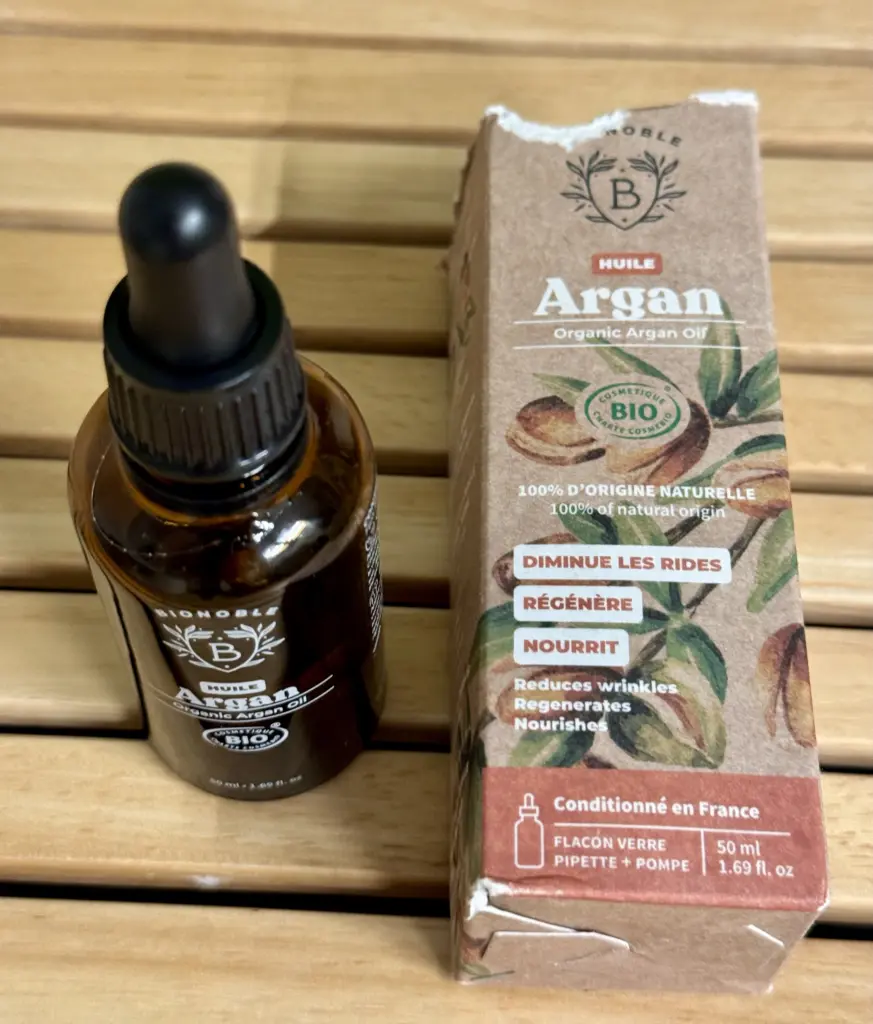
An example makes this concrete. For Moroccanoil Treatment Original, the manufacturer lists Cyclomethicone and Dimethicone as the first ingredients, followed by argan oil, Parfum and two colorants. On the organic argan oil from Bionoble, the list reads Argania Spinosa (Argan) Kernel Oil and Tocopherol. Two hair oils, two different worlds.
Seals that rule out silicones and synthetic fragrances
If you would rather not study ingredient lists, natural cosmetics seals are a useful guide. According to the Verbraucherzentrale, COSMOS and NATRUE prohibit silicones, paraffins and other petroleum products, synthetic fragrances and synthetic colorants, among other things.
- COSMOS is the joint standard of BDIH, Cosmébio, Ecocert, ICEA and Soil Association. COSMOS ORGANIC requires a high organic share; COSMOS NATURAL meets the same bans without the organic quota. The French seal “Cosmétique Bio” from Cosmébio is based on this standard.
- NATRUE was founded by natural cosmetics manufacturers and has two levels: natural cosmetics and organic cosmetics.
Be careful with claims such as “98 percent of natural origin.” They often follow the ISO 16128 standard, in which water also counts, and they are not a seal. A natural scent also contains allergens: essential oils bring Linalool and Limonene with them. Natural does not mean allergen-free.
Nine hair oils and their ingredients compared
Information based on the ingredient lists from the manufacturers or retailers, as of November 2026. Formulations change; what counts is the list on the package you buy.
Premium class: brand-name oils with fragrance and instant shine
Price range roughly €18 to €50 per bottle (prices in Germany, as of November 2026). Here you are mainly paying for the brand, the scent and the texture. None of these three oils carries a natural cosmetics seal.
Our pick in the premium class: Nuxe Huile Prodigieuse. According to the manufacturer, this dry oil from France combines seven plant oils, including argan, camellia, macadamia and borage, and contains no silicones. It does, however, contain Parfum and the fragrance allergens Benzyl Salicylate, Linalool, Limonene, Citronellol and Geraniol. If you like the typical Nuxe scent and have no problem with fragrances, you get one oil for hair, face and body. If you want to avoid fragrances, it is not for you.
Moroccanoil Treatment Original is the salon classic and stands for the shine that silicones deliver. It has little to do with argan oil as the main ingredient. Olaplex No.7 Bonding Oil is similar: Dimethicone comes first, along with Phenyl Trimethicone, isoparaffins and Parfum. According to the manufacturer, it protects against heat up to 232 °C (450 °F) during styling. For blow dryers and flat irons, that is an argument; for our criterion, it is not. Gisou’s Honey Infused Hair Oil is also silicone-based and contains fragrance.
Mid-range class: pure plant oils with a seal
Price range roughly €10 to €20 for 30 to 50 milliliters. The price per liter looks high. But since two to three drops per application are enough, a bottle lasts a long time.
Our pick in the mid-range class: Bionoble Bio-Arganöl. The ingredient list consists of organically grown argan oil and 0.1 percent vitamin E, certified COSMOS ORGANIC with the Cosmébio seal. According to the manufacturer, it is pressed in Morocco and bottled in France, in amber glass with a dropper and an additional pump. We used this oil in our own hair for several months and rated it five out of five stars; the details are in our review of the Bionoble organic argan oil.
Primavera Arganöl bio from the Allgäu region in southern Germany is the German alternative with the NATRUE seal. According to the manufacturer, the nuts come from a Moroccan women’s cooperative. It only comes in 30 milliliters, so the price per liter is correspondingly higher. If you have fine hair that gets greasy quickly, reach for Primavera Jojobaöl bio: jojoba oil is actually a liquid wax, feels lighter than many oils and is also NATRUE certified.
Entry class: little money, big differences
Price range up to about €10 per bottle; pure coconut oil in a 200-milliliter jar costs a little more but the least per milliliter. This is where natural cosmetics and drugstore formulas part ways most clearly.
Our pick in the entry class: Weleda Hydra Shine Gloss Drops. This hair oil blends apricot kernel, coconut, jojoba, argan and castor oil with squalane and the ester Isoamyl Laurate. There are no silicones, and the NATRUE seal is shown on the manufacturer’s website. It is not completely fragrance-free: Weleda uses a Parfum made from natural essential oils. According to the manufacturer, one to two drops in dry hair or two to three in damp hair are enough.
Pure coconut oil is the most economical option, for example CMD Rio de Coco Kokosöl in a glass jar with just one ingredient, cold-pressed in Sri Lanka and, according to the manufacturer, certified as natural cosmetics to ICADA. It solidifies below about 24 °C and has to be melted between your hands; for fine hair it is often too heavy. L’Oréal Paris Elvital Öl Magique costs the least, but it is based on Isododecane, Dimethicone and Dimethiconol and contains Parfum with Coumarin. It smooths instantly. It simply does not fit the goal of avoiding silicones and synthetic fragrances.
Getting the amount right: less than you think
The most common mistake with hair oil is the amount. Two to three drops are enough for shoulder-length hair, rubbed between your palms and worked into the ends, never into the roots. The oil spreads most evenly in towel-dried hair. If you apply it to dry hair, use one drop less. An overnight oil treatment, which some manufacturers recommend once a month, is washed out with shampoo in the morning.
Pure oils go rancid over time. Store them away from light, in a cool place and tightly closed; Bionoble specifies 18 months after opening. If you are prone to allergies, try a new oil on a small patch of skin first.
How we would decide
- You want a short ingredient list without silicones, fragrance and parabens: Bionoble Bio-Arganöl or Primavera Arganöl bio.
- Your hair is fine and gets greasy quickly: Primavera Jojobaöl bio, used very sparingly.
- You want to spend little and like a light natural scent: Weleda Hydra Shine Gloss Drops.
- Scent and instant shine matter more to you than the ingredient list: Nuxe Huile Prodigieuse without silicones, Moroccanoil or Olaplex with silicones.
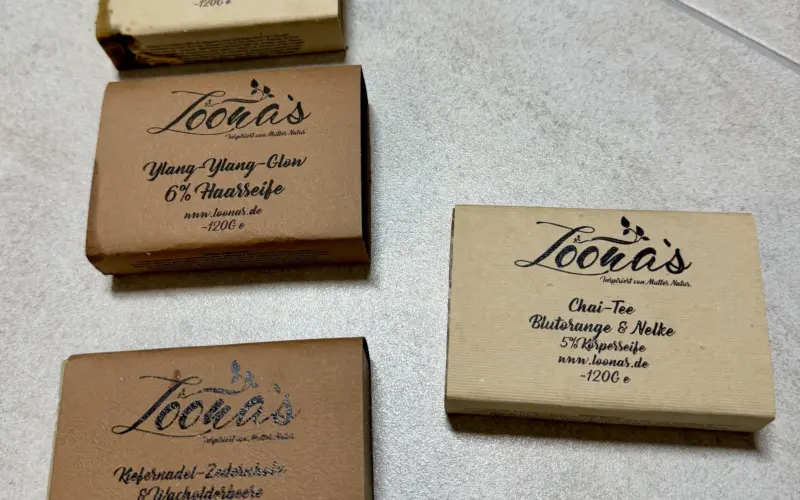
If you want to switch your entire hair care routine to a few low-plastic products, our guide to shampoo bars and our long-term review of Loona’s shampoo bars are the next step. For badly damaged hair, with bond builders and treatments, see our guide to caring for damaged hair.
Frequently asked questions
How can I spot silicones in hair oil?
By endings such as -cone, -conol and -siloxane in the ingredient list, for example Dimethicone, Dimethiconol, Amodimethicone, Cyclomethicone or Cyclopentasiloxane. The further up the list they appear, the larger their share.
Does Moroccanoil contain silicones?
Yes. For Moroccanoil Treatment Original, the manufacturer lists Cyclomethicone and Dimethicone as the first ingredients, followed by argan oil, Parfum and two colorants.
Which seals rule out silicones in hair oil?
According to Germany's consumer advice center (Verbraucherzentrale), natural cosmetics seals such as COSMOS, NATRUE or the French Cosmébio seal prohibit silicones, paraffins, synthetic fragrances and synthetic colorants.
How much hair oil should you use?
For shoulder-length hair, two to three drops are enough, rubbed between your palms and worked into the ends of towel-dried hair. Keep it away from the roots, or your hair will quickly look stringy.
Can hair oil repair split ends?
No. Split ends do not grow back together. An oil can smooth them and help prevent further splitting, but the only way to get rid of split ends is to cut them off.
Sources
- Verbraucherzentrale: What do cosmetics seals mean? (in German)
- Verbraucherzentrale: Microplastics and plastics in cosmetics (in German)
- EU Regulation 358/2014 (ban on five parabens)
- EU Regulation 2023/1545 (labeling of allergenic fragrances)
- COSMOS standard
- Gharby, Charrouf: Argan Oil, Frontiers in Nutrition 2022
- Cosmébio: Bionoble Argan Oil
- Primavera: organic argan oil
- Primavera: organic jojoba oil
- Weleda: Hydra Shine Gloss Drops (ingredients)
- Moroccanoil: Treatment Original (ingredients)
- L’Oréal Paris: Elvital Öl Magique hair oil
- CMD Naturkosmetik Rio de Coco (retailer information)
Where to buy
- Nuxe Huile ProdigieuseCheck price at Amazon.deCheck price at Amazon.co.ukCheck price at Amazon.nlCheck price at Amazon.com.beCheck price at Amazon.frCheck price at Amazon.itCheck price at Amazon.esCheck price at Amazon.plCheck price at Amazon.seAvailable in Germany: Amazon.de
- Moroccanoil Treatment OriginalCheck price at Amazon.deCheck price at Amazon.co.ukCheck price at Amazon.nlCheck price at Amazon.com.beCheck price at Amazon.frCheck price at Amazon.itCheck price at Amazon.esCheck price at Amazon.plCheck price at Amazon.seAvailable in Germany: Amazon.de
- Olaplex No.7 Bonding OilCheck price at Amazon.deCheck price at Amazon.co.ukCheck price at Amazon.nlCheck price at Amazon.com.beCheck price at Amazon.frCheck price at Amazon.itCheck price at Amazon.esCheck price at Amazon.plCheck price at Amazon.seAvailable in Germany: Amazon.de
- Bionoble Bio-ArganölCheck price at Amazon.deCheck price at Amazon.co.ukCheck price at Amazon.nlCheck price at Amazon.com.beCheck price at Amazon.frCheck price at Amazon.itCheck price at Amazon.esCheck price at Amazon.plCheck price at Amazon.seAvailable in Germany: Amazon.de
- Primavera Arganöl bioCheck price at Amazon.deCheck price at Amazon.co.ukCheck price at Amazon.nlCheck price at Amazon.com.beCheck price at Amazon.frCheck price at Amazon.itCheck price at Amazon.esCheck price at Amazon.plCheck price at Amazon.seAvailable in Germany: Amazon.deView at Natur Kräuter ShopAvailable in Germany: Natur Kräuter Shop
- Primavera Jojobaöl bioCheck price at Amazon.deCheck price at Amazon.co.ukCheck price at Amazon.nlCheck price at Amazon.com.beCheck price at Amazon.frCheck price at Amazon.itCheck price at Amazon.esCheck price at Amazon.plCheck price at Amazon.seAvailable in Germany: Amazon.de
- Weleda Hydra Shine Gloss DropsCheck price at Amazon.deCheck price at Amazon.co.ukCheck price at Amazon.nlCheck price at Amazon.com.beCheck price at Amazon.frCheck price at Amazon.itCheck price at Amazon.esCheck price at Amazon.plCheck price at Amazon.seAvailable in Germany: Amazon.de
- CMD Rio de Coco KokosölCheck price at Amazon.deCheck price at Amazon.co.ukCheck price at Amazon.nlCheck price at Amazon.com.beCheck price at Amazon.frCheck price at Amazon.itCheck price at Amazon.esCheck price at Amazon.plCheck price at Amazon.seAvailable in Germany: Amazon.de
- L'Oréal Paris Elvital Öl MagiqueCheck price at Amazon.deCheck price at Amazon.co.ukCheck price at Amazon.nlCheck price at Amazon.com.beCheck price at Amazon.frCheck price at Amazon.itCheck price at Amazon.esCheck price at Amazon.plCheck price at Amazon.seAvailable in Germany: Amazon.de
Still undecided?
Keep comparing at your own pace – every article in this category is checked monthly for new and discontinued models.