Contents7 sections
This guide was first published in German on handgetestet.de.
Jackery or Anker Solix? The answer hinges on a single question: should the power station grow with your needs? If yes, there is little among the units compared here that beats the Jackery Explorer 1000 Plus v2, because it takes extra batteries up to 11 kWh, while Anker’s C1000 Gen 2 cannot be expanded at all according to the manufacturer. If no, Anker delivers more output and more solar input in the same size. And for a pure reserve in the closet, Anker has the S2000, a unit with no direct counterpart at Jackery. One caveat up front: the Explorer 1000 Plus v2 is new, and we only had specifications from Jackery and one retailer, no data sheet and no independent measurement. Read its figures with appropriate caution.
Two brands, two philosophies
Jackery builds its new Plus series as a small base unit with large battery add-ons. Anker differentiates more by purpose: the C series for fast charging and high output, the S2000 for long runtime at low weight. The large F models are missing from this comparison because Anker most recently listed the F3800 and the standalone F3000 as sold out in its German online store.
One more distinction, because the name is confusing. Anker Solix also stands for the Solarbank, the storage unit for a plug-in balcony solar system. According to Anker, the Solarbank 3 E2700 Pro offers 2.68 kWh and 1,200 watts; Jackery competes there with its SolarVault series. That is a different buying decision with different rules, covered in our buying guide to balcony solar systems with storage. Here, we are talking about units with a handle.
| Model | Capacity / continuous output | Weight | Solar input / expansion | Cycles to remaining capacity |
|---|---|---|---|---|
| Jackery Explorer 1000 v2 | 1,070 Wh / 1,500 W | 10.8 kg | 400 W / none | 4,000 to 70 % |
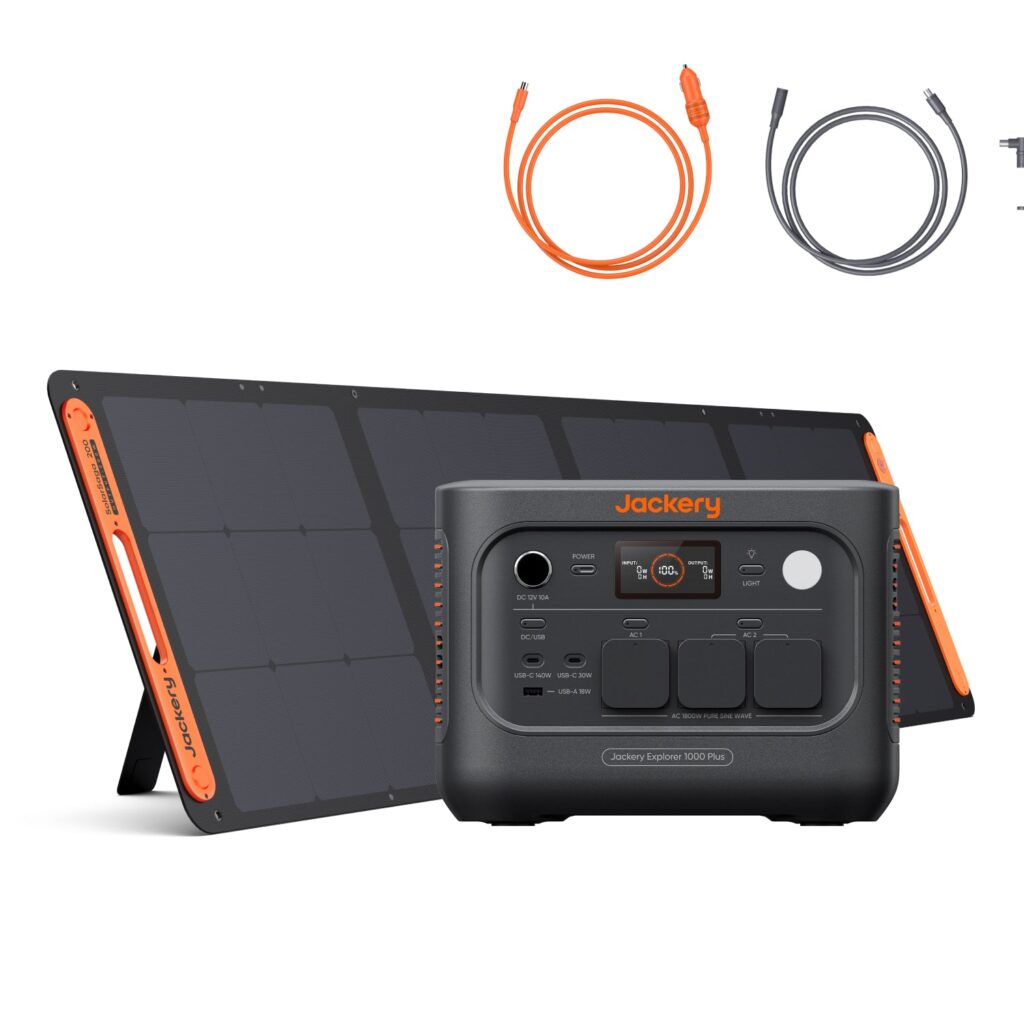
| Jackery Explorer 1000 Plus v2 | 1,024 Wh / 1,800 W | 10.8 kg | 400 W / up to 11 kWh | 6,000 to 70 % |
| Anker SOLIX C1000 Gen 2 | 1,024 Wh / 2,000 W | 11.3 kg | 600 W / none | 4,000 to 80 % |
| Jackery Explorer 2000 Plus v2 | 2,048 Wh / 2,400 W | 19.1 kg | 800 W / up to 12 kWh | 6,000 to 70 % |
| Anker SOLIX C2000 Gen 2 | 2,048 Wh / 2,400 W | 18.9 kg | 800 W / up to 4 kWh | 4,000 to 80 % |
| Anker SOLIX S2000 | 2,010 Wh / 1,500 W | 16.2 kg | 400 W / none | 6,000 to 80 % |
The Jackery weights and solar figures come from the retailer GreenDrive; the other specifications come from the manufacturers. In the last column, pay attention to both numbers. Anker advertises the S2000 with 10,000 cycles, but that refers to 60 percent remaining capacity. Jackery calculates to 70 percent, the C series to 80 percent. Ranking by the biggest number is therefore misleading.
You go camping and don’t want to freeze in winter
On the road, what counts first is what the outlet can deliver. The C1000 Gen 2 delivers 2,000 watts, and with its SurgePad mode up to 2,400 watts for heating appliances such as electric kettles. The Explorer 1000 Plus v2 tops out at 1,800 watts. So a 2,000-watt electric kettle only runs on the Anker unit. Fast charging is a tie: both reach 49 minutes in emergency mode. With Anker, however, this only applies above a battery temperature of 20 degrees Celsius; below that, charging becomes significantly slower according to the manufacturer.
In the cold, Jackery is ahead, provided the specification is correct. Anker states charging from 0 degrees for the C1000 Gen 2, GreenDrive from minus 10 degrees for the Explorer 1000 Plus v2. That is a retailer specification, not a data sheet. If you will be at a campsite in January, it is better to ask beforehand. More on everyday use in a vehicle is in our guide power station in an RV.
You want a reserve for power outages
Let’s calculate with a refrigerator using 1.1 kWh per day and Anker’s own formula: capacity times 0.9 divided by daily consumption. The Explorer 1000 Plus v2 then lasts a good 20 hours. The S2000 manages a good day and a half. With a BP2000 battery pack, the Jackery system reaches 3,072 Wh and around two and a half days, and in two separate units instead of one heavy block.
According to Anker, one point speaks for the S2000 that hardly anyone checks: self-consumption. Anker states 10 watts at idle and, by its own comparison, the lowest value among common 2 kWh stations. That is still not little: 240 watt-hours per day. If you leave the station running continuously, more than ten percent of the charge is lost every day for nothing. According to the specifications, both brands switch over in 10 milliseconds during an outage, which is enough for a router and PC. How to calculate your own situation is shown in our guides backup power with a power station (in German) and calculating runtime.
You don’t yet know how much storage you will need
Then the matter is clear. Jackery offers up to five packs of 2,048 Wh each, while at Anker the C2000 Gen 2 tops out at 4 kWh with one extra battery. The C1000 Gen 2 and S2000 stay what they are. Jackery’s approach has one catch: only the v2 packs fit, older ones do not. Our guide to extra batteries (in German) explains which fits which.
In practice, it looks like this: today you buy the Explorer 1000 Plus v2 for camping, because 10.8 kilos still fit in the trunk. A year later, you add a pack for the basement that stays at home while the base unit keeps traveling. With Anker, you would have to go straight for the C2000 Gen 2 to take the same route, which at 18.9 kilos is already noticeably heavier for a short trip, and with the 15.3-kilo extra battery, 4 kWh is the limit. If you know for sure that 2 kWh is enough, though, you do not have to pay for this detour.
The six units in detail
Jackery Explorer 1000 Plus v2
For anyone who does not want to commit and is willing to accept the retailer’s specifications. The weak points are 400 watts of solar, and according to GreenDrive, the warranty only reaches five years after registration.
Jackery Explorer 1000 v2
The economical version: 300 watts less, no extra batteries, but one price tier lower. In spring 2025, the German automobile club ADAC downgraded the Explorer 1000 v2 to „poor“ because its two DC inputs are not decoupled. So never charge it via solar and the car outlet at the same time.
Anker SOLIX C1000 Gen 2
The highest continuous output of the 1 kWh units here, with 600 watts of solar input and time-of-use scheduling by electricity tariff via the app. The price you pay is the fixed capacity. Anker explicitly rules out the BP1000 extra battery.
Jackery Explorer 2000 Plus v2
The same key specs as the C2000 Gen 2, but three times the room for expansion: 12 instead of 4 kWh. Peak output is 4,800 watts according to Jackery, 4,000 at Anker. For an RV and the home, the better foundation if you really want to expand.
Anker SOLIX C2000 Gen 2
Its advantage lies in the vehicle. Via the alternator charger, it takes 800 watts and is full in 2.6 hours according to Anker; for the Explorer 2000 Plus v2, GreenDrive states around four hours. If you drive a lot and park little, factor that in.
Anker SOLIX S2000
Two kilowatt-hours in 16.2 kilos, which is light for its class. Plus a five-year warranty according to Anker. The limit is hard: 1,500 watts, no extra battery, only 400 watts of solar. According to the manufacturer, a microwave can draw more than its rating plate says and then stall the station. So check appliances with high heating power beforehand.
Which brand for whom?
Choose Jackery if your needs could grow, or if the unit should also charge in freezing temperatures and the retailer’s figure is confirmed. Choose Anker if the capacity is fixed and you want more output, more solar or, in the 2 kWh class, the lowest weight. The purely sensible choice for the basement is the S2000, the most flexible choice the Explorer 1000 Plus v2. You do not need to settle more than these two questions.
Frequently asked questions
What is the difference between the Jackery Explorer 1000 Plus v2 and the Anker SOLIX C1000 Gen 2?
Both have 1,024 Wh. The Jackery delivers 1,800 watts and can be expanded up to 11 kWh. The Anker delivers 2,000 watts and accepts 600 instead of 400 watts of solar, but according to the manufacturer it cannot be expanded. A 2,000-watt electric kettle only runs on the Anker unit.
Which power station charges in freezing temperatures?
Anker specifies charging from 0 degrees Celsius for the C1000 Gen 2. For the Explorer 1000 Plus v2, the retailer GreenDrive states minus 10 degrees; that is a retailer specification, not a data sheet. If you will be at a campsite in January, ask beforehand.
Are 10,000 cycles on the Anker S2000 worth more than 6,000 on the Jackery?
Not necessarily. With its 10,000 cycles, Anker means 60 percent remaining capacity; Jackery calculates to 70 percent, the C series to 80 percent. Ranking by the biggest number is therefore misleading; both values have to be read together.
How long does a power station keep a refrigerator running during a power outage?
At 1.1 kWh per day and using Anker's formula, the Explorer 1000 Plus v2 lasts a good 20 hours, the S2000 a good day and a half. With a BP2000 battery pack, the Jackery system reaches 3,072 Wh and around two and a half days, split into two units.
What should you watch for when expanding a Jackery power station?
Only the v2 packs fit the v2 models; older ones do not. Jackery offers up to five packs of 2,048 Wh each. At Anker, the C2000 Gen 2 tops out at 4 kWh with one extra battery, while the C1000 Gen 2 and S2000 stay fixed.
What is the difference between an Anker Solix power station and the Solarbank?
The Solarbank is a storage unit for a plug-in balcony solar system; according to Anker, the Solarbank 3 E2700 Pro offers 2.68 kWh and 1,200 watts. Jackery competes there with its SolarVault series. That is a different buying decision from the portable units with a handle.
Sources
- Anker SOLIX: C1000 Gen 2
- Anker SOLIX: C2000 Gen 2
- Anker SOLIX: S2000
- Anker SOLIX: Solarbank 3 E2700 Pro
- GreenDrive: Jackery Explorer 1000 v2 (retailer information)
- GreenDrive: Jackery Explorer 1000 Plus v2 (retailer information)
- GreenDrive: Jackery Explorer 2000 Plus v2 (retailer information)
- ADAC: Portable power stations tested (spring 2025)
Where to buy
- Jackery Explorer 1000 Plus v2View at JackeryAvailable in Germany: JackeryCheck price at Amazon.deCheck price at Amazon.co.ukCheck price at Amazon.nlCheck price at Amazon.com.beCheck price at Amazon.frCheck price at Amazon.itCheck price at Amazon.esCheck price at Amazon.plCheck price at Amazon.seAvailable in Germany: Amazon.de
- Jackery Explorer 1000 v2View at JackeryAvailable in Germany: JackeryCheck price at Amazon.deCheck price at Amazon.co.ukCheck price at Amazon.nlCheck price at Amazon.com.beCheck price at Amazon.frCheck price at Amazon.itCheck price at Amazon.esCheck price at Amazon.plCheck price at Amazon.seAvailable in Germany: Amazon.de
- Jackery Explorer 2000 Plus v2View at JackeryAvailable in Germany: JackeryCheck price at Amazon.deCheck price at Amazon.co.ukCheck price at Amazon.nlCheck price at Amazon.com.beCheck price at Amazon.frCheck price at Amazon.itCheck price at Amazon.esCheck price at Amazon.plCheck price at Amazon.seAvailable in Germany: Amazon.de
- Anker SOLIX C1000 Gen 2Check price at Amazon.deCheck price at Amazon.co.ukCheck price at Amazon.nlCheck price at Amazon.com.beCheck price at Amazon.frCheck price at Amazon.itCheck price at Amazon.esCheck price at Amazon.plCheck price at Amazon.seAvailable in Germany: Amazon.de
- Anker SOLIX C2000 Gen 2Check price at Amazon.deCheck price at Amazon.co.ukCheck price at Amazon.nlCheck price at Amazon.com.beCheck price at Amazon.frCheck price at Amazon.itCheck price at Amazon.esCheck price at Amazon.plCheck price at Amazon.seAvailable in Germany: Amazon.de
- Anker SOLIX S2000Check price at Amazon.deCheck price at Amazon.co.ukCheck price at Amazon.nlCheck price at Amazon.com.beCheck price at Amazon.frCheck price at Amazon.itCheck price at Amazon.esCheck price at Amazon.plCheck price at Amazon.seAvailable in Germany: Amazon.de