Contents12 sections
This guide was first published in German on handgetestet.de.
In the store, people tend to pick the smallest, prettiest device. What each individual print costs only becomes clear weeks later. For vacation and family photos in postcard size, almost everything usually points to a dye-sublimation printer such as the Canon Selphy CP1500. Instant printers with Instax film make more of an impression as gifts, but cost considerably more per print.
Four technologies, four very different printers
Brand and housing color are almost beside the point. Whether a print turns out large or small, how long it lasts and what it costs depends on the technology inside. Among small printers there are four, and they have little to do with one another.
The most widespread is dye sublimation. Here, heat transfers a ribbon in yellow, magenta and cyan onto the paper, followed by a protective layer at the end. This produces smooth color gradients with no visible dot pattern. The Canon Selphy, HP Sprocket Studio Plus and the Kodak printers work on this principle.
Fujifilm takes a different route. The Instax printers expose real Instax film with OLED light, after which the picture develops just as with an instant camera. The white frame is part of the deal.
Zink works without ink or ribbon. The special paper contains color crystals that become visible when heated. In return, the prints stay small, usually 5 × 7.6 cm, and the colors rather pale.
That leaves ink. A photo printer with an ink tank handles up to A4 and has the lowest cost per print. It will not fit in your jacket pocket; it needs its own spot on the desk.
Once the technology is settled, three practical questions remain. How does the photo get from your phone to the printer, via Wi-Fi or Bluetooth? Does it need a power outlet, or does it have a battery? And will the consumables still be sold in a few years? With Zink paper and older cartridges, availability fluctuates. Supplies for Canon and Instax, on the other hand, are carried by almost every retailer.
Calculate instead of guessing: the price per print
The math is simple. Divide the price of the refill set by the number of sheets. With dye sublimation, the set always contains paper and ribbon together; with Instax, only the film. Comparisons by the German broadcaster ZDF (via ifun.de) and by fotowissen.eu arrive at the same ranking. The inkjet printer comes first, followed by dye sublimation in postcard size. Zink prints cost considerably more, even though they are much smaller. And an Instax print comes to roughly three to four times the cost of a Selphy postcard print.
That is still no argument against Instax. It is simply something different: a small one-of-a-kind keepsake to give away. You will not fill a photo album with it.
Seven photo printers currently available
| Model | Process | Print size | Connection | Best for |
|---|---|---|---|---|
| Canon Selphy CP1500 | Dye sublimation | Postcard 10 × 14.8 cm, smaller possible | Wi-Fi, USB, SD card | Family photos, albums |
| Canon Selphy QX20 | Dye sublimation | square or credit card size, stickers | Wi-Fi, battery | Stickers, journals, on the go |
| Fujifilm instax mini Link 3 | Instant film (OLED) | 6.2 × 4.6 cm | Bluetooth, battery | Parties, gifts |
| Fujifilm instax Link WIDE 2 | Instant film (OLED) | 6.2 × 9.9 cm | Bluetooth 5.1, battery | The Instax look, but bigger |
| Kodak Mini 3 Retro | Dye sublimation with lamination | 7.6 × 7.6 cm | Bluetooth | Square prints on a budget |
| HP Sprocket Studio Plus | Dye sublimation | 10 × 15 cm | Bluetooth 5.0, power adapter | Postcard size at your desk |
| Epson EcoTank ET-8500 | Ink, six colors | up to A4 | Wi-Fi, Wi-Fi Direct, LAN | Heavy printing, large formats |
Canon Selphy CP1500
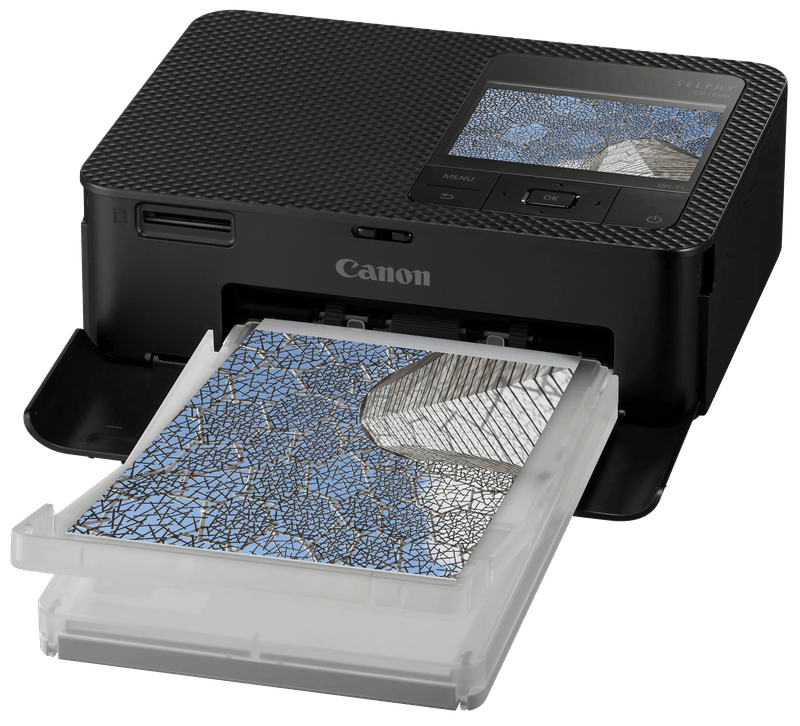
For years the benchmark among compact photo printers. Canon quotes about 41 seconds for a postcard print. The ribbon applies three colors and a protective layer, and in an album the prints should stay colorfast for up to 100 years. You print via Wi-Fi from the app, from an SD card or over USB. At 850 grams it can travel with you, but it is not a pocket device. If you simply want your phone photos on paper, this is the safest bet.
Canon Selphy QX20
The little sibling also uses dye sublimation. However, it prints only on sticker paper, square or in credit card size. It has a battery, charges over USB-C and connects via Wi-Fi. For calendars, notebooks and photo albums, it delivers better image quality than Zink. Postcards? It lacks the format for that.
Fujifilm instax mini Link 3
It exposes real Instax mini film via OLED, in about 15 seconds per print according to Fujifilm. According to the manufacturer, one battery charge yields roughly 100 prints, and without film the device weighs about 210 grams. The image area is small at 6.2 × 4.6 cm. At a party, that is exactly the appeal. In everyday use, it gets in the way. The film is sold separately.
Fujifilm instax Link WIDE 2
The new wide-format version exposes Instax WIDE film at 6.2 × 9.9 cm, roughly twice the area of mini. Fujifilm quotes about 14 seconds per print, and it connects via Bluetooth 5.1. It prints directly from some Fujifilm cameras such as the X-T30 III. Group photos come across much better here. At 363 grams, though, the device is also noticeably larger.
Kodak Mini 3 Retro
Square, 7.6 cm on each side, in four passes. First come three colors, then a laminate layer meant to protect against water and fingerprints. The connection runs via Bluetooth through the Kodak app. In purchase price, the Kodak usually sits below a Selphy. It only takes the matching Kodak cartridges in the 3 × 3 inch format, though.
HP Sprocket Studio Plus
The name Sprocket makes many people think of the small Zink printers for sticker prints. The Studio Plus has little in common with those. It uses dye sublimation at 10 × 15 cm and 300 dpi, manages about one print per minute according to the spec sheet, holds 18 sheets and weighs 1.15 kg. Because it runs on a power adapter, it stays on the desk. If you only print at home anyway, this is a genuine alternative to the Selphy.
Epson EcoTank ET-8500
A different league. This A4 all-in-one works with six inks, one of them gray for black-and-white photos. Epson promises up to 2,300 photos from one set of ink bottles and about 25 seconds for a 10 × 15 print. The Belgian consumer organization Test-Aankoop got fewer photos than stated, but the cost per print still stayed very low. To buy, it costs several times as much as a Selphy. That only makes sense if you print a great deal or also need A4.
Which technology suits which purpose
For photos in the album, for Grandma and for the fridge, the Canon Selphy CP1500 remains our first choice: postcard size, low cost per print and, according to Canon, long-lasting. If you want stickers for journals and planners, go for the Selphy QX20, whose colors are visibly better than Zink.
For parties, weddings or as a gift, the instax mini Link 3 fits. If the prints should be larger, it is the Link WIDE 2. With both, factor in the cost of film from the start. More gift ideas around photography, from the Selphy set to the travel tripod, are collected in our guide gifts for photographers (in German).
Lots of photos, plus large formats? Then the Epson EcoTank ET-8500, provided there is room on your desk. And if you want square prints and do not want to spend much on the device, reach for the Kodak Mini 3 Retro.
In the end, any printer is only as good as the source image. Which phone takes good photos is covered in our smartphone guide. How to store your pictures safely is explained in our article on NAS backup for photos and videos. And if you prefer shooting with a camera, you will find suitable models in our mirrorless camera guide (in German).
Frequently asked questions
Which printing technology is best for photos?
Dye sublimation transfers a color ribbon using heat and delivers smooth gradients without a dot pattern. Instax exposes real instant film. Zink needs neither ink nor a ribbon, but the prints stay small and rather pale. Inkjet printers go up to A4 and have the lowest cost per print, but they need space on your desk.
How do I calculate the cost per photo print?
Divide the price of the refill set by the number of sheets. With dye sublimation, the set contains paper and color ribbon; with Instax, only the film. Comparisons by the German broadcaster ZDF and by fotowissen.eu show the same ranking: ink first, then dye sublimation, with Zink considerably more expensive. An Instax print costs roughly three to four times as much as a Selphy postcard print.
Is an Instax printer worth it?
As a small one-of-a-kind keepsake for gifts, parties or weddings, the instax mini Link 3 fits; for larger prints, the Link WIDE 2. You will not fill a photo album with it. With both, factor in the cost of film from the start.
How long do prints from the Canon Selphy last?
The ribbon applies three colors and a protective layer. According to Canon, the prints should stay colorfast for up to 100 years in an album. Canon quotes about 41 seconds for a postcard print, and you can print via Wi-Fi, from an SD card or over USB.
Who is an inkjet printer like the Epson EcoTank ET-8500 for?
For anyone who prints a great many photos or also needs A4. It works with six inks, one of them gray for black-and-white. Epson promises up to 2,300 photos from one set of ink bottles; in the Test-Aankoop test there were fewer, but the cost per print still stayed very low. It costs several times as much as a Selphy to buy.
Sources
- Canon: Selphy CP1500, technical specifications
- Canon: Selphy photo printers at a glance
- Fujifilm: instax mini Link 3
- Fujifilm: instax Link WIDE 2
- HP Sprocket: Studio Plus spec sheet
- Kodak: Mini Photo Printers
- Epson: EcoTank ET-8500
- ifun.de: ZDF compares mobile instant printers
- fotowissen.eu: Photo printers compared
Where to buy
- Canon Selphy CP1500View at CoolblueAvailable in Germany: CoolblueCheck price at Amazon.deAvailable in Germany: Amazon.de
- Canon Selphy QX20View at CoolblueAvailable in Germany: CoolblueCheck price at Amazon.deAvailable in Germany: Amazon.de
- Fujifilm instax mini Link 3Check price at Amazon.deAvailable in Germany: Amazon.de
- Fujifilm instax Link WIDE 2Check price at Amazon.deAvailable in Germany: Amazon.de
- Kodak Mini 3 RetroCheck price at Amazon.deAvailable in Germany: Amazon.de
- HP Sprocket Studio PlusCheck price at Amazon.deAvailable in Germany: Amazon.de
- Epson EcoTank ET-8500Check price at Amazon.deAvailable in Germany: Amazon.de