Contents10 sections
This guide was first published in German on handgetestet.de.
Saturday morning: two side panels made of spruce glued laminated board lie on the sawhorses, 18 mm thick, plus five shelves. The bookcase is supposed to stand without a single screw head showing at the front. That is exactly what a pocket hole jig is for. For a project like this, a simple jig such as the Kreg 320 or the Undercover Jig from wolfcraft is enough; if you build furniture regularly, a benchtop station such as the Kreg 720 makes you considerably faster.
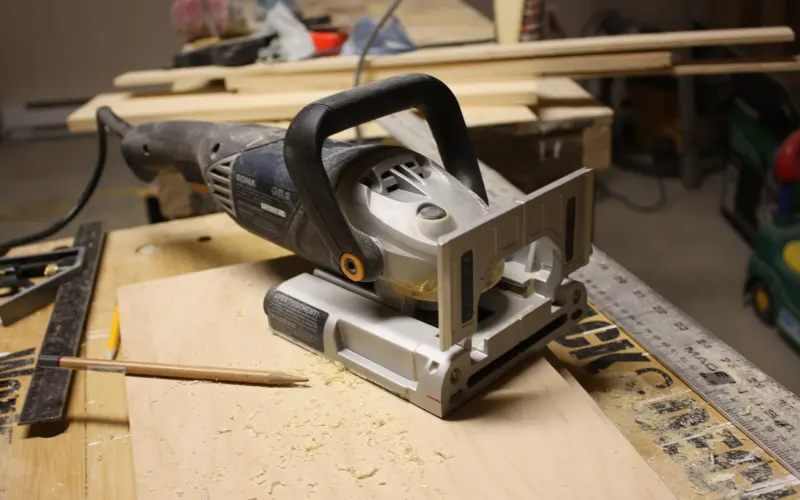
The principle is simple. A 9.5 mm stepped drill bit drills a pocket at a shallow angle into the underside of the shelf, the screw runs in at an angle and bites into the side panel. Milescraft states a drilling angle of 15 degrees for its jigs. Add glue, done. If you would rather join invisibly with biscuits, our biscuit joiner guide covers the alternative with a joiner.
Measure the wood thickness first, then buy the screws
Almost every jig comes with a set of sample screws. For the second piece of furniture you need more, and this is where the typical mistakes happen. Kreg assigns wood thickness, jig setting and screw length in a chart that also works as a guideline for jigs from other brands:
- Boards around 13 mm (roughly 11 to 16 mm): 25 mm screw; for 13 mm plywood, Kreg recommends 19 mm.
- Boards around 19 mm (roughly 16 to 22 mm): 32 mm screw. This covers the common 18 mm glued laminated panels from the home improvement store.
- Square timber from about 33 mm: 64 mm screw.
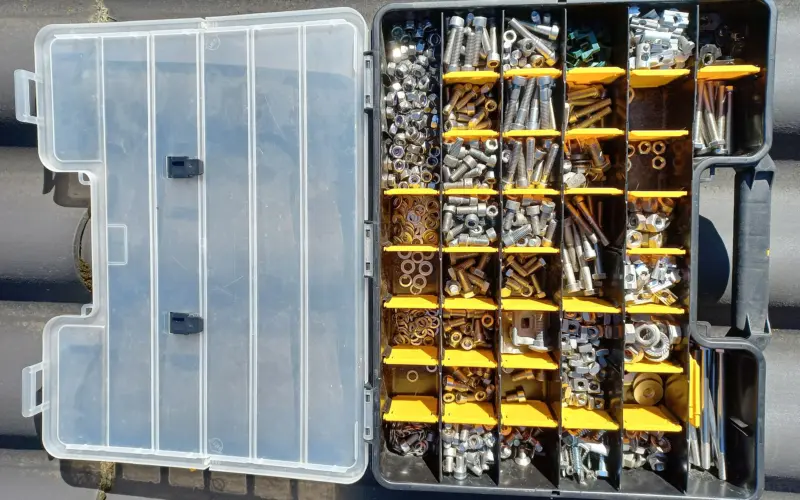
Then there is the thread. According to Kreg’s instructions, oak, maple, cherry, walnut or birch call for a fine thread; pine, plywood, particleboard and MDF for a coarse thread. Spruce counts as a softwood. Our laminated-panel bookcase therefore needs 32 mm with a coarse thread. If parts of different thickness meet, drill the pocket into the thinner part and choose the screw by its thickness, as long as both outer faces are meant to be flush. Kreg’s instructions describe this in detail. One more word about the screws themselves. Pocket hole screws have a flat washer head that seats on the bottom of the pocket instead of wedging itself in like a countersunk head. Regular wood screws work, but they split thin material more easily. For an overview of lengths and drive types, see our guide to screw assortments.
Six pocket hole jigs side by side
Kreg Pocket-Hole Jig 320
The small Kreg comes apart into two separate drill guides. That lets you reach places where no benchtop station fits, for example when reinforcing a cabinet after the fact. A clamp is not included, only an adapter for one. For the bookcase from the introduction it is entirely sufficient, and it sits in the lower price range.
Kreg Pocket-Hole Jig 520PRO
The handle doubles as the clamp. You pump it closed and the unit holds, slip-resistant thanks to a coated pad, according to Kreg. That is practical with two-meter side panels you do not want to heave onto a benchtop jig. Fixed settings exist for only three thicknesses; for in-between sizes, you set it according to the chart.
Kreg Pocket-Hole Jig 720
Insert the workpiece, press the lever. According to the manufacturer, the Automaxx clamp adjusts itself to thicknesses from 13 to 38 mm, and a port for the shop vacuum collects the chips. If you are building a kitchen front from 40 frame parts, that saves noticeable time. For a single shelf a year, the station is oversized. It is also available as the 720PRO with a docking station and material supports, then in the upper price range.
wolfcraft Undercover Jig Set (Torx)
The wolfcraft set is the cheapest way to get started. According to retailer information, the case contains a 9.5 mm stepped drill bit, a depth stop, a TX 20 screwdriver bit, ten wood screws each in 25, 30, 40 and 60 mm, and ten beech plugs for closing the pockets. The wood thickness is taken directly on the jig. wolfcraft does not clearly state an upper limit for this set. Ten screws per length are a starter supply, nothing more.
Trend Pocket Hole Jig PH/JIG/AK
Trend builds its pro jig entirely from metal, with the hardened drill bushings fixed 30 mm apart. According to retailer information, support bars, stops and a face clamp are part of the kit, which turns the jig into a small station. This is solid workshop equipment. If you only drill occasionally, you are paying for hardware you will not make full use of.
Milescraft PocketJig200
Milescraft includes 60 Torx-drive screws in six types, plus plugs and two magnetic bits. The jig has four settings, including one for 27 mm, which Kreg does not offer on its small models. A clamp is bought separately; a magnet in the body holds it in position. On Amazon, the set is listed as Pocket Jig 200 ST.
How we would decide
One bookcase, one shoe cabinet, the occasional workbench: here the Kreg 320 is enough. It is small, handles thicknesses up to 38 mm and can be used on any workpiece. If you first want to find out whether the technique suits your own projects, take the wolfcraft set and then buy matching pocket hole screws afterwards.
From the third piece of furniture on, the 720 is worth a look.
It is expensive, but it makes every hole the same. Trend appeals to buyers who want a jig made entirely of metal. With Milescraft, check before buying whether Torx screws are standard in your workshop anyway.
Whichever jig you choose: the cordless drill needs a clutch that can be finely adjusted, otherwise it pulls the screw through the soft spruce. Which tools do that well is covered in the cordless drill driver guide.
Frequently asked questions
How does a pocket hole jig work?
A 9.5 mm stepped drill bit drills a pocket at a shallow angle into the underside of a board. The screw runs in at an angle and bites into the adjoining part, such as a side panel. Milescraft states a drilling angle of 15 degrees for its jigs. Add glue, and you get a joint with no visible screw head.
Which screw length for which wood thickness?
Kreg assigns this in a chart that also works as a guideline for other jigs: boards around 13 mm get 25 mm screws, boards around 19 mm, which includes common 18 mm glued laminated panels, get 32 mm. For square timber from about 33 mm, Kreg specifies 64 mm. For 13 mm plywood, Kreg recommends 19 mm.
Fine thread or coarse thread for pocket hole screws?
According to Kreg's instructions, oak, maple, cherry, walnut or birch call for a fine thread. Pine, plywood, particleboard and MDF take a coarse thread, and spruce also counts as a softwood. A shelf made of 18 mm spruce laminated panels therefore needs 32 mm screws with a coarse thread.
Can you use regular wood screws for pocket holes?
They work, but they split thin material more easily. Pocket hole screws have a flat washer head that seats on the bottom of the pocket instead of wedging itself in like a countersunk head. The sample screws included in the box are usually only enough for the first piece of furniture.
When is a benchtop station like the Kreg 720 worth it?
From the third piece of furniture on, or when you have many identical parts. According to the manufacturer, the Automaxx clamp adjusts itself to thicknesses from 13 to 38 mm, and a port for the shop vacuum collects the chips. For a kitchen front made of 40 frame parts, that saves noticeable time; for one shelf a year, the station is oversized.
What does the cordless drill need for pocket hole joints?
A clutch that can be finely adjusted. Otherwise it pulls the screw through soft wood like spruce. If parts of different thickness meet, the pocket goes into the thinner part, and the screw is chosen by its thickness, as long as both outer faces are meant to be flush.
Sources
- Kreg: material thickness, setting and screw length
- Kreg: Pocket-Hole Jig 320
- Kreg: Pocket-Hole Jig 520PRO
- Kreg: Pocket-Hole Jig 720
- Kreg: instructions with thread recommendation (PDF)
- Retailer information on the wolfcraft Undercover Jig Set TX
- Retailer information on the Trend PH/JIG/AK
- Milescraft: PocketJig200
Where to buy
- Kreg Pocket-Hole Jig 320Check price at Amazon.deCheck price at Amazon.co.ukCheck price at Amazon.nlCheck price at Amazon.com.beCheck price at Amazon.frCheck price at Amazon.itCheck price at Amazon.esCheck price at Amazon.plCheck price at Amazon.seAvailable in Germany: Amazon.de
- wolfcraft Undercover Jig Set TorxCheck price at Amazon.deCheck price at Amazon.co.ukCheck price at Amazon.nlCheck price at Amazon.com.beCheck price at Amazon.frCheck price at Amazon.itCheck price at Amazon.esCheck price at Amazon.plCheck price at Amazon.seAvailable in Germany: Amazon.de
- Kreg Pocket-Hole Jig 520PROCheck price at Amazon.deCheck price at Amazon.co.ukCheck price at Amazon.nlCheck price at Amazon.com.beCheck price at Amazon.frCheck price at Amazon.itCheck price at Amazon.esCheck price at Amazon.plCheck price at Amazon.seAvailable in Germany: Amazon.de
- Kreg Pocket-Hole Jig 720Check price at Amazon.deCheck price at Amazon.co.ukCheck price at Amazon.nlCheck price at Amazon.com.beCheck price at Amazon.frCheck price at Amazon.itCheck price at Amazon.esCheck price at Amazon.plCheck price at Amazon.seAvailable in Germany: Amazon.de
- Trend Pocket Hole Jig PH/JIG/AKCheck price at Amazon.deCheck price at Amazon.co.ukCheck price at Amazon.nlCheck price at Amazon.com.beCheck price at Amazon.frCheck price at Amazon.itCheck price at Amazon.esCheck price at Amazon.plCheck price at Amazon.seAvailable in Germany: Amazon.de
- Milescraft Pocket Jig 200 STCheck price at Amazon.deCheck price at Amazon.co.ukCheck price at Amazon.nlCheck price at Amazon.com.beCheck price at Amazon.frCheck price at Amazon.itCheck price at Amazon.esCheck price at Amazon.plCheck price at Amazon.seAvailable in Germany: Amazon.de
Still undecided?
Keep comparing at your own pace – every article in this category is checked monthly for new and discontinued models.