Contents18 sections
This guide was first published in German on handgetestet.de.
A fan under the radiator does not produce heat; it just draws heat out of the metal faster. That makes sense wherever a room does not get warm enough or a heat pump is meant to run at a lower flow temperature. For that, we consider the SpeedComfort Duo set with Control Sensor the obvious buy. Its switch-on point can be set between 27 and 35 °C, so it suits a heat pump just as well as a gas boiler. If you have gas or oil heating and do not want to adjust anything at all, go for the simpler version with Automatic Sensor. The expansion set from ELV (German retailer), on the other hand, is purely an accessory and only works with an existing base set.
What does a fan like this do, physically?
It pushes room air through the radiator. The fins then give off their heat faster instead of relying on sluggish natural convection. Milieu Centraal, the Dutch consumer information center for energy, speaks of around 20 percent more heat output. That refers to output, not savings. You only save once you turn the extra output into a lower water temperature or a lower room temperature.
Even the supplier Heatfan writes that faster warm-up does not in itself prove a lower annual bill.
Is the 22 percent SpeedComfort advertises accurate?
As an upper limit under certain conditions, yes, or at least that is what the manufacturer says. In its manual, SpeedComfort lists four prerequisites: distribute the fans across the most-used rooms, lower the thermostat by one to two degrees, turn down the heating temperature and hydronically balance the system. If you only attach the strips and change nothing else, you get a room that warms up faster, nothing more.
„Twice as fast to warm up“ is also a manufacturer claim. We are not aware of any independent verification of either figure. Heatfan does not give a percentage.
Does it do more with a heat pump than with a gas boiler?
Usually, yes. Viessmann calculates an average of 2.5 percent in heating costs per degree when heating system temperatures are lowered. If a house can deliver the same heat with a flow temperature three degrees lower, that works out to around 7.5 percent on paper. Milieu Centraal explicitly considers fans on regular radiators a good idea with a heat pump, because the pump then runs more efficiently.
However, the heating curve can only be lowered if the coldest room still gets warm. A single fan in the living room changes nothing as long as the bathroom sets the pace. A first-hand account on co2online shows what this looks like in practice: a homeowner first equipped one room, found that it got warmer than the rest, then gradually fitted most of the radiators and lowered the flow temperature. A single case without figures on the fans‘ share, but the order is right. What the electricity costs depends on your rate; see heat pumps and electricity rates (in German).
With a heat pump, pay attention to the sensor. The Automatic Sensor only switches on at 35 degrees on the radiator and, according to the manual, is intended for systems with a water temperature above 55 degrees. For low-temperature systems, SpeedComfort specifies the Control Sensor, whose starting point can be set between 27 and 35 degrees.
And with gas or oil?
Here the benefit comes through the boiler temperature. Milieu Centraal suggests trying 50 degrees, SpeedComfort mentions 60 degrees. If it stays warm enough, the boiler runs more efficiently. Only change this according to the instructions or with your heating contractor. In a rented apartment with central heating, you have no access to this lever, so what remains is mainly comfort: a sluggish home office warms up faster.
How much power does it use?
Very little. SpeedComfort states 0.55 watts per fan strip and less than one kilowatt-hour per year, while Milieu Centraal speaks of a few kilowatt-hours. Heatfan gives no fixed figure and recommends measuring the entire setup, including controller and power supply. With an energy meter (in German), that takes a few minutes. Do not confuse the strips with a fan heater. A fan heater turns electricity directly into heat; see the guide to infrared heaters and fan heaters (in German).
Can you hear the fans in the bedroom?
According to the manual, the fixed level of the Automatic Sensor stays below 20 dB(A). The Control Sensor offers three levels from below 17.5 to below 21.5 dB(A). The manual does not say under what conditions these were measured, and Heatfan itself points out that the level, installation and surroundings change the value. Milieu Centraal warns that some people find the noise disturbing and advises sensitive people to buy a single unit first. For the bedroom, that argues for the quietest level of the Control Sensor.
Am I even allowed to do this in a rented apartment?
That is the question you need to settle before buying. On its product page, ELV quotes the German tenant protection association Interessenverband Mieterschutz: if heat cost allocators are attached to the radiators, the fans must not be installed. So check whether a small metering device is stuck to the radiator. If so, ask your landlord or the billing company before you order.
Which size, and will it fit my radiator?
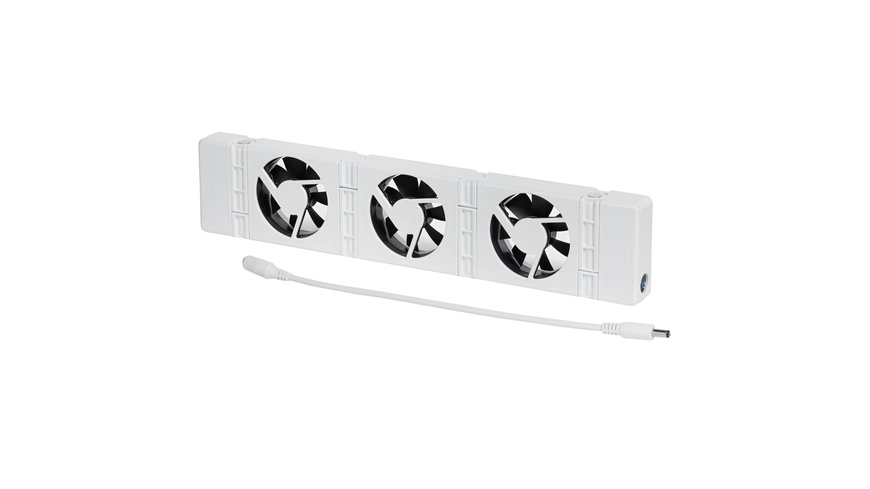
SpeedComfort goes by width: 40 to 70 centimeters takes a Mono set, 70 to 120 a Duo set, 120 to 180 a Trio set. Beyond that, expansion sets are added, with a maximum of five strips per power supply. Magnets hold the strips, which are 34 centimeters long and about 2 centimeters high, under the radiator; on convectors they stand on feet. The manufacturer speaks of 95 percent of all radiators; some designer models are excluded, and cast iron radiators require extra hooks. You need an outlet within reach, which is easy to overlook.
Measure beforehand where the problem lies. If a radiator only gets warm in places, the issue is elsewhere, for example air in the system or missing hydronic balancing. An infrared thermometer shows this quickly. And if what you really want is to control schedules, smart radiator thermostats (in German) are the better choice.
Seven sets compared
| Model | Control | Radiator according to the manufacturer | Best for |
|---|---|---|---|
| SpeedComfort Duo set with Automatic Sensor | Starts at 35 °C, one level | 70 to 120 cm | Gas and oil above 55 °C |
| SpeedComfort Duo set with Control Sensor | Starts at 27 to 35 °C, three levels | 70 to 120 cm | Heat pump |
| SpeedComfort Mono set with Automatic Sensor | Starts at 35 °C, one level | 40 to 70 cm | Small radiator, first try |
| SpeedComfort Trio set with Control Sensor | Starts at 27 to 35 °C, three levels | 120 to 180 cm | Wide radiator, heat pump |
| SpeedComfort radiator fan expansion set | Via existing set | From 180 cm as an add-on | Owners of a base set |
| Heatfan 5 Duo set | Continuously variable, Wi-Fi controller | 80 to 160 cm | Data enthusiasts, heat pump |
| Heatfan 3 Duo set | Continuously variable, Wi-Fi controller | 70 to 130 cm | Medium-size radiators with app |
SpeedComfort Duo set with Automatic Sensor
No buttons, no settings. The sensor switches on at 35 degrees and off at 25 degrees. For typical gas or oil heating, that is enough. The manufacturer states an airflow of 30 cubic meters per hour per strip and a ten-year warranty. According to the manual, the power supply has a considerably shorter technical service life of four years than the strip.
SpeedComfort Duo set with Control Sensor
A control unit with a display and three buttons, plus a summer mode that runs the fans without a warm radiator. According to the manual, this is the intended version for heat pumps.
SpeedComfort Mono set with Automatic Sensor
One strip for narrow radiators. Exactly the right size for the trial run Milieu Centraal recommends to people sensitive to noise.
SpeedComfort Trio set with Control Sensor
Three strips for long radiators up to 180 centimeters.
SpeedComfort radiator fan expansion set
Purely an accessory. It adds one strip with a 30-centimeter cable to an existing Mono, Duo or Trio set of version 3.0. Without a base set, you have no power supply and no sensor. So it is not suitable as a starting point, but it is for a particularly wide radiator.
Heatfan 5 Duo set
Two strips, each with five fans and 47 centimeters long, controlled via a Wi-Fi controller. The fan speed follows the radiator temperature continuously, the app shows temperature curves, and without the app everything keeps running automatically. The warranty is two years; Heatfan does not give figures for power consumption or noise.
Heatfan 3 Duo set
The same system with shorter 33-centimeter strips and three fans each. That is enough for medium-size radiators.
Which solution for which heating system?
- Gas or oil, one room does not get warm: SpeedComfort with Automatic Sensor in the width of your radiator.
- Heat pump with regular radiators: SpeedComfort with Control Sensor or Heatfan, starting with the critical rooms.
- Base set already in place, radiator wider than 180 centimeters: the expansion set from ELV.
- Heat cost allocators on the radiator: install nothing until billing has been clarified.
Frequently asked questions
What does a fan on a radiator do?
It pushes room air through the radiator so the fins give off their heat faster. Milieu Centraal speaks of around 20 percent more heat output. That is output, not savings. You only save once you turn the extra output into a lower water temperature or room temperature.
Is the 22 percent savings figure SpeedComfort advertises accurate?
Only as an upper limit under certain conditions, according to the manufacturer. The manual lists four prerequisites: fans in the most-used rooms, lowering the thermostat by one to two degrees, turning down the heating temperature and hydronic balancing. If you only attach the fan strips, you get a room that warms up faster. There is no independent verification of the figure.
Is a radiator fan worth it with a heat pump?
Usually more so than with a gas boiler. Viessmann calculates an average of 2.5 percent in heating costs per degree when the heating system temperature is lowered. However, the heating curve can only be lowered if the coldest room still gets warm. Equip the critical rooms first and choose the Control Sensor.
How much electricity does a radiator fan use?
Very little. SpeedComfort states 0.55 watts per fan strip and less than one kilowatt-hour per year, while Milieu Centraal speaks of a few kilowatt-hours. Heatfan gives no fixed figure and recommends measuring the entire setup, including controller and power supply, with an energy meter.
Can you hear radiator fans in the bedroom?
According to the manual, the Automatic Sensor stays below 20 dB(A), and the Control Sensor offers three levels from below 17.5 to below 21.5 dB(A). The measurement conditions are not stated. Some people find the noise disturbing, and Milieu Centraal advises sensitive people to buy a single unit first.
Am I allowed to install radiator fans in a rented apartment?
Not if there are heat cost allocators on the radiators. ELV points this out, citing the German tenant protection association Interessenverband Mieterschutz. Check whether a small metering device is attached to the radiator, then ask your landlord or the billing company before you order.
Sources
- Milieu Centraal: Heating savings tips (in Dutch)
- Viessmann: Heat pump flow temperature
- co2online: Heat pump in an unrenovated older building
- ELV: SpeedComfort expansion set (retailer information)
- SpeedComfort: Manufacturer website
- SpeedComfort: Warranty
- SpeedComfort: Manual (PDF)
- Heatfan: Heatfan 5 Duo set
- Heatfan: Heatfan 3 Duo set
- Heatfan: Measuring savings
Where to buy
- SpeedComfort Duo-Set mit Automatic SensorCheck price at Amazon.deAvailable in Germany: Amazon.de
- SpeedComfort Duo-Set mit Control SensorCheck price at Amazon.deAvailable in Germany: Amazon.de
- SpeedComfort Mono-Set mit Automatic SensorCheck price at Amazon.deAvailable in Germany: Amazon.de
- SpeedComfort Trio-Set mit Control SensorCheck price at Amazon.deAvailable in Germany: Amazon.de
- SpeedComfort Heizkörperventilator ErweiterungssetView at ELVAvailable in Germany: ELV
- Heatfan 5 Duo-SetCheck price at Amazon.deAvailable in Germany: Amazon.de
- Heatfan 3 Duo-SetCheck price at Amazon.deAvailable in Germany: Amazon.de