Contents14 sections
This guide was first published in German on handgetestet.de.
50 percent sounds like half a wall. In reality, it is 27 degrees. For slopes over 45 percent, we recommend the all-wheel-drive Worx Landroid Vision Cloud 4WD WR341E, because according to its data sheet it brings the most reserve. Up to about 30 percent and with open sky, the considerably cheaper Ecovacs GOAT O800 RTK is enough.
Percent or degrees: what does the figure actually mean?
Percent describes how many centimeters the ground rises over one meter of horizontal distance. 100 percent is 45 degrees, not 90. The conversion is not linear either: 17% is around 10 degrees, 30% about 17 degrees, 45% around 24 degrees, 50% just under 27 degrees and 84% almost exactly 40 degrees. A brochure that states degrees looks more modest; one that states percent looks more impressive. Both mean the same thing.
How do I measure my slope?
With a straight board, a spirit level and a folding ruler. Lay the board on the ground pointing uphill, lift the lower end until it is level and measure the distance to the lawn. With a one-meter board, the number in centimeters is directly the gradient in percent. 32 cm means 32%. Ecovacs illustrates it exactly the same way in its manual: 17 cm of height over 100 cm of length is the limit.
Measuring once is not enough. Check the steepest spot, every edge, the route to the station and any cross slopes. A bump distorts the measurement, so on an uneven lawn use a two-meter board and divide the result by two.
Which value on the data sheet counts?
The smaller one. Husqvarna and Ecovacs state two limits, and they are far apart. According to the data sheet, the Automower 430V NERA handles 50% on the lawn area but 25% at the boundary. For the GOAT O800 RTK, the shop lists 45%, while according to the manual the virtual boundary must not run across slopes of more than 17%. For the A1600 and A3000, it is 20%. So if your lawn drops toward the fence at 30%, none of these mowers fits without adjustment, no matter how big the brochure figure is. The boundary then moves inward, and the strip is left for the cordless grass trimmer (in German). Worx states only one value, and so does Segway in its model overview. Ask them about the boundary value before you buy.
A second contradiction concerns Ecovacs itself. The shop advertises 50% (27°) for the A1600 and A3000. The manual for the same mowers says slopes of more than 45% should become a no-go zone. Plan on 45%.
And the charging station? According to Ecovacs, it needs a flat, open area without any slope. On a hillside, that often means planning for a terrace or a ledge, plus power nearby, for example via an outdoor power outlet post (in German). Be careful with attractive degree figures, too: Anker advertises 18 degrees for the eufy E15 and E18 models but states in the fine print that they are built for flat lawns with less than 36 cm of height difference.
Do I really need all-wheel drive?
Above 50% yes, below that not necessarily. All-wheel drive alone is not a spec, though. Segway rates the i2 AWD at 45%, exactly as much as Ecovacs states for the O800, whose documentation does not mention all-wheel drive at all. Husqvarna reaches 50% with the 430V NERA thanks to a movable front axle. Only the two all-wheel-drive models, the Worx WR341E and the Segway Navimow X420, list 84% here.
We consider reserve more important than the peak figure. A mower that works at its limit has nothing left to give on the next damp morning. That is why the value on the data sheet should be well above your measurement. That is our assessment, not a manufacturer promise.
What changes on a wet slope?
You will not find a separate gradient value for wet grass in the Ecovacs and Worx manuals. Ecovacs advises against mowing wet grass in manual mode; the GOAT pauses in rain and then resumes automatically, and the waiting time can be adjusted. Worx also has a rain sensor. On a slope, it is better to set a generous delay. Gardena points out another problem: clumps of grass on the wheels reduce performance on slopes, which is why wheel brushes are available as accessories. Cleaning the wheels regularly is therefore part of maintenance.
Safety: what applies near walls, ponds and embankments?
Ecovacs recommends setting up no-go zones at least 30 cm from ponds and drop-offs. Then there is the O800’s reference station: on muddy ground, its pole can tip over, which affects accuracy. According to Stiftung Warentest (German consumer testing organization), children and pets should not be near the mower unsupervised. On a slope, you will also be carrying 15 to 18 kg with the large models when the mower gets stuck. According to Ecovacs, sturdy footwear and secure footing are part of the deal.
Five robot mowers for sloped gardens
| Model | Area according to the manufacturer | Gradient lawn area / boundary | Drive, weight | Best for |
|---|---|---|---|---|
| Worx Landroid Vision Cloud 4WD WR341E | 1,000 m² | 84% / not specified | All-wheel drive, 16.9 kg | steep slopes over 45% |
| Segway Navimow X420 | 2,000 m² | 84% / not specified | All-wheel drive | steep and large |
| Segway Navimow i210 LiDAR Pro | 1,000 m² | 55% / not specified | not specified | slopes up to 50%, 1,000 m² |
| Ecovacs GOAT A1600 LiDAR PRO | 1,600 m² | 50% (manual 45%) / 20% | no all-wheel drive mentioned, 17.8 kg | slopes up to 45%, weak reception |
| Ecovacs GOAT O800 RTK | 800 m² | 45% / 17% | no all-wheel drive mentioned, 10.7 kg | gentle slope, open sky |
Worx Landroid Vision Cloud 4WD WR341E
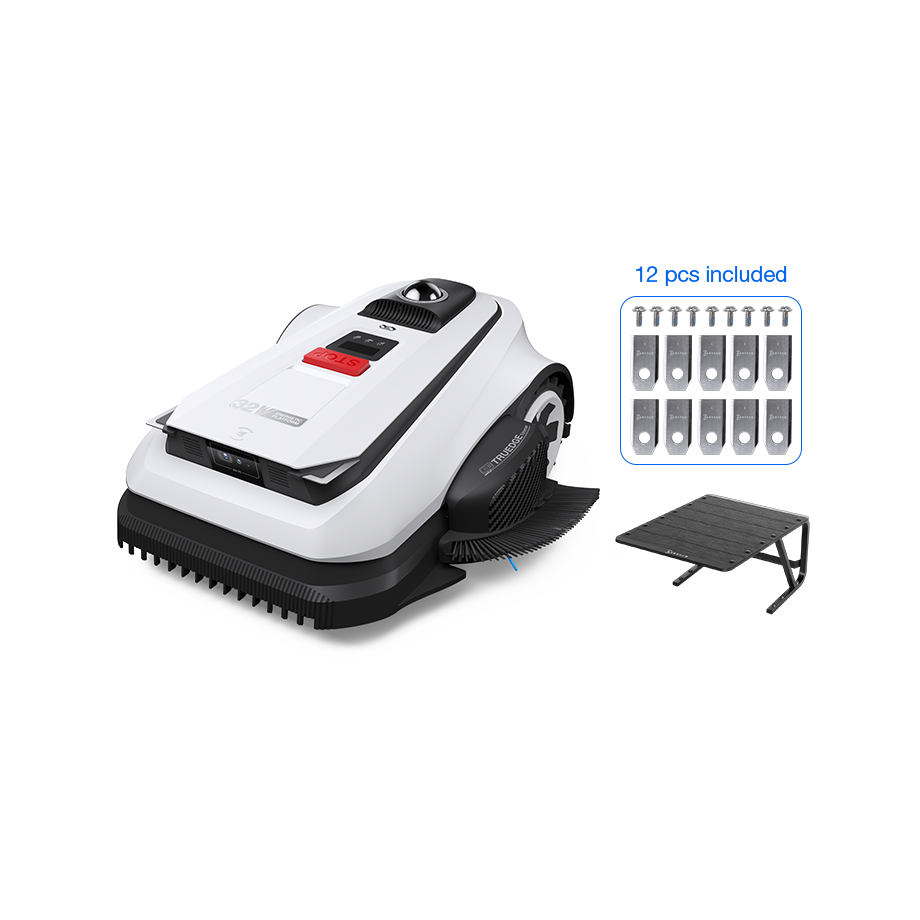
Four motors, an articulated chassis, 84% (40°) according to Worx, and the figure is in the manual too. Correction data comes from the cloud, so there is no antenna in the garden. That means no antenna pole on soft hillside ground. There are weaknesses: a value for the boundary is missing, and we know of no freely accessible independent confirmation of the 84%. According to Worx, the Cut-to-Zero edging module is only standard on selected models, so check what is included. For smaller lawns, there is the WR340E for 600 m².
Segway Navimow X420
The same 84% (40°), all-wheel drive, 2,000 m². According to the buying guide, it is designed for steep hills, uneven terrain and exposed roots; Segway states 675 m² per charge. For a 400 m² slope, that is too much machine.
Segway Navimow i210 LiDAR Pro
55% (29°) for 1,000 m², so more than Ecovacs with similar technology. The model overview says nothing about the boundary, so check that before you buy.
Ecovacs GOAT A1600 LiDAR PRO
Navigates with LiDAR and a camera; no satellite antenna is involved. That helps when trees or the slope itself block the sky; more on this in our buying advice on wire-free robot mowers (in German). Plan on the 45% from the manual. It weighs 17.8 kg, no all-wheel drive is mentioned, and for trimming the manual states a sound power level of 82 dB(A).
Ecovacs GOAT O800 RTK
For gentle slopes up to 30% with reserve, this is the most affordable entry point here. The antenna needs firm ground and open sky, and the boundary can handle at most 17%. On a lawn that drops toward the fence, a wider strip is therefore left uncut than with Husqvarna. Up by the terrace, a lawn edging (in German) saves some touch-up work.
What suits your slope?
- Up to 30% and open sky: Ecovacs GOAT O800 RTK.
- 30 to 45%, trees or a house wall in the way: Ecovacs GOAT A1600 LiDAR PRO, though with no reserve near 45%.
- Over 45%: Worx Landroid Vision Cloud 4WD WR341E, for large areas the Segway Navimow X420.
- Above 60% at the steepest spot, we would block off the zone or replant the embankment rather than push the data sheet limit.
Care and protection are covered in our guides to robot mower maintenance and theft protection.
If the slope is in a garden of more than 1,500 m², our guide robot mowers for large areas does the math on reserve and mowing time.
A garage can interfere with positioning, too: in our review of the Gimisgu robot mower garage, our Navimow had no satellite reception under the metal roof.
Frequently asked questions
What is the difference between a gradient in percent and in degrees?
Percent indicates how many centimeters the ground rises over one meter of horizontal distance. 100 percent is 45 degrees, not 90. The conversion is not linear: 30% is about 17 degrees, 50% just under 27 degrees and 84% almost exactly 40 degrees.
How do I measure the gradient of my lawn?
With a straight board, a spirit level and a folding ruler. Lay the board pointing uphill, lift the lower end until it is level and measure the distance to the lawn. With a one-meter board, the number in centimeters is the gradient in percent. Check the steepest spot, every edge and the route to the station.
Which gradient value on the data sheet counts?
The smaller one. Husqvarna and Ecovacs state separate values for the lawn area and the boundary. According to the shop, the GOAT O800 RTK handles 45%, but the virtual boundary must not run across slopes of more than 17%. If the lawn drops steeply toward the fence, the boundary moves inward and a strip is left uncut.
Do I need a robot mower with all-wheel drive for a slope?
Above 50% yes, below that not necessarily. Segway rates the i2 AWD at 45%, exactly as much as Ecovacs states for the O800 without all-wheel drive. Only the all-wheel-drive Worx WR341E and Segway Navimow X420 list 84% here. The value on the data sheet should be well above your measurement.
What should I keep in mind with wet grass on a slope?
Ecovacs and Worx do not state a separate gradient value for wet grass. The GOAT pauses in rain and resumes after an adjustable waiting time; Worx has a rain sensor. Set a generous delay on a slope. According to Gardena, clumps of grass on the wheels reduce performance, so clean the wheels regularly.
What safety distances apply near ponds and embankments?
Ecovacs recommends setting up no-go zones at least 30 cm from ponds and drop-offs. The charging station needs a flat area without any slope, which on a hillside often means a terrace or a ledge. According to Stiftung Warentest (German consumer testing organization), children and pets should not be near the mower unsupervised.
Sources
- Worx: Landroid Vision Cloud 4WD WR341E
- Worx: Vision Cloud 4WD, models and technology
- Worx: Manual WR340E to WR344E (PDF)
- Segway: Navimow models and buying guide
- Husqvarna: Automower 430V NERA
- Ecovacs: GOAT A1600 LiDAR PRO
- Ecovacs: GOAT O800 RTK
- Ecovacs: Manual GOAT A1600 and A3000 LiDAR PRO (PDF)
- Ecovacs: Manual GOAT O600 RTK, O800 RTK (PDF)
- Gardena: Wheel brushes for robot mowers
- Anker: eufy E series
- Stiftung Warentest: Robot mowers tested (freely accessible part, March 23, 2026, in German)
Where to buy
- Worx Landroid Vision Cloud 4WD WR341ECheck price at Amazon.deAvailable in Germany: Amazon.de
- Segway Navimow X420Check price at Amazon.deAvailable in Germany: Amazon.de
- Segway Navimow i210 LiDAR ProView at CoolblueAvailable in Germany: CoolblueCheck price at Amazon.deAvailable in Germany: Amazon.de
- Ecovacs GOAT A1600 LiDAR PROView at EcovacsAvailable in Germany: EcovacsCheck price at Amazon.deAvailable in Germany: Amazon.de
- Ecovacs GOAT O800 RTKView at EcovacsAvailable in Germany: EcovacsCheck price at Amazon.deAvailable in Germany: Amazon.de