Contents12 sections
This guide was first published in German on handgetestet.de.
A weather station that is meant to help control roller shutters, an awning and irrigation is not something you buy based on the display. You buy it based on two questions. Who reads the values, and how quickly do they get there? For a home running Homematic IP, we consider the Homematic IP weather sensor pro the most coherent choice among the devices compared here, because it can be linked directly to roller shutter, awning and heating control. With Home Assistant, the Ecowitt Wittboy comes out ahead.
If all you want to know is how much it has rained, you do not need this article. For that, there is our general weather station guide (in German), which also explains the right location according to the rules of the Deutscher Wetterdienst, Germany’s national meteorological service. This article is about devices that have something connected to them.
Three minutes can be a long time: the underrated transmission interval
It sits at the very bottom of the spec sheet, yet it is what separates the classes. The weather sensor pro does measure wind every 2 seconds, but it only transmits every 120 to 184 seconds. The data packet then contains the maximum, minimum, average and last measurement for that period. So the gust is not lost; it just arrives late. How late? Let’s assume a gust front approaching at 60 km/h. That is just under 17 meters per second, so around three kilometers in 184 seconds. In the worst case, the awning only retracts once the front has long since arrived. Ecowitt states a transmission interval of 8.8 seconds for the WS90 outdoor sensor, and Davis states 2.5 seconds for wind and 10 seconds for rain for the Vantage Pro2 with WeatherLink Live.
Does that rule out Homematic? No. The sensor reports rain immediately as soon as the first drop falls, regardless of the interval. And no automatic system reliably protects against sudden storm gusts anyway, as Somfy itself acknowledges as a limit; you can read more in our article on awning control (in German). So set the wind threshold low and keep the awning retracted when there is a severe weather warning.
Whoever reads the data decides what happens in an outage
On the Homematic IP Access Point 2, rules run through the cloud. If the internet goes down, the automation stops. The Home Control Unit and the older CCU3 work locally; which hub suits you is covered in our comparison of Homematic hubs (in German). We therefore advise newcomers against the Wetter Profi set with the CCU3, because eQ-3 discontinued this hub in July 2025.
In Home Assistant, the systems clearly part ways. The Ecowitt integration runs as „Local Push“: the GW2000 gateway sends its values directly to your server, with no third-party cloud at all. The Homematic IP integration does list the weather sensors basic, plus and pro, but it talks to the cloud and, according to the developers, is based on a reverse-engineered interface. Netatmo runs there as „Cloud Polling,“ and the weather station is excluded from the fast webhook notifications. That is no good for rules that are supposed to kick in within seconds.
Seven stations, ranked by suitability for automation
| Model | Outdoor transmission interval | Readings | Power and protection | Best for |
|---|---|---|---|---|
| Homematic IP weather sensor pro HmIP-SWO-PR | 120 to 184 s, start of rain immediately | Wind, wind direction, rain, brightness | 3 × AA, typically 2 years, IP22 | Switching in a Homematic home when wind direction matters |
| Homematic IP Set Wetter Pro | same as weather sensor pro | same as weather sensor pro, plus Access Point 2 | same as weather sensor pro | Getting started with the app, rules via the cloud |
| Homematic IP weather sensor plus HmIP-SWO-PL | Start of rain immediately | Wind, rain, brightness, no wind direction | 3 × AA, typically 2 years | Awning and irrigation without a wind vane |
| Ecowitt Wittboy GW2001 | 8.8 s, gust = peak of the last 28 s | Ultrasonic wind, piezo rain, UV, light | Solar, 2 × AA as backup, IPX5 | Home Assistant, locally |
| Davis Vantage Pro2 with WeatherLink Live | Wind 2.5 s, rain 10 s | Wind, rain; Plus version with UV and solar radiation | Wireless up to 300 m | Measurement series over years |
| dnt WeatherScreen PRO V2 | not specified | Wind, rain, UV, light, 7-inch display | Solar, 2 × AA as backup, IP44 | Display indoors, upload to the web |
| Netatmo Smart Weather Station with anemometer and rain gauge | not specified | Wind and rain as accessories | AA and AAA batteries | App users, rules via the cloud only |
Homematic IP weather sensor pro HmIP-SWO-PR
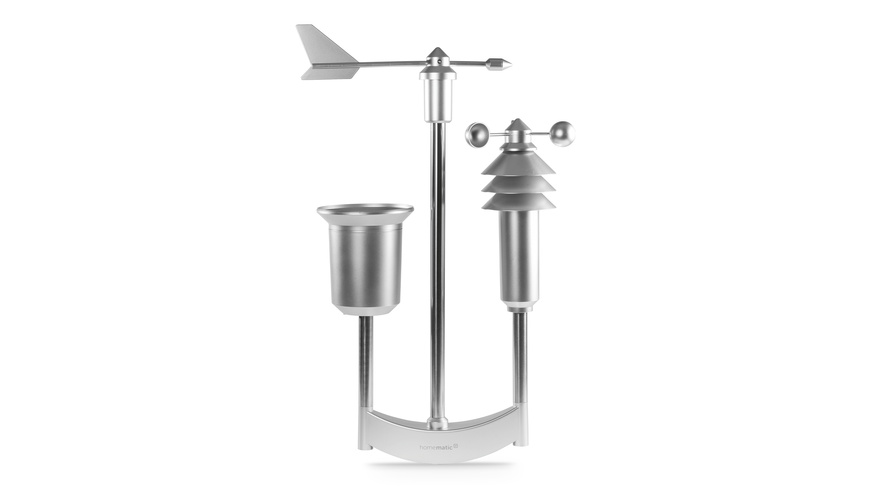
The switching device in this lineup. According to the manufacturer, each reading can be used individually in direct links on a CCU3, so the roof window responds to rain and the roller shutter to wind. The manual specifies temperature with a typical accuracy of ±0.3 degrees and humidity with ±3 percent. Both are clearly better than the ±1 degree and ±5 percent that Ecowitt and dnt state. There are weaknesses too. The IP22 protection rating is modest, eQ-3 gives no tolerance for rainfall amount, and the mechanics with wind wheel and tipping bucket need maintenance. According to the manual, sand and leaves clog the funnel. ELV (German retailer) at least stocks a replacement mechanism with wind wheel, vane, funnel and tipping bucket. The included mast is 1.58 meters long and goes into the ground. Because of the risk of lightning, the device must not be the highest point in open terrain.
Homematic IP Set Wetter Pro
The same device plus the Access Point 2. That is convenient for getting started. But you are also buying into the cloud variant, and the readings stay on the servers for one year at most, with up to 20 attributes. A CSV export is possible.
Homematic IP weather sensor plus HmIP-SWO-PL
Only the wind direction is missing here. Start of rain, rainfall amount, wind speed and brightness are all on board. An awning does not care where the wind comes from. That is why this remains our budget recommendation, as long as no window needs to close depending on compass direction.
Ecowitt Wittboy GW2001
No moving parts on the anemometer, a solar cell, IPX5. For Home Assistant, this is the cleanest solution in this comparison. According to the manual, the measuring range ends at 40 m/s, which is 144 km/h. Rain is measured by a piezo sensor with ±10 percent between 5 and 50 mm/h and only ±20 percent outside that range. If the value is meant to control irrigation, that is usually enough; for the annual total, less so. The heating plate against ice needs a separate 12-volt power supply, which means running a cable to the mast.
Davis Vantage Pro2 with WeatherLink Live
Davis describes the Vantage Pro2 as a station for industrial requirements, with a wireless range of up to 300 meters. WeatherLink Live brings the data onto the network via Wi-Fi or cable, and on the same Wi-Fi network in real time, according to Davis. It is expensive in any case. It only makes sense at an open location where someone really wants to keep year-long records.
dnt WeatherScreen PRO V2
More display than control. The 7-inch display, storm gust alarms and logging to a microSD card are strong, as is the upload to Ecowitt, Weather Underground and other portals. For the route into the smart home, ELV only mentions IFTTT. Wireless range in open terrain: up to 100 meters. Rechargeable batteries are explicitly not permitted in the outdoor sensor.
Netatmo Smart Weather Station with anemometer and rain gauge
The nicest app does little good when wind and rain are add-on accessories and everything has to go through the cloud. For indoor climate, the system is well rounded; as a sensor for automation, we do not see it.
How to choose
Start with the hub, not the station. With Homematic IP in the house, take the weather sensor pro or, if you do not need wind direction, the plus. Completely new to the subject, with no existing setup? Then the Set Wetter Pro fits, with the understanding that nothing switches without internet.
If you run Home Assistant, the Ecowitt Wittboy is the better choice, not least because it reports in seconds rather than minutes. And if the station is supposed to water the lawn, read beforehand which signals an irrigation controller (in German) actually accepts. The same goes for windows with an automatic window opener.
Frequently asked questions
Why does a weather station's transmission interval matter?
It determines how late a gust arrives. The Homematic weather sensor pro measures wind every 2 seconds but only transmits every 120 to 184 seconds. Ecowitt states 8.8 seconds for the WS90, Davis 2.5 seconds for wind. Homematic reports the start of rain immediately.
Does a weather station reliably protect an awning from storms?
Not completely. No automatic system reliably protects against sudden storm gusts, as Somfy itself acknowledges as a limit. Set the wind threshold low and keep the awning retracted when there is a severe weather warning.
Which weather station works with Home Assistant?
The Ecowitt Wittboy. Its integration runs as Local Push: the gateway sends the values directly to your server, with no third-party cloud, and reports in seconds rather than minutes. Homematic IP and Netatmo run through the cloud in Home Assistant.
Does the Homematic weather station work without internet?
On the Access Point 2, rules run through the cloud; if the internet goes down, the automation stops. The Home Control Unit and the older CCU3 work locally. We advise newcomers against the set with the CCU3, because eQ-3 discontinued this hub in July 2025.
Weather sensor pro or plus: what is the difference?
The weather sensor plus lacks only wind direction. Start of rain, rainfall amount, wind speed and brightness are all on board. An awning does not care where the wind comes from. The plus therefore remains our budget recommendation, as long as no window needs to close depending on compass direction.
Sources
- ELV: Homematic IP weather sensor pro (retailer details, FAQ on measuring interval)
- eQ-3: HmIP-SWO-PR installation and operating manual
- ELV: Homematic IP weather sensor plus
- ELV: Homematic IP Set Wetter Pro
- ELV: dnt WeatherScreen PRO V2
- Ecowitt: WS90 manual
- Home Assistant: Ecowitt integration
- Home Assistant: HomematicIP Cloud integration
- Home Assistant: Netatmo integration
- Netatmo: Smart Weather Station
- Netatmo: Smart Anemometer
- Davis Instruments: Vantage Pro2
- Davis Instruments: WeatherLink Live
Where to buy
- Homematic IP Wettersensor pro HmIP-SWO-PRView at ELVAvailable in Germany: ELVCheck price at Amazon.deAvailable in Germany: Amazon.de
- Homematic IP Set Wetter ProView at ELVAvailable in Germany: ELV
- Homematic IP Wettersensor plus HmIP-SWO-PLView at ELVAvailable in Germany: ELVCheck price at Amazon.deAvailable in Germany: Amazon.de
- dnt WeatherScreen PRO V2View at ELVAvailable in Germany: ELV
- Ecowitt Wittboy GW2001Check price at Amazon.deAvailable in Germany: Amazon.de
- Davis Vantage Pro2 mit WeatherLink LiveCheck price at Amazon.deAvailable in Germany: Amazon.de
- Netatmo Smarte Wetterstation mit Windmesser und RegenmesserCheck price at Amazon.deAvailable in Germany: Amazon.de