Contents15 sections
This guide was first published in German on handgetestet.de.
With smart plugs, people rarely buy the wrong model. Far more often, they buy into the wrong wireless network. With a FRITZ!Box in the house, the FRITZ! plugs are the most convenient; if you don’t want to commit, take a Matter model such as the Shelly Plug S Gen3 or the Tapo P110M. And to hunt down standby power hogs, the plug also needs to measure small loads cleanly.
Obvious? Unfortunately not. A plug-in adapter that your hub doesn’t understand remains an expensive light switch.
Which wireless network does my plug need?
There are four routes, each with its own price. Wi-Fi plugs work without an extra hub but put a load on the router once twenty of them are plugged in around the house. DECT plugs from FRITZ! communicate directly with the FRITZ!Box, which needs a DECT base station for this. Zigbee models such as the Hue Smart Plug or the Nous A1Z run via a bridge or gateway. And Thread, the wireless network behind many Matter devices, requires a Thread border router, such as a compatible smart speaker or an Apple TV.
What does Matter bring, and where does it fall short?
Matter is not a radio standard. It is a common language. A Matter plug works in Apple Home, Google Home, Alexa or Home Assistant without locking you into one camp. The catch: Matter has only transmitted energy data since version 1.3, and by no means every platform displays it. For its Eve Energy, Eve currently names only SmartThings and Home Assistant; in Apple Home, the Eve app takes over. Which hub suits you is covered in buying a smart home hub.
Which numbers on the spec sheet matter?
First, the switching capacity. Almost any plug can handle lamps and TVs. For fan heaters or electric kettles it should be 16 A, as with Tapo, Meross and the Nous A8M; Shelly and Eve specify 2,500 W.
Then the measuring accuracy. FRITZ! specifies ±100 mW up to 5 W, a rare figure, but one that is decisive when hunting for standby consumption. Incidentally, the plug itself also draws power; for FRITZ!, according to the data sheet, about 0.4 to 0.5 W in standby. Outdoors, IP44 is the minimum, although with FRITZ! the protection only applies if the wall socket also meets IP44.
How do I find standby power hogs without getting bogged down?
Move the metering plug around. One week on the fridge, then on the TV together with the receiver, then on the power strip at your desk. For the fridge, the German consumer advice center (Verbraucherzentrale) recommends measuring for about seven days and extrapolating to a full year. The interesting devices are the ones that look switched off: the German Environment Agency (Umweltbundesamt) cites the washing machine as an example, which can still draw power even when switched off.
If you only want to check once, you don’t need to buy anything. Many consumer advice centers in Germany lend out energy meters, often free of charge. A smart plug becomes truly useful once it should also switch things afterward, for example disconnecting the TV cabinet from the mains completely at night.
Seven smart plugs and their key specs
| Model | Wireless | Metering / load (manufacturer specs) | Who it’s for |
|---|---|---|---|
| FRITZ!Smart Energy 200 / 210 | DECT via FRITZ!Box | yes; 2,300 W (200), 3,450 W and IP44 (210) | FRITZ!Box households, outdoors too |
| Shelly Plug S Gen3 | Wi-Fi, Bluetooth, Matter | yes; 12 A, 2,500 W | Tinkerers and Home Assistant users |
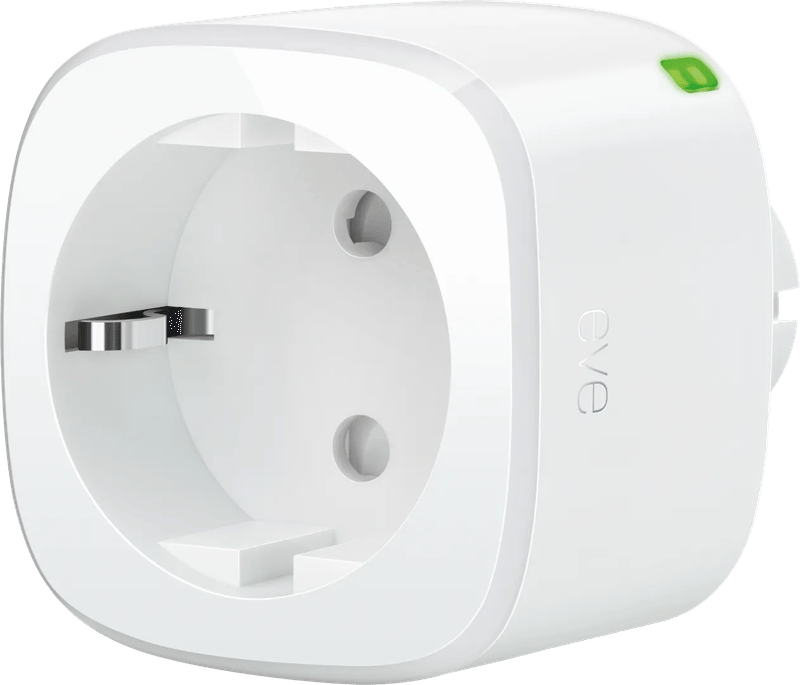
| Eve Energy (Matter) | Thread, Matter | yes; 11 A, 2,500 W | Apple Home households with a border router |
| TP-Link Tapo P110M | Wi-Fi, Matter | yes; 16 A, 3,680 W | Beginners on a small budget |
| Meross MSS315 | Wi-Fi, Matter | yes; 16 A | Matter newcomers, Alexa users |
| Nous A8M / A1Z | Wi-Fi, Matter / Zigbee 3.0 | yes; 16 A | Budget-conscious buyers, local systems |
| Philips Hue Smart Plug | Zigbee, Bluetooth | no | Lamps in the Hue system |
FRITZ!Smart Energy 200 and 210
New name, familiar technology. According to FRITZ!, the devices were called FRITZ!DECT 200 and 210 until early 2026, and both names turn up in stores. The 200 switches up to 2,300 W and evaluates consumption in 15-minute intervals as well as by day, month and year; it requires a FRITZ!Box with a DECT base station. The 210 covers garden and patio, with IP44 and an operating range of −20 to +40 °C. There is no Matter; everything stays within the FRITZ! ecosystem.
Shelly Plug S Gen3
The Shelly measures voltage, current, power and energy, and from firmware 1.6.0 it speaks Matter. With fan heaters, 2,500 W of resistive load is cutting it close. Outdoors, the Shelly Outdoor Plug S Gen3 takes over, with IP44 and the same load ratings. One Shelly page now lists the Plug S Gen3 as discontinued, so check the exact product name carefully when ordering.
Eve Energy (Matter)
Thread and Matter all the way. According to the manufacturer, the Eve Energy works with Apple Home, Alexa, Google Home, SmartThings, Home Assistant and Homey. The load rating is 11 A and 2,500 W; for incandescent bulbs, Eve separately specifies 1 A. Without a border router, nothing works. The Eve Energy Outdoor replaces an existing outdoor socket, has IP44 and, according to Eve, may only be connected by a qualified electrician. So not a plug-in adapter, but an installation.
TP-Link Tapo P110M
Compact enough to leave the neighboring socket free. TP-Link specifies 16 A and 3,680 W but advises against air conditioners, refrigerators and similar motor-driven appliances. The Tapo app shows consumption data, optionally with your electricity rate entered. Matter 1.3 with energy data came later via an update; Notebookcheck names Home Assistant and SmartThings as compatible platforms.
Meross MSS315
Meross was early with a Matter plug for the European market. The MSS315 uses 2.4 GHz Wi-Fi, switches up to 16 A and shows real-time and historical values. Not meant for outdoor use. Buyer reports on connection stability are mixed.
Nous A8M and A1Z
Nous targets DIY enthusiasts. The A8M is a 16 A Wi-Fi plug with Matter and energy monitoring; the A1Z is its counterpart for Zigbee 3.0, also with metering and requiring a gateway. However, one retailer lists only 10 A continuous load and 16 A peak for the A1Z. For a fan heater, we would therefore choose a different model.
Philips Hue Smart Plug
A lamp switch, not a meter. It is controlled via Bluetooth without a bridge or via Zigbee through the Hue Bridge, where the plug also acts as a Zigbee repeater. It does a good job of bringing that old floor lamp into an existing Hue system. It does not measure consumption.
Measuring a balcony solar system: can a plug do that?
Only to a limited extent. For the FRITZ!Smart Energy 200, FRITZ! explicitly does not guarantee operation with devices that feed power into the grid, such as balcony solar systems. For the 210, on the other hand, FRITZ! describes in its own documentation that it can also record power production. So whether a model measures feed-in at all should be clarified before you buy. There is more on the system and storage under balcony solar systems with storage.
So which one should I get?
If there is a FRITZ!Box in the house, the FRITZ!Smart Energy 200 is the obvious choice, or the 210 for outdoors, with no additional device. For hunting standby power on a small budget, the Tapo P110M or Meross MSS315 will do, and a single plug is enough to get started.
In Apple Home with a border router, the Eve Energy fits. If you only have Wi-Fi, a Wi-Fi plug makes more sense. Home Assistant and custom automations argue for the Shelly Plug S Gen3 or the Nous A8M, and if all you want is to add a lamp to the Hue system, take the Hue Smart Plug. For anything more, it is too expensive. More ideas for saving energy come from smart radiator thermostats.
Once you know your consumption, you should also check the price per kilowatt hour. Notice periods, special termination rights and the typical bonus traps are explained in our guide to switching electricity providers (in German).
For outdoors, we set up a Matter plug ourselves: our review of the Meross outdoor plug shows how easy it was.
Frequently asked questions
Which wireless network does a smart plug need?
There are four routes. Wi-Fi plugs work without an extra hub but put a load on the router once you have many devices. FRITZ! plugs communicate via DECT with the FRITZ!Box. Zigbee models need a bridge or gateway, and Thread needs a border router such as a compatible smart speaker or an Apple TV.
What does Matter bring to smart plugs?
Matter is a common language, not a radio standard. A Matter plug works in Apple Home, Google Home, Alexa or Home Assistant without locking you into one ecosystem. However, Matter has only transmitted energy data since version 1.3, and by no means every platform displays it.
Which smart plug can handle a fan heater?
For fan heaters or electric kettles it should be 16 A, as with the Tapo P110M, Meross MSS315 and Nous A8M. Shelly and Eve specify 2,500 W, which is cutting it close with a fan heater. For the Nous A1Z, one retailer lists only 10 A continuous load.
How do I find standby power hogs with a metering plug?
Move the plug around: one week on the fridge, then on the TV together with the receiver, then on the power strip. For the fridge, the German consumer advice center (Verbraucherzentrale) recommends measuring for about seven days and extrapolating to a full year. For small loads, accurate measurement counts; FRITZ! specifies ±100 mW up to 5 W.
Do I need a smart plug for a one-off measurement?
No. Many German consumer advice centers lend out energy meters, often free of charge. A smart plug becomes useful once it should also switch things, for example to disconnect the TV cabinet from the mains completely at night. Bear in mind that it draws power itself, about 0.4 to 0.5 W in the case of FRITZ!.
Can a smart plug measure a balcony solar system?
Only to a limited extent. For the FRITZ!Smart Energy 200, FRITZ! explicitly does not guarantee operation with devices that feed power into the grid, whereas for the 210 FRITZ! describes that it can also record power production. Whether a model measures feed-in should be clarified before you buy.
Sources
- FRITZ!: Smart Energy 200, technical data
- FRITZ!: Smart Energy 210, technical data
- FRITZ!: Which devices can be connected to the FRITZ! plug?
- FRITZ!: Solar and energy industry
- Shelly: Plug S Gen3
- Shelly: Outdoor Plug S Gen3
- Eve: Eve Energy
- Eve: Eve Energy Outdoor
- Tapo: P110M
- Notebookcheck: Matter 1.3 update for the Tapo P110M
- Philips Hue: Smart Plug
- Zigbee2MQTT: Nous A1Z
- Verbraucherzentrale: measuring fridge consumption
- Umweltbundesamt (German Environment Agency): energy-saving kit with energy meter
Where to buy
- FRITZ!Smart Energy 200Check price at Amazon.deAvailable in Germany: Amazon.de
- FRITZ!Smart Energy 210Check price at Amazon.deAvailable in Germany: Amazon.de
- Shelly Plug S Gen3 (schwarz)Check price at Amazon.deAvailable in Germany: Amazon.de
- Shelly Outdoor Plug S Gen3Check price at Amazon.deAvailable in Germany: Amazon.de
- Eve Energy (Matter)Check price at Amazon.deAvailable in Germany: Amazon.deView at CoolblueAvailable in Germany: Coolblue
- Eve Energy Outdoor (Matter)Check price at Amazon.deAvailable in Germany: Amazon.de
- TP-Link Tapo P110MCheck price at Amazon.deAvailable in Germany: Amazon.de
- Meross MSS315Check price at Amazon.deAvailable in Germany: Amazon.de
- Nous A8MCheck price at Amazon.deAvailable in Germany: Amazon.de
- Nous A1ZCheck price at Amazon.deAvailable in Germany: Amazon.de
- Philips Hue Smart PlugView at CoolblueAvailable in Germany: CoolblueCheck price at Amazon.deAvailable in Germany: Amazon.de