Contents11 sections
This guide was first published in German on handgetestet.de.
A watch that never needs a battery and sets itself to the second every night sounds like luxury. It isn’t. We see the Citizen CB1160-55L as a sensible middle ground; according to the manufacturer, it is solar powered, radio-controlled, with a lightweight titanium case and sapphire crystal. If you mainly want a tough watch and plastic doesn’t bother you, the Casio G-Shock GW-M5610U is enough for a fraction of that.
People usually pick the wrong watch here for one simple reason. „Solar“ and „radio-controlled“ often appear close together in the product title, yet they are two different things. Many solar watches don’t receive any time signal at all. They are as accurate as any good quartz watch and have to be set to daylight saving or standard time by hand twice a year.
First fork in the road: solar, radio or both?
A solar watch charges a battery via cells under the dial. Citizen calls this Eco-Drive, Casio Tough Solar. What matters is the power reserve, meaning how long the watch keeps running in the dark. The range is wide. For the SNE525, Seiko specifies around ten months; Junghans specifies up to three years for the max bill MEGA Solar.
A radio-controlled watch sets itself by a time signal transmitter. In Germany, that’s DCF77. The Physikalisch-Technische Bundesanstalt (PTB), Germany’s national metrology institute, uses it to broadcast the country’s official time, transmitted from Mainflingen near Frankfurt on 77.5 kHz. According to PTB, the signal can be received up to about 2,000 kilometers away. PTB itself qualifies this, however: at great distances, the field strength is sufficient for sensitive receivers, but rarely for wristwatches. Within a radius of around 500 kilometers, the ground wave is strong and stable. In Germany and neighboring countries, reception isn’t an issue. In southern Europe, it can get tighter.
For frequent travelers, multiple transmitters matter. Among the models below, Citizen, Casio and Junghans receive Japan and the US in addition to Europe, some also China and the UK.
Second fork: material and water resistance
This is where the price classes part ways. Titanium is significantly lighter than stainless steel; according to the manufacturer, the Citizen CB1160-55L weighs 80 grams with a titanium bracelet. Untreated titanium scratches more easily than steel, though, which is why Citizen hardens the surface with its own coating (Duratect). Sapphire crystal is very scratch-resistant. According to manufacturer or retailer information, all the analog watches on our list have it.
5 bar and 10 bar sound similar. In everyday use, they aren’t. If you swim or dive, read our notes on dive watches (in German) first. And the power reserve? Below six months, it gets tight if the watch disappears under your sleeve in winter. More is nice, but doesn’t justify paying double.
Order by the exact reference number. Many models exist in almost identical variants with a different strap, a different color or an older movement. Listings from unknown third-party sellers at a suspiciously low price aren’t a find; they’re a risk.
Six solar and radio-controlled watches side by side
| Model | Power and time signal | Case, crystal, water resistance | Best for |
|---|---|---|---|
| Citizen CB1160-55L | Eco-Drive H149, radio (Europe, US, Japan, China), 180-day power reserve | Super Titanium, 37.5 mm, sapphire crystal, 10 bar | everyday wear, light watch with radio |
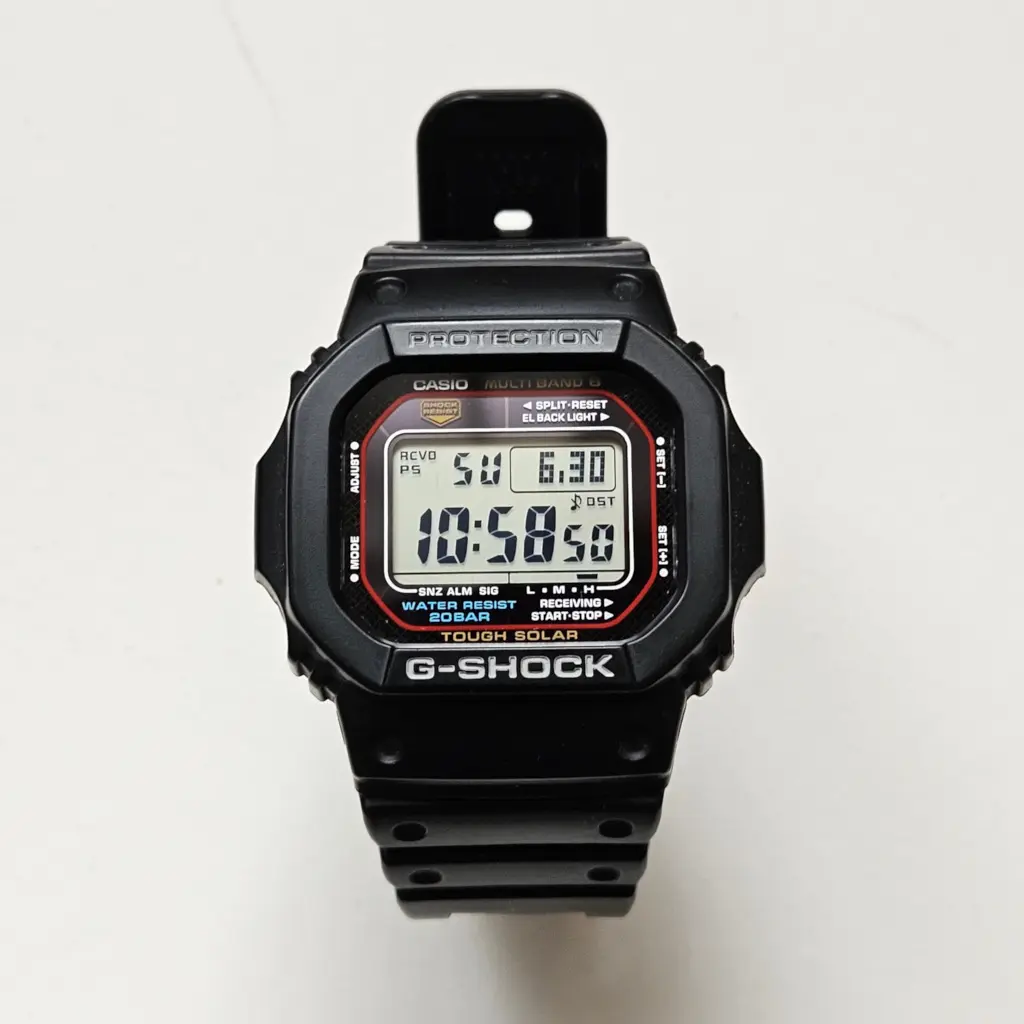
| Casio G-Shock GW-M5610U-1ER | Tough Solar, Multiband 6 (six transmitters), about 10 months without light | resin, 46.7 × 43.2 mm, 200 m | sports, workshop, small budget |
| Junghans max bill MEGA Solar Titan 059/2021.02 | radio-controlled solar movement J101.85, up to 3 years of power reserve in the dark, app | polished titanium, 38 mm, sapphire crystal, 5 bar | design, office, higher price class |
| Seiko SNE525P1 | solar V158, about 10 months, no radio | stainless steel, 40 mm, sapphire crystal, 10 bar | classic look without radio |
| Casio Edifice EFS-S650D-2AEF | solar, no radio | anti-reflective sapphire crystal, 10 bar | sporty analog watch |
| Boccia Titanium 3643-02 | solar, no radio | titanium, 39 mm, sapphire crystal, 10 bar (retailer information) | light titanium watch at a low price |
Citizen CB1160-55L: radio and titanium in a compact size
At 37.5 mm in diameter and just over 9 mm thick, the CB1160 is unusually slim for a radio-controlled watch. According to Citizen, the H149 caliber receives time signals from Europe, Japan, the US and China and runs for 180 days on a full charge, with sapphire crystal and 10 bar. At its suggested retail price, it sits in the mid three-figure euro range. Because the line is new, check on Amazon.de (Amazon Germany) whether the blue variant is currently in stock.
Casio G-Shock GW-M5610U: the rugged shortcut
According to Casio, the square shape goes back to the DW-5600 series. Casio specifies six time signal transmitters, including DCF77, and up to six automatic reception attempts per day. Without light, it runs about ten months according to Casio, and around 22 months in power-saving mode. It is water-resistant to 200 meters and weighs 52 grams. No sapphire, no metal. Can you live with that? Then you get the same basic functions for around a fifth of the Citizen’s price.
Junghans max bill MEGA Solar Titan: Bauhaus with radio
Junghans, based in Schramberg in Germany’s Black Forest, fits the J101.85 radio-controlled solar movement into a polished 38 mm titanium case. According to the manufacturer, the power reserve in the dark lasts up to three years; a perpetual calendar and an app for time zones are also on board. With 5 bar, it’s a watch for a dress shirt and the office, not the pool. In price, it’s clearly in the four-figure euro range, and the money goes mainly into the design. Technically, the Citizen does almost the same.
Seiko SNE525P1: solar without radio, solidly built
Seiko equips the SNE525 with the V158 solar caliber, sapphire crystal and 10 bar. The stainless steel case measures 40 mm, and on a full charge, the watch runs about ten months according to Seiko. There’s no radio. If you don’t mind setting the watch yourself when the clocks change, you get an honest, classically designed solar watch at a price that stays in three figures, toward the lower end.
Casio Edifice EFS-S650D: sapphire instead of resin
If the G-Shock is too sporty for you, look at the Edifice. Casio specifies solar power, anti-reflective sapphire crystal and 10 bar. No radio reception is listed for this model, and no specific power reserve either. A real drawback. If the watch sits in a drawer for a while, you don’t know exactly how long it will last.
Boccia Titanium 3643-02: an affordable way into titanium
According to retailer information, the Boccia 3643-02 has a 39 mm titanium case, sapphire crystal, 10 bar and solar power, plus a leather strap. It has no radio. As a light, simple watch that never needs a battery change, it’s the most affordable titanium option on our list.
At the end of the road: which watch for whom
- Radio, titanium, everyday wear: Citizen CB1160-55L. It combines everything this guide is about at a still reasonable price.
- Tough and affordable: Casio G-Shock GW-M5610U. Less refined, but with radio and solar for sports, construction sites and travel.
- Design first: Junghans max bill MEGA Solar Titan, provided money isn’t a big issue and 5 bar is enough.
- Without radio, classic or sporty: Seiko SNE525P1 or Casio Edifice EFS-S650D.
- Titanium on a small budget: Boccia 3643-02, but then without radio.
If you have a mechanical watch in mind, our overview of automatic watches (in German) explains the differences. Notifications and heart rate tracking on your wrist? Then a solar watch is the wrong choice, and our smartwatch guide (in German) will help.
If the battery in a classic quartz watch needs replacing, our guide to button cells (in German) helps you find the right silver oxide number.
Frequently asked questions
What's the difference between a solar watch and a radio-controlled watch?
A solar watch charges a battery via cells under the dial. A radio-controlled watch sets itself by a time signal transmitter, which in Germany is DCF77. The two terms often appear close together in product titles, but many solar watches receive no time signal and have to be set by hand when the clocks change.
How far does the DCF77 radio signal reach?
According to PTB, Germany's national metrology institute, the signal from Mainflingen can be received up to about 2,000 kilometers away, but at great distances it is rarely strong enough for wristwatches. Within a radius of around 500 kilometers, it is strong and stable. In Germany and neighboring countries, reception isn't an issue; in southern Europe, it can get tighter.
How much power reserve does a solar watch need?
The power reserve tells you how long the watch keeps running in the dark. Below six months, it gets tight if the watch disappears under your sleeve in winter. According to Seiko, the SNE525 manages around ten months, and the Junghans max bill MEGA Solar up to three years. More is nice, but doesn't justify paying double.
Is titanium better than stainless steel for a watch?
Titanium is significantly lighter; according to the manufacturer, the Citizen CB1160-55L weighs 80 grams with a titanium bracelet. Untreated titanium scratches more easily than steel, though, which is why Citizen hardens the surface with its own coating. Sapphire crystal is very scratch-resistant.
Which radio-controlled watch is suitable for travel?
For frequent travelers, multiple transmitters matter. According to Casio, the G-Shock GW-M5610U receives six time signal transmitters and attempts reception up to six times a day. The Citizen CB1160-55L receives signals from Europe, Japan, the US and China.
When is a solar watch the wrong choice?
If you want notifications and heart rate tracking on your wrist, a smartwatch serves you better. For a mechanical watch, our overview of automatic watches helps. For swimming, also check the water resistance: the Junghans with 5 bar is a watch for the office, not the pool.
Sources
- PTB: DCF77, dissemination of Germany’s official time
- PTB: DCF77 range
- Citizen: CB1160-55L
- Casio: G-Shock GW-M5610U-1
- Junghans: max bill MEGA Solar 59/2021.02
- Seiko: SNE525
- Casio: Edifice EFS-S650D-2A
- digitec.ch: Boccia 3643-02 (retailer information)
Where to buy
- Citizen CB1160-55LCheck price at Amazon.deCheck price at Amazon.co.ukCheck price at Amazon.nlCheck price at Amazon.com.beCheck price at Amazon.frCheck price at Amazon.itCheck price at Amazon.esCheck price at Amazon.plCheck price at Amazon.seAvailable in Germany: Amazon.de
- Casio G-Shock GW-M5610U-1ERCheck price at Amazon.deCheck price at Amazon.co.ukCheck price at Amazon.nlCheck price at Amazon.com.beCheck price at Amazon.frCheck price at Amazon.itCheck price at Amazon.esCheck price at Amazon.plCheck price at Amazon.seAvailable in Germany: Amazon.de
- Junghans max bill MEGA Solar Titan 059/2021.02Check price at Amazon.deCheck price at Amazon.co.ukCheck price at Amazon.nlCheck price at Amazon.com.beCheck price at Amazon.frCheck price at Amazon.itCheck price at Amazon.esCheck price at Amazon.plCheck price at Amazon.seAvailable in Germany: Amazon.de
- Seiko SNE525P1Check price at Amazon.deCheck price at Amazon.co.ukCheck price at Amazon.nlCheck price at Amazon.com.beCheck price at Amazon.frCheck price at Amazon.itCheck price at Amazon.esCheck price at Amazon.plCheck price at Amazon.seAvailable in Germany: Amazon.de
- Casio Edifice EFS-S650D-2AEFCheck price at Amazon.deCheck price at Amazon.co.ukCheck price at Amazon.nlCheck price at Amazon.com.beCheck price at Amazon.frCheck price at Amazon.itCheck price at Amazon.esCheck price at Amazon.plCheck price at Amazon.seAvailable in Germany: Amazon.de
- Boccia Titanium 3643-02Check price at Amazon.deCheck price at Amazon.co.ukCheck price at Amazon.nlCheck price at Amazon.com.beCheck price at Amazon.frCheck price at Amazon.itCheck price at Amazon.esCheck price at Amazon.plCheck price at Amazon.seAvailable in Germany: Amazon.de