Contents12 sections
This guide was first published in German on handgetestet.de.
Eight-inch monitors in a room of twelve square meters: it sounds like clarity and usually ends in boom. In small rooms, more bass mostly brings problems. At most desks, five inches are enough, and if you work in an untreated room, you are better off putting your money into room calibration than into bigger woofers. That is exactly where models like the iLoud MTM MKII from IK Multimedia come in.
What the room does to the sound
A studio monitor is not supposed to sound beautiful. It is supposed to be honest. But the room has a strong influence on everything it reveals, and Genelec gives a figure worth knowing: if a speaker stands directly against a solid wall, the bass can swell by up to 6 dB, and in a corner by up to 12 dB. A large woofer makes the problem worse instead of solving it.
Five inches (around 13 cm) therefore suit most home offices. Seven or eight inches only pay off when the room and the distances allow it and the room is acoustically treated.
Position them before you start turning knobs
According to Genelec, the two speakers and your head form an equilateral triangle. That means 60 degrees between left and right, each speaker angled toward the listening position, with the acoustic axis at ear height, typically 1.2 to 1.4 meters above the floor. According to Genelec, two-way monitors should stand upright. Lying on their side, the sound loses level around the crossover frequency as soon as you move your head sideways.
Both speakers should be the same distance from the rear wall and from the side wall. If there is a bass reflex port on the back, it needs at least 5 cm of clearance according to the manufacturer.
For the connection, XLR or balanced TRS jacks are the safe choice because they suppress hum on long cables. RCA is unbalanced and intended more for mixers without professional outputs. And room correction? Simple switches for bass and treble help roughly. Calibration with a microphone corrects more precisely.
The speakers connect to the output of your audio interface. Which devices come with balanced line outputs is covered in our audio interface guide for the home studio (in German). For late-night mixing without volume, closed-back headphones help; we present suitable models in our guide to studio headphones (in German). If you mainly record speech, you will find suitable microphones in our podcast microphone buying guide (in German).
Seven near-field monitors, compared soberly
| Model | Woofer | Inputs | Room correction | Best for |
|---|---|---|---|---|
| Yamaha HS5 | 5 inches | XLR, TRS | Switches for bass (below 500 Hz) and treble | Getting started, the tried and tested |
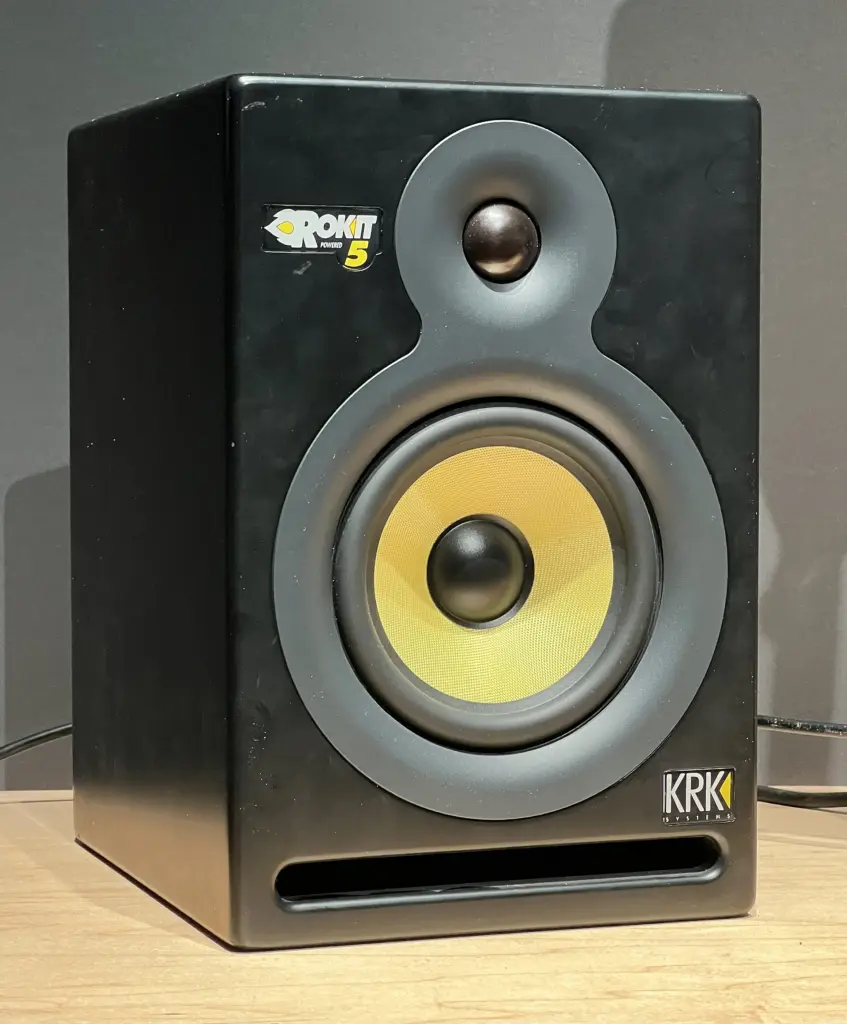
| KRK Rokit 5 G5 | 5 inches | XLR/TRS combo jack | DSP, 25 EQ combinations, app | Beat production, beginners with an app |
| ADAM Audio T5V | 5 inches | XLR, RCA | Switches for bass and treble (±2 dB) | Small budget, small room |
| IK Multimedia iLoud MTM MKII | 2 × 3.5 inches | XLR/TRS combo jack, USB | Automatic calibration (ARC) | Untreated rooms, desktop |
| ADAM Audio A7V | 7 inches | XLR, RCA, Ethernet | DSP, profiles from Sonarworks SoundID | Larger rooms, fine-tuning |
| Genelec 8030C | 130 mm | XLR | Switches for room correction | Compact pro class |
| Neumann KH 120 II | 130 mm | XLR, S/PDIF | DSP, calibration with MA 1 (sold separately) | Demanding mixes |
Yamaha HS5: the no-frills classic
A 5-inch woofer, a 1-inch dome tweeter and, according to Yamaha, 45 plus 25 watts of amplifier power. On the back are XLR and TRS inputs, and a switch lowers the range below 500 Hz by 2 or 4 dB. Deep bass is not its strength; Yamaha states 54 Hz as the lower limit at −10 dB. The HS7 with 6.5 inches or the HS8 with 8 inches offer more. But only if the room is right.
KRK Rokit 5 G5: tuning via app
The fifth Rokit generation uses a 5-inch Kevlar woofer and a sound processor. According to KRK, 25 combinations of wall and tone equalization are available, along with the Mix, Create and Focus modes. The free app analyzes the room and suggests settings. According to KRK, only the Mix mode is tuned flat, and you should stick with it for mixing. According to KRK, the larger Rokit 7 G5 goes down to 45 Hz.
ADAM Audio T5V: little money, ribbon tweeter
Even in the affordable T5V, ADAM installs its U-ART ribbon tweeter. According to the manufacturer, the frequency response ranges from 45 Hz to 25 kHz (−6 dB). Besides XLR, there is an RCA input, handy for older mixers. Bass and treble can be raised or lowered by 2 dB in two steps. Because the bass port is on the back, the speaker should not sit directly against the wall.
IK Multimedia iLoud MTM MKII: small, but calibrated
Two 3.5-inch woofers frame a silk dome tweeter. IK states 48 Hz to 28 kHz (±2 dB) and 100 watts per speaker. People buy this model for its built-in ARC correction. A measurement microphone plugs into the speaker, and then calibration runs automatically, according to IK also as a quick single-point measurement without a computer. According to IK, the microphone is included in the bundle but not with a single speaker. In many home studios, that is money better spent than a bigger woofer.
ADAM Audio A7V: plenty of adjustment room for larger rooms
A 7-inch woofer, an X-ART tweeter, and according to ADAM down to 44 Hz (−3 dB). The sound processor accepts correction profiles from Sonarworks SoundID Reference, and everything is controlled from a computer via the A Control software. On top of that come two voicings and a network connection. A small room cannot do much with this much speaker.
Genelec 8030C: compact with a metal enclosure
Hardly bigger than an HS5, and according to Genelec 5 kg in weight. The 130 mm woofer reaches down to 47 Hz (−6 dB). Inputs? XLR only, no RCA. It comes with the Iso-Pod stand, which decouples the speaker from the desk and, according to the manufacturer, allows around 15 degrees of tilt. You pay considerably more here, mainly for build quality and tuning.
Neumann KH 120 II: digital and precise
44 Hz to 21 kHz (±3 dB) at 145 plus 100 watts, according to Neumann. In addition to the analog XLR input, S/PDIF is on board. On the back, bass, low mids and treble can be attenuated. Automatic calibration requires the separately available MA 1 kit. If you buy in this class, you should also invest in acoustic panels; otherwise you give away part of the precision. The KH 120 II is currently not available on Amazon (as of November 9, 2026).
Which speakers for which room?
- Small, untreated room at the desk: iLoud MTM MKII. Here, calibration counts for more than the inch figure.
- Tight budget: ADAM Audio T5V or Yamaha HS5, properly set up in a triangle and with distance from the wall.
- Enjoy tweaking curves: KRK Rokit 5 G5 with the app, in Mix mode when mixing.
- Larger room from about 20 square meters: ADAM Audio A7V.
- Pro standards in a small space: Genelec 8030C or Neumann KH 120 II, ideally combined with room acoustics.
One last piece of advice. Buy stands or decoupling feet first. A speaker that sits flat on the desk and plays into the monitor sounds worse than it should in every price range.
Good monitors are of little use for recordings if the room resonates along with them; how much a vocal booth for your head helps is shown in our review of the Vocal Head Booth from t.akustik.
Frequently asked questions
What size should studio monitors be for a small room?
Five inches suit most home offices. Seven or eight inches only pay off when the room and the distances allow it and the room is acoustically treated. A large woofer makes bass problems in a small room worse instead of solving them.
How do you position studio monitors correctly?
According to Genelec, the two speakers and your head form an equilateral triangle, each speaker angled toward the listening position, with the acoustic axis at ear height. Two-way monitors should stand upright. Both should be the same distance from the rear and side walls; according to the manufacturer, a rear bass reflex port needs at least 5 cm of clearance.
Why does the bass boom near the wall?
The room has a strong influence. Genelec gives a figure for this: if a speaker stands directly against a solid wall, the bass can swell by up to 6 dB, and in a corner by up to 12 dB. That is why a speaker with a rear bass port in particular should not sit right against the wall.
XLR, TRS or RCA for connecting?
XLR or balanced TRS jacks are the safe choice because they suppress hum on long cables. RCA is unbalanced and intended more for mixers without professional outputs. The speakers connect to the output of your audio interface.
Is automatic room calibration worth it?
In many home studios, it is money better spent than a bigger woofer. Simple switches for bass and treble only help roughly; calibration with a microphone corrects more precisely. With the iLoud MTM MKII, the measurement microphone is included in the bundle according to IK; the Neumann KH 120 II requires the separately available MA 1 kit.
What should you keep in mind with the KRK Rokit 5 G5?
It uses a sound processor and an app that analyzes the room and suggests settings. According to KRK, only the Mix mode is tuned flat, so you should stick with it for mixing.
Sources
- Yamaha: HS series, specifications
- KRK: Rokit 5 Generation Five
- ADAM Audio: T5V
- ADAM Audio: A7V
- IK Multimedia: iLoud MTM MKII
- Genelec: 8030C
- Neumann: KH 120 II
- Genelec: Studio Monitor Placement
Where to buy
- IK Multimedia iLoud MTM MKIICheck price at Amazon.deAvailable in Germany: Amazon.de
- ADAM Audio T5VCheck price at Amazon.deAvailable in Germany: Amazon.de
- Yamaha HS5 (schwarz)Check price at Amazon.deAvailable in Germany: Amazon.de
- KRK Rokit 5 G5Check price at Amazon.deAvailable in Germany: Amazon.de
- ADAM Audio A7VCheck price at Amazon.deAvailable in Germany: Amazon.de
- Genelec 8030CCheck price at Amazon.deAvailable in Germany: Amazon.de
- Neumann KH 120 IICheck price at Amazon.deAvailable in Germany: Amazon.de