
Contents11 sections
This guide was first published in German on handgetestet.de.
A truck GPS costs more than a car GPS, and for good reason: it is supposed to keep your semi from ever being sent down the lane with the 3.40-meter bridge. For long-haul drivers carrying dangerous goods or switching trailers, we recommend the TomTom GO Expert Plus 7 Welt (the version with world maps). If parking, breaks and a large display matter more to you, you are more likely to end up with Garmin’s dēzl LGV820. A smartphone with a car navigation app does not replace either.
Do you drive a van or a motorhome privately? Then our guide to GPS navigation for the car (in German) is the better read. This one is about devices that know weight, axle load, height and cargo.
What a truck GPS calculates differently
At its core is the vehicle profile. You enter length, width, height, gross weight and axle load, and the device then plans routes that are cleared for those dimensions. In the GO Expert Plus manual, TomTom also describes maximum speed, the nine UN dangerous goods classes, a setting for substances hazardous to water and the ADR tunnel categories B through E. According to its manual, Garmin’s dēzl warns of roads not cleared for trucks, crosswinds, steep grades, narrow roads and the risk of grounding the underbody.
Even so, it is no guarantee. Garmin itself states very clearly that profile data cannot be taken into account in every route and that the map data has gaps. The sign at the bridge always applies, not the screen. If you haul dangerous goods, treat the hazmat profile as an aid and check the tunnel category yourself as well.
Breaks, Sundays, speed cameras: what the device may and may not do
Both manufacturers advertise break assistants. Garmin calls its version a break planner; the device alerts you one hour before the suggested break and proposes rest areas along the route. Legally, however, the tachograph is what counts. Under Article 7 of EU Regulation 561/2006, a break of at least 45 minutes is mandatory after four and a half hours of driving, which can be split into 15 minutes followed by 30 minutes. The daily driving time is nine hours, and ten are allowed twice a week. The GPS keeps track as well but does not replace any recording; the Garmin manual says so too.
Second point: the Sunday and public holiday driving ban. Under Section 30 (3) of the German Road Traffic Regulations (StVO), trucks over 7.5 tonnes permissible gross weight, as well as trailers behind trucks, may not carry goods commercially on those days from midnight to 10 p.m., with exceptions such as fresh food. Neither TomTom nor Garmin states in their data sheets that the devices factor this ban into route planning. So you plan Sundays yourself.
And the speed camera warnings? TomTom includes them as a trial period, two years with the Premium Pack. In Germany, Section 23 (1c) StVO prohibits using such functions while driving, even if the device is actually intended for something else. TomTom itself points out that the warnings are prohibited in some countries. So switch the function off here. It is no reason to buy.
Six truck GPS units compared
| Model | Display | Storage, battery | Best for |
|---|---|---|---|
| TomTom GO Expert Plus 7 Welt | 7 inches, 1280 × 800 | 32 GB, battery life not specified | Long haul with dangerous goods, world map |
| TomTom GO Expert Plus 6 Welt | 6 inches, 1280 × 720 | 32 GB, battery life not specified | Same features, smaller cab |
| TomTom GO Professional 6 Europa | 6 inches, 1280 × 720 | 32 GB, battery life not specified | Regional distribution in Europe, no voice control |
| Garmin dēzl LGV720 | 6.95 inches, 1024 × 600 | 32 GB, up to 1.5 hours | Entry into Garmin with community parking |
| Garmin dēzl LGV820 | 8 inches, 1280 × 800, rotatable | 32 GB, up to 2 hours | Long-haul drivers focused on breaks and parking |
| Garmin dēzl LGV1020 | 10.1 inches, 1280 × 800, rotatable | 32 GB, up to 2 hours | Large cab, arrival planning with satellite imagery |
TomTom GO Expert Plus 7 Welt
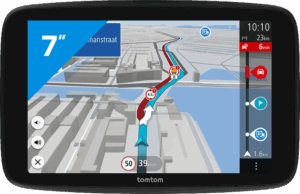
According to TomTom, the 7-inch model has 1280 × 800 pixels, 32 GB of storage, 2 GB of RAM, Wi-Fi at 2.4 and 5 GHz and voice control. Several vehicle profiles can be saved, and the device can avoid low-emission zones along the route. Add to that the dangerous goods classes and ADR tunnel codes. Traffic data comes via the smartphone. For us, it is the well-rounded choice for long haul, because the hazmat options are clearly described in the manual and the world map also covers trips outside Europe. The Premium Pack adds a dual charger, adhesive mounting plates and a leather case, but you do not need them.
TomTom GO Expert Plus 6 Welt
Technically, it is the same device with a 6-inch display and 1280 × 720 pixels. Profiles, dangerous goods, low-emission zones and the magnetic mount are identical. It makes sense if the windshield is already crowded with telematics, a camera and a tablet. The price difference to the 7-inch model is small; one extra inch is noticeably easier to read at 80 km/h.
TomTom GO Professional 6 Europa
The second generation of the GO Professional (here the version with Europe maps) also works with dimensions, weight, dangerous goods and ADR tunnels, has 32 GB of storage and a permanently built-in, reversible mount. Maps cover 46 European countries and are updated monthly. According to the TomTom data sheet, it lacks voice control. For drivers who almost only travel within Europe and prefer to type in their destination, this is the cheapest serious solution. We would not take the 5-inch sibling with 854 × 480 pixels into a truck.
Garmin dēzl LGV720
Garmin’s smallest device in the current lineup: 6.95 inches with 1024 × 600 pixels, 242 grams, and a battery that lasts up to an hour and a half according to Garmin. Even this model includes simple break planning, truck parking spots rated by drivers and community destinations such as loading docks. The resolution is the weakest figure in the comparison. If you want Garmin and have little space, this is the right pick.
Garmin dēzl LGV820
With 8 inches and 1280 × 800 pixels, the LGV820 is rotatable according to the data sheet, so it can also be used in portrait orientation, and it comes with a magnetic mount. Garmin also lists wind warnings, arrival planning with BirdsEye satellite imagery and alerts for violations of driving and rest times. It weighs 405 grams, and the battery lasts up to two hours. Live traffic and weather reach the device via the dēzl app. For drivers who care more about finding a parking spot in the evening than about the dangerous goods list, this is our pick.
Garmin dēzl LGV1020
Same features as the LGV820, just with a 10.1-inch diagonal, a 24.5 × 15.4 centimeter housing and 554 grams. In a large long-haul cab, that is comfortable. In the middle of the windshield, a device of this size can noticeably restrict the field of view; Section 23 StVO requires that vision and hearing are not impaired by devices. So measure the space at the lower left of the windshield beforehand. It is the most expensive device here, and the extra cost over the LGV820 mainly buys screen area.
How we would decide
- Dangerous goods, ADR tunnels, occasional trips outside Europe: TomTom GO Expert Plus 7 Welt.
- Long haul with overnight stays in the truck, focus on parking and breaks: Garmin dēzl LGV820.
- Regional distribution in Europe, tight budget: TomTom GO Professional 6 Europa.
- Very large cab and a wish for satellite imagery on arrival: Garmin dēzl LGV1020.
Two more notes. All six devices have only a small battery and belong permanently on the vehicle’s power supply. And if you want a camera on the windshield next to the GPS, you will find criteria and the legal situation in our dashcam guide; for the blind spot when maneuvering, a backup camera helps, which Garmin supports on the dēzl devices according to the data sheet.
Frequently asked questions
What can a truck GPS do that a regular GPS cannot?
It works with a vehicle profile made up of length, width, height, gross weight and axle load and plans routes that are cleared for those dimensions. TomTom also knows the nine UN dangerous goods classes and the ADR tunnel categories. Garmin warns of crosswinds, steep grades and narrow roads.
Can I rely blindly on the route from a truck GPS?
No. Garmin itself states that profile data cannot be taken into account in every route and that the maps have gaps. The sign at the bridge always applies, not the screen. If you haul dangerous goods, check the tunnel category yourself as well.
Does the break planner in the GPS replace the tachograph?
No, legally the tachograph is what counts. Under EU Regulation 561/2006, a break of at least 45 minutes is mandatory after four and a half hours of driving, which can be split into 15 and 30 minutes. The GPS keeps track as well but does not replace any recording; the Garmin manual says so too.
Does a truck GPS take the Sunday driving ban into account?
Neither TomTom nor Garmin states in their data sheets that the devices factor the ban under Section 30 of the German Road Traffic Regulations (StVO) into route planning. Trucks over 7.5 tonnes may not carry goods commercially on Sundays and public holidays from midnight to 10 p.m. So you plan Sundays yourself.
Am I allowed to use the speed camera warning in a truck GPS?
Not in Germany. Section 23 (1c) of the German Road Traffic Regulations (StVO) prohibits using such functions while driving. TomTom includes the warnings as a trial period and points out itself that they are prohibited in some countries. Switch the function off; it is no reason to buy.
Which truck GPS is the cheapest option for regional distribution in Europe?
The TomTom GO Professional 6 Europa also works with dimensions, weight, dangerous goods and ADR tunnels and has maps for 46 European countries. According to the data sheet, it lacks voice control. For drivers who almost only travel within Europe and prefer to type in their destination, it is the cheapest serious solution.
Sources
- TomTom: GO Expert Plus, product page and technical specifications
- TomTom: GO Expert Plus user manual (PDF)
- TomTom: GO Professional 2nd generation, product page
- TomTom: GO Professional 2nd generation user manual (PDF)
- Garmin: dēzl LGV series, product page with technical specifications
- Garmin: dēzl LGV820 and LGV1020 user manual (PDF)
- EUR-Lex: Regulation (EC) No 561/2006, driving and rest times
- German StVO Section 30: Sunday and public holiday driving ban
- German StVO Section 23: visibility, electronic devices, radar detectors
Where to buy
- TomTom GO Expert Plus 7 WeltView at CoolblueAvailable in Germany: Coolblue
- Garmin dēzl LGV820View at CoolblueAvailable in Germany: Coolblue
- Garmin dēzl LGV1020View at CoolblueAvailable in Germany: Coolblue
- Garmin dēzl LGV720View at CoolblueAvailable in Germany: Coolblue
- TomTom GO Expert Plus 6 WeltView at CoolblueAvailable in Germany: Coolblue
- TomTom GO Professional 6 EuropaView at CoolblueAvailable in Germany: Coolblue