Contents14 sections
This guide was first published in German on handgetestet.de.
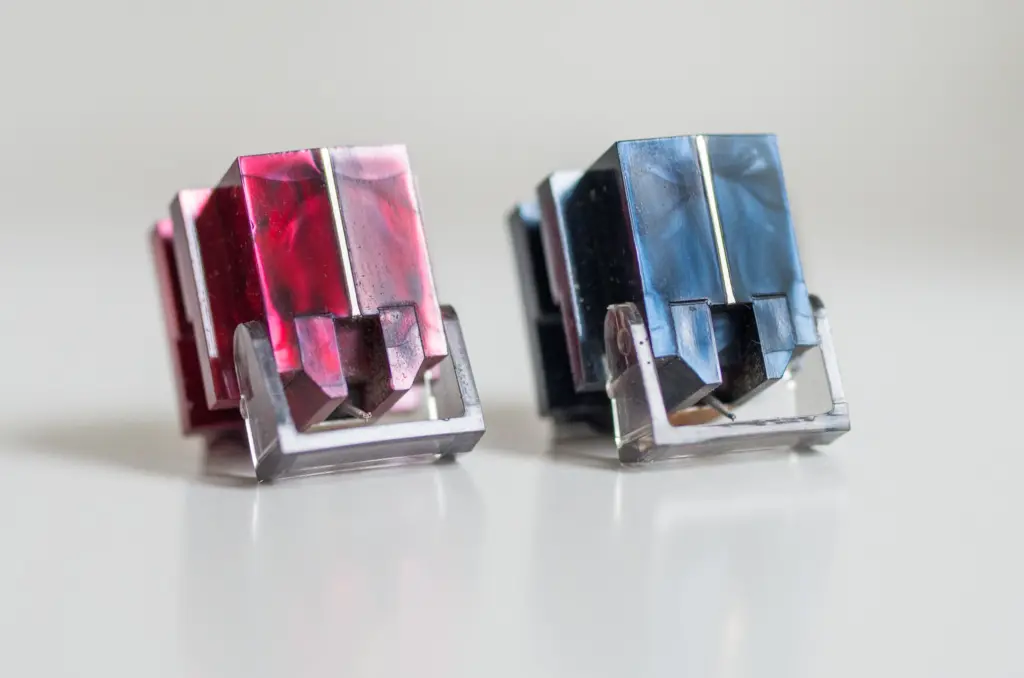
Before you order a new cartridge, take a look at the back of your amplifier. If it only says „Phono MM,“ a moving magnet cartridge is the option, for example the Audio-Technica AT-VM95E or the Ortofon 2M Red. An MC cartridge, by contrast, delivers only a fraction of the voltage and needs a dedicated MC input. Connected to the wrong input, it stays quiet and hisses.
This guide explains the technology behind the spec sheets, presents seven current cartridges from Audio-Technica, Ortofon, Nagaoka, Goldring and Denon, and shows how to mount a cartridge correctly. The turntable itself is covered in our guide to buying a turntable (in German).
Magnet or coil: two principles, two voltages
In a moving magnet (MM) cartridge, a tiny magnet sits at the end of the cantilever and moves in front of fixed coils. That produces strong signals. In our list, the MM cartridges range from 3.5 to 5.5 millivolts. In a moving coil (MC) cartridge, it is the other way around: the coils move and the magnet stays put. The moving mass goes down, and so does the voltage. According to the manufacturer, the Denon DL-103 outputs 0.3 millivolts, the Goldring Eroica LX 0.5 millivolts.
A factor of ten. That is exactly why MC needs its own amplifier stage. Cambridge Audio, for example, amplifies MM signals by 39 dB and MC signals by 60 dB in the Alva Duo.
Nagaoka takes a third route. With the MP principle (moving permalloy), the cantilever carries no magnet but a piece of highly permeable material that is magnetized. To the amplifier, the MP-110 behaves like an MM cartridge: 5 millivolts, 47 kiloohm load.
In everyday use, another difference matters. With the MM cartridges in this list, you pull the worn stylus out toward the front and push in a new one. With MC, the stylus is permanently fitted. That is why Goldring offers an exchange service for the Eroica LX in which the stylus is replaced.
Spherical, elliptical, fine line: what the stylus profile changes
The groove walls are modulated more finely than a round stylus tip can trace. Elliptical profiles are therefore narrow on the contact side and wide in the direction of travel. Ortofon specifies the radii as r/R: the 2M Red has 8/18 micrometers, the 2M Bronze with a fine line profile 8/40, and the 2M Black with a Shibata profile 6/50. According to Ortofon, the longer the contact line, the lower the distortion and the wear on record and stylus.
Just as important is how the diamond is mounted. „Bonded“ means a small diamond tip sits on a metal shank. „Nude“ means the entire stone is diamond, which lowers the mass at the tip. The 2M Red has a bonded stylus, the 2M Blue a nude one. According to Ortofon, both share the same generator, and the styli in the series are interchangeable.
That leads to our most important buying rule: choose a cartridge whose body can take a better stylus later. Then you only buy the generator once.
Seven cartridges and their key specs
| Model | Type and stylus | Output voltage | Tracking force (recommended) | Best for |
|---|---|---|---|---|
| Audio-Technica AT-VM95E | MM, elliptical bonded 0.3 × 0.7 mil | 4.0 mV | 2.0 g (1.8–2.2 g) | Getting started, with a stylus upgrade later |
| Ortofon 2M Red | MM, elliptical bonded 8/18 µm | 5.5 mV | 1.8 g (1.6–2.0 g) | Replacement on common belt-drive turntables |
| Nagaoka MP-110 | MP, elliptical bonded 0.4 × 0.7 mil | 5 mV | 1.5–2.0 g | MM input, lightweight cartridge |
| Goldring E3 | MM, super-elliptical bonded 0.3 × 0.7 mil | 3.5 mV | 2.0 g (1.75–2.25 g) | medium to heavy arms |
| Goldring E4 | MM, elliptical nude | 3.5 mV | 1.75 g (1.5–2.0 g) | lighter arms, step up within the E series |
| Denon DL-103 | MC, solid diamond | 0.3 mV | 2.5 g (± 0.3 g) | heavy arms, MC preamp available |
| Goldring Eroica LX | MC, Gyger II nude | 0.5 mV | 1.75 g (1.5–2.0 g) | light to medium arms, MC input |
All figures come from the manufacturers. We deliberately do not give verdicts on sound here; the data says more about whether a cartridge suits your arm and your amplifier.
Audio-Technica AT-VM95E
The VM95E works with two magnets in a V arrangement, and the stylus sits on an aluminum tube. Audio-Technica specifies 4.0 millivolts, 2.0 grams of tracking force and a weight of 6.1 grams. The real reason for our pick is in the catalog: six styli fit into the same body, from a spherical profile through MicroLinear to Shibata, one of them for shellac records. The replacement for the fitted stylus is called AT-VMN95E. The body has threaded inserts for M2.6 screws, so no nuts are needed.
Ortofon 2M Red
At 5.5 millivolts, the 2M Red is the loudest cartridge in the list. Ortofon recommends 1.8 grams, 47 kiloohms and 150 to 300 picofarads. If you want more, you can later fit the nude diamond of the 2M Blue onto the same body. One point argues against buying it: if your arm already has a 2M Red, a second one gets you nothing, and a new stylus is the more sensible step.
Nagaoka MP-110
The Japanese cartridge weighs 6.5 grams and outputs 5 millivolts. Nagaoka recommends 1.5 to 2.0 grams as well as a 47 kiloohm and 100 picofarad load. The elliptical stylus is bonded, and the cantilever is made of an aluminum alloy. The replacement is called JN-P110.
Goldring E3
Goldring specifies an effective arm mass of 10 to 30 grams for the E3. That means it also suits older, rather heavy arms. At 3.5 millivolts, the output voltage is somewhat lower than Ortofon’s, but plenty for a normal MM input.
Goldring E4
The E4 is the top of the E series and uses the same core as the smaller models. Instead of the bonded stone, it has a nude elliptical diamond. Pay attention to the arm. Goldring specifies 5 to 20 grams of effective mass, so lighter than for the E3. For owners of an E-series cartridge, Goldring intends a stylus swap as the way up.
Denon DL-103
Denon developed the DL-103 together with the research laboratories of the Japanese public broadcaster NHK for broadcasting stations. It calls for 2.5 grams of tracking force, plus or minus 0.3 grams, and weighs 8.5 grams. At 0.3 millivolts, the manual explicitly recommends an MC step-up transformer or an MC preamplifier. We would not mount it on the light arm of a modern entry-level turntable. For turntables with an iron platter, Denon also warns that the magnetic attraction can increase the tracking force.
Goldring Eroica LX
The Eroica LX is an MC cartridge with 0.5 millivolts and a Gyger II diamond, a fine line profile with a small radius of 6 micrometers. It weighs 5.2 grams and, according to Goldring, needs an MC input with a 100 ohm load. It is intended for light to medium-weight arms. You do not replace a worn stylus yourself.
The phono stage has a say too
A turntable does not deliver a finished line-level signal. Only the phono stage raises it and equalizes it according to the RIAA curve. If your turntable has a built-in preamp, its input is what counts. Whether it handles MM or MC is stated in the manual.
Rega’s Fono MM MK5 is a pure MM stage with 41.4 dB of gain and an input of 47 kiloohms in parallel with 100 picofarads. The Cambridge Audio Alva Duo can do both: MM with 47 kiloohms, MC with 100 ohms. It adds a subsonic filter against rumble from warped records and a headphone output.
Capacitance matters too. Audio-Technica and Goldring specify 100 to 200 picofarads, Ortofon 150 to 300. The capacitance of the tonearm cable and the RCA lead adds to the 100 picofarads of the preamp. A short cable is more likely to keep an Audio-Technica or Goldring cartridge within the recommended range. Which amplifier otherwise suits the turntable is covered in our guide to stereo amplifiers and streamers.
How to mount the cartridge correctly
Mount the cartridge with the stylus guard in place, which Denon also advises. Then align the overhang to the tonearm manufacturer’s dimension; an alignment protractor for your arm makes this easier. The stylus must sit on the specified line and the body must point parallel to the groove.
Next comes the height. The tonearm should be set so that the cartridge sits parallel to the record surface. Denon recommends a simple trick: the reference line on the front of the body and its reflection on the record should form an almost straight line.
You set the tracking force on the counterweight and check it with a stylus force gauge. The scale on the weight is a guide, nothing more. Stay within the manufacturer’s range. Denon, for example, allows 2.2 grams for the DL-103 on flawless records and up to 2.8 grams in cold surroundings. After that comes the anti-skating, set exactly as your tonearm’s manual specifies.
For care: remove dust from the stylus with a soft brush, working from the base of the cantilever toward the tip. Let wet records dry first, then put them on.
Which cartridge suits whom
- You have a turntable with a built-in preamp or an amplifier with an MM input: the Audio-Technica AT-VM95E is our pick, because you can later switch to a finer profile without a new body.
- Your turntable came with an Ortofon 2M from the factory: buy the 2M Blue stylus rather than a new cartridge.
- Your arm is heavy, for example on an older turntable: according to the manufacturer, the Goldring E3 covers 10 to 30 grams of effective arm mass.
- You own a phono stage with an MC input and a light to medium arm: the Goldring Eroica LX is built for that. For heavy arms, the Denon DL-103 is an option.
- Your amplifier has no phono input: first a phono stage such as the Rega Fono MM MK5 (MM only) or the Cambridge Alva Duo (MM and MC), then the cartridge.
Frequently asked questions
What is the difference between MM and MC cartridges?
In an MM cartridge, a magnet moves in front of fixed coils, which produces strong signals between 3.5 and 5.5 millivolts. In an MC cartridge, the coils move, and the voltage drops to 0.3 to 0.5 millivolts. That is why MC needs its own amplifier stage; otherwise it stays quiet and hisses.
Can I replace the stylus on the cartridge myself?
With the MM cartridges in this comparison, you pull the worn stylus out toward the front and push in a new one. With MC, the stylus is permanently fitted. That is why Goldring offers an exchange service for the Eroica LX in which the stylus is replaced.
What does an elliptical or fine line profile do?
The groove walls are modulated more finely than a round tip can trace. Elliptical profiles are narrow on the contact side. According to Ortofon, the longer the contact line, the lower the distortion and the wear on record and stylus.
Is an upgrade from the Ortofon 2M Red worth it?
A second 2M Red gets you nothing. A new stylus makes more sense: according to Ortofon, the nude diamond of the 2M Blue fits the same generator, and the styli in the series are interchangeable. That way you only buy the generator once.
Which cartridge suits a heavy tonearm?
According to the manufacturer, the Goldring E3 covers an effective arm mass of 10 to 30 grams, so it also suits older, heavy arms. For MC on heavy arms, the Denon DL-103 with 2.5 grams of tracking force is an option. The Goldring E4, at 5 to 20 grams, is intended for lighter arms.
How do I set the tracking force correctly?
Set it on the counterweight and check it with a stylus force gauge, because the scale on the weight is only a guide. Stay within the manufacturer's range. Align overhang and height beforehand, then set the anti-skating as your tonearm's manual specifies.
Sources
- Audio-Technica: Cartridge catalog 2025 (VM95 series)
- Ortofon: 2M series data sheet (PDF)
- Nagaoka: MP-110
- Nagaoka: MP principle
- Goldring: E3
- Goldring: E4
- Goldring: Eroica LX
- Denon: DL-103
- Denon: DL-103 owner’s manual (PDF)
- Rega: Fono MM MK5
- Cambridge Audio: Alva Duo
Where to buy
- Audio-Technica AT-VM95ECheck price at Amazon.deAvailable in Germany: Amazon.de
- Ortofon 2M RedCheck price at Amazon.deAvailable in Germany: Amazon.de
- Nagaoka MP-110Check price at Amazon.deAvailable in Germany: Amazon.de
- Goldring E3Check price at Amazon.deAvailable in Germany: Amazon.de
- Goldring E4Check price at Amazon.deAvailable in Germany: Amazon.de
- Denon DL-103Check price at Amazon.deAvailable in Germany: Amazon.de
- Goldring Eroica LXCheck price at Amazon.deAvailable in Germany: Amazon.de
- Rega Fono MM MK5Check price at Amazon.deAvailable in Germany: Amazon.de
- Cambridge Audio Alva DuoCheck price at Amazon.deAvailable in Germany: Amazon.de