Contents11 sections
This guide was first published in German on handgetestet.de.
An evening on stream. The mechanical keyboard sits an arm’s length in front of the microphone, the computer hums, and your voice swings back and forth between calm commentary and loud outbursts. This is exactly where sensitive condenser microphones fail, because they transmit every keystroke along with your voice. If you talk while you play, check the polar pattern and noise suppression first. Lighting and sample rate come after that.
We see the Elgato Wave:3 MK.2 as a well-thought-out middle ground, because the microphone, headphone monitoring and mixing software work together. Is there a loud keyboard clattering right in front of you? Then a dynamic model such as the Shure MV6 Gen 2 or the Logitech G Yeti GX is the quieter choice.
This guide is about streaming, Discord and gaming at the desk. For recording conversations with XLR microphones, see our buying guide for podcast microphones, which also covers the Shure MV7+.
What the microphone should hear and what it shouldn’t
Compared with a podcast microphone, a streaming microphone works under worse conditions. It starts with the direction. Cardioid or supercardioid patterns pick up mainly from the front, which is the right setting for a single person. You only need omnidirectional and figure-eight when two people share one microphone.
Then there is the design. Dynamic capsules are less sensitive and pick up less of the keyboard and the room. In return, you have to get close. About a hand’s width away.
A headphone output on the microphone lets you hear your own voice without delay, and once you have set it up, you speak more evenly. Software with separate mixes for the stream and the headphones helps when game audio, music and chat should be at different volumes. Finally, against the loud outburst, a limiter or a technology such as Elgato’s Clipguard works by catching it before it distorts.
An arm and a pop filter almost always belong with it. A boom arm brings the capsule close to your mouth and away from the desktop, through which typing noise travels as structure-borne sound. Pay attention to the thread. Boom arms usually have 5/8 inch, many desk stands 1/4 inch, and adapters cost little. A pop filter helps against hard P and T sounds. The RØDE NT-USB+ comes with one; Shure solves this digitally on the MV6.
Seven USB microphones for streaming and gaming
| Model | Type and pattern | Monitoring and software | Who it’s for |
|---|---|---|---|
| Elgato Wave:3 MK.2 | Condenser, cardioid | Headphone output, Wave Link | Streamers with several audio sources |
| RØDE NT-USB+ | Condenser, cardioid | Headphone output, RØDE Central and Connect | Quiet rooms, also for smartphones |
| HyperX QuadCast 2 S | Condenser, four patterns | Headphone output, NGENUITY | Duo streams, RGB setups |
| Shure MV6 Gen 2 | Dynamic, cardioid | MOTIV Mix, Auto Level, Denoiser | Loud keyboards, little appetite for settings |
| Logitech G Yeti GX | Dynamic, supercardioid | G HUB, Blue VO!CE | Gamers with Logitech accessories |
| Logitech G Yeti 2 | Condenser, multiple patterns | On-device controls, G HUB | People who move around a lot |
| Logitech G Yeti Orb | Condenser, cardioid | G HUB, Blue VO!CE | Getting started on a small budget |
Elgato Wave:3 MK.2: the mixing desk comes included
It has been on sale since March 2026, with a 16 mm condenser capsule, cardioid pattern and 24-bit at 48 kHz. The real reason to buy it, though, is the software. According to Elgato, Wave Link splits game, browser and chat across up to five mixes, so the stream hears something different from what you hear. According to the manufacturer, Clipguard 2.0 works with three converters of different sensitivity at the same time so that a scream does not distort. And the keyboard? It is still a condenser microphone.
RØDE NT-USB+: a classic studio microphone with USB
Behind the condenser capsule sits the low-noise Revolution preamp. The compressor, noise gate and APHEX effects are unlocked via RØDE Central or Connect and stored in the microphone. A pop filter and desk stand are included, and the headphone output has its own controls for volume and mix. For streams from a reasonably quiet room, with the occasional vocals or guitar, this is the most neutral approach. With a loud keyboard, less so.
HyperX QuadCast 2 S: four patterns and plenty of light
With three 14 mm capsules, cardioid, omnidirectional, figure-eight and stereo are possible. A single control knob handles gain, headphone volume, monitor mix and pattern; a tap mutes it. HyperX quotes up to 32-bit and 192 kHz. For speech on a stream, that is far more than necessary. The shock mount with 3/8 and 5/8 inch threads fits common arms. Console players should know that HyperX lists only PC and Mac as compatible.
Shure MV6 Gen 2: the microphone that adjusts itself
Shure has packed a lot of automation into this dynamic cardioid microphone for the desk. Auto Level adjusts the gain to distance and volume, and the target level and response time are adjustable. On top of that come an adjustable real-time denoiser and a digital pop filter; the desk stand with a damped base is included. No interest in setting levels, but a loud keyboard? Then it is a good fit.
Logitech G Yeti GX: dynamic, supercardioid, RGB
According to Logitech, the dynamic capsule with a supercardioid pattern is designed to filter out key clicks. Smart Audio Lock combines an analog limiter against clipping with an expander that lowers quiet background noise. It is controlled via G HUB, where the two RGB zones also sync with other Logitech accessories. At 616 grams, it stands firmly. It still belongs on an arm, and Logitech also sells it as the Yeticaster GX with an arm included.
Logitech G Yeti 2: successor to the well-known Blue Yeti
Unveiled at the end of September 2026, which makes it the newest model here. Logitech describes it as a microphone with multiple polar patterns; according to Logitech, a proximity sensor tracks the voice in the room and continuously adjusts gain and sound. A noise filter is meant to remove key clicks, notification sounds and fans. It is operated via a small color display with a control knob, and G HUB offers further settings. Because it is so new, there are still few independent assessments. If you want to play it safe, wait a few weeks.
Logitech G Yeti Orb: the small entry point
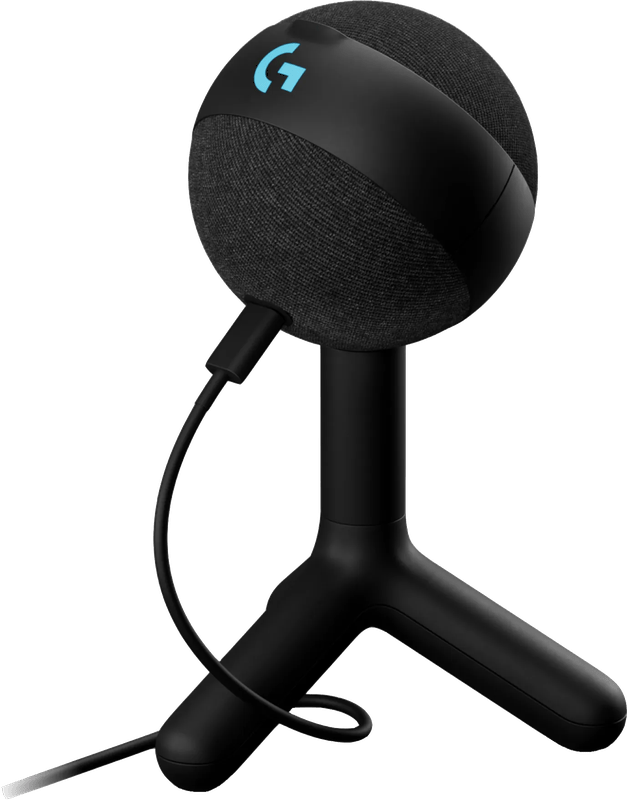
The sphere is the most affordable microphone in this comparison and costs a fraction of the others. Condenser capsule, cardioid, 24-bit at 48 kHz, plus Blue VO!CE via G HUB. Logitech does not list a headphone output. Discord and your first stream work fine with it; if you want more, you will soon be buying again.
Which microphone suits which desk
- Regular streams with several audio sources: Elgato Wave:3 MK.2, on an arm and with headphones plugged into the microphone.
- Mechanical keyboard, noisy room: Shure MV6 Gen 2 or Logitech G Yeti GX. A dynamic microphone close to the mouth picks up far less keyboard noise than a condenser microphone.
- Quiet room, also music or recordings on a smartphone: RØDE NT-USB+.
- Two people at one microphone: HyperX QuadCast 2 S with figure-eight or omnidirectional, on a PC or Mac.
- Small budget: Logitech G Yeti Orb. The next money is better spent on an arm than on a more expensive microphone.
Without decent headphones, the microphone is only half the story. For streaming, a closed-back model from our guide to studio headphones is a good fit. Prefer everything in one? Then our gaming headsets guide will help.
How a dynamic USB microphone sounds in a direct comparison with a studio condenser is shown in our review of the RØDE PodMic USB.
Frequently asked questions
Dynamic or condenser microphone for streaming?
Dynamic capsules are less sensitive and pick up less of the keyboard and the room, but you have to get close, about a hand's width away. Condenser microphones pick up keystrokes more easily. With a mechanical keyboard and a noisy room, the Shure MV6 Gen 2 or the Logitech G Yeti GX are therefore the better fit.
Which polar pattern does a streaming microphone need?
For a single person, cardioid or supercardioid, which pick up mainly from the front. You only need omnidirectional and figure-eight when two people share one microphone. The HyperX QuadCast 2 S offers four patterns and suits duo streams on a PC or Mac.
What is a headphone output on the microphone for?
It lets you hear your own voice without delay, and once you have set it up, you speak more evenly. Software with separate mixes helps when game audio, music and chat should be at different volumes. According to Elgato, Wave Link splits game, browser and chat across up to five mixes.
Do I need a boom arm for a USB microphone?
Almost always. An arm brings the capsule close to your mouth and away from the desktop, through which typing noise travels as structure-borne sound. Pay attention to the thread: boom arms usually have 5/8 inch, many desk stands 1/4 inch. On a small budget, the next money is better spent on an arm than on a more expensive microphone.
What helps against distortion when you shout?
A limiter or a technology such as Elgato's Clipguard, which catches the shout before it distorts. According to Elgato, Clipguard 2.0 works with three converters of different sensitivity at the same time. On the Logitech G Yeti GX, Smart Audio Lock combines an analog limiter with an expander.
Sources
- Elgato: Wave:3 MK.2
- Elgato: What is Clipguard 2.0?
- RØDE: NT-USB+
- HyperX: QuadCast 2 S
- Shure: MV6 Gen 2
- Logitech G: Yeti GX
- Logitech G: Yeti 2
- Logitech G: Yeti Orb
Where to buy
- Elgato Wave:3 MK.2View at CoolblueAvailable in Germany: CoolblueCheck price at Amazon.deAvailable in Germany: Amazon.de
- RØDE NT-USB+View at CoolblueAvailable in Germany: CoolblueCheck price at Amazon.deAvailable in Germany: Amazon.de
- HyperX QuadCast 2 SView at CoolblueAvailable in Germany: CoolblueCheck price at Amazon.deAvailable in Germany: Amazon.de
- Shure MV6 Gen 2Check price at Amazon.deAvailable in Germany: Amazon.de
- Logitech G Yeti GXView at CoolblueAvailable in Germany: CoolblueCheck price at Amazon.deAvailable in Germany: Amazon.de
- Logitech G Yeti 2Check price at Amazon.deAvailable in Germany: Amazon.de
- Logitech G Yeti OrbView at CoolblueAvailable in Germany: CoolblueCheck price at Amazon.deAvailable in Germany: Amazon.de