Contents14 sections
This guide was first published in German on handgetestet.de.
For spare parts, figurines and housings up to roughly shoebox size, we currently recommend the Revopoint INSPIRE 2. If you want to capture larger things, from a garden chair to a fender, you are better served by the Creality Otter Lite. And if you want to scan without a laptop at all, you end up with the Einstar Vega from Shining 3D.
Many buyers start with the wrong question. They compare hundredths of a millimeter, even though their actual problem is a shiny black knob on which the scanner simply cannot find any points. Settle object size and surface first. Then the numbers.
How accurate does a 3D scanner really need to be?
Spec sheets often list three different values, and they do not mean the same thing. Precision tells you how much several measurements of the same spot vary. Accuracy describes how far the result deviates from the true dimension. For the INSPIRE 2, Revopoint puts the single-frame precision at up to 0.03 mm and the accuracy at up to 0.05 mm. According to the manufacturer, both values come from the lab.
For longer parts, volumetric accuracy is the more honest figure. Revopoint specifies it as 0.05 mm plus 0.1 mm per meter of object length, measured with markers. For a 30-centimeter housing, that works out to 0.08 mm. That is enough for almost any DIY project, because a filament printer with the usual 0.4 mm nozzle cannot reproduce such fine detail anyway. It is a different story for miniatures and jewelry destined for a resin printer. There, every detail counts.
Be careful with figures for point spacing. It only describes how densely the measuring points are placed, not how dimensionally accurate the model will be. For the Einstar Vega, Shining 3D advertises 0.05 mm; that is the smallest point spacing in HD mode.
Handheld scanning or turntable?
Both, usually. Small parts under about ten centimeters go on a turntable while the scanner stays on its tripod. That keeps the distance constant, and the software loses its orientation less often. The POP 3 Plus comes with a tripod and a small turntable in the standard edition; according to the manual, the Advanced and Premium packages include a dual-axis turntable and a power bank.
For a motorcycle fairing, no turntable will help. Here, the working distance is what matters. The POP 3 Plus works between 15 and 40 centimeters and captures at most 244 × 180 mm per frame. According to Creality, the Otter Lite manages a distance of up to 1.2 meters with a field of 1,460 × 1,017 mm. If you sweep a car door with it, you need considerably fewer frames.
What helps with black and shiny surfaces?
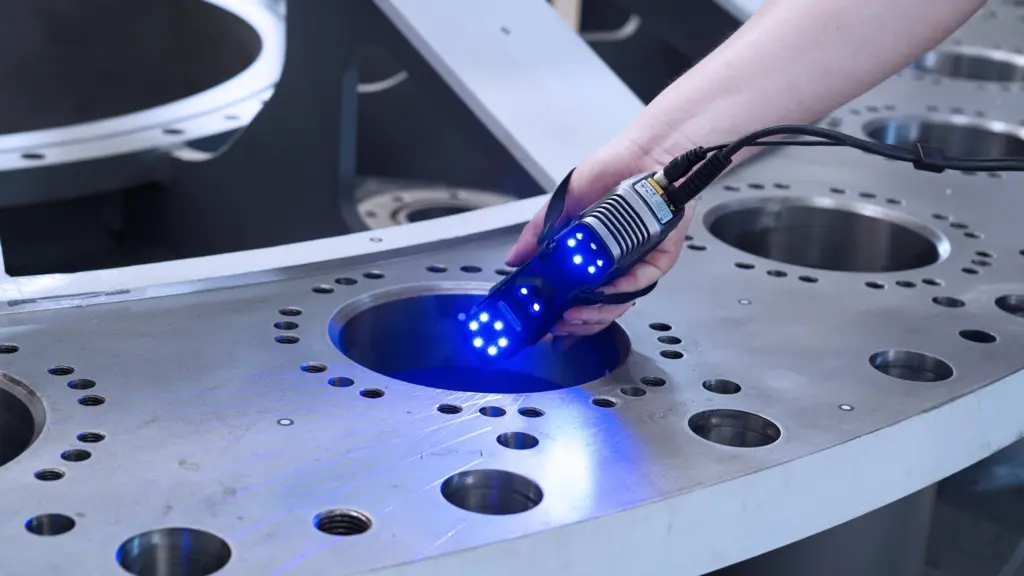
Classic infrared structured light struggles with dark plastic and polished metal. Laser lines handle them better, which is why the INSPIRE 2 (eleven infrared laser lines) and the Creality Raptor (seven blue laser lines) combine both methods. If there are still gaps, adhesive markers or a matting scanning spray help.
Outdoors, things get tricky. Revopoint specifies up to 20,000 lux for the INSPIRE 2 but advises against direct sunlight. Shining 3D, by contrast, explicitly advertises stable scanning in sunlight for the Einstar Vega.
What software do I need?
Every manufacturer supplies its own scanning software: Revo Scan from Revopoint, CrealityScan from Creality, StarVision from Shining 3D. They stitch the individual frames together and export STL, OBJ or PLY for the slicer. A scan, however, is a triangle mesh and not a CAD model with clean holes. If you want to continue designing with the parts, you need reverse engineering into surfaces. Creality sells QuickSurface Lite separately for this as an annual license.
The computer is underestimated. Revopoint specifies the laser mode of the INSPIRE 2 at 90 frames per second on a graphics card, and at 40 on the processor alone.
Is the light safe for the eyes?
Revopoint classifies the light source of the POP 3 Plus and INSPIRE 2 as Class 1 and still recommends not looking directly into it for extended periods. Because of the flashing lights, the devices may be unsuitable for people with photosensitive epilepsy. Creality states Class I for the Otter Lite, and Shining 3D likewise states Class I for the Vega’s light source. Creality does not state a laser class for the Raptor online. Here, read the manual before the first scan.
6 3D scanners at a glance
Revopoint POP 3 Plus
A compact scanner with two depth cameras and infrared structured light that connects to a PC, Mac or smartphone via USB-C or Wi-Fi. Revopoint gives the smallest object size as 20 × 20 × 20 mm. Its strength is on the desk. For dark or shiny parts, it lacks the laser lines of the INSPIRE 2.
Revopoint INSPIRE 2
Two measuring methods in a housing weighing just 190 grams. The structured light works without markers and, according to Revopoint, is also suitable for body scans, while the laser lines take care of difficult surfaces. Outdoors, the working distance shrinks to 150 to 250 mm. For household spare parts, this is our first choice.
Creality Otter Lite
The Otter Lite transmits via Wi-Fi 6 to a handle with a built-in battery that, according to Creality, lasts around three hours. At 0.05 mm at a 100 mm distance, it is somewhat coarser than the larger model. If you want to scan furniture, bike frames or fenders, you gain more from the range than you lose in detail.
Creality Otter
According to Creality, the Otter captures objects from as small as 10 mm and, at up to 0.02 mm at a 60 mm distance, is finer than the Lite. In return, it weighs 390 instead of 300 grams. It only becomes cordless with separate wireless accessories.
Creality CR-Scan Raptor
With blue laser lines, the Raptor targets technical components where edges and holes matter. Creality specifies up to 0.02 mm and a weight of about 372 grams.
Shining 3D Einstar Vega
The Vega is more of a tablet with a scanning head. A 6.4-inch screen, 32 GB of RAM and a 512 GB SSD are built into the device, and according to the manufacturer the battery lasts 1.5 to 2 hours. In HD mode it works between 100 and 350 mm, in Fast mode up to 1.5 meters. At over half a kilo, it is noticeably heavier than the other devices here.
Professional devices such as the Artec Eva play in a different league. Artec specifies 0.1 mm accuracy and a weight of 0.9 kg and targets industry, medicine and research. For hobby and workshop use, that is simply not necessary.
How we would decide
- Spare parts, brackets, figurines up to shoebox size: Revopoint INSPIRE 2.
- Pure desk work with small, light-colored parts on the turntable: Revopoint POP 3 Plus.
- Furniture, vehicle parts, large sculptures: Creality Otter Lite; if you need more detail and can work with a cable, the Otter.
- Technical parts with sharp edges and holes: Creality CR-Scan Raptor.
- On the go without a computer: Shining 3D Einstar Vega.
Frequently asked questions
How accurate does a 3D scanner need to be for 3D printing?
Less accurate than many spec sheets suggest. For the INSPIRE 2, Revopoint specifies a volumetric accuracy of 0.05 mm plus 0.1 mm per meter, which works out to 0.08 mm for a 30-centimeter housing. A filament printer with a 0.4 mm nozzle cannot reproduce such fine detail anyway. For miniatures and jewelry for a resin printer, on the other hand, every detail counts.
What is the difference between precision and accuracy in a 3D scanner?
Precision tells you how much several measurements of the same spot vary. Accuracy describes how far the result deviates from the true dimension. Point spacing, in turn, only indicates how densely the measuring points are placed, not how dimensionally accurate the model will be. For longer parts, volumetric accuracy is more meaningful.
What helps when scanning black or shiny parts?
Infrared structured light struggles with dark plastic and polished metal; laser lines handle them better. That is why the Revopoint INSPIRE 2 and the Creality CR-Scan Raptor combine both methods. If the scan still has gaps, adhesive markers or a matting scanning spray help.
Do I need a turntable for small parts?
For parts under about ten centimeters, it helps: the scanner sits on the tripod, the distance stays constant and the software loses its orientation less often. The Revopoint POP 3 Plus comes with a tripod and a small turntable in the standard edition. For large objects such as a motorcycle fairing, on the other hand, the working distance is what matters.
What software do you need for a 3D scanner?
Every manufacturer supplies its own scanning software, such as Revo Scan, CrealityScan or StarVision. It stitches the individual frames together and exports STL, OBJ or PLY for the slicer. A scan, however, remains a triangle mesh and not a CAD model. For further design work, you need reverse engineering into surfaces; Creality sells QuickSurface Lite separately for this.
Is the light from a 3D scanner safe for the eyes?
Revopoint classifies the light source of the POP 3 Plus and INSPIRE 2 as Class 1 but recommends not looking directly into it for extended periods. Because of the flashing lights, the devices may be unsuitable for people with photosensitive epilepsy. Creality does not state a laser class for the Raptor online, so read the manual before the first scan.
Sources
- Revopoint: INSPIRE 2 data sheet
- Revopoint: POP 3 Plus data sheet
- Revopoint: POP 3 Plus quick start guide (Polish version)
- Creality: Otter Lite with comparison to the Otter
- Creality: 3D scanner comparison 2026
- Creality: CR-Scan Raptor
- Shining 3D: Einstar Vega
- Shining 3D: Einstar Vega specifications
- Artec 3D: Eva data sheet
Where to buy
- Revopoint INSPIRE 2 (Standard, mit Scan-Spray)Check price at Amazon.deCheck price at Amazon.co.ukCheck price at Amazon.nlCheck price at Amazon.com.beCheck price at Amazon.frCheck price at Amazon.itCheck price at Amazon.esCheck price at Amazon.plCheck price at Amazon.seAvailable in Germany: Amazon.de
- Revopoint POP 3 PlusCheck price at Amazon.deCheck price at Amazon.co.ukCheck price at Amazon.nlCheck price at Amazon.com.beCheck price at Amazon.frCheck price at Amazon.itCheck price at Amazon.esCheck price at Amazon.plCheck price at Amazon.seAvailable in Germany: Amazon.de
- Creality Otter LiteCheck price at Amazon.deCheck price at Amazon.co.ukCheck price at Amazon.nlCheck price at Amazon.com.beCheck price at Amazon.frCheck price at Amazon.itCheck price at Amazon.esCheck price at Amazon.plCheck price at Amazon.seAvailable in Germany: Amazon.de
- Creality OtterCheck price at Amazon.deCheck price at Amazon.co.ukCheck price at Amazon.nlCheck price at Amazon.com.beCheck price at Amazon.frCheck price at Amazon.itCheck price at Amazon.esCheck price at Amazon.plCheck price at Amazon.seAvailable in Germany: Amazon.de
- Creality CR-Scan RaptorCheck price at Amazon.deCheck price at Amazon.co.ukCheck price at Amazon.nlCheck price at Amazon.com.beCheck price at Amazon.frCheck price at Amazon.itCheck price at Amazon.esCheck price at Amazon.plCheck price at Amazon.seAvailable in Germany: Amazon.de
- Shining 3D Einstar VegaCheck price at Amazon.deCheck price at Amazon.co.ukCheck price at Amazon.nlCheck price at Amazon.com.beCheck price at Amazon.frCheck price at Amazon.itCheck price at Amazon.esCheck price at Amazon.plCheck price at Amazon.seAvailable in Germany: Amazon.de
Still undecided?
Keep comparing at your own pace – every article in this category is checked monthly for new and discontinued models.