Contents11 sections
This guide was first published in German on handgetestet.de.
Am I even allowed to ride this thing? That question belongs at the start, because many e-scooters offered cheaply online are not allowed on the road in Germany at all. Only buy a model that is expressly approved for Germany, usually recognizable by the suffix „D“ or „DE“ in the name. It needs an operating permit under the eKFV and a valid insurance plate. For short trips around town, a lightweight scooter with front suspension is then enough. If you ride over cobblestones and long distances, you need large pneumatic tires, front and rear suspension and a bigger battery.
Which papers does an e-scooter need in Germany?
Legally, e-scooters are small electric vehicles, governed by the German Small Electric Vehicles Ordinance (eKFV). According to the German Federal Ministry of Transport and the German Insurance Association (GDV), a scooter needs a general operating permit (Allgemeine Betriebserlaubnis, ABE) or an individual operating permit. An EC declaration of conformity does not replace it. This is exactly the hurdle where many cheap imported scooters fail: no ABE, so no place on public roads.
On the technical side, the ordinance sets tight limits, namely a design-limited maximum of 20 km/h and no more than 500 watts of continuous rated power. Peak power may be higher. There are minimum requirements for brakes, lights, riding dynamics and electrical safety.
Liability insurance is mandatory. Proof comes in the form of a small adhesive plate, valid from March 1 to the end of February of the following year. Since March 1, 2026, it has been black. If you ride with an expired plate, you are not insured.
You may ride from age 14, without a driver’s license. Bike paths and bike lanes are mandatory where they exist, otherwise the road. Sidewalks are off-limits unless they are expressly approved. Passengers are prohibited. The 0.5 per mille blood alcohol limit applies, and zero for new drivers and anyone under 21. What applies to younger children and which scooters suit teenagers is covered in our guide E-scooters for children and teenagers.
Do I need to watch out for anything because of the 2027 reform?
On December 19, 2025, the German Bundesrat approved a reform of the eKFV. From 2027, newly approved e-scooters must have turn signals, plus stricter requirements for battery safety and riding dynamics. On March 1, 2027, the rules of conduct move into the German Road Traffic Regulations (Straßenverkehrs-Ordnung). If you already own a scooter with an ABE, you may keep riding it and do not need to retrofit anything, according to the German Federal Ministry of Transport. For a new purchase, we see things differently. We would no longer choose a model without built-in turn signals today.
How do the models really differ?
First, the version trap. Many models also come as an EU version with 25 km/h, and that one is not approved in Germany. So look for „D“ or „DE“ in the name and for the ABE in the box.
Manufacturers measure range under ideal conditions, usually with a rider weight of 75 kg, 25 °C and a moderate speed. In the cold, on inclines and with more weight, it drops considerably. A more honest comparison uses battery capacity in watt-hours (Wh). And plan generously.
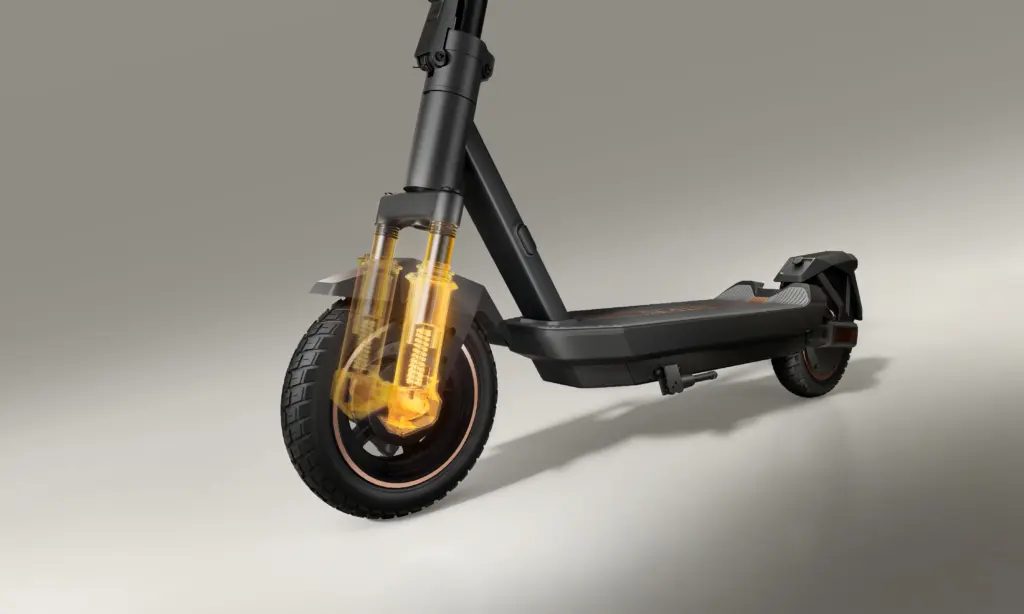
Large pneumatic tires from 10 inches already absorb many bumps, and a front suspension fork helps on paving. Front and rear suspension brings the most comfort but makes the scooter heavier. Weight? No side issue. If you have to carry the scooter onto buses or trains or up a stairwell, stay under 22 kg; models with a large battery often weigh 25 kg or more.
When it comes to brakes, disc brakes usually modulate more finely than drum brakes. Built-in turn signals are safer than hand signals, especially when you have to take a hand off the handlebar to give them.
Which road-legal scooters are worth considering?
NIU KQi 300P: the lightweight
Of our five candidates, this is the lightest. NIU cites a hydraulic dual-tube suspension fork with 45 mm of travel, disc brakes front and rear, 450 watts of rated power and turn signals. The tubeless tires measure 10.5 inches. Order the German version with 20 km/h.
VMAX VX2 Gear: suspension at both ends
VMAX combines an oil-pressure suspension fork at the front with elastomer suspension at the rear. Turn signals sit at the front and rear, and the payload is 130 kg. According to VMAX, only the 20 km/h version is approved in Germany, not the 25 km/h version. How far you get depends on the battery variant you choose.
Segway-Ninebot MAX G2 D: for longer commutes
Segway cites a 551 Wh battery, hydraulic front suspension and rear suspension, as well as built-in turn signals. The 10-inch tires are tubeless and have a gel layer against punctures. Segway does skimp on the brakes, though: a drum brake at the front, an electronic brake at the rear.
Egret X ultra: the biggest battery
The Hamburg-based company relies on large 12.5-inch pneumatic tires and the biggest battery in the comparison. Only the front is suspended, with 20 mm of travel. Egret cites a disc brake, turn signals front and rear and a 130 kg payload. You will need patience when charging; the manufacturer states around nine hours.
Xiaomi Electric Scooter 6 Pro: heavy but comfortable
Xiaomi equips the 6 Pro with 12-inch tires for uneven paths. At the front, a dual spring with 40 mm of travel does the work, at the rear a central spring damper, and a disc brake brakes the front wheel. At 27.3 kg, it is the heaviest scooter here. It is hardly suitable for carrying.
So which one suits my route?
- Buses, trains, stairs: NIU KQi 300P, light, with front suspension and two disc brakes.
- Daily commuting with hills: VMAX VX2 Gear or Segway-Ninebot MAX G2 D, both with front and rear suspension and turn signals.
- Cobblestones and dirt tracks: Xiaomi Electric Scooter 6 Pro with 12-inch tires or Egret X ultra with 12.5 inches.
The same applies to every model: get the insurance plate before your first ride and renew it every year on March 1.
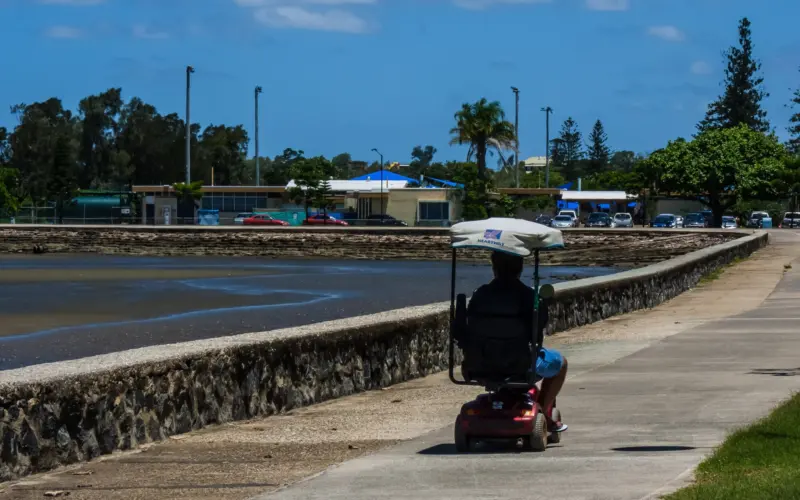
What 6 and 15 km/h mean for health insurance coverage and insurance is covered in our guide to the mobility scooter for seniors.
Frequently asked questions
Which papers does an e-scooter need in Germany?
You need a general operating permit or an individual operating permit under the German Small Electric Vehicles Ordinance (eKFV). An EC declaration of conformity does not replace it. On top of that comes liability insurance, proven by a sticker that is valid from March 1 to the end of February. With an expired sticker, you are not insured.
Why is the EU version with 25 km/h not allowed in Germany?
The ordinance limits e-scooters by design to a maximum of 20 km/h and 500 watts of continuous rated power. Many models also come as an EU version with 25 km/h, which has no approval here. When buying, look for the suffix D or DE in the name and the ABE in the box.
What changes with the eKFV reform from 2027?
From 2027, newly approved e-scooters must have turn signals, plus stricter requirements for battery safety and riding dynamics. If you already own a scooter with an ABE, you may keep riding it and do not need to retrofit anything, according to the German Federal Ministry of Transport. For a new purchase, this guide recommends a model with built-in turn signals.
How realistic are the range figures?
Manufacturers measure under ideal conditions, usually with a rider weight of 75 kg, 25 °C and a moderate speed. Cold, inclines and more weight reduce the range considerably. A more honest comparison uses battery capacity in watt-hours, and you should plan generously.
How heavy can an e-scooter be if you need to carry it?
If you carry the scooter onto buses or trains or up stairwells, stay under 22 kg. The NIU KQi 300P weighs 20.9 kg and is the lightest in the comparison. Models with a large battery often weigh 25 kg or more; the Xiaomi Electric Scooter 6 Pro comes to 27.3 kg.
Who may ride e-scooters, and where?
You may ride from age 14 without a driver's license. Bike paths and bike lanes are mandatory where they exist, otherwise the road. Sidewalks are only allowed if they are expressly approved, and passengers are prohibited. The 0.5 per mille blood alcohol limit applies, and zero for new drivers and anyone under 21.
Sources
- German Federal Ministry of Transport: Questions and answers on the eKFV
- German Federal Government: Rules for e-scooters tightened
- GDV: Insurance plates
- NIU: KQi 300
- NIU Shop: KQi 300P
- VMAX: VX2 Gear
- Segway-Ninebot: MAX G2 D
- Egret: X series
- Xiaomi: Electric Scooter 6 Pro
Where to buy
- NIU KQi 300PCheck price at Amazon.deCheck price at Amazon.co.ukCheck price at Amazon.nlAvailable in Germany: Amazon.deCheck price at Amazon.itCheck price at Amazon.es
- VMAX VX2 GearCheck price at Amazon.deAvailable in Germany: Amazon.de
- Segway-Ninebot MAX G2 DCheck price at Amazon.deAvailable in Germany: Amazon.deCheck price at Amazon.com.beCheck price at Amazon.frCheck price at Amazon.it
- Egret X ultraCheck price at Amazon.deCheck price at Amazon.co.ukCheck price at Amazon.nlCheck price at Amazon.com.beCheck price at Amazon.frCheck price at Amazon.itCheck price at Amazon.esCheck price at Amazon.plCheck price at Amazon.seAvailable in Germany: Amazon.de
- Xiaomi Electric Scooter 6 ProCheck price at Amazon.deCheck price at Amazon.co.ukCheck price at Amazon.nlCheck price at Amazon.com.beCheck price at Amazon.frCheck price at Amazon.itCheck price at Amazon.esCheck price at Amazon.plCheck price at Amazon.seAvailable in Germany: Amazon.de
- EVERCROSS EV10S MAX ABEView at EvercrossAvailable in Germany: Evercross
Still undecided?
Keep comparing at your own pace – every article in this category is checked monthly for new and discontinued models.