Contents10 sections
This guide was first published in German on handgetestet.de.
Anyone buying an electric citrus juicer usually looks at the wattage first. Yet something else decides whether the appliance is still on the counter after three weeks: how quickly it can be taken apart and washed after breakfast. For households that juice two to four glasses in the morning, we consider the compact Bosch VitaPress MCP3500N the most sensible choice. It has a pulp control, a 0.8-liter container and dishwasher-safe parts. If you go through a kilo of oranges or more every day, take a look at the Advanced Pro S lever press from Gastroback.
Cone with hand pressure or cone with a lever?
All appliances in this guide work with a rotating reamer cone. The difference lies in who does the pressing. With the simple design, you hold the orange half on the cone by hand; the motor starts under the pressure and stops as soon as you let go. That is compact and easy to store.
A lever press takes over this part for you. An arm with a pressure dome lowers onto the fruit and presses it evenly onto the cone. Gastroback credits this pressing arm on the Advanced Pro S with optimal juice yield, a claim made by the manufacturer. Our assessment is more sober. The lever is mainly worth the space when ten or fifteen fruits are to go through in one session, because then your wrist does not tire. For two oranges in the morning, it is a luxury. At around 46 cm tall and just under 3 kg, this appliance also will not fit in any wall cabinet.
Pulp, rotation, wattage: what the specs reveal
Pulp is a matter of taste. Some like their juice thick, others as smooth as from the carton. A control in the strainer changes the openings the juice runs through and holds back more or less fiber. On the VitaPress, Bosch calls this PulpControl. Gastroback solves it differently and includes two stainless steel strainer inserts with the Advanced Pro S, one for juice with pulp and one without. For the Braun CJ 3050, Smeg CJF11 and Bosch VitaStyle Citro, the manufacturers do not mention a pulp control.
Next point: the direction of rotation. Both Bosch models turn the cone alternately left and right, which according to the manufacturer increases the yield. Smeg specifies a counterclockwise cone for the CJF11.
And the power? It ranges from 25 W for the VitaPress to 100 W for the Gastroback. More watts do not automatically mean more juice. How much comes out of the fruit also depends on the shape of the cone, the pressure and how ripe the orange is. We would therefore never make wattage the first criterion.
Directly into the glass or into a container
This is where the appliances differ most clearly in everyday use. Braun, Smeg and Gastroback send the juice directly into the glass. On the Smeg, a flap on the spout stops drips, and Braun mentions an anti-drip system. If you are juicing a glass just for yourself, that saves you washing a container. Bosch relies on a collecting container with a scale (VitaPress, 0.8 l) or a 1-liter glass carafe (VitaStyle Citro) that can go into the fridge with its lid. That suits families who juice once and pour several times.
Even so, the juice should not stand for long. The German consumer testing organization Stiftung Warentest points out that vitamin C is broken down by long storage, light and heat. According to its figures, freshly squeezed orange juice contains about 400 to 500 mg of vitamin C per liter.
Bosch VitaPress MCP3500N
The smallest juicer in the selection, at 0.9 kg and 20 cm tall. Bosch lists a universal cone for small and large fruit, PulpControl for the amount of pulp, cord storage and a dust cover. According to the data sheet, the parts are dishwasher-safe. At 25 W, it is no powerhouse. For breakfast quantities, we consider that sufficient; for a weekend supply of juice, less so.
Bosch VitaStyle Citro MCP72GPB
Here the juice flows into a 1,000 ml glass carafe that goes into the fridge with its lid. For a lime to season a dish, you can juice without the carafe. Bosch specifies 40 W, left and right rotation and DripStop. According to the manufacturer, the carafe, strainer, cone, base, dust cover and collecting container can go in the dishwasher. Glass is heavier than plastic; the appliance weighs 1.4 kg.
Braun TributeCollection CJ 3050
Braun keeps it simple. Pressing down the fruit starts the 60 W motor, letting go stops the cone. The juice runs directly into the glass, and an anti-drip system is meant to keep the counter clean. The housing is plastic, and a protective lid is included. Braun does not mention a pulp control for this model.
Smeg CJF11
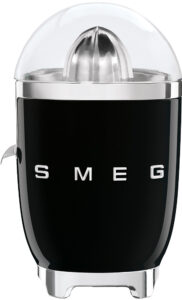
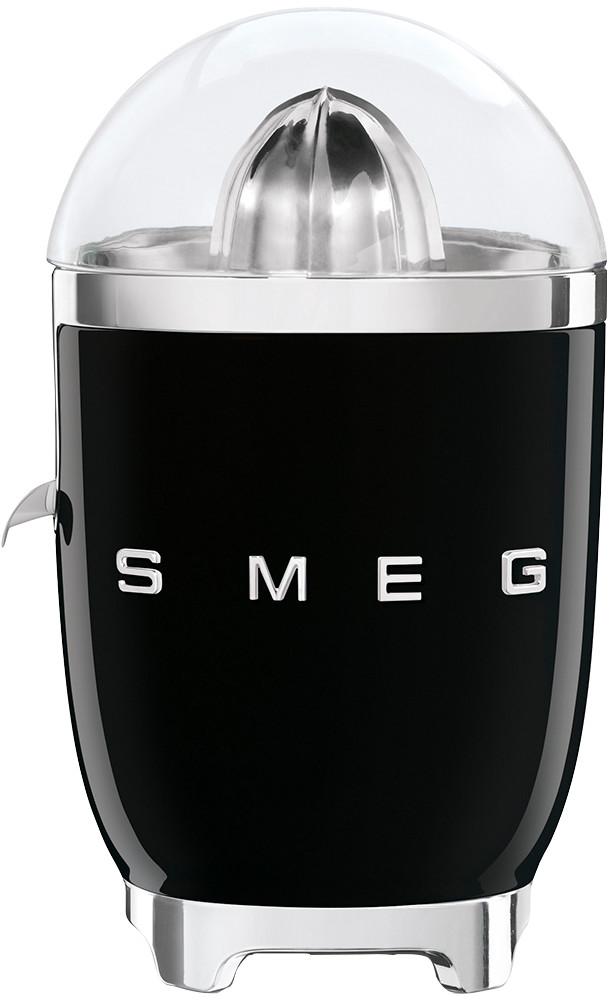
An appliance for the open-plan kitchen. The cone, filter strainer and spout are stainless steel, the juice chamber is Tritan Renew, and the spout has a flap to stop drips. Smeg specifies 70 W, non-slip feet and cord storage in the base. At 2.56 kg it stands firmly, but you will not want to carry it back and forth. The product page does not say whether all parts are dishwasher-safe. We would check the manual before buying.
Gastroback Advanced Pro S 41150
The only lever press here. The housing is brushed die-cast aluminum, the motor has 100 W, and two stainless steel strainers regulate the pulp. According to Gastroback, the attachments are dishwasher-safe. At about 19 × 24.5 × 46.5 cm, it needs a permanent spot under a high shelf. If you only use it on weekends, you are wasting its advantage.
How we would decide
- Two to four glasses in the morning, little space: Bosch VitaPress MCP3500N.
- Juice for the family table, ideally made in advance: Bosch VitaStyle Citro with glass carafe.
- One glass for yourself, without a container to wash: Braun CJ 3050.
- The appliance stays out in view and should last a long time: Smeg CJF11 with stainless steel cone.
- A bag of oranges every day, or a small café at home: Gastroback Advanced Pro S.
If you also want to turn apples, carrots or ginger into juice, no citrus juicer will help. For that you need a juicer; the difference between a centrifugal juicer and a slow juicer is explained in our juicer guide (in German). For smoothies with whole fruit, a countertop blender is the better choice.
Frequently asked questions
Is a lever press worth it for orange juice?
Mainly when ten or fifteen fruits go through in one session, because then your wrist does not tire. For two oranges in the morning, the lever is a luxury. The Gastroback Advanced Pro S is also around 46 cm tall and will not fit in any wall cabinet.
Does more wattage mean more juice?
Not automatically. Power ranges from 25 W for the Bosch VitaPress to 100 W for the Gastroback. How much comes out of the fruit also depends on the shape of the cone, the pressure and how ripe the orange is. Wattage should therefore not be the first criterion.
How can you adjust the amount of pulp?
A control in the strainer changes the openings and holds back more or less fiber; at Bosch, this is called PulpControl. Gastroback includes two stainless steel strainers with the Advanced Pro S, with and without pulp. For the Braun CJ 3050, Smeg CJF11 and Bosch VitaStyle Citro, the manufacturers do not mention a pulp control.
Juice directly into the glass or into a container?
Braun, Smeg and Gastroback send the juice directly into the glass, which saves washing a container when you make a single glass. Bosch uses a container with a scale or a 1-liter glass carafe with a lid. That suits families who juice once and pour several times.
How long does freshly squeezed orange juice keep its vitamin C?
It should not stand for long. The German consumer testing organization Stiftung Warentest points out that vitamin C is broken down by long storage, light and heat. According to its figures, freshly squeezed orange juice contains about 400 to 500 mg of vitamin C per liter.
Can I also juice apples or carrots with a citrus juicer?
No, a citrus juicer will not help with that. Apples, carrots or ginger need a juicer, meaning a centrifugal juicer or a slow juicer. For smoothies with whole fruit, a countertop blender is the better choice.
Sources
- Bosch: VitaPress MCP3500N data sheet
- Bosch: VitaStyle Citro MCP72GPB data sheet
- Braun Household: CJ 3050 citrus juicer
- Smeg: CJF11 citrus juicer
- Gastroback: Citrus Juicer Advanced Pro S 41150
- Stiftung Warentest: Orange juice tested (10/26/2023)
Where to buy
- Bosch VitaPress MCP3500NCheck price at Amazon.deCheck price at Amazon.co.ukCheck price at Amazon.nlCheck price at Amazon.com.beCheck price at Amazon.frCheck price at Amazon.itCheck price at Amazon.esCheck price at Amazon.plCheck price at Amazon.seAvailable in Germany: Amazon.de
- Bosch VitaStyle Citro MCP72GPBCheck price at Amazon.deCheck price at Amazon.co.ukCheck price at Amazon.nlCheck price at Amazon.com.beCheck price at Amazon.frCheck price at Amazon.itCheck price at Amazon.esCheck price at Amazon.plCheck price at Amazon.seAvailable in Germany: Amazon.de
- Braun TributeCollection CJ 3050 (weiß)Check price at Amazon.deCheck price at Amazon.co.ukCheck price at Amazon.nlCheck price at Amazon.com.beCheck price at Amazon.frCheck price at Amazon.itCheck price at Amazon.esCheck price at Amazon.plCheck price at Amazon.seAvailable in Germany: Amazon.de
- Smeg CJF11 (schwarz)Check price at Amazon.deCheck price at Amazon.co.ukCheck price at Amazon.nlCheck price at Amazon.com.beCheck price at Amazon.frCheck price at Amazon.itCheck price at Amazon.esCheck price at Amazon.plCheck price at Amazon.seAvailable in Germany: Amazon.de
- Gastroback Advanced Pro S 41150Check price at Amazon.deCheck price at Amazon.co.ukCheck price at Amazon.nlCheck price at Amazon.com.beCheck price at Amazon.frCheck price at Amazon.itCheck price at Amazon.esCheck price at Amazon.plCheck price at Amazon.seAvailable in Germany: Amazon.de
Still undecided?
Keep comparing at your own pace – every article in this category is checked monthly for new and discontinued models.