Contents15 sections
This guide was first published in German on handgetestet.de.
In January, the display shows fewer kilometers in the morning than in summer, and a second battery is already in the shopping cart. Often unnecessarily. Frequently, there is no real capacity problem behind it at all. Only buy a replacement once your dealer has measured a loss of capacity, and then only the original part for your system.
How far can you go on 500, 625 or 800 Wh?
Watt-hours are the size of the tank. How fast it empties is up to you. Bosch itself gives an enormous range, from under 50 kilometers per charge to around 170. A calculation example from the manufacturer shows how much the assist level alone matters: according to Bosch, a cargo bike with 1,600 Wh manages about 80 miles in Turbo and about 183 in Eco. Converted, that is a good 12 Wh per kilometer versus a good 5.
That gives a rough rule of thumb. A 500 Wh battery takes you 90 kilometers and more when riding economically, and more like 40 in Turbo. For your own riding profile, the range estimate in the e-bike configurator (in German) works through the factors.
The assist level has the biggest impact: set it higher and the distance gets shorter, all else being equal. Climbs, headwind and rough surfaces also cost a lot. Bosch additionally mentions tire pressure and cadence, considering roughly 60 to 90 revolutions per minute favorable. Rider, bike and luggage all add up. And in the cold, internal resistance rises and performance temporarily drops.
How long does a battery last?
The manufacturers answer this very differently. For its STEPS batteries, Shimano states that more than 60 percent of the capacity remains after 1,000 full charge cycles. Bosch deliberately does not commit; the exact service life cannot be predicted, it says, but a specialist dealer can measure the remaining capacity with a diagnostic tool. In an older user manual, Yamaha writes that mileage drops by about 40 percent after three to four years.
According to Bosch, partial charging does no harm. You can top up at any time, even when the battery is half full.
Charging in everyday use, storing over the winter
Bosch advises keeping the charge level between 20 and 80 percent in everyday use where possible and only charging fully when you need the range. Charge between 0 and 40 °C, ideally at room temperature. Shimano additionally warns against constantly topping up in the range between 80 and 100 percent.
Over the winter, according to Bosch, the battery should be removed and stored at 30 to 60 percent, dry at 0 to 20 °C, ideally in a basement or garage. Shimano specifies around 70 percent. Yamaha talks about two to three segments on the display and recharging at least every three months. Never store it empty, never full. If you ride in winter, bring the battery into the warm overnight and only insert it shortly before you set off; that does more than a cover.
Fire safety, car, parcel, plane
An e-bike battery holds a lot of energy, along with flammable substances. Bosch itself points this out. Charge in a dry environment with a smoke detector and, if possible, not unattended or overnight. Store it in a ventilated place with a smoke detector and away from flammable material. According to Bosch, defective or old batteries should neither be repaired nor opened, because that defeats the protective circuits.
If the bike travels on a carrier on the car, Bosch recommends removing the battery where possible and putting it inside the car. What else matters with the carrier is covered in the guide to bike carriers.
On a plane, that is where it ends. According to the Luftfahrt-Bundesamt (German Federal Aviation Office), e-bikes with lithium batteries do not travel as sports or special baggage, but only as dangerous goods cargo. Shipping by parcel is also difficult, because the German national dangerous goods rules of Deutsche Post and DHL limit loose lithium-ion batteries to 100 Wh per battery. An e-bike battery is far above that. So clarify any shipment with your dealer or the manufacturer beforehand.
Dual batteries and range extenders only work if the frame allows it
At Bosch, two combined batteries are called DualBattery. According to Bosch, up to 1,600 Wh is possible in the Smart System, for example with two PowerPack 800 Frame batteries, and up to 1,250 Wh in the older System 2. This cannot simply be retrofitted at will. The bike manufacturer must have designed the frame for it, and that also applies to the small PowerMore 250 add-on battery with its reinforced mounting points.
A second battery to swap in is simpler. Commuters with a charger at the office, however, pay a lot for something the outlet at their desk handles just as well. We advise against third-party replica batteries: Bosch explicitly recommends original parts, and buyers of third-party batteries report a poor fit in the mount.
7 original batteries, chargers and accessories
| Model | System | Key data according to the manufacturer | Best for |
|---|---|---|---|
| Bosch PowerTube 800 | Bosch Smart System, in the frame | approx. 800 Wh, approx. 3.9 kg, horizontal or vertical | Touring and e-MTB with long daily distances |
| Bosch PowerPack 545 Frame | Bosch Smart System, on the frame | approx. 545 Wh, approx. 3.0 kg, DualBattery-capable | Trekking and city bikes with an externally mounted battery |
| Bosch PowerPack 500 Rack | Bosch, rear rack | approx. 500 Wh, approx. 2.8 kg | older Bosch bikes with a rack-mounted battery |
| Shimano STEPS BT-E8036 | Shimano, in the down tube | 630 Wh, 36 V, over 60 % after 1,000 cycles | E-MTBs and trekking bikes with a Shimano drive |
| Bosch 4A Charger (BPC3400) | Bosch Smart System | PowerTube 800 fully charged in approx. 6.9 h | Standard charger for home |
| Shimano STEPS EC-E6002 | Shimano STEPS | 42 V, 1.8 A, approx. 523 g, charging at 0 to 40 °C | second charger for the office |
| Neoprene battery cover | depending on battery shape | insulation against cold and dirt according to the seller | Winter commuters with long parking times |
Bosch PowerTube 800
Bosch does not make a frame battery any bigger. Bosch specifies about 3.9 kilograms. The battery only fits bikes designed for it and is offered for both horizontal and vertical installation.
Bosch PowerPack 545 Frame
This Smart System battery sits on the outside of the frame, with around 545 Wh at about three kilograms. According to Bosch, it is fully charged on the 4A charger in just under five hours.
Bosch PowerPack 500 Rack
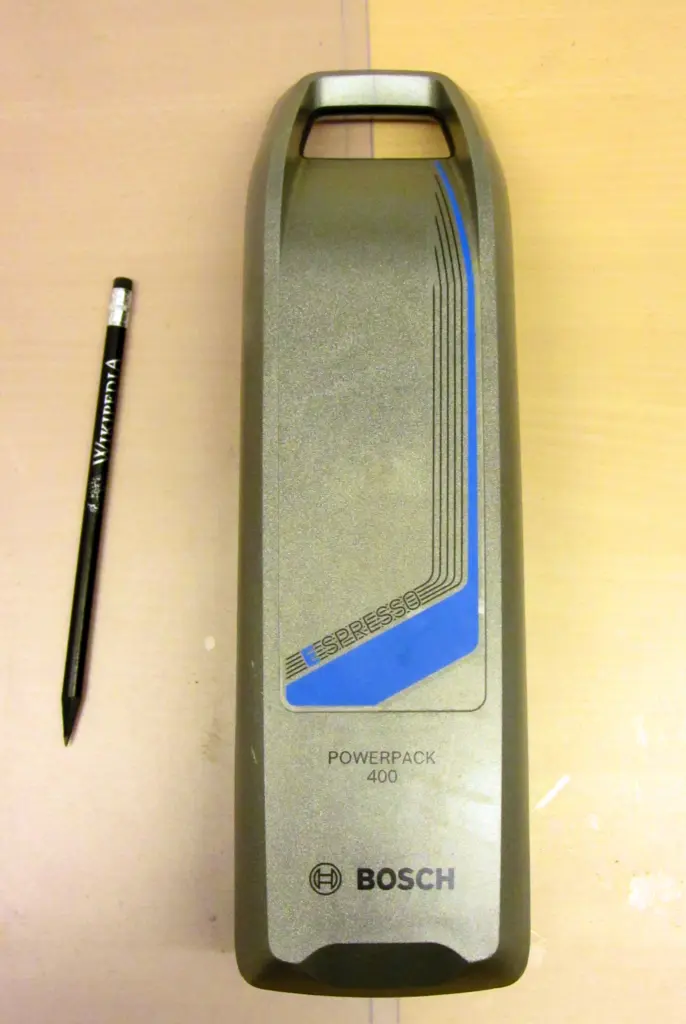
For many older trekking and city bikes, this rack-mounted battery with around 500 Wh is the right replacement. The frame and rack versions are not interchangeable. Because Bosch systems differ, compare the part number of your old battery first.
Shimano STEPS BT-E8036
Many e-mountain bikes with a Shimano motor carry this integrated 630 Wh battery. After 1,000 full cycles, Shimano promises more than 60 percent capacity remaining. Charging outside the bike requires an adapter.
Bosch 4A Charger
The standard charger for the Smart System, and exclusively for Smart System batteries. The smaller 2A unit weighs a little over 500 grams. It needs around 12 hours for the PowerTube 800.
Shimano STEPS EC-E6002
According to Shimano, this charger fits the BT-E8036 and fills an empty 630 Wh battery in around ten hours. Whether a power cable and adapter are included depends on the individual offer.
Neoprene battery cover
A cover retains heat. It does not generate any. It therefore makes sense for a battery prewarmed indoors on a long ride in freezing weather. Measure the battery carefully first, because according to buyer reports, universal covers turn out too short on long PowerTubes.
What we would buy in your place
If the range is enough in summer but not in winter, correct storage and inserting the battery warm help first, perhaps also a cover. A second battery does not. If you commute and can charge at the office, a second original charger is a better investment than a second battery.
For long tours, that leaves a swap battery in the same format or a factory-prepared DualBattery. If you notice a clear loss of capacity, have your dealer measure it and then buy an original replacement. In a camper, a power station can also charge the e-bike; more on this in the power station guide (in German). And if it is time for a whole new bike, the configurator with leasing calculator (in German) helps.
Mid-drive or rear hub, sensor and newton meters are compared in the guide to e-bike motors.
How many watt-hours a battery charge costs on the road is calculated in the guide Charging an e-bike with a power station (in German).
What accident data says about falls and how to get back on the bike is covered in the guide E-bikes for seniors (in German).
Frequently asked questions
How far can I go on a 500 Wh battery?
As a rough rule of thumb, a 500 Wh battery takes you 90 kilometers and more when riding economically, and more like 40 in Turbo. The assist level has the biggest impact, followed by climbs, headwind, surface, tire pressure, weight and cold.
How long does an e-bike battery last?
The manufacturers give different answers. Shimano states that more than 60 percent of the capacity remains after 1,000 full charge cycles. Bosch does not commit to a figure, but your specialist dealer can measure the remaining capacity. According to Bosch, partial charging does no harm.
How do I charge an e-bike battery correctly?
Bosch advises keeping the charge level between 20 and 80 percent in everyday use where possible and only charging fully when needed, at 0 to 40 degrees Celsius. Charge in a dry place with a smoke detector and, if possible, not unattended or overnight.
How do I store an e-bike battery over the winter?
According to Bosch, removed from the bike, at 30 to 60 percent charge, dry at 0 to 20 degrees Celsius, for example in a basement or garage, ventilated and away from anything flammable. Never store it empty and never full. Shimano specifies around 70 percent.
Can I retrofit a second battery or range extender?
Only if the bike manufacturer designed the frame for it; that applies to DualBattery as well as to the PowerMore 250. A second battery to swap in is simpler. We advise against third-party replica batteries; Bosch explicitly recommends original parts.
Can I ship an e-bike battery or take it on a plane?
According to the Luftfahrt-Bundesamt (German Federal Aviation Office), e-bikes with lithium batteries only travel by air as dangerous goods cargo. For parcels, the rules of Deutsche Post and DHL limit loose batteries to 100 Wh, and an e-bike battery is far above that. Clarify shipping with your dealer or the manufacturer beforehand.
Sources
- Bosch eBike: Batteries and charging times
- Bosch eBike: 12 questions about the battery
- Bosch eBike: Tips for handling batteries (PDF)
- Bosch eBike: Range with DualBattery 1600
- Bosch eBike: Retrofitting the PowerMore 250
- Bosch eBike: Chargers
- Shimano: BT-E8036
- Shimano: EC-E6002
- Shimano: STEPS FAQ
- Yamaha Motor Europe: Notes on batteries and storage (PDF)
- Yamaha: PW series user manual (PDF)
- Luftfahrt-Bundesamt (German Federal Aviation Office): E-bikes on planes
- DHL: German national dangerous goods regulations (PDF)
Where to buy
- Bosch PowerTube 800Check price at Amazon.deAvailable in Germany: Amazon.de
- Bosch PowerPack 545 FrameCheck price at Amazon.deAvailable in Germany: Amazon.de
- Bosch PowerPack 500 RackCheck price at Amazon.deAvailable in Germany: Amazon.de
- Shimano STEPS BT-E8036 630 WhCheck price at Amazon.deAvailable in Germany: Amazon.de
- Bosch 4A Charger BPC3400Check price at Amazon.deAvailable in Germany: Amazon.de
- Bosch 2A Charger BPC3200Check price at Amazon.deAvailable in Germany: Amazon.de
- Shimano STEPS EC-E6002Check price at Amazon.deAvailable in Germany: Amazon.de
- Neopren-Akkuschutzhülle E-BikeCheck price at Amazon.deAvailable in Germany: Amazon.de