Contents12 sections
This guide was first published in German on handgetestet.de.
Bosch or Shimano? It sounds like the most important question when buying an e-bike, but it comes too early. Stiftung Warentest, the German consumer testing organization, does not consider the motor brand alone a sensible buying criterion, because the riding feel comes from the interplay of motor, sensors and bike. Decide first on where the motor sits, then on the sensor and only at the end on the logo. We deliberately do not give a top recommendation here: for none of the bikes listed below do we have an independent measurement of exactly that version.
Middle, rear, front: what the mounting position changes
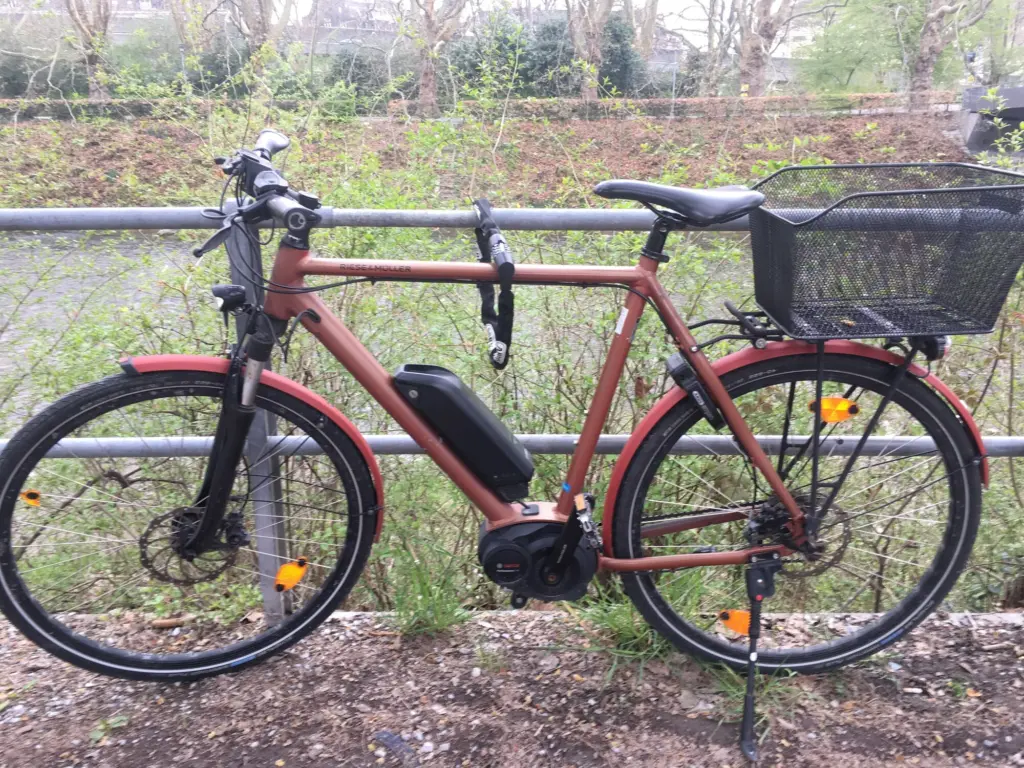
The mid-drive motor sits at the bottom bracket. That keeps the center of gravity low and distributes the weight evenly, and it works with both derailleur and hub gears. Stiftung Warentest calls it the standard on city and trekking bikes; of the eleven trekking e-bikes tested in 2024, eight had this design. It does, however, require a frame built specifically for it. And its power runs through the chain: the German magazine BIKE describes greater wear and often clearly audible gear shifts on mid-drive bikes with derailleur gears.
With the rear hub motor, it is the other way around. It sits in the rear wheel hub, often runs quietly and is easy on the chain, but makes removing the rear wheel more cumbersome. If you like to patch your own tires, keep that in mind. On the other hand, it is relatively easy to remove if it fails. Of the ten urban e-bikes Stiftung Warentest tested in 2026, eight had one. Among the trekking bikes from 2024, it was found only on the three inexpensive models, which also carried smaller batteries.
How clearly the two differ on hills is shown by a comparison from the TCS, the Swiss touring club, published by the ADAC, the German automobile club: fast pedelecs with rear hub motors accelerated harder on the flat but were at a clear disadvantage on steep terrain, while mid-drive bikes remained easy to ride everywhere. That applied to bikes up to 45 km/h. For regular pedelecs up to 25 km/h, it can only be read as an indication, not as a measured value.
The front hub motor remains the exception and is found almost only on inexpensive bikes. Stiftung Warentest does not consider it ideal for less confident riders, because the front wheel slips more easily on slick or loose surfaces. That said, one front-wheel drive in the 2026 urban field made a fairly good impression there.
The sensor often counts for more than the brand
This is where the expensive mistakes happen. Of ten inexpensive step-through bikes the ADAC tested in 2024, eight used a drive that only detects pedaling cadence, not the force on the pedal. The consequences, according to the ADAC: the motor kicks in with a delay, starting on a hill becomes a struggle, and keeping up in a group is difficult. On two bikes, the motor kept running for a long time after the rider stopped pedaling, and even braking did not interrupt it. That kind of thing is dangerous.
So ask about the torque sensor before you ask about newton meters. Incidentally, a rear hub motor does not automatically mean a basic drive: BIKE lists drives with and without this sensor among hub motors, too. The test ride reveals it quickly. Pedal, stop, then watch for overrun.
Newton meters: how much is enough?
More is not better. Stiftung Warentest advises anyone who is not quite so fit or has not ridden for a long time to choose 60 Nm at most. In the city, 40 to 45 Nm is usually enough, but it gets tight on steeper climbs. If you ride hills regularly and are in shape, you can make use of the power of a motor such as the Bosch Performance Line CX with 85 Nm. Drives like that accelerate hard enough to overwhelm inexperienced riders.
Consumption shows why the assistance level matters more than the motor. For 500 Wh, Stiftung Warentest gives about 20 kilometers uphill with full assistance and about 85 kilometers on the flat in eco mode. Converted, that is 25 Wh versus just under 6 Wh per kilometer, or more than four times as much from the same battery. How to care for it and when more capacity pays off is covered in our e-bike battery guide (in German).
Bosch, Shimano, Yamaha: what can be backed up
Bosch has the widest range. According to the ADAC, the current Performance Line delivers 75 Nm, the PX variant 85 or 90 Nm depending on the version, and with the Hub Line the brand now also offers a hub motor. At the top end, the ADAC lists up to 100 Nm for a CX on a current Winora. In the lab of the German magazine EMTB in 2023, the lightweight Performance Line SX achieved the highest peak output of the lightweight motors measured there, at 508 watts, but it only delivers that briefly, at a high cadence and with strong pedaling input.
From the same comparison, we only have a variant of a Shimano motor: the EP8 RS, whose hardware corresponds to the EP8 and whose software comes from Orbea. At 2.65 kg, it was heavier than the Bosch SX at 2.07 kg, but it delivered its power even with little effort from the rider. Very high cadences suit it less. Both figures come from mountain bike drives, so conclusions about city bikes are limited; our e-MTB guide (in German) is a better fit for those.
We cannot give any reliable measured values for Yamaha. We would therefore rather leave the brand open than rate it based on manufacturer figures. Pinion takes its own path: the MGU combines the motor and a 12-speed gearbox in a single unit, with up to 85 Nm according to the ADAC. One principle applies to all three and to smaller suppliers as well: Stiftung Warentest recommends a drive from a fairly large manufacturer, because that increases the chance of still getting spare parts and batteries in a few years. With house-brand motors, you should therefore ask about spare parts availability before ordering.
5 e-bikes sorted by drive
The list is not a ranking. It shows how the designs turn up in bikes offered on Amazon.de. Bikes with Shimano or Yamaha drives are missing because no version could be clearly identified there. All information comes from the listings, not from a measurement.
| Model | Drive according to listing | Battery, gears | Best for |
|---|---|---|---|
| Fischer Cita Move 01 W | Rear hub motor, 50 Nm | 474 Wh, 8-speed chain | Flat routes, little chain maintenance |
| Fischer Cita 4.3i | Bafang mid-drive motor, 65 Nm | 7-speed hub | Everyday riding with climbs, low maintenance |
| Airtracks Lumina GX3 LS | Bosch Active Line Plus, mid-drive motor | 500 Wh, 9-speed chain | Touring, if you want Bosch service |
| Airtracks Creon V-Tron LS | Bosch Active Line Plus, mid-drive motor | 400 Wh, 7-speed hub | Short city trips |
| Telefunken City-E-Bike 28 Zoll | Mid-drive motor, 80 Nm | 468 Wh, 7-speed hub | Lots of power on a smaller budget; check the motor’s origin |
Fischer Cita Move 01 W
The only bike here with a rear hub motor, plus a low wave frame. The design suits flat city routes well. Check beforehand whether a torque sensor is fitted, because the listing says nothing definite about it. The bike cannot currently be found in Fischer’s online shop; it is offered on Amazon.
Fischer Cita 4.3i
Mid-drive motor with hub gears, which keeps maintenance low. Another Fischer model with a mid-drive motor, the Cita 2.2i, did well in the 2024 ADAC test and stood out for its drive system, but at 28.8 kg it was also the heaviest bike in the field. That verdict cannot be transferred to the 4.3i.
Airtracks Lumina GX3 LS
A trekking bike with a Bosch drive and 500 Wh, which according to Stiftung Warentest is usually enough for medium distances. The Bosch motor is the strongest argument here, because it takes the edge off the question of spare parts. Derailleur gears mean regular cleaning and lubricating.
Airtracks Creon V-Tron LS
Same motor, smaller battery, hub instead of chain gears. That is enough for the daily commute; for longer outings, you are better off planning with economical assistance levels.
Telefunken City-E-Bike 28 Zoll
The 80 Nm is in the listing, the motor manufacturer is not. This is exactly the case in which the number says little. For inexperienced riders, the figure is also well above the 60 Nm that Stiftung Warentest recommends.
How we would decide
- Flat city, short trips, little desire for chain maintenance: rear hub motor with a torque sensor.
- Hills, luggage or touring: mid-drive motor, ideally from a major manufacturer.
- Not confident on a bike: 60 Nm at most, and preferably avoid a front hub motor.
- Bike often has to be carried: consider a lightweight drive and lift the bike beforehand, because you feel the weight on the basement stairs, not while riding.
Ride the first lap without assistance, as the ADAC also advises, because otherwise the drive masks a critical look at the bike itself. For an overview of frames, batteries and brakes, see our guide to buying an e-bike (in German). If you service the crank on a mid-drive motor or the rear wheel yourself, a bike repair stand (in German) makes the job much more relaxed.
What the missing top tube means for the frame, your knees and the payload is covered in our guide to the step-through e-bike (in German).
Frequently asked questions
What is the difference between a mid-drive motor and a rear hub motor?
The mid-drive motor sits at the bottom bracket, keeps the center of gravity low and stays easy to ride on hills too, but puts more strain on the chain. The rear hub motor sits in the rear wheel hub, often runs quietly and is easy on the chain, but makes removing the rear wheel more cumbersome. On steep terrain, it was at a clear disadvantage in the TCS comparison.
Does the motor brand matter on an e-bike?
Less than often assumed. Stiftung Warentest does not consider the brand alone a sensible buying criterion, because the riding feel comes from the motor, sensors and bike together. It does, however, recommend a drive from a fairly large manufacturer so that spare parts and batteries are still available in a few years.
Why is a torque sensor important on an e-bike?
According to the ADAC, drives that only detect pedaling cadence kick in with a delay and make starting on a hill and riding in a group harder. On two inexpensive bikes, the motor kept running for a long time after the rider stopped pedaling, even when braking. Check on the test ride: pedal, stop, and watch for overrun.
How many newton meters does an e-bike need?
In the city, 40 to 45 Nm is usually enough, but it gets tight on steeper climbs. According to Stiftung Warentest, anyone who is not quite so fit or has not ridden for a long time should stick to 60 Nm at most. Powerful 85 Nm drives are for trained hill riders; they can overwhelm inexperienced riders.
Who is an e-bike with a front hub motor suitable for?
Front hub motors are found almost only on inexpensive bikes. Stiftung Warentest does not consider them ideal for less confident riders, because the front wheel slips more easily on slick or loose surfaces. That said, one front-wheel drive in the 2026 urban field made a fairly good impression.
How far does an e-bike go on 500 Wh?
According to Stiftung Warentest, about 20 kilometers uphill with full assistance and about 85 kilometers on the flat in eco mode. That is 25 Wh versus just under 6 Wh per kilometer. The assistance level therefore matters more for range than the motor.
Sources
- Stiftung Warentest: E-bike buying advice (2026)
- Stiftung Warentest: E-bikes tested (2026)
- ADAC: Inexpensive step-through pedelecs (2024)
- ADAC: Speed pedelecs, TCS test (2022)
- ADAC: New e-bikes for 2026
- BIKE/EMTB: Six lightweight motors in the lab (2023)
- BIKE: Nine lightweight pedelecs compared (2023)
Where to buy
- Fischer Cita Move 01 WCheck price at Amazon.deCheck price at Amazon.co.ukCheck price at Amazon.nlCheck price at Amazon.com.beCheck price at Amazon.frCheck price at Amazon.itCheck price at Amazon.esCheck price at Amazon.plCheck price at Amazon.seAvailable in Germany: Amazon.de
- Fischer Cita 4.3iCheck price at Amazon.deCheck price at Amazon.co.ukCheck price at Amazon.nlCheck price at Amazon.com.beCheck price at Amazon.frCheck price at Amazon.itCheck price at Amazon.esCheck price at Amazon.plCheck price at Amazon.seAvailable in Germany: Amazon.de
- Airtracks Lumina GX3 LSCheck price at Amazon.deCheck price at Amazon.co.ukCheck price at Amazon.nlCheck price at Amazon.com.beCheck price at Amazon.frCheck price at Amazon.itCheck price at Amazon.esCheck price at Amazon.plCheck price at Amazon.seAvailable in Germany: Amazon.de
- Airtracks Creon V-Tron LSCheck price at Amazon.deCheck price at Amazon.co.ukCheck price at Amazon.nlCheck price at Amazon.com.beCheck price at Amazon.frCheck price at Amazon.itCheck price at Amazon.esCheck price at Amazon.plCheck price at Amazon.seAvailable in Germany: Amazon.de
- Telefunken City-E-Bike 28 ZollCheck price at Amazon.deCheck price at Amazon.co.ukCheck price at Amazon.nlCheck price at Amazon.com.beCheck price at Amazon.frCheck price at Amazon.itCheck price at Amazon.esCheck price at Amazon.plCheck price at Amazon.seAvailable in Germany: Amazon.de